John Atkinson Grimshaw
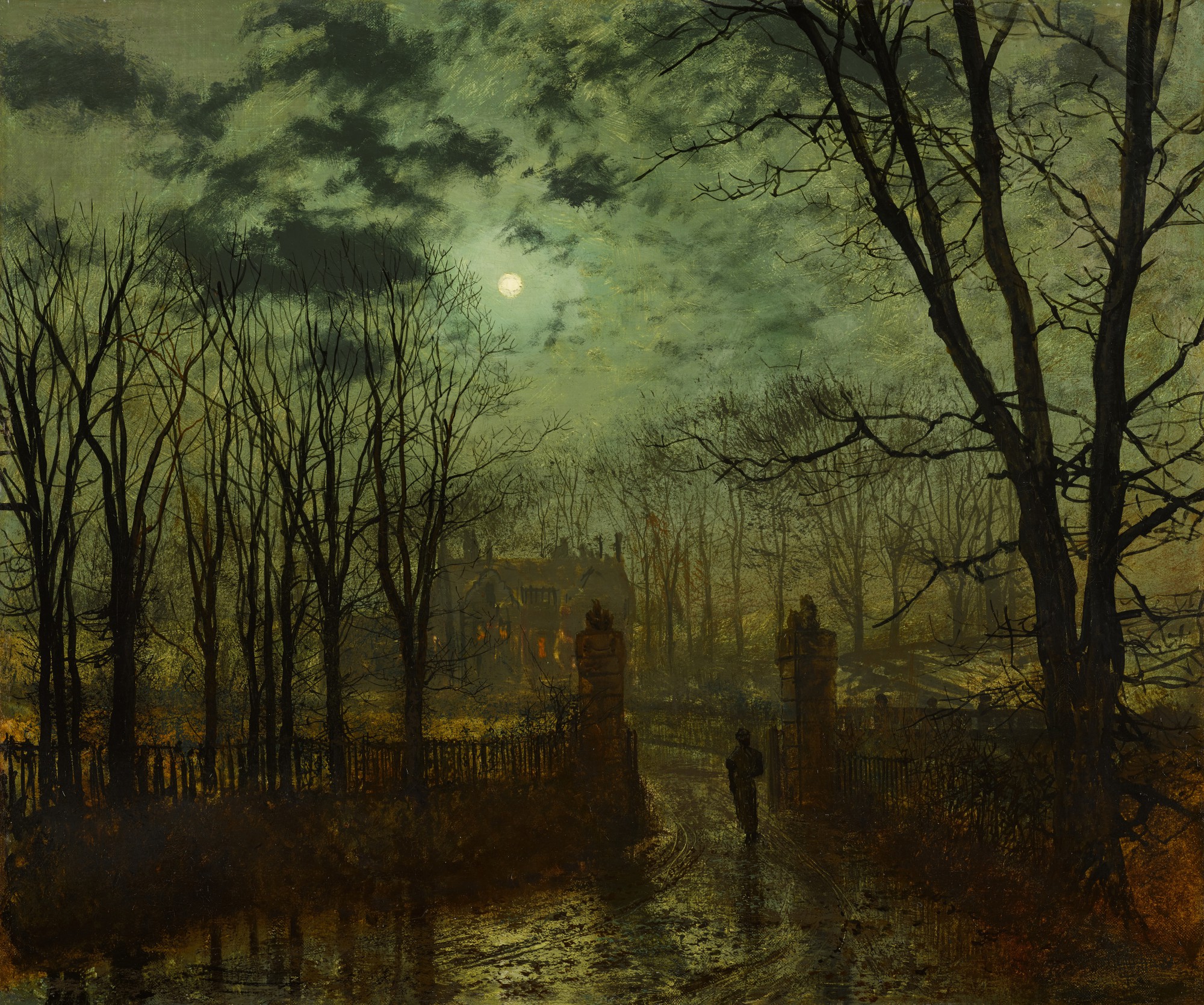
Grimshaw: Master of the Luminous Night
Artist Spotlight · The Collection Editorial
There is a moment, familiar to anyone who has stood beneath a Victorian street lamp on a wet November evening, when the world becomes something more than ordinary. The cobblestones gleam, the fog softens every hard edge, and the gaslight seems to breathe. John Atkinson Grimshaw spent his entire career chasing that moment and capturing it with a precision and poetry that still stops viewers cold more than a century after his death. His paintings hang in the Leeds Art Gallery, the Merseyside Maritime Museum collection, and in the hands of devoted private collectors who return to them again and again, finding new depths in their glowing, introspective quiet.
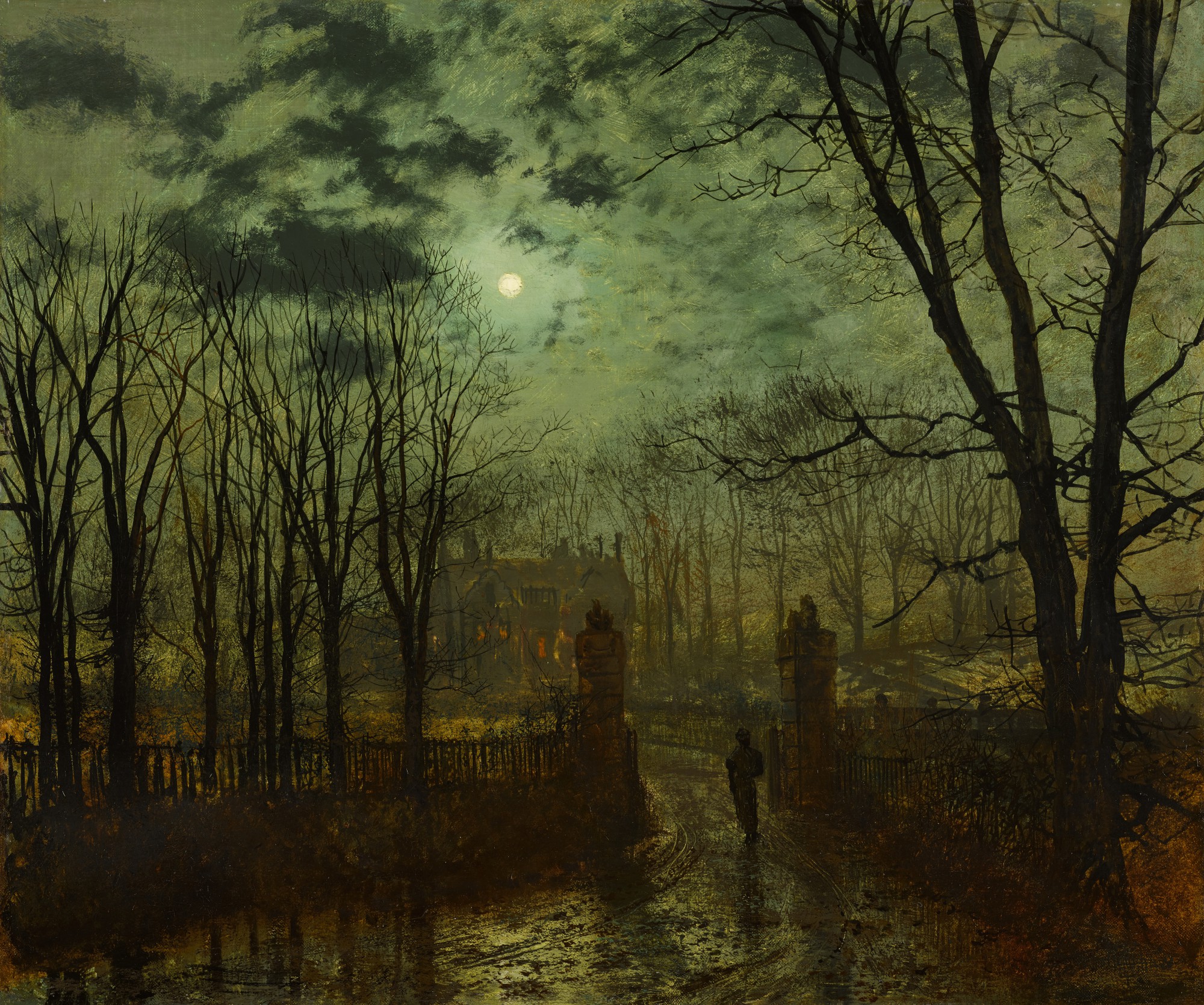
John Atkinson Grimshaw
At the Park Gate
Grimshaw was born in Leeds in 1836, the son of a former police constable, and his early years were shaped by the particular texture of northern English life: industrial, atmospheric, often grey, but shot through with moments of unexpected beauty. His family had no particular connection to the arts, and his early employers certainly did not encourage any. He worked as a clerk for the Great Northern Railway in his teens and early twenties, a respectable and utterly conventional path for a young man of his background. Yet he was drawing and painting in every spare moment, and by the late 1850s he had made the decision to pursue art seriously, against the wishes of his parents, who saw it as a precarious and unsuitable ambition.
His self education was thorough and deeply personal. He studied the work of the Pre Raphaelites with close attention, and their influence is visible in his early still life paintings, which display a meticulous botanical precision and a jewelled intensity of colour. Works such as Still Life with Pineapple, Apple and Plums reveal a painter who had truly absorbed the Pre Raphaelite lesson: look harder, paint what you actually see, and trust that fidelity to the visible world carries its own emotional weight. But Grimshaw was not destined to remain a still life painter.
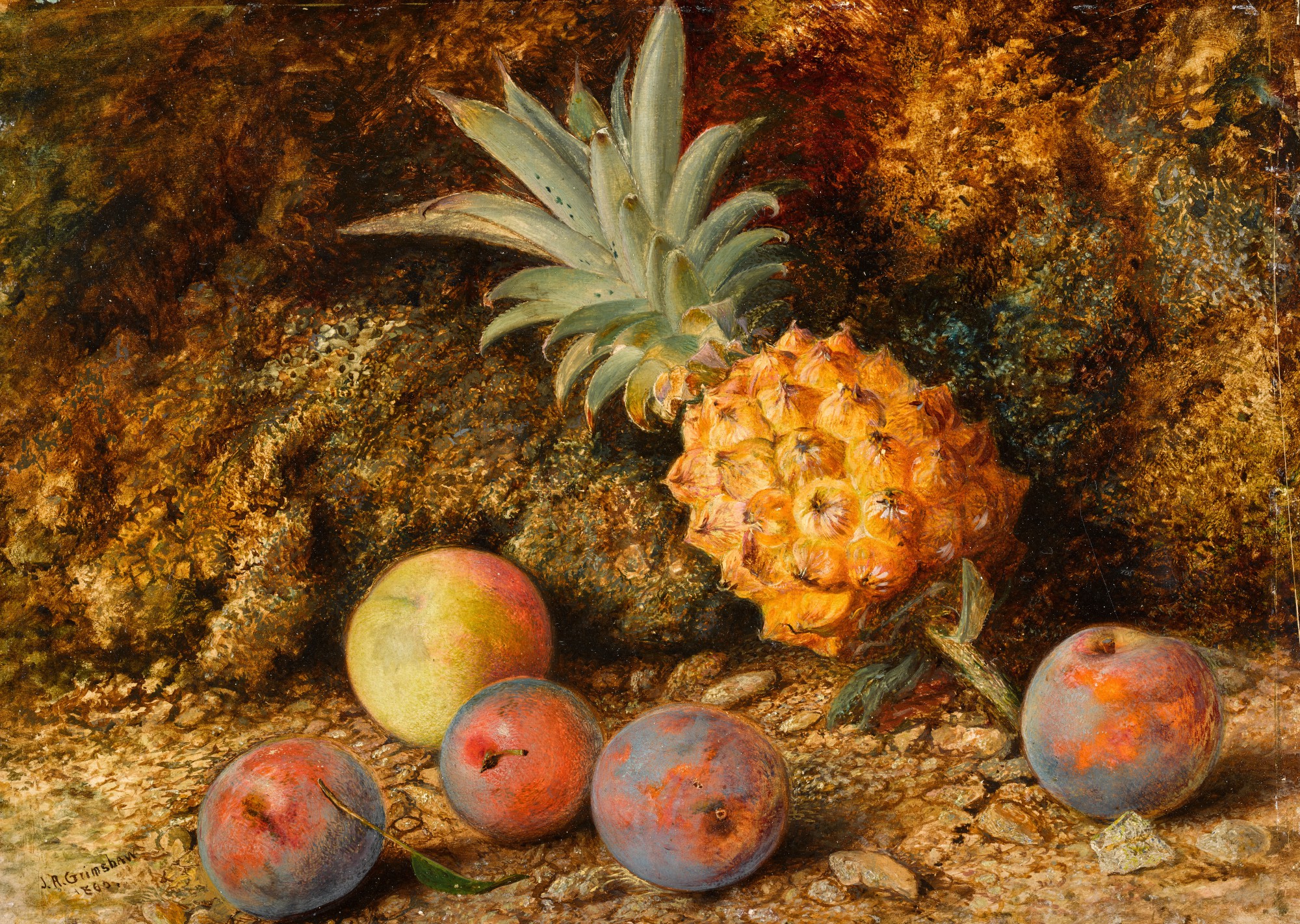
John Atkinson Grimshaw
Still Life with Pineapple, Apple and Plums
His imagination was always reaching toward something larger and more atmospheric, and through the 1860s and 1870s he began the shift toward the nocturnal landscapes that would define his legacy. The breakthrough was gradual but unmistakable. Grimshaw discovered that the landscapes he loved most, the parks and lakesides of Yorkshire, the suburban roads of Leeds, the docklands of Liverpool and London, were most fully themselves at dusk and after dark. He developed a technique of extraordinary subtlety, building up glazes of oil paint over pencil underdrawings and sometimes working on card or board as well as canvas, which allowed him to achieve the luminous, almost phosphorescent quality that became his signature.
Roundhay Lake, one of his finest Yorkshire subjects, captures the particular melancholy and majesty of an English park in the fading light, the water holding the last of the sky while the trees go dark around it. A Yorkshire Road, November is equally revelatory: a single figure on a muddy lane, the bare trees overhead, the cold light pressing down from a moon half hidden in cloud. These are not simply pretty pictures. They are studies in mood, in the passage of time, in the way landscape reflects and amplifies interior feeling.
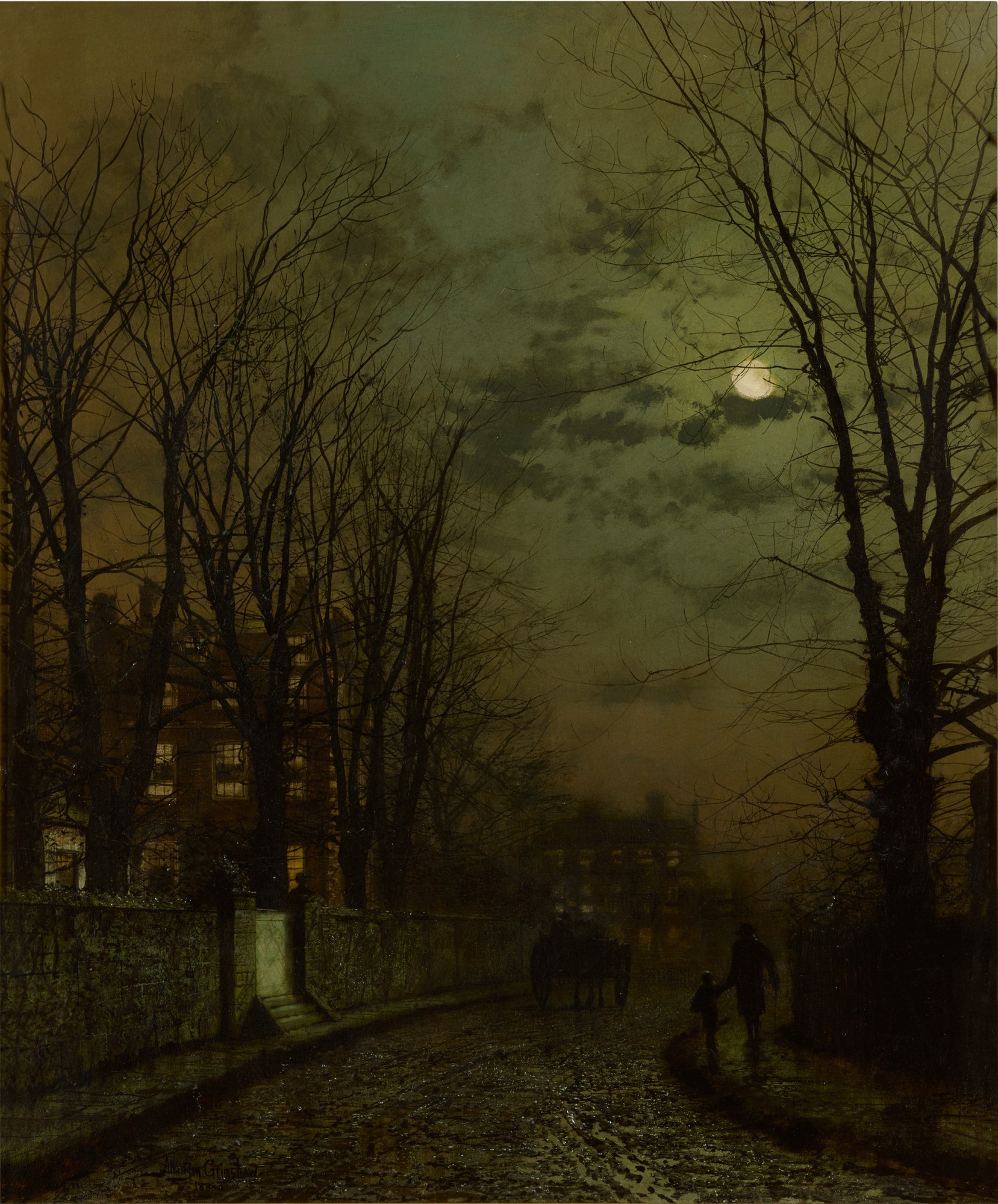
John Atkinson Grimshaw
A Yorkshire Road, November
His urban nocturnes represent perhaps his most enduring achievement. Paintings such as A Moonlit Street, with its slick reflective pavements and the warm glow escaping through domestic windows, anticipate the Impressionist interest in artificial light and the poetry of the modern city, yet they do so entirely on their own terms. Grimshaw was not part of any Parisian conversation. He was painting Leeds, Liverpool, Whitby and the Thames from his own direct experience, with a northern English sensibility that prized atmosphere over bravura brushwork.
The painter James McNeill Whistler, who encountered Grimshaw's nocturnes in the 1870s, is reported to have said that he himself had invented the nocturne, only to discover that Grimshaw had been there first. Whether or not the exact words are apocryphal, the sentiment captures something true: Grimshaw arrived at the nocturne independently, and his version of it has a specificity and a warmth that Whistler's more austere tonal studies sometimes lack. For collectors, Grimshaw's work presents one of the most rewarding areas of the Victorian market. His paintings appear regularly at the major London auction houses, where strong examples have consistently achieved prices that reflect both their rarity and their enduring appeal.
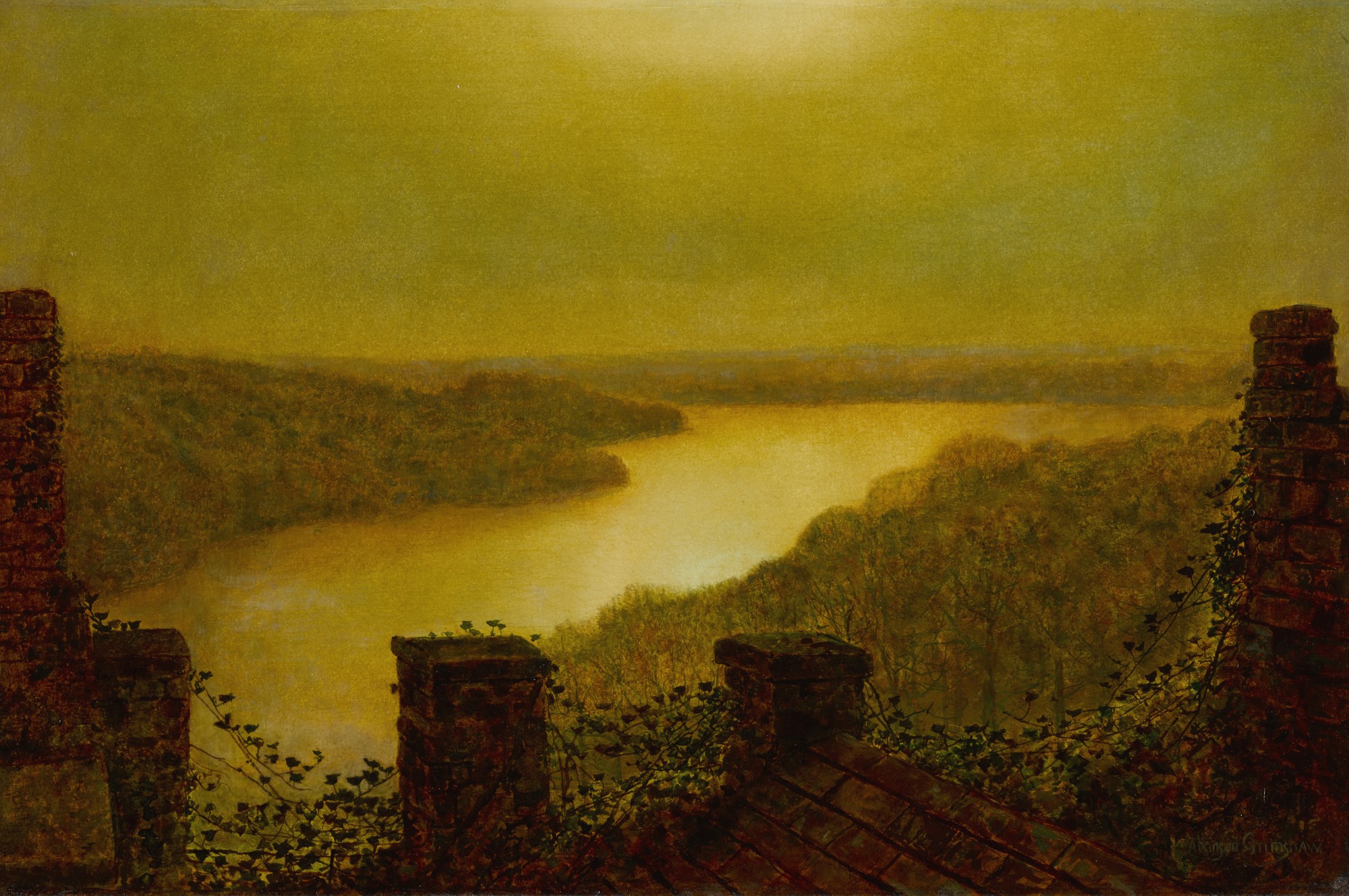
John Atkinson Grimshaw
Roundhay Lake
Works on card and paper, such as Under the Harvest Moon and the luminous Sunset over a Lake, offer a more intimate encounter with his process and are particularly prized by collectors who appreciate the spontaneity and directness of works produced outside the formal studio context. When considering a Grimshaw, condition and provenance are as important as subject matter: his best moonlit street scenes and parkland views command the greatest interest, while his still lifes and daylight landscapes offer a different and equally worthwhile window into his range. The key is authenticity and the quality of that distinctive atmospheric glow. When it is there, it is unmistakable.
Grimshaw belongs to a broader tradition of painters who found the poetic possibilities of the everyday English landscape, a tradition that includes Samuel Palmer, whose visionary moonlit pastorals preceded Grimshaw's by a generation, and later extended to the Camden Town painters and beyond. His urban nocturnes also place him in conversation with the Aesthetic Movement and with artists such as Walter Sickert, who shared his fascination with the drama of artificial light in domestic and urban settings. Yet Grimshaw remains distinctly his own figure, not easily absorbed into any movement or school, which is part of what makes him so endlessly interesting to scholars and collectors alike. His death in 1893 at the age of fifty six came before he could receive the full critical recognition his work deserved.
The twentieth century was slow to reassess him, but the second half brought a steady rehabilitation, and today the critical consensus articulated by Christopher Wood in Victorian Painting is widely shared: Grimshaw was a remarkable and imaginative painter whose vision of the Victorian world at night is among the most original contributions of his era. In a culture increasingly drawn to mood, to atmosphere, and to the kind of quiet intensity that resists easy summarising, his paintings feel more contemporary than ever. To spend time with a Grimshaw is to be reminded that the world has always been capable of becoming luminous, if you know how to look at it.
Explore books about John Atkinson Grimshaw
John Atkinson Grimshaw and the Victorian Vision
Benedict Read
John Atkinson Grimshaw: His Life and Work
Lionel Lambourne
Grimshaw: Artist of the Gaslit Night
Chris Beetles
John Atkinson Grimshaw 1836-1893
Julian Treuherz
The Pre-Raphaelites and Their Contemporaries
Christopher Newall