Johann Gottfried Steffan
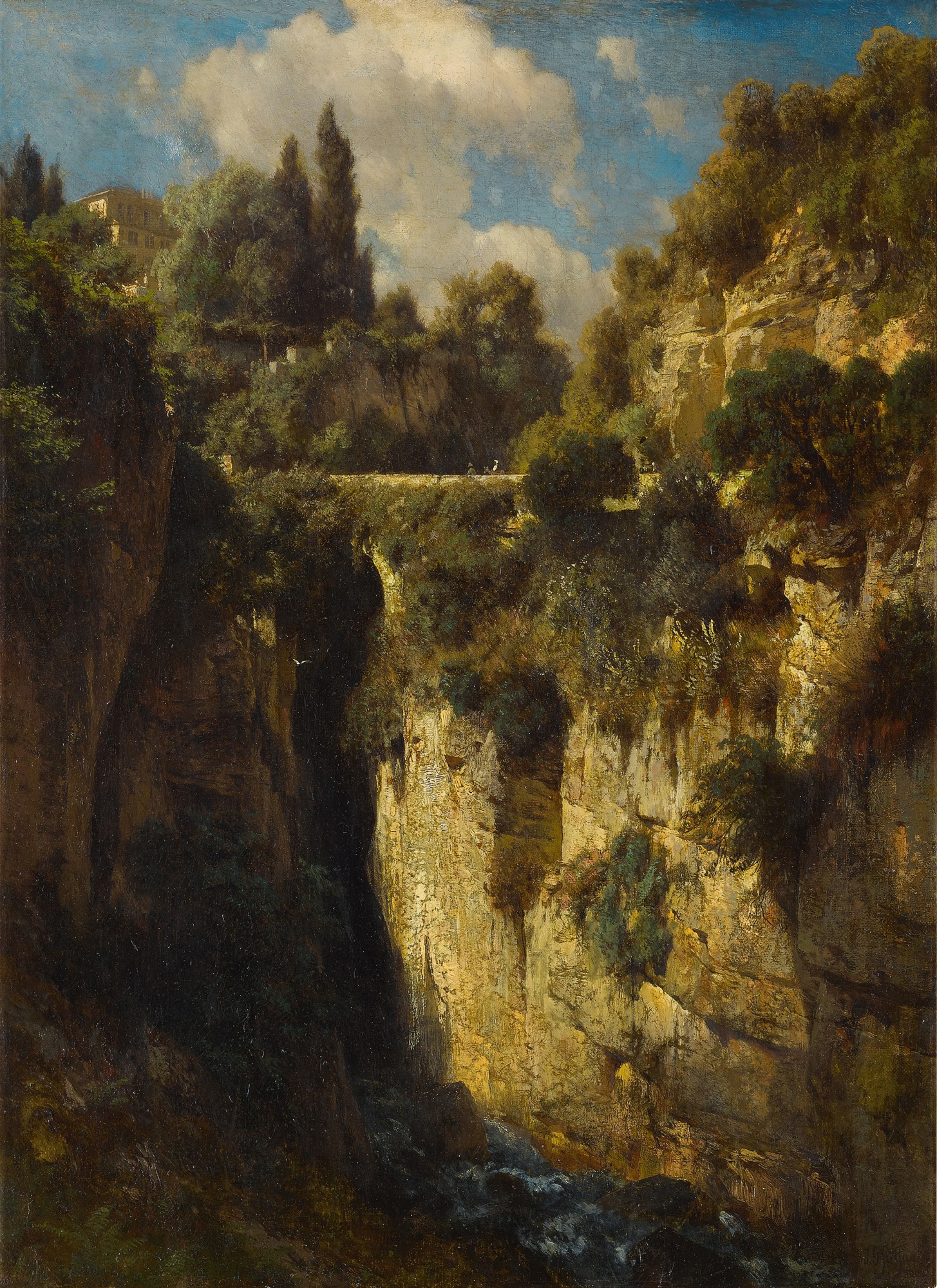
Alpine Light, Endlessly and Beautifully Rendered
Artist Spotlight · The Collection Editorial
There is a particular quality of light that settles over a Alpine lake in the late afternoon, when the sun has dropped behind the peaks and the water becomes a mirror of pale gold and violet. Johann Gottfried Steffan spent a lifetime chasing that light, and in doing so produced a body of work that stands among the finest achievements of nineteenth century European landscape painting. His canvases, serene and luminous and meticulously observed, continue to draw serious attention from collectors and institutions alike, a testament to the enduring power of a painter who understood nature not as a backdrop but as a living, breathing presence worthy of devoted study. Steffan was born in 1815 in Aarau, in the Swiss canton of Aargau, a region whose rolling countryside and proximity to the Alps would leave an indelible mark on his artistic imagination.
Johann Gottfried Steffan
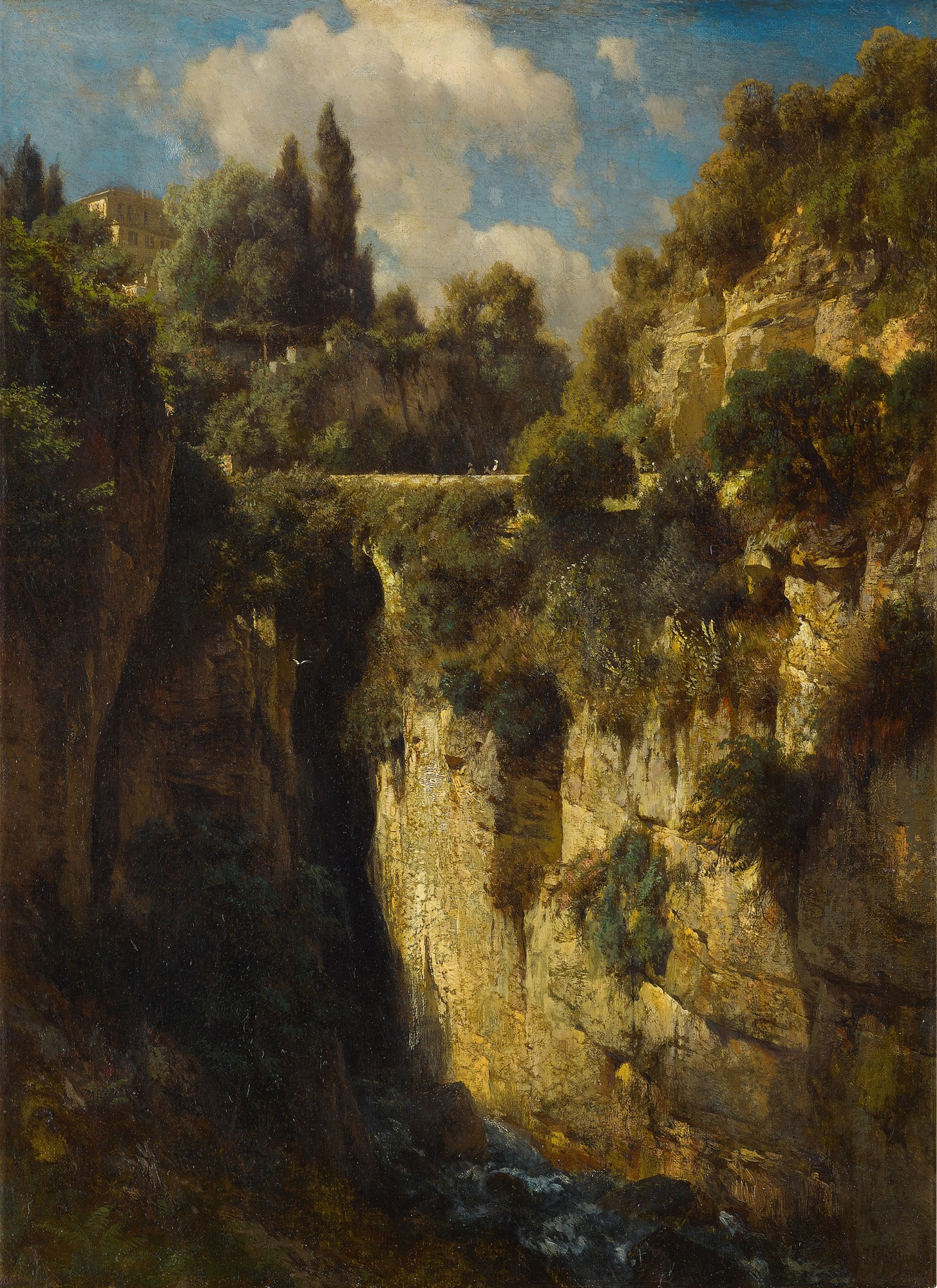
A Mountainous Landscape with a Waterfall
He came of age during a period of intense cultural ferment in German speaking Europe, when the ideas of Romanticism were reshaping how artists and intellectuals understood the natural world. The mountains were no longer merely obstacles or scenery; they had become symbols of the sublime, of spiritual aspiration, of a purity that the rapidly industrializing cities could not offer. Steffan absorbed these ideas deeply, and they gave his early ambitions a philosophical as well as aesthetic dimension. His training took him to Munich, which by the mid nineteenth century had established itself as one of the great centers of European artistic life.
The Bavarian capital offered young painters access to the Academy, to masterworks in the royal collections, and to a community of artists who were actively reinventing the traditions of landscape painting. Steffan found in Munich both a rigorous technical education and a network of peers who shared his passion for the outdoors. He studied with care and discipline, developing the precise draftsmanship and sensitivity to atmospheric effect that would define his mature work. Munich became his adopted home, and he would remain a central figure in its artistic community for decades, earning recognition as one of the leading landscape painters working in the German Romantic tradition.
Johann Gottfried Steffan
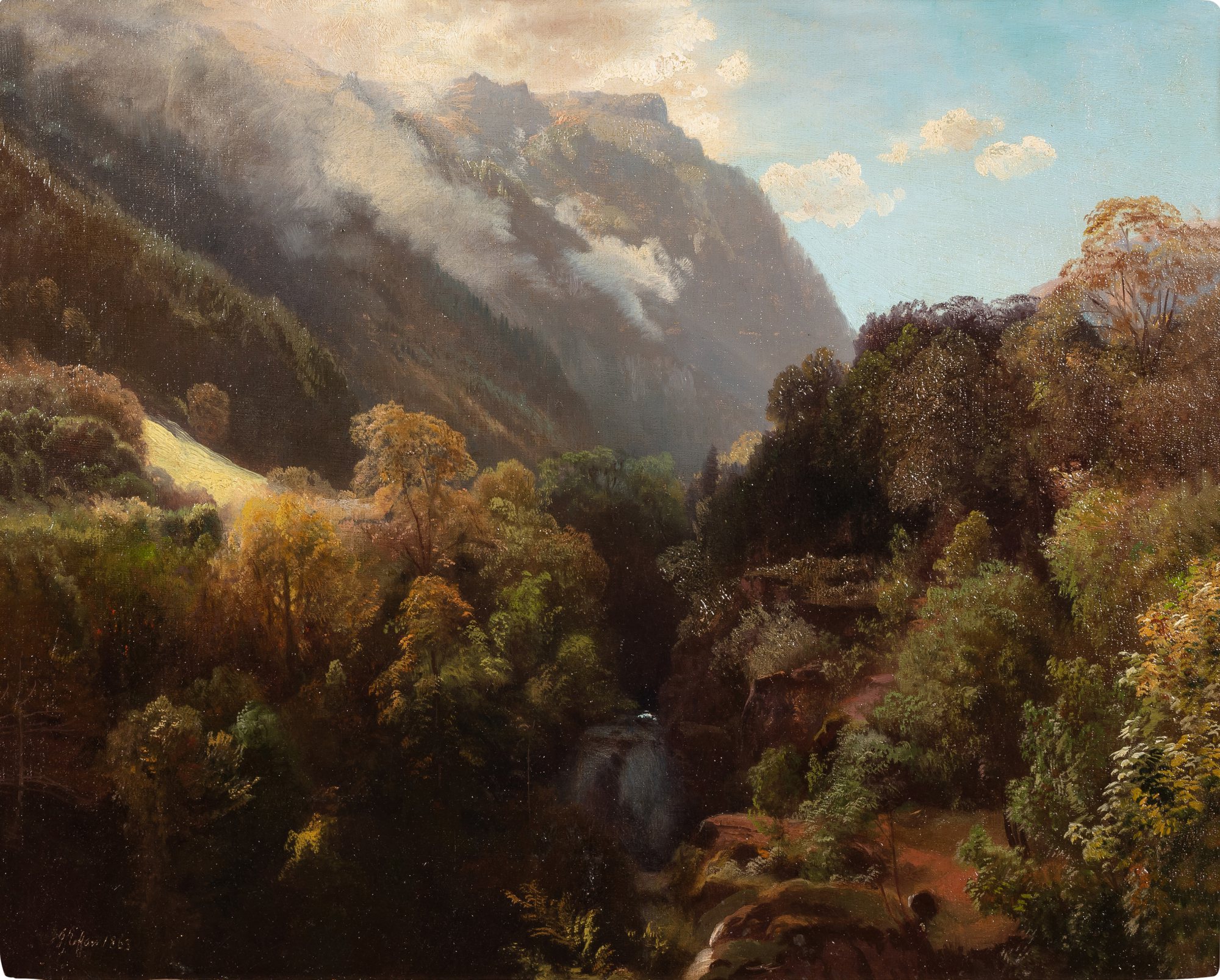
Paysage montagneux
The development of Steffan's practice can be traced through his deepening engagement with the specific character of Swiss and Bavarian landscape. In his earlier work, one sees the influence of the broader Romantic tradition, with its dramatic compositional arrangements and its preference for emotional intensity. As he matured, however, Steffan moved toward something more personal and more nuanced. He became increasingly interested in the precise observation of natural phenomena, in the way mist gathers in a valley at dawn, in the texture of sunlight filtered through pine canopy, in the still perfection of a mountain lake undisturbed by wind.
This shift brought his work closer in spirit to the Barbizon painters working in France during the same period, though Steffan's palette and his emotional register remained distinctly his own. Among the most celebrated examples of his achievement is "A Mountainous Landscape with a Waterfall," an oil on canvas that exemplifies everything that makes Steffan's work so compelling. The composition draws the viewer deep into a world of rock and rushing water and filtered light, yet it does so without melodrama. There is a quality of stillness at the heart of the painting even where the water moves, a sense that the artist has captured not just a moment but a mood, a feeling of being genuinely present in a landscape of extraordinary beauty.
His "Paysage montagneux," executed in oil on canvas laid down on board, similarly rewards close attention, with its delicate rendering of mountain terrain and its mastery of tonal gradation. These are works that reveal new details with every viewing, painted by an artist who trusted that the landscape, observed with sufficient patience and skill, could speak for itself. For collectors, Steffan represents a compelling proposition that combines aesthetic distinction with genuine art historical significance. His works were exhibited widely during his lifetime and attracted admiration across Europe, which means that they entered important collections early and have been carefully preserved.
When examples appear at auction, they tend to draw competitive interest from collectors who appreciate the German and Swiss Romantic traditions, as well as from those who collect more broadly within nineteenth century European landscape painting. The condition of the support and the luminosity of the paint surface are particularly important considerations when evaluating a Steffan, as his characteristic atmospheric effects depend on the integrity of his layered glazes. Works on canvas and works on board each offer distinct pleasures, and the range of formats in which he worked means that collectors with varying budgets and spatial considerations can find an entry point into his practice. To fully appreciate Steffan's place in art history, it is useful to consider him alongside contemporaries who were grappling with similar questions about the representation of nature.
Artists such as Ludwig Richter and Carl Rottmann, both central figures in the Munich school, shared Steffan's commitment to the landscape as a subject of serious artistic inquiry. In the Swiss context, one might think of Alexandre Calame, whose depictions of Alpine scenery achieved international renown during roughly the same period. Steffan's work holds its own in this distinguished company, distinguished by a particular warmth of palette and a compositional clarity that makes his paintings immediately accessible without sacrificing depth or complexity. He occupied a productive space between the grandeur of the Romantic sublime and the quieter pleasures of careful naturalistic observation.
Steffan lived until 1905, a remarkably long life that allowed him to witness the emergence of Impressionism and the beginnings of Modernism, though he remained committed throughout to his own deeply considered vision of what landscape painting could be. His longevity meant that he produced an extensive body of work, and it also meant that he became a living link between the Romantic generation and a new century with very different artistic priorities. Today, as collectors and institutions increasingly look to reassess and celebrate the achievements of nineteenth century European painting beyond the most canonical names, Steffan's work feels more relevant and more rewarding than ever. His Alpine vistas offer not nostalgia but genuine visual intelligence, the record of a lifetime spent learning how to see one of the world's most magnificent landscapes and finding, again and again, the precise means to share that vision with others.