Johan Barthold Jongkind
The Dutchman Who Taught the World to See
Artist Spotlight · The Collection Editorial
Stand before one of Johan Barthold Jongkind's luminous watercolors and you understand immediately why Claude Monet called him the father of Impressionism. There is a quality of light in his work that feels almost impossible to achieve with pigment and paper, a shimmering, living atmosphere that seems to breathe. Long celebrated by scholars and quietly revered by discerning collectors, Jongkind is now receiving renewed attention as institutions and auction houses alike recognize that his contribution to the story of modern art has been persistently, almost willfully, underestimated. His works occupy a singular place in the history of Western painting, standing at the precise threshold between two worlds, and that position makes him endlessly fascinating.
Johan Barthold Jongkind
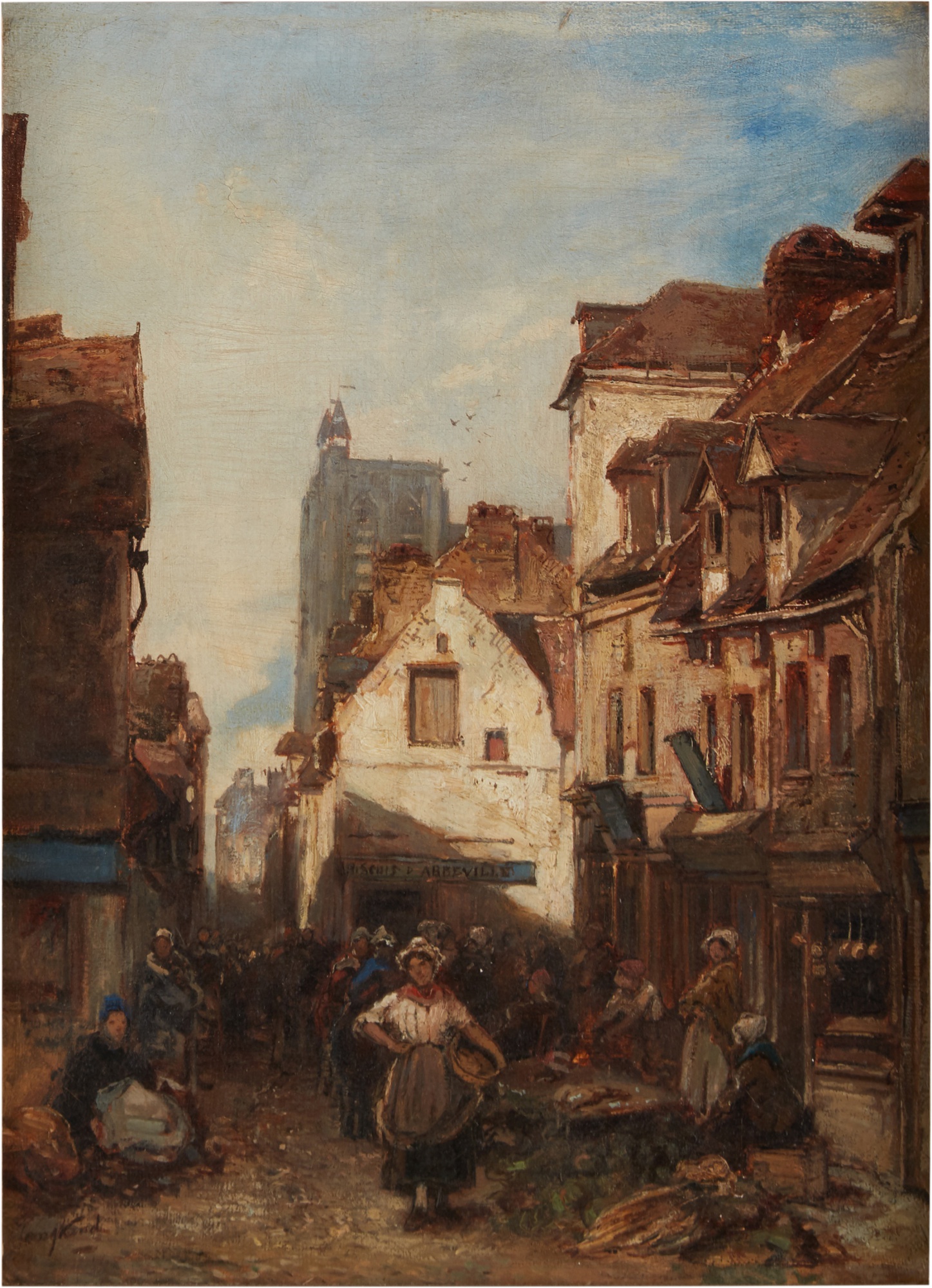
The Market at Abbeville
Jongkind was born in 1819 in Lattrop, a small village in the Dutch province of Overijssel. His early years were spent in a landscape shaped by water, flat horizons, and vast northern skies, the same elemental scenery that had nourished Rembrandt and Ruisdael before him. He trained in The Hague under the Dutch marine painter Andreas Schelfhout, who gave him a rigorous grounding in coastal subjects and atmospheric observation. By the late 1840s Jongkind had made his way to Paris, where he studied under Eugène Isabey and found himself drawn into the orbit of the Barbizon painters who were revolutionizing the French relationship with landscape.
The move to France would prove decisive, not just geographically but spiritually, opening Jongkind to a new set of questions about what painting could be. The years Jongkind spent moving between the Netherlands and France gave his work its distinctive double identity. He was equally at home sketching the canals and windmills of Holland and painting the Seine as it wound through Paris, and this restlessness sharpened his eye. He became an obsessive observer of weather and time of day, filling notebooks with chalk studies that he would later work up into oils and watercolors.
Johan Barthold Jongkind
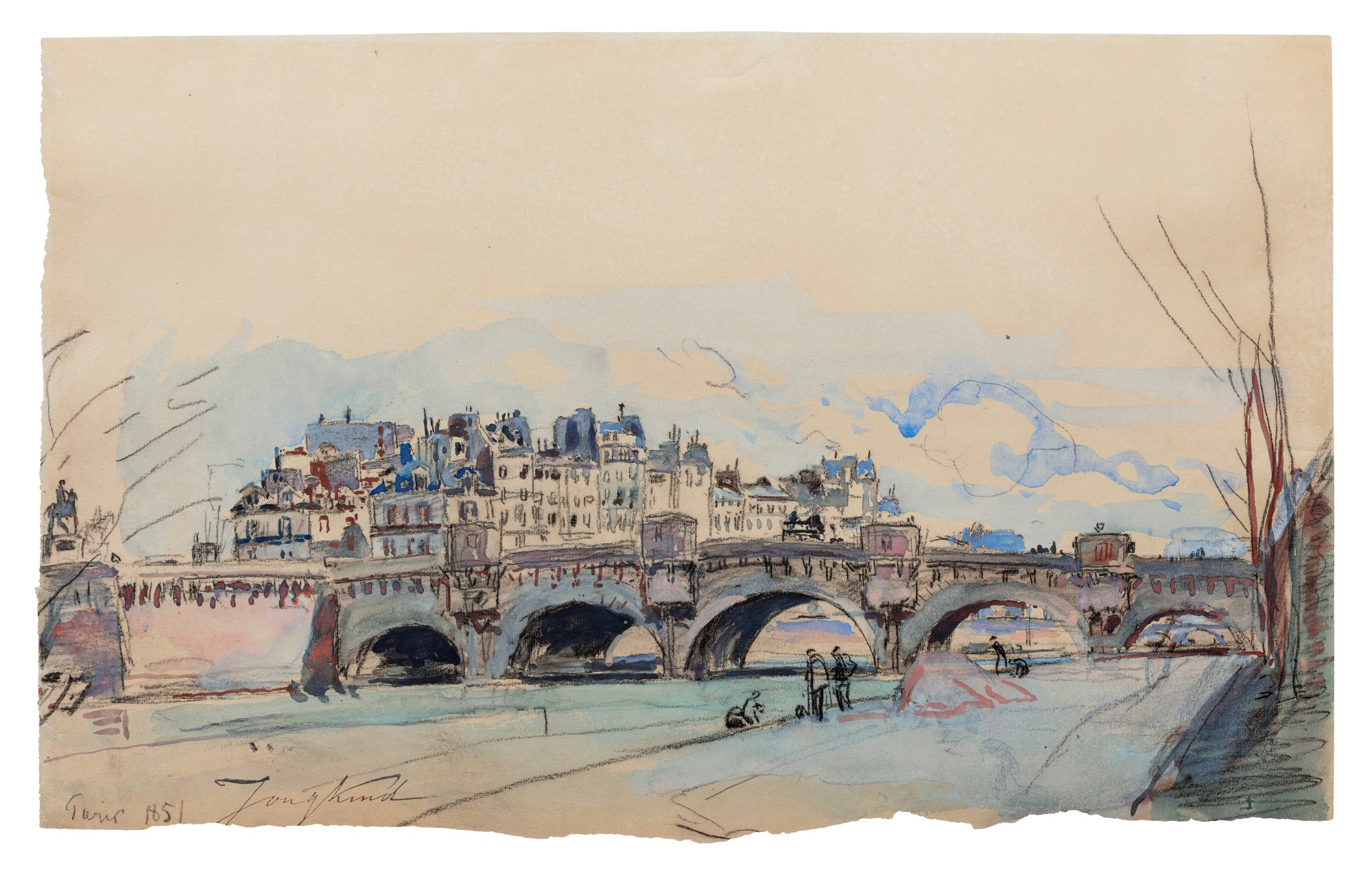
Le Pont-Neuf et l'île de la Cité
His friendship with the Barbizon painters, particularly Eugène Boudin, pushed him toward ever greater directness and spontaneity. Where academic painters labored to produce smooth, idealized surfaces, Jongkind embraced the evidence of his own hand, letting brushstrokes and chalk marks remain visible, alive, and urgent. Jongkind's practice spanned oil painting, watercolor, and printmaking, and each medium brought out a different dimension of his sensibility. His oils, such as the tender and atmospheric Moonlight, View of Dordrecht, demonstrate his ability to construct a mood from almost nothing, a few strokes of warm amber against a deepening sky and suddenly the viewer is standing on a Dutch quayside at dusk.
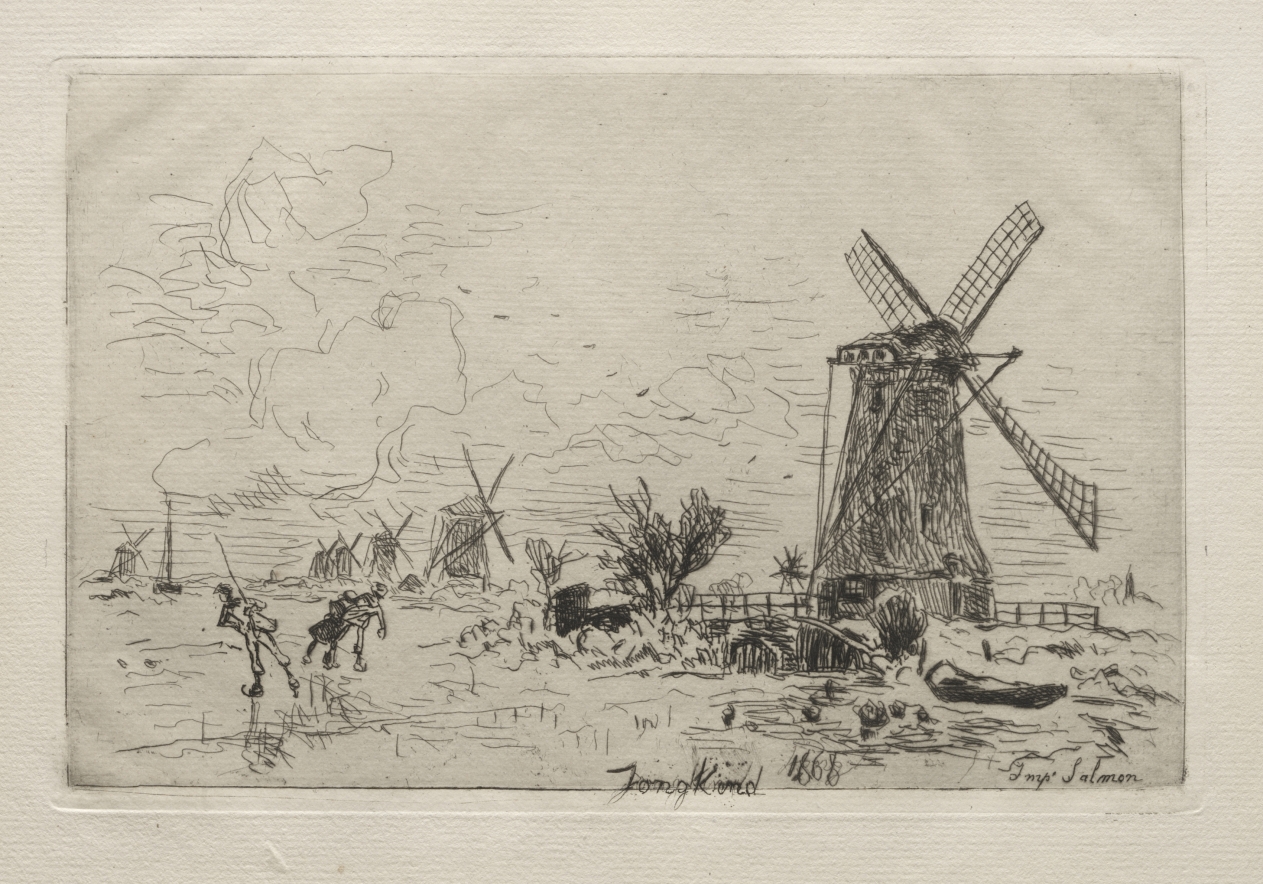
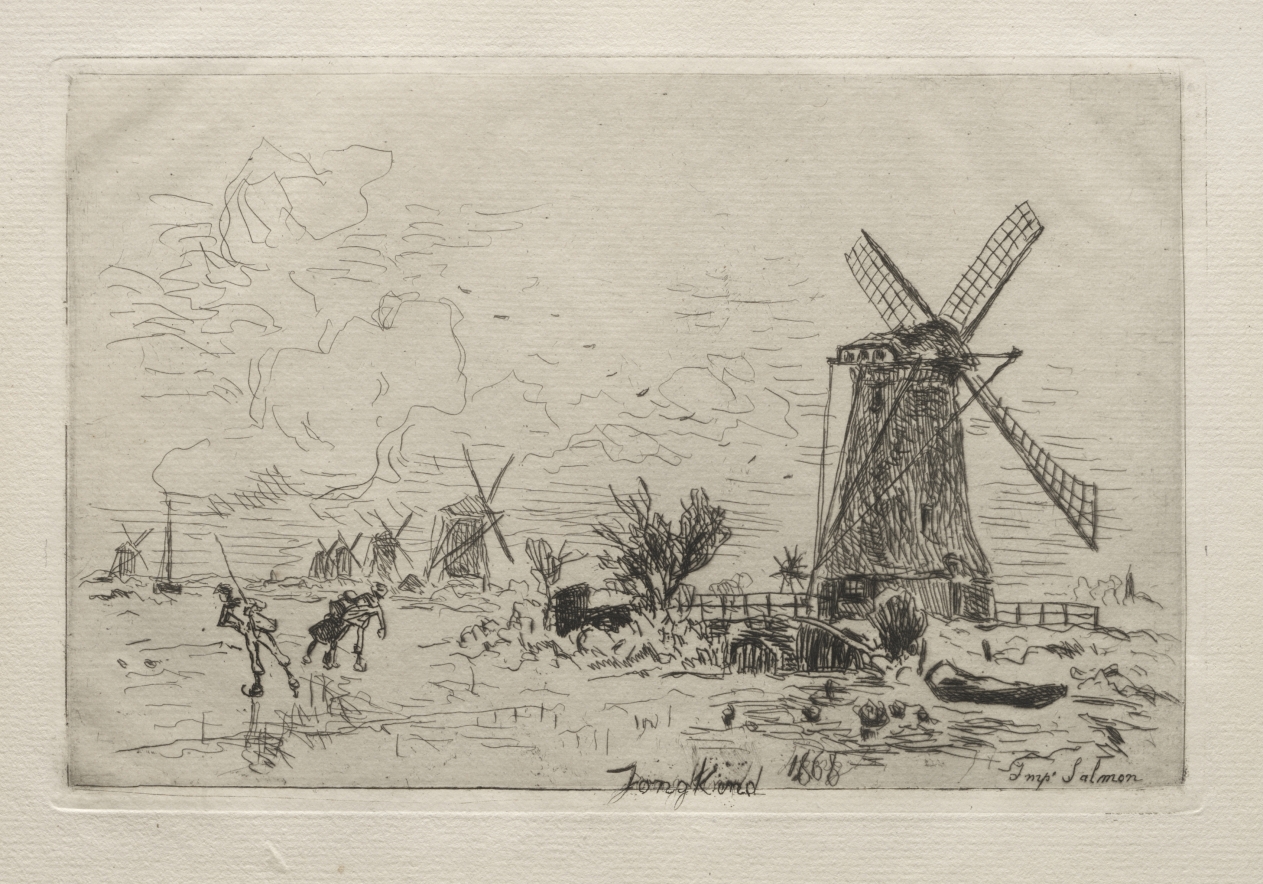
His watercolors, including the celebrated Le Havre from 1862 and the View of Arnheim from 1864, reveal a more intimate and searching intelligence at work, the hand moving quickly to capture a truth that a slower approach would lose. His etchings, such as the 1868 work Batavia and the 1862 Vue de la Ville de Maaslins, show yet another face: precise, tonal, and deeply meditative. The range across these works is astonishing and speaks to a restless creative mind that refused to be confined. For collectors, Jongkind presents an opportunity that is both historically significant and visually rewarding in the most immediate sense.
Johan Barthold Jongkind
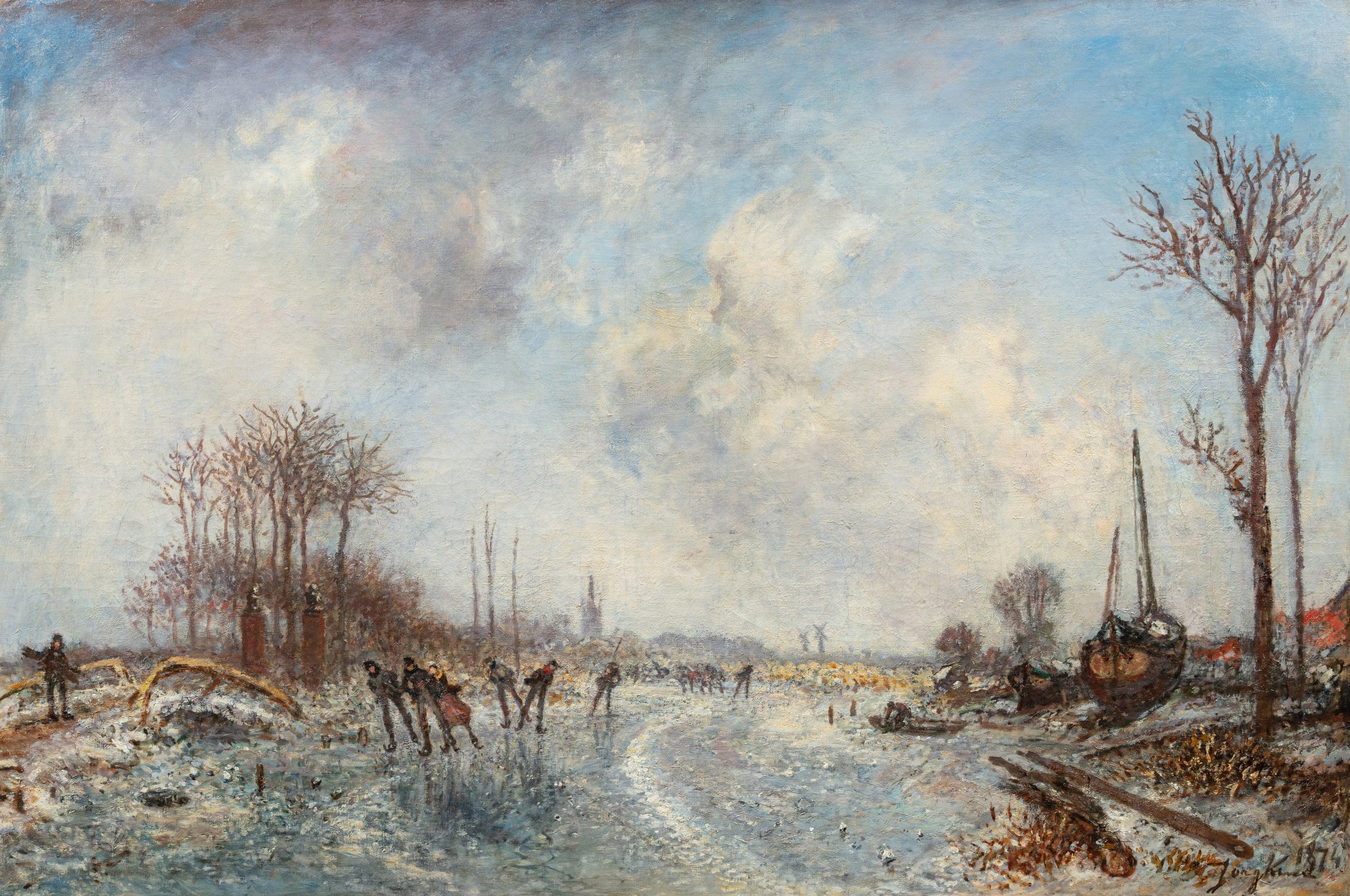
Patineurs près d'Overschie
His works appear regularly at the major European and American auction houses, where his oils and watercolors command serious attention. Works on paper, particularly the watercolors combining gouache and black chalk, are especially prized for the directness with which they capture his method. Collectors drawn to the Impressionists often find their way to Jongkind through a kind of reverse archaeology, following Monet and Sisley back to their sources and discovering that the source is itself a master. What to look for is that quality of light and movement that distinguishes his finest work from his more routine production: when Jongkind was fully engaged, his skies are almost electric, his water restless and alive.
Works from the 1860s, widely considered his peak decade, are particularly sought after. To understand Jongkind fully it helps to situate him among his contemporaries and successors. He sits comfortably alongside Eugène Boudin, with whom he shared a passion for working from direct observation and a preference for coastal and maritime subjects. Together, the two men formed something like a bridge between the structured naturalism of Corot and the liberated color and brushwork of Monet and Pissarro.
Johan Barthold Jongkind
Batavia, 1868
Jongkind's influence on Monet in particular is well documented. The two met in Normandy in 1862 and Monet later described the encounter as transformative, crediting Jongkind with completing his education as a painter. That testimony alone would secure Jongkind's place in art history, but the quality of the work itself more than justifies the admiration. What makes Jongkind compelling in the present moment is not merely his historical importance but the way his work continues to speak directly to the eye and the emotions.
There is nothing academic or dutiful about looking at a great Jongkind. The pleasure is immediate and physical, a sensation of air and light and movement that bypasses learned appreciation and goes straight to the senses. As collectors and curators continue to reassess the Impressionist orbit, looking past the canonical figures to the visionaries who made the revolution possible, Jongkind's reputation can only grow. He was a man who saw the world with unusual freshness and urgency, and who found ways to put that freshness onto canvas, paper, and copper plate with astonishing consistency.
To own a Jongkind is to own a piece of that vision, and to be reminded that the history of modern art is richer, stranger, and more generous than any single story can contain.
Explore books about Johan Barthold Jongkind
Jongkind: Sa vie et son oeuvre
Eugène Bouvy
Johan Barthold Jongkind
Adolphe Bastin
Jongkind 1819-1891
Helene Adhémar and Françoise Cachin
Johan Barthold Jongkind, 1819-1891
Victorine Hefting
Jongkind: aquarelles et dessins
Françoise Cachin