Jim Shaw
Jim Shaw Makes America Dream Again
Artist Spotlight · The Collection Editorial
When the Museum of Contemporary Art Los Angeles mounted its sweeping survey of Jim Shaw's work, the rooms felt less like a gallery and more like the inside of a very particular and very American mind. Canvases borrowed from thrift stores hung alongside intricate dream drawings, painted monsters, and devotional objects stripped of their original faith and refilled with something stranger and more searching. The effect was both disorienting and deeply familiar, the way a half remembered dream from childhood can feel urgent and a little dangerous when it surfaces decades later. Shaw has spent more than four decades building one of the most singular bodies of work in contemporary American art, and the art world is paying close attention.
Jim Shaw
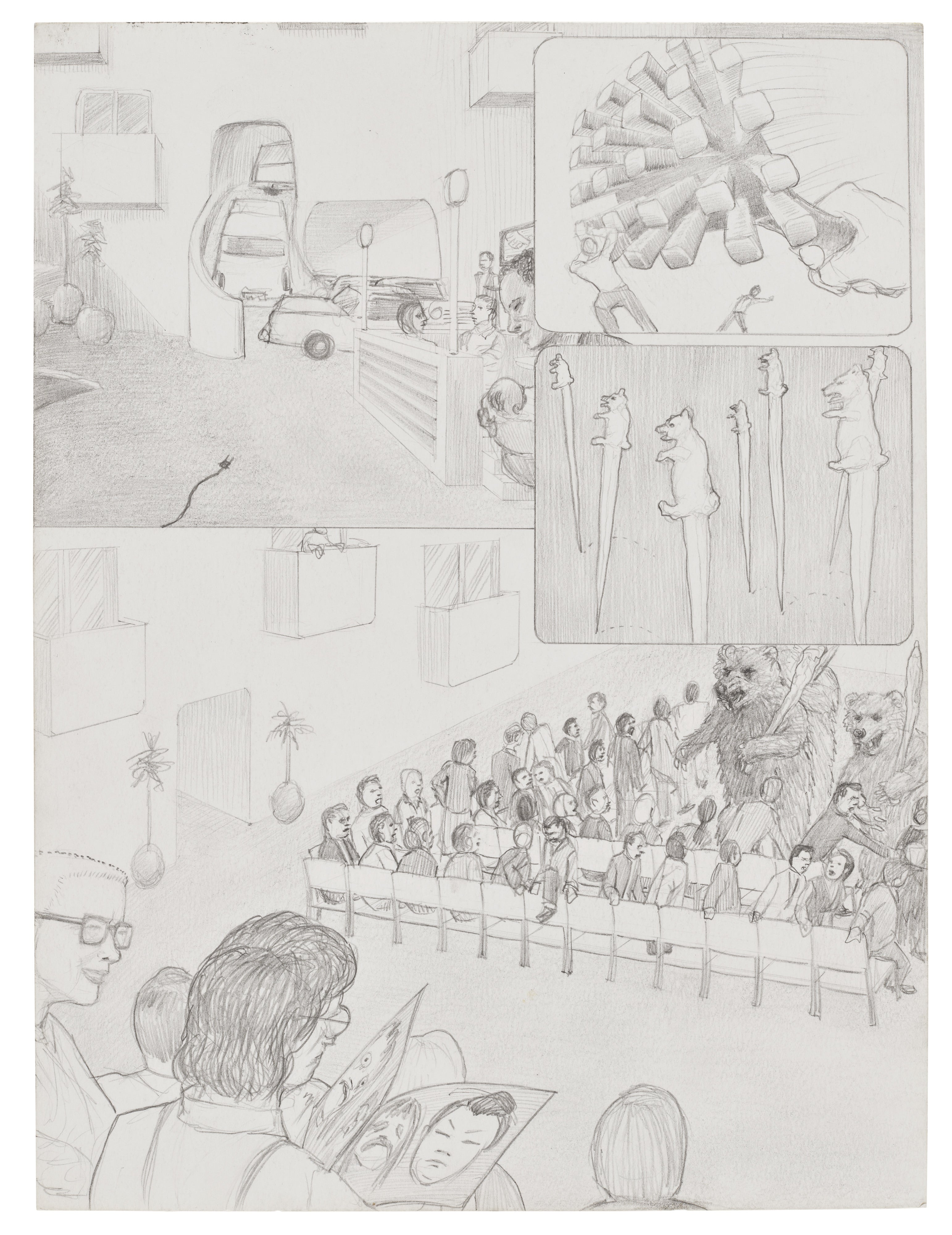
Dream Drawing
Shaw was born in Midland, Michigan in 1952, growing up in the postwar American interior where mass culture arrived in waves of television, comic books, roadside signage, and evangelical fervor. These were not simply influences he would later process ironically at a critical distance. They were the water he swam in, and his relationship to them has always been one of genuine fascination rather than detached commentary. He studied at the University of Michigan before moving to Los Angeles to attend the California Institute of the Arts, where he encountered a generation of artists who would reshape American art.
His time at CalArts in the mid 1970s placed him alongside Mike Kelley, a friendship and creative kinship that would prove formative for both artists and for the broader landscape of West Coast conceptualism. Before his solo practice fully crystallized, Shaw was a founding member of Destroy All Monsters, the Detroit and Ann Arbor based band and art collective that he formed with Mike Kelley, Niagara, and Cary Loren in the early 1970s. The group occupied a genuinely strange corner of American underground culture, mixing noise music, surrealist imagery, found objects, and a gleeful disregard for the boundaries between art and music. This spirit of radical eclecticism never left Shaw's work.
Jim Shaw
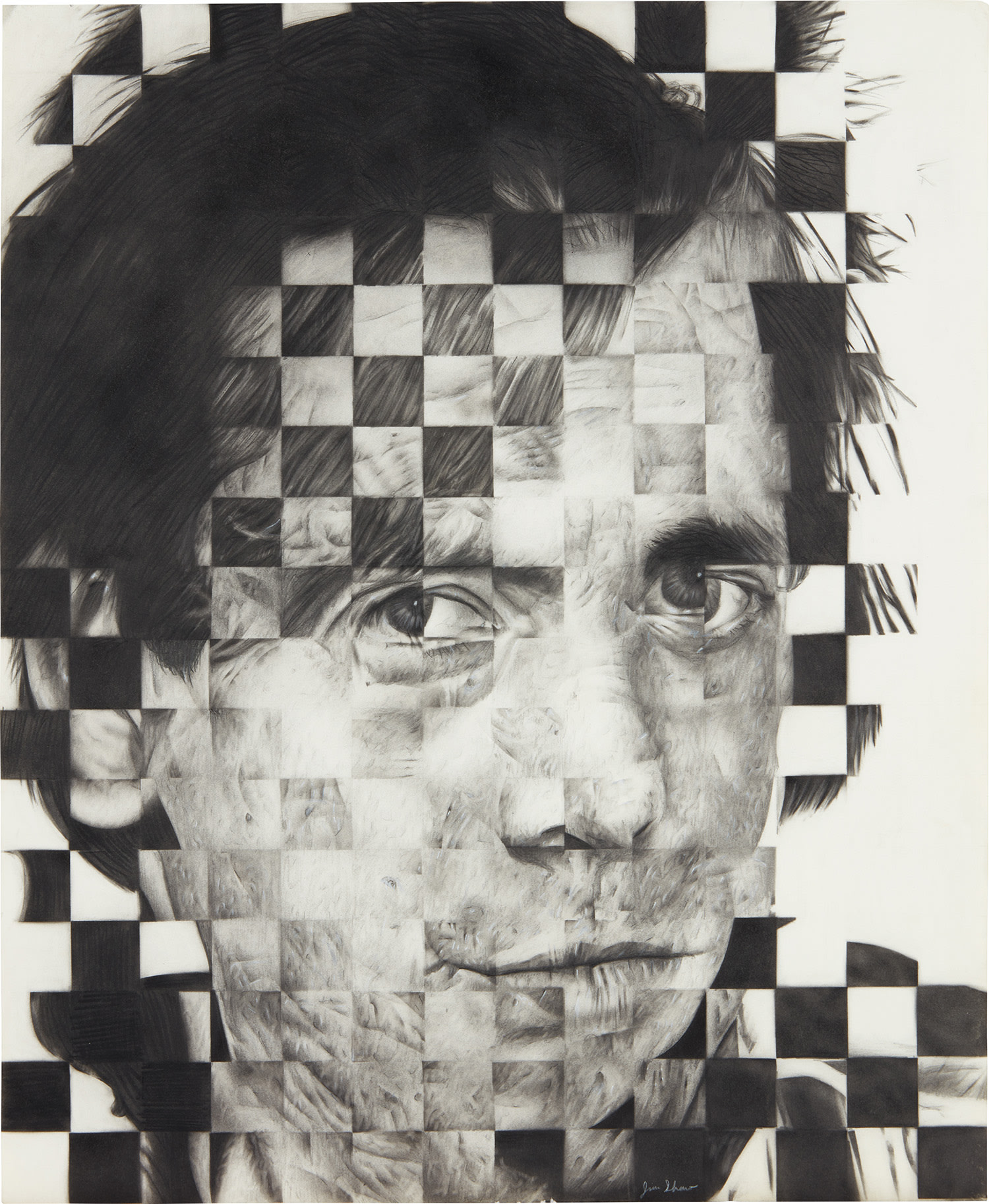
Study for A Taste of Honey (Portrait of Bob Flanagan), 1990
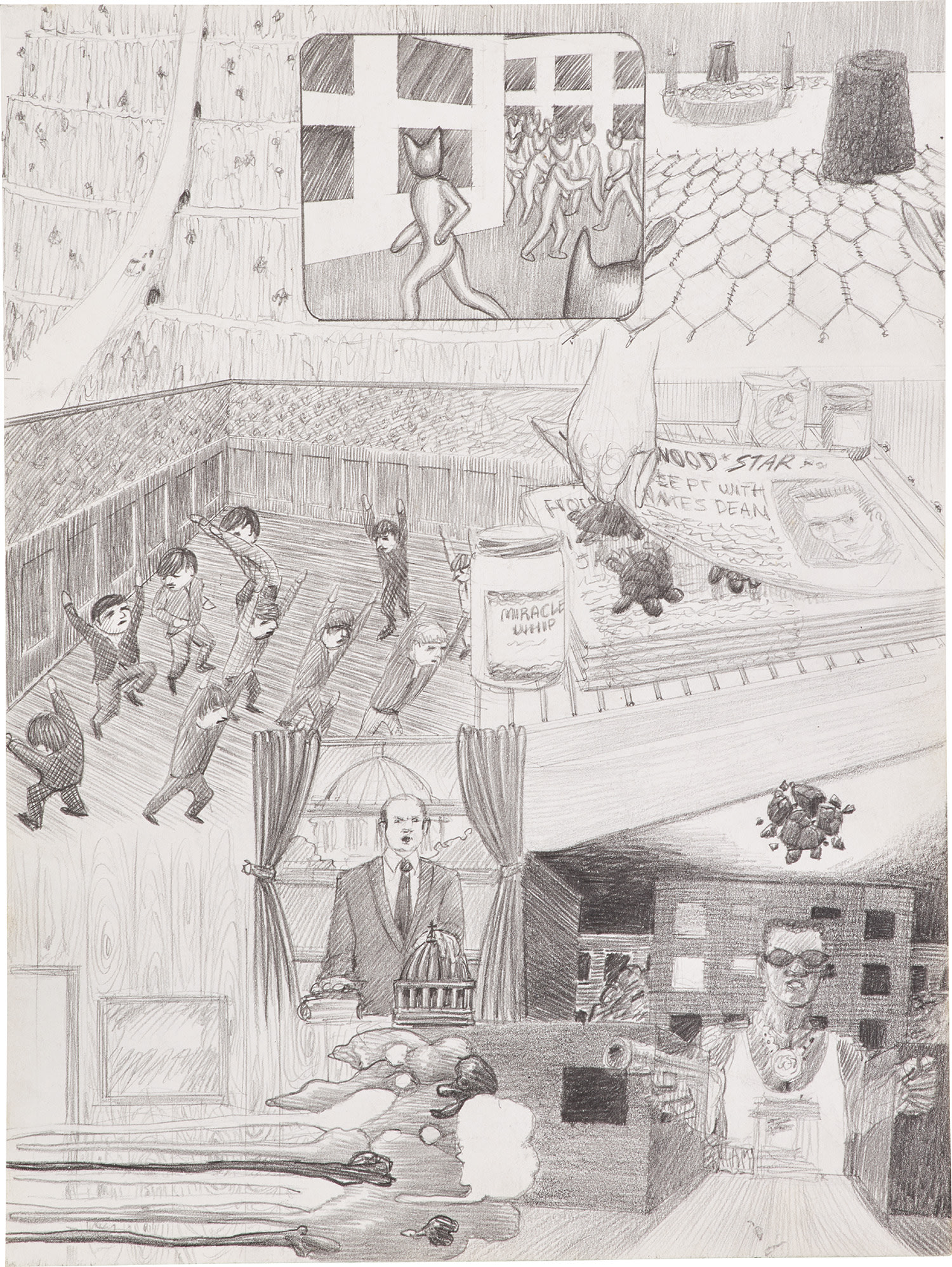
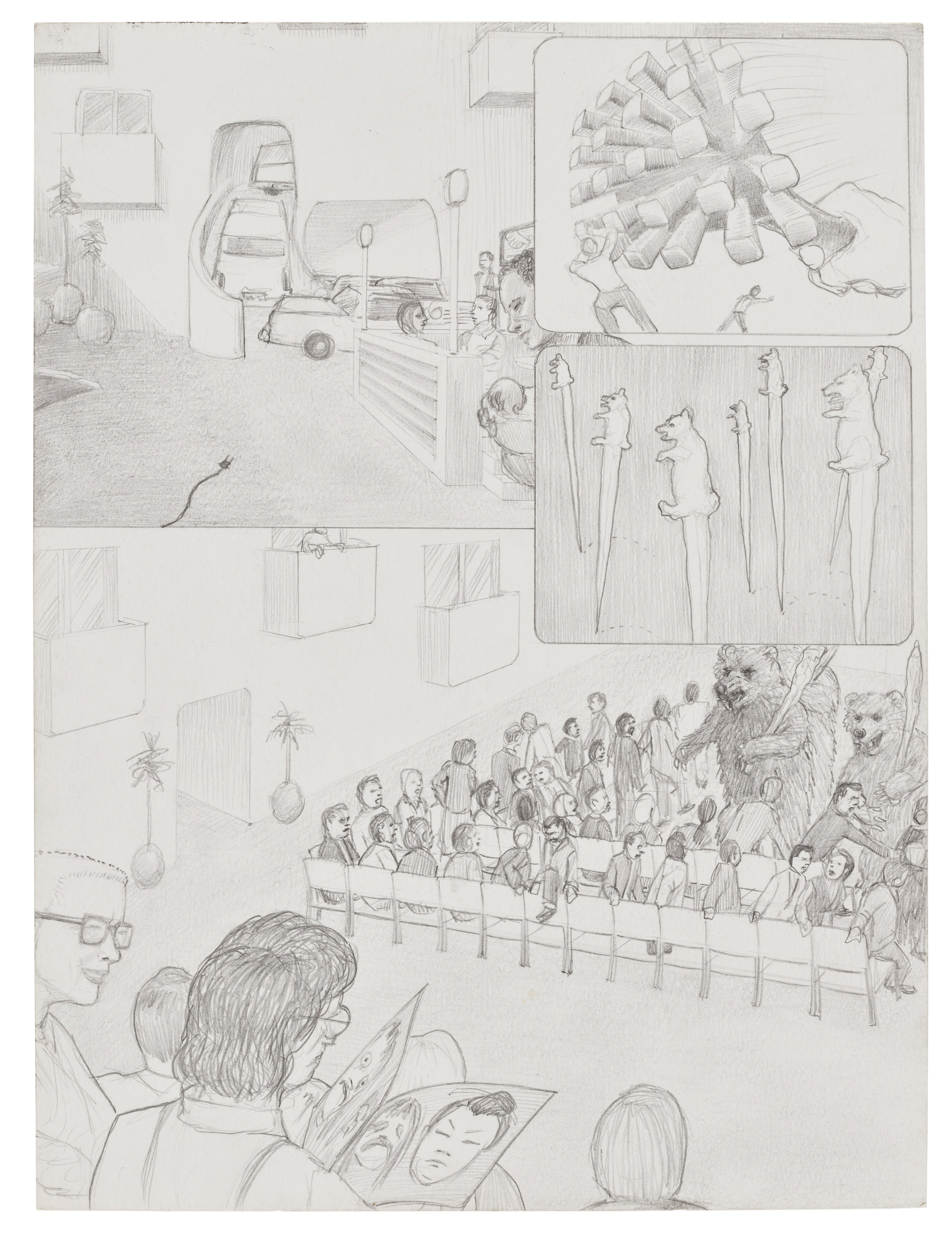
It became the engine of his practice, the willingness to treat a thrift store oil painting of a mountain lake with the same seriousness as a carefully constructed dream narrative, to find the hidden cosmology inside American kitsch. Shaw's artistic development unfolded through several interconnected and overlapping bodies of work, each of which rewards sustained attention. His ongoing Dream Drawings and Dream Objects series, which he began documenting in the 1990s, translate the specific imagery of his own sleeping unconscious into pencil drawings and three dimensional objects rendered with a flat, almost clinical precision. The drawings are typically accompanied by handwritten narrative inscriptions on the reverse, so that each work carries a kind of prose poem describing its origin.
Works such as Dream Drawing, inscribed with detailed narrative text in pencil on the reverse, and Dream Object (Mike Gonzales and I were at Larry's Studio) from 1996 in acrylic on wood, demonstrate how Shaw transforms the deeply private into the culturally resonant. The logic of dreams, with their free association and collapsed timelines, turns out to be an excellent tool for examining what American culture suppresses or cannot quite say out loud. The Thrift Store Paintings series, for which Shaw is perhaps most widely known, began in earnest in the 1980s and represents one of the most sustained and thoughtful engagements with vernacular painting in postwar art. Shaw collected amateur oil paintings from thrift stores across America and presented them as a found collection, allowing the anonymous desires, failures, and aspirations of ordinary painters to speak as a kind of collective portrait of the nation.
Jim Shaw
Dream Drawing (I was dawdling)
The project sits in productive conversation with the work of artists such as Mike Kelley, Raymond Pettibon, and Paul McCarthy, all of whom have interrogated American mythology through subcultural and popular forms. But Shaw's approach carries a particular tenderness alongside its critical intelligence. He seems genuinely moved by these paintings, not just by what they reveal about cultural delusion but by the human effort they represent. His My Mirage series, begun in 1986 and continuing through the early 1990s, traced the spiritual and psychological development of a fictional American teenager named Billy from adolescence through religious conversion and disillusionment.
Executed across multiple mediums including painting, drawing, and installation, the series drew on the visual language of underground comics, Christian evangelism, and psychedelic culture to construct a complete mythology. My Mirage No. 4 from 1987, rendered in chromed bronze on velvet in the artist's own wood strip frame, exemplifies the series' ability to hold sincere emotional content and formal sophistication in the same object. Study for A Taste of Honey (Portrait of Bob Flanagan) from 1990 shows Shaw extending his empathy toward the figures of Los Angeles underground culture, creating a record of a community as much as a series of individual portraits.
Jim Shaw
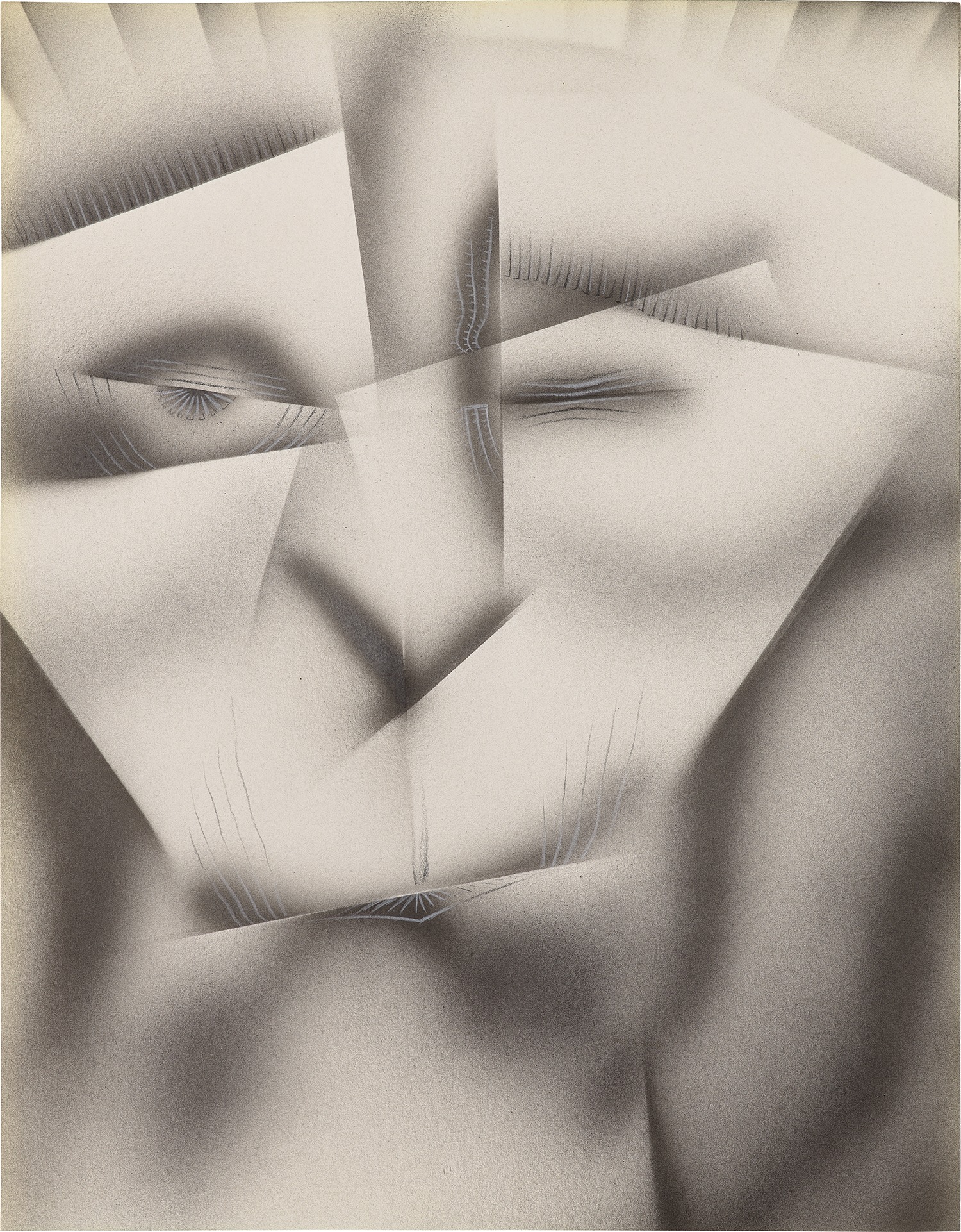
Face in the Mirror
For collectors, Shaw's work offers something rare in contemporary art: a practice with genuine intellectual depth that also rewards looking. His drawings in particular, including the Silhouette Drawings in spray paint on paper and the Face in the Mirror pieces in airbrush and pencil on wove paper, demonstrate a draughtsmanship that is precise and expressive in equal measure. The market for his work has grown steadily among collectors who appreciate the way his practice connects to broader currents in American art history while remaining entirely and irreducibly his own. Shaw is represented by Metro Pictures in New York and Blum and Poe in Los Angeles, galleries with serious programs that have supported his work for many years.
Collectors drawn to the worlds of Kelley, Pettibon, and John Baldessari will find in Shaw an artist whose work deepens and complicates the story those names already tell. What makes Shaw essential right now, as American culture continues to reckon with its own mythologies and mass produced belief systems, is his refusal of easy cynicism. His work knows exactly what it is looking at when it examines evangelical imagery, comic book violence, outsider painting, and the dream life of the unconscious. But it looks with curiosity rather than contempt, and with a formal intelligence that transforms its raw material into something genuinely new.
He is an artist who has spent a lifetime paying attention to the things that more respectable culture prefers to overlook, and in doing so he has produced a body of work that is both a document of American life and a sustained act of imagination.
Explore books about Jim Shaw
Jim Shaw: Thaw
Jim Shaw, Robert Storr
Jim Shaw: Selected Works 1978-1992
Jim Shaw

Jim Shaw: Dream Objects and Photographs
Jim Shaw, Lane Relyea
Jim Shaw: The End of the World as We Know It
Jim Shaw
Jim Shaw: My Mirage
Jim Shaw, various contributors