Jim Isermann
Jim Isermann Makes the World More Beautiful
Artist Spotlight · The Collection Editorial
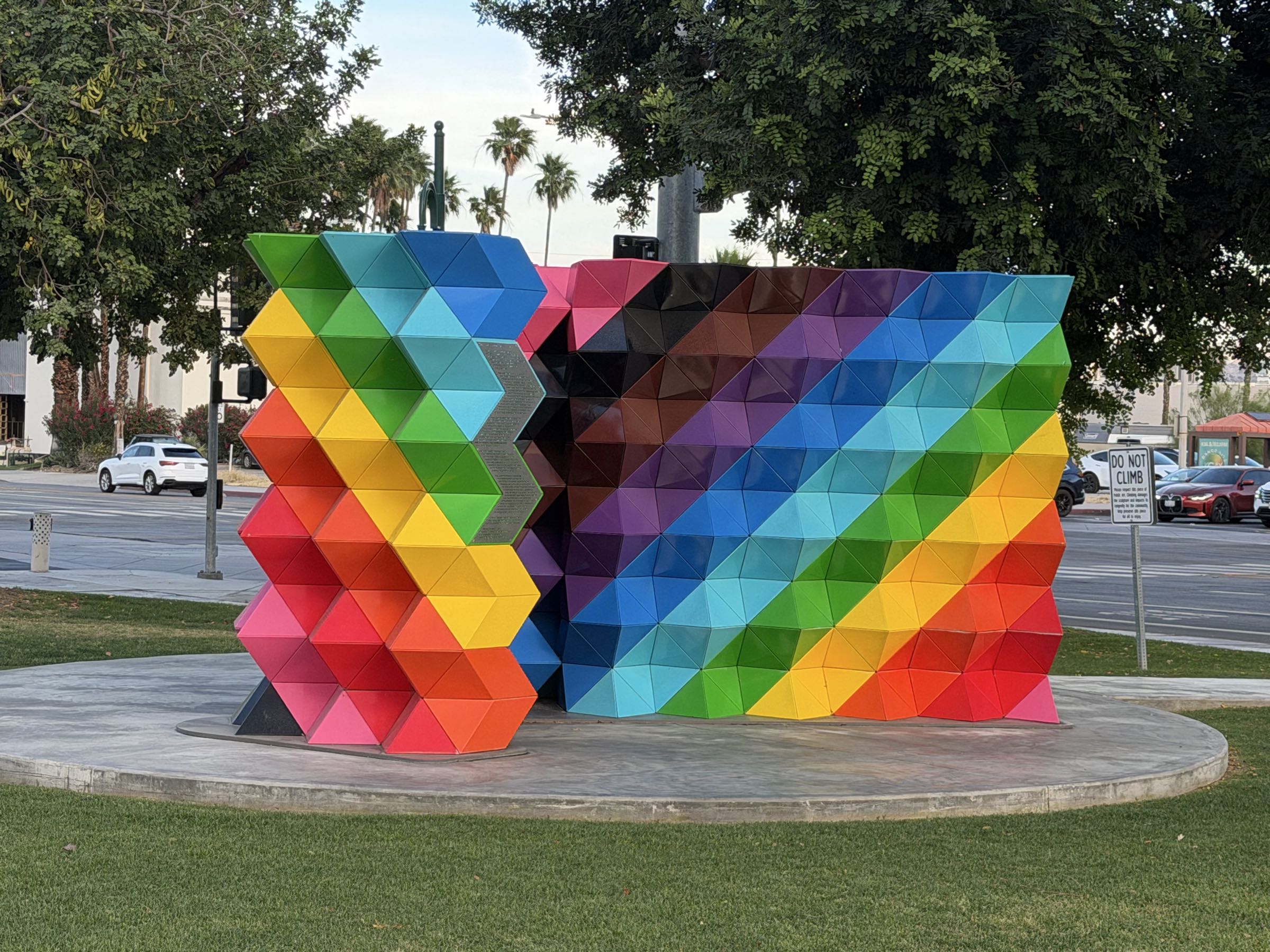
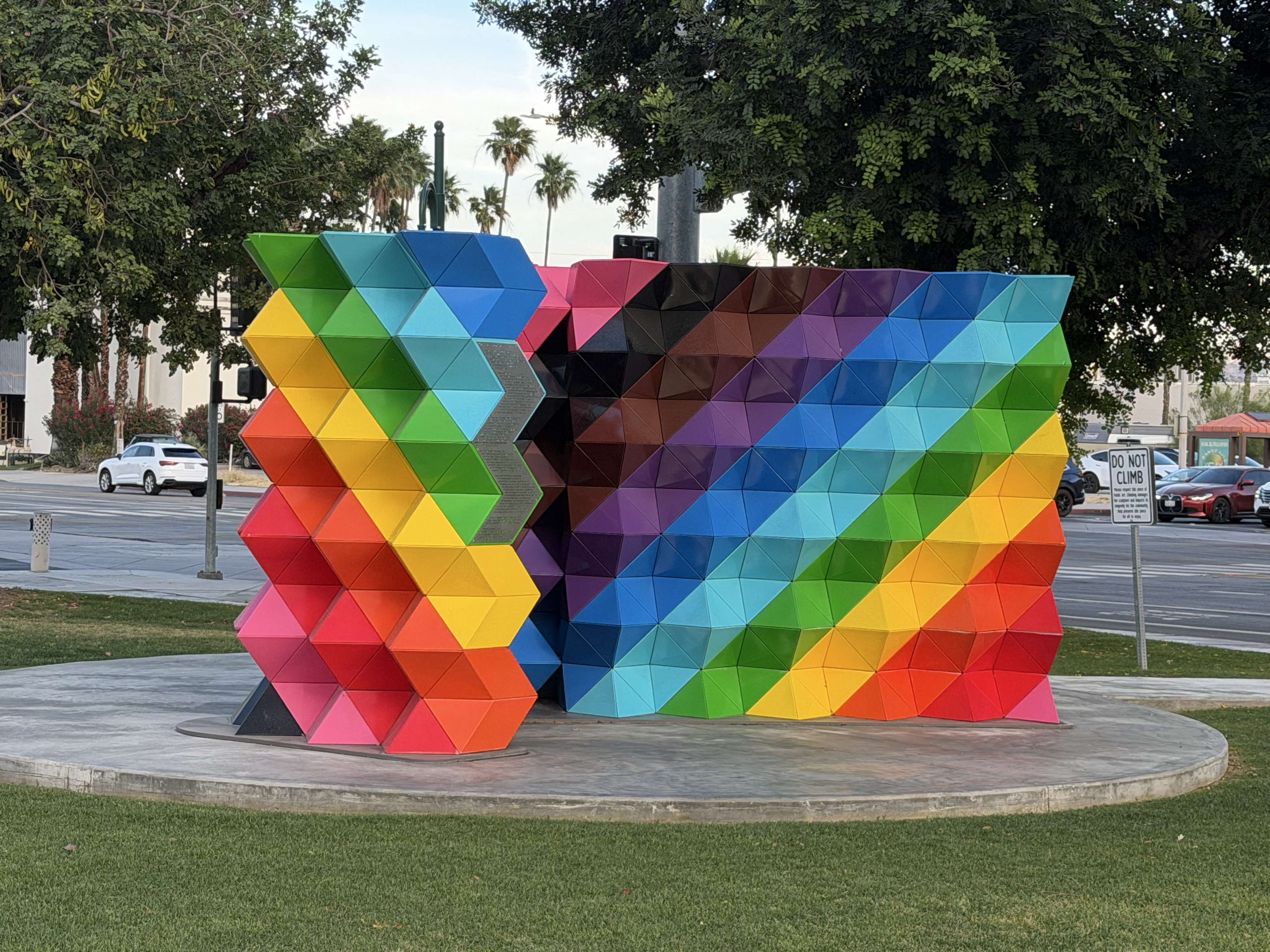
In 2025, Jim Isermann unveiled The Pride Monument, a major public sculpture that stands as one of the most joyful and visually commanding works of his career. The commission arrives at a moment when public art is being asked to do meaningful cultural work, and Isermann answers that call with characteristic conviction: bold geometry, radiant color, and a formal intelligence that feels at once timeless and urgently present. For those who have followed his practice across four decades, the work confirms what collectors and curators have long understood. Isermann is one of the most consistently vital artists working in American abstraction today.
Jim Isermann
The Pride Monument, 2025
Born in 1955, Isermann grew up in an America saturated with the visual language of postwar consumer culture, suburban design, and the optimistic geometry of the space age. These were not influences he would later distance himself from in the manner of an artist performing critical irony. Instead, he absorbed them genuinely and transformed them into a sophisticated visual vocabulary that honors the decorative while transcending it. His formation as an artist took place against the backdrop of a generation reckoning with Minimalism and Pattern and Decoration, and he found his footing somewhere between those poles, committed to pleasure without apology.
Isermann studied at the University of Wisconsin and later at the California Institute of the Arts, where he received his MFA. CalArts in the late 1970s and early 1980s was a crucible of ideas, and Isermann emerged from it with a clear sense of purpose. He settled in Southern California, a landscape and cultural environment that would prove generative for his work. The light, the architecture, the legacy of California design culture from Charles and Ray Eames to the Case Study Houses all left visible traces in his practice.
Los Angeles gave him permission to be serious about surfaces, about the sensory experience of looking, about the relationship between art and the spaces it inhabits. His paintings and sculptures are built from repeating geometric units: hexagons, diamonds, interlocking grids, and modular forms that create optical vibrations across their surfaces. Isermann works with color the way a composer works with tone, understanding that certain combinations create harmony while others produce productive tension. His palette often draws from the mid century modern design tradition, referencing the optimistic hues of 1950s and 1960s American interiors and textiles, but the results are never nostalgic in any simple sense.
They feel forward looking, as though geometry itself were still full of undiscovered possibility. Galleries including Richard Telles Fine Art in Los Angeles gave early support to his vision, and his reputation grew steadily among collectors who valued rigor alongside warmth. What distinguishes Isermann from many of his contemporaries is his commitment to expanding the sites and materials of his practice. He has worked not only in paint on canvas but in fabric, tile, blown glass, cast plastic, and architectural installation.
He has designed environments in which pattern functions as total immersion rather than framed object, and this willingness to move across media reflects a fundamental belief that the distinction between fine art and applied design is an artificial one worth questioning. His engagement with the Pattern and Decoration movement of the 1970s connects him to artists like Robert Kushner and Kim MacConnel, but his stripped formal economy is equally indebted to the Color Field tradition and to the geometric rigor of artists like Frank Stella in his more exuberant phases. For collectors, the appeal of Isermann's work is layered and lasting. On first encounter, there is the immediate sensory reward: his works are genuinely pleasurable to be near, producing the kind of sustained visual engagement that deepens rather than diminishes with familiarity.
On longer acquaintance, the conceptual architecture becomes apparent, the way each work is a meditation on repetition, variation, and the limits of pattern. Collectors who have lived with his pieces often describe the experience of noticing something new months or years after acquisition, a quality that speaks to the depth of his formal thinking. His works translate beautifully across a range of interiors, from modernist residences to more traditional settings, because the geometry carries its own authority. Within the broader history of American abstraction, Isermann occupies a position that is both distinctive and well connected.
His work participates in the ongoing conversation about what geometric abstraction can mean after Minimalism, after postmodernism, in a moment when the decorative has been fully rehabilitated as a serious mode of inquiry. He shares that conversation with artists like Tauba Auerbach, who investigates pattern and surface with similar conceptual seriousness, and with the legacy of Bridget Riley, whose optical work demonstrated how geometry could produce genuine emotional experience. Isermann's contribution to this lineage is to bring warmth and a specifically American vernacular to questions that might otherwise feel purely formal. The Pride Monument of 2025 crystallizes many of these themes in a public register.
As a monument, it participates in a long tradition of commemorative sculpture while redefining what a monument can look like and what values it can celebrate. Where much monumental sculpture relies on figuration and heroic narrative, Isermann trusts abstraction to carry emotional weight, to mark pride, community, and belonging through the pure language of form and color. It is a bold proposition and it succeeds, demonstrating that his vision has the scale and the civic generosity to speak to broad audiences without compromising its integrity. Isermann's legacy is still very much in formation, which is one of the most exciting things about engaging with his work now.
He is an artist at the height of his powers, producing work that feels both deeply considered and genuinely alive. For collectors entering his practice today, there is the particular pleasure of participating in a story that continues to unfold. His work rewards close attention, sustained living with, and the kind of trust that the best art always asks of us. To collect Isermann is to bet on beauty, on rigor, and on the abiding human need for environments that elevate the spirit through the intelligence of their making.