Jeffrey Gibson
Jeffrey Gibson Is Remaking Everything We Know
Artist Spotlight · The Collection Editorial
“I want the work to be an affirmation of existence, of presence, of being alive and here right now.”
Jeffrey Gibson, interview with Artforum
In the summer of 2024, the United States Pavilion at the Venice Biennale became one of the most talked about destinations in the entire Giardini. For the first time in the history of that storied institution, a Native American artist represented the country on art's most visible international stage. Jeffrey Gibson arrived in Venice not with apology or explanation but with an overwhelming abundance of color, sound, pattern, and presence. The pavilion, titled "The Space in Which to Place Me," was a full sensory declaration, and the art world responded with something close to reverence.
Jeffrey Gibson
Hit That Perfect Beat
Gibson was born in 1972 and grew up moving between cultures in ways that would prove formative rather than disorienting. As a Mississippi Choctaw and Cherokee artist raised partly in the United States and partly abroad due to his father's military career, he spent time in South Korea, Germany, and England before returning to the American South. That early experience of navigating between worlds, of belonging fully to more than one place and tradition, became not a source of tension in his practice but the very engine of it. He studied at the Kansas City Art Institute and later at the Royal College of Art in London, bringing a rigorous formal education into contact with the deeply personal cultural inheritance he carried with him everywhere.
His artistic development resists easy periodization because Gibson has always worked across disciplines simultaneously. From early in his career he moved fluidly between painting, sculpture, beadwork, textile, and performance, treating none of these as primary and none as supplementary. What crystallized over time was a visual language that draws with equal confidence from the geometric traditions of Native American craft, the bold chromatic energy of Abstract Expressionism, the subcultural codes of queer nightlife and music, and the institutional vocabulary of contemporary conceptual art. By the time major institutions began paying sustained attention in the 2010s, Gibson had already constructed a practice of rare internal coherence.
Jeffrey Gibson
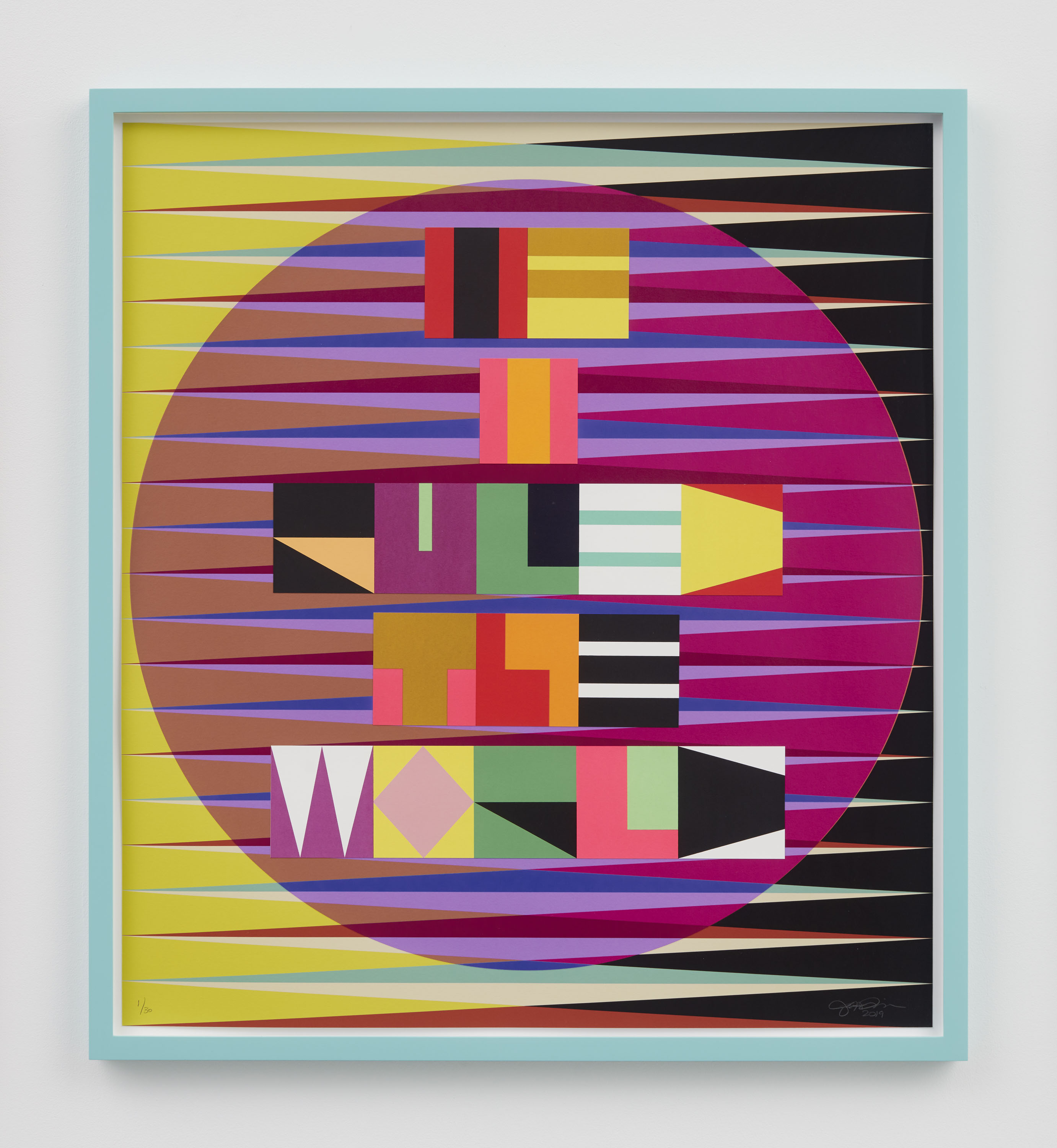
If I Ruled The World
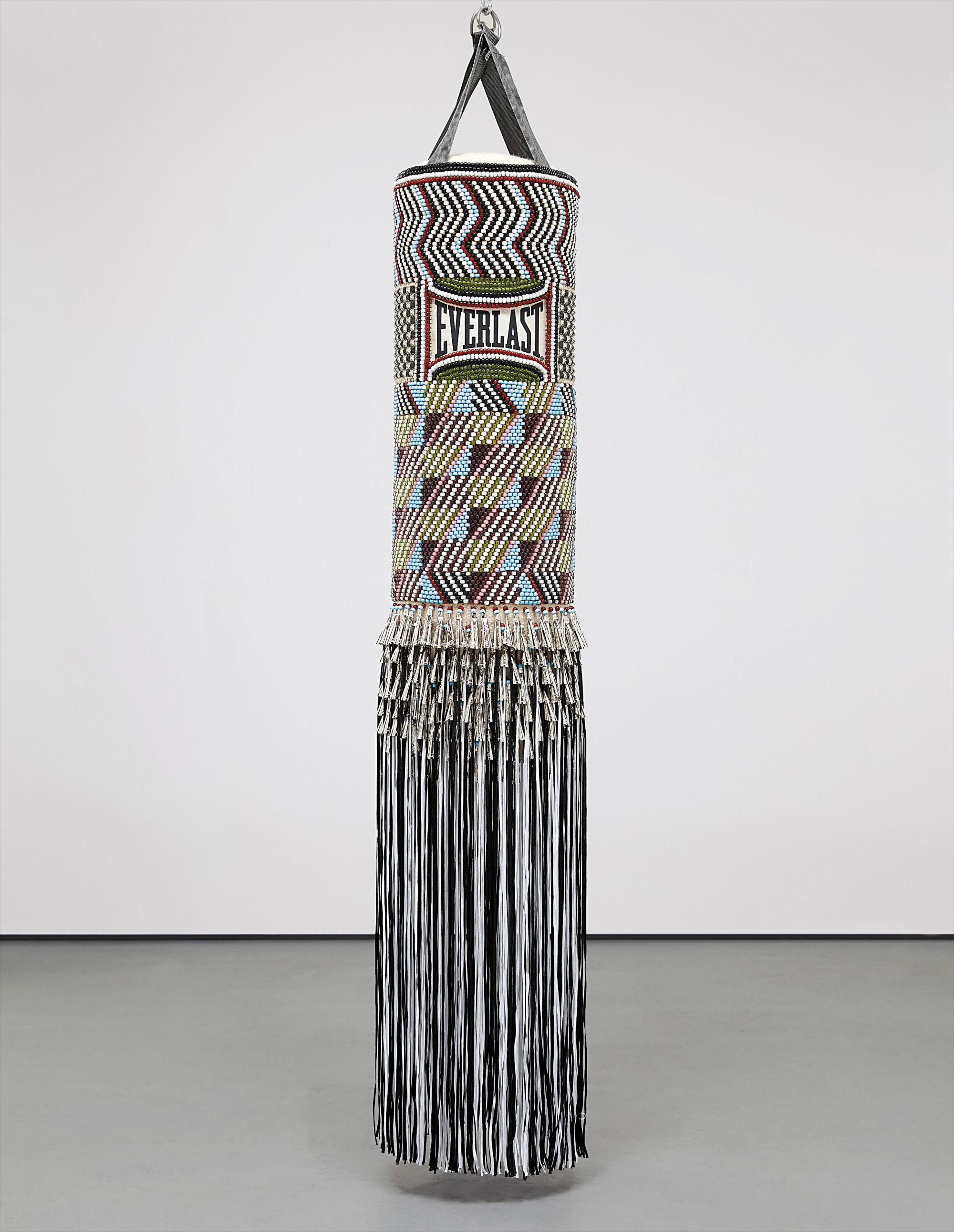
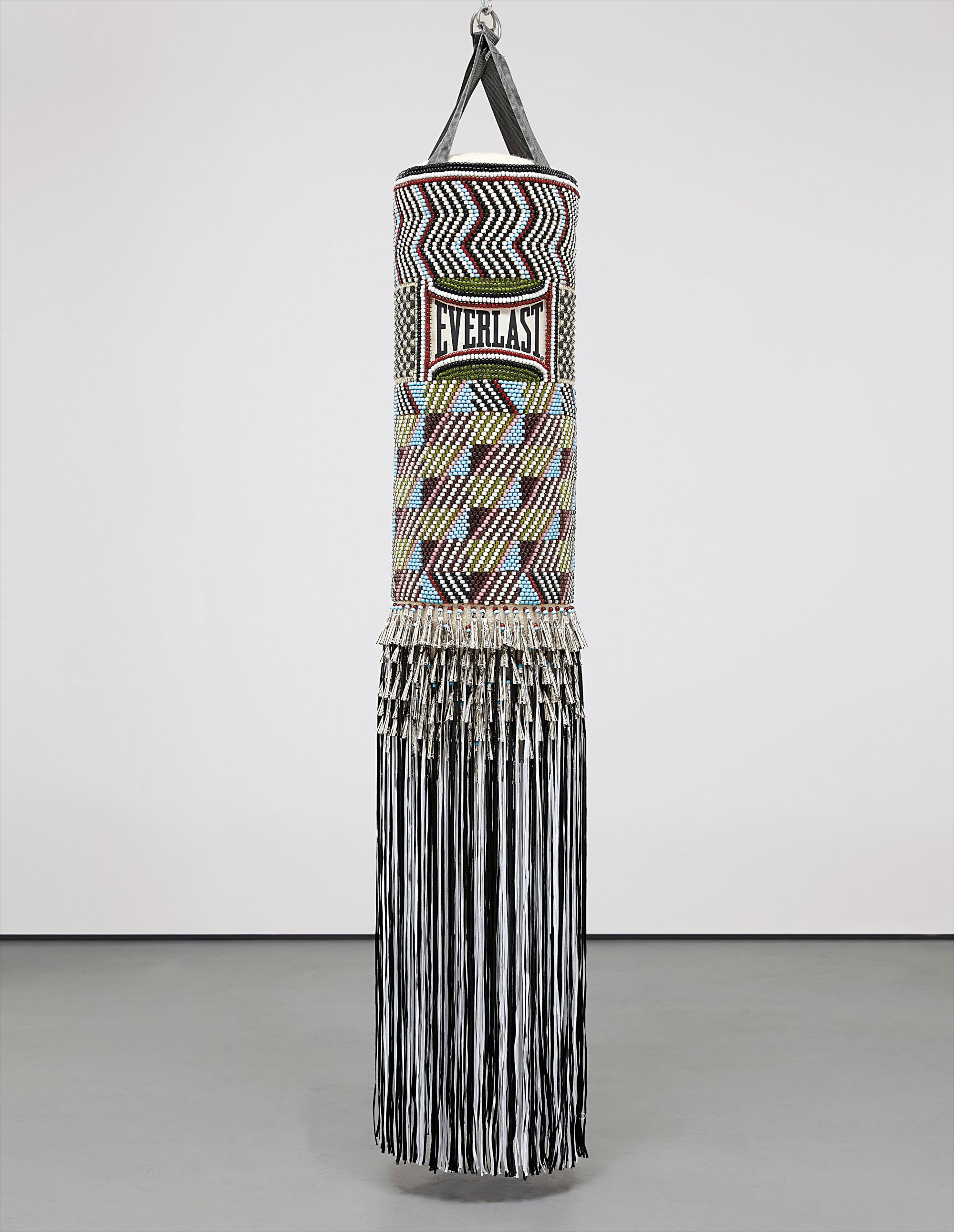
The works that have come to define his reputation share a quality that is difficult to name but immediately felt: they are simultaneously ancient and urgent. "Shield, #3" from 2012, made from deer hide, nails, and acrylic paint on a found ironing board, compresses into a single object the domestic and the ceremonial, the everyday and the sacred. The ironing board as armature is a stroke of genius, a found form that carries its own social history while being utterly transformed by the materials layered upon it. "Like a Hammer (Figure)" extends this logic into three dimensions, a hanging sculptural form constructed from wool, wood, deer rawhide, glass beads, steel studs, copper jingles, quartz crystals, brass bells, Angora goat fur, and artificial sinew.
The work commands the room not through scale alone but through the density of its references and the sheer physical intensity of its making. Painting remains central to his practice, and works like "MAKE ME FEEL IT" from 2015 and "Turn It Up," executed in acrylic, spray paint, colored pencil, and graphite on goat skin mounted to panel, demonstrate how thoroughly Gibson has absorbed and then exceeded the legacies of color field painting and pattern and decoration. The text that appears in many of his works, drawn from song lyrics, affirmations, and cultural slogans, transforms the picture plane into something closer to a manifesto. These are not decorative objects.
Jeffrey Gibson
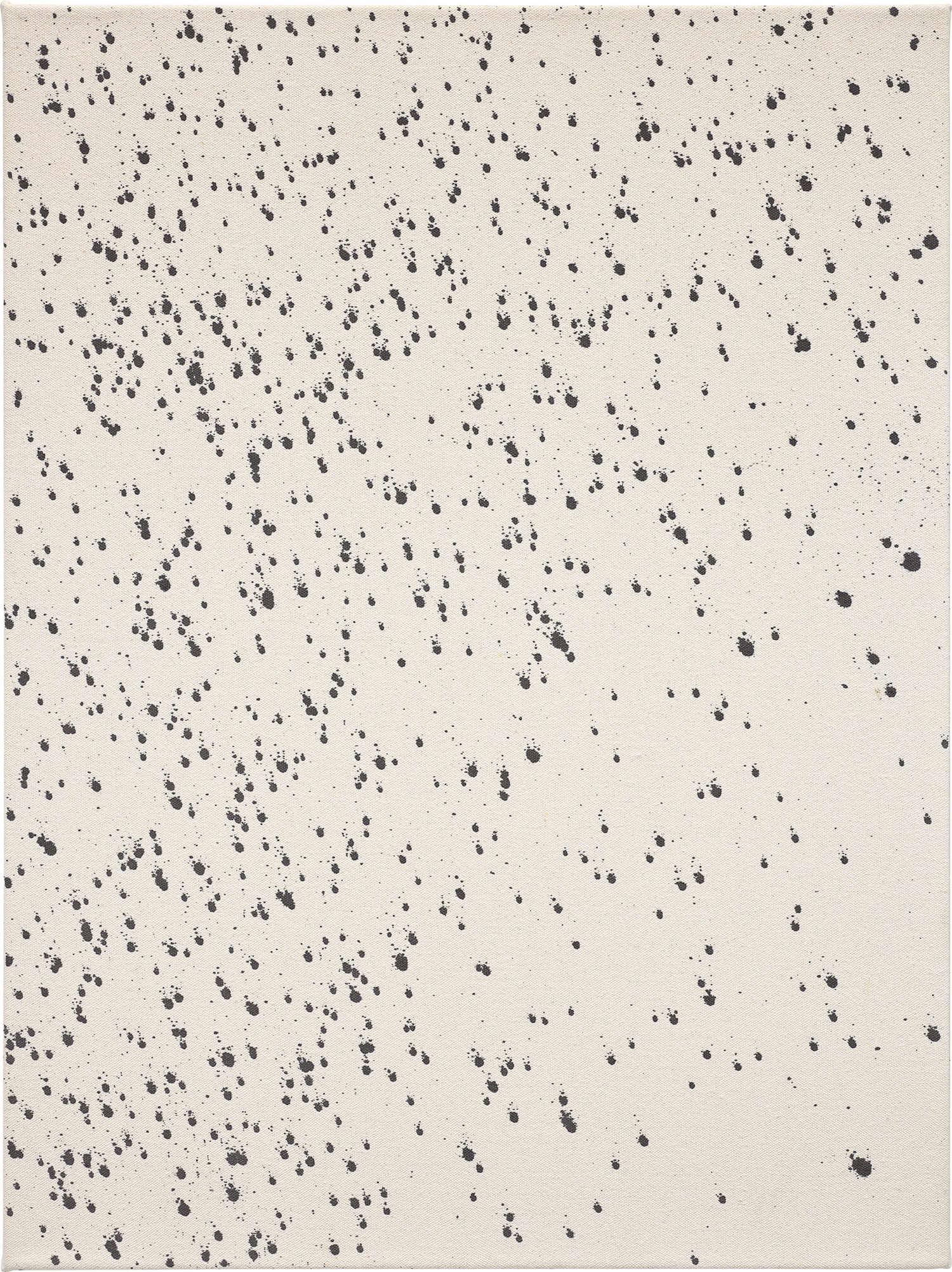
Shield, #3, 2012
They are arguments made in color, insisting on joy as a political position and on Indigenous life as something present and generative rather than historical and elegiac. Works on paper such as "The Future Is Present" and "If I Ruled The World" bring the same intensity to the printed and collaged surface, layering screenprint and archival inkjet with an almost architectural sense of composition. From a collecting perspective, Gibson represents one of the more significant opportunities in the current market for work that sits at the genuine intersection of critical importance and visual power. His institutional trajectory has been extraordinary: exhibitions at the Smithsonian's National Museum of the American Indian, the Denver Art Museum, and the Brooklyn Museum, along with representation by Sikkema Jenkins and Kavi Gupta, have built a collector base that spans museums, foundations, and serious private collections.
Works on paper and smaller editions offer points of entry for collectors building toward the larger sculptural and mixed media works that require more committed space and budget. The material richness of pieces like "Family" from 2013, which incorporates acrylic tube, color gel, deer hide, artificial sinew, and commercial light fixtures, means that condition and installation context are considerations worth discussing with an advisor before acquiring. Gibson occupies a genuinely singular position in art history, but he is not without peers or context. Collectors who respond to his work often find themselves drawn to artists like Jaune Quick to See Smith, whose engagement with Indigenous identity and contemporary painting shares a similar insistence on complexity, or to Theaster Gates, whose practice also treats craft traditions and cultural history as legitimate and rigorous artistic materials.
Jeffrey Gibson
MAKE ME FEEL IT, 2015
The generation of queer artists of color who emerged in the 1980s and 1990s, figures like Glenn Ligon and Kara Walker, created some of the critical infrastructure that made Gibson's kind of layered, text inflected, identity conscious practice legible to the broader art world. Gibson has absorbed all of this and made something new from it. What Gibson has accomplished, over more than two decades of sustained and evolving practice, is the creation of a body of work that refuses every false choice offered to it. He refuses the choice between tradition and contemporaneity, between political content and aesthetic pleasure, between Indigenous cultural specificity and universal human resonance.
The Venice Biennale representation in 2024 was not a culmination but a visibility moment in an ongoing project of enormous ambition. For collectors with the vision to see what he has been building, and the good fortune to acquire a work now, the experience of living with his art is one that deepens over time. These are objects and images made to last, made to mean, and made with an integrity that the market increasingly recognizes and rewards.
Explore books about Jeffrey Gibson