Jean-Paul Riopelle
Riopelle: Where Wild Nature Meets Pure Paint
Artist Spotlight · The Collection Editorial
“I paint the way I hunt. You have to be ready for anything, and move fast.”
Jean-Paul Riopelle
In the spring of 2023, the Musée national des beaux arts du Québec mounted one of the most ambitious retrospectives in its history to mark the centenary of Jean Paul Riopelle's birth. The exhibition drew thousands of visitors and reminded the art world of something that collectors in Paris and Montreal had long understood: Riopelle was not merely a significant Canadian artist but one of the defining voices of postwar abstraction on a genuinely international scale. Works that had quietly appreciated in private collections for decades were suddenly the subject of renewed critical attention, and institutions from Europe to North America reasserted his place among the great painters of the twentieth century. The centenary felt less like a commemoration and more like an overdue coronation.
Jean-Paul Riopelle
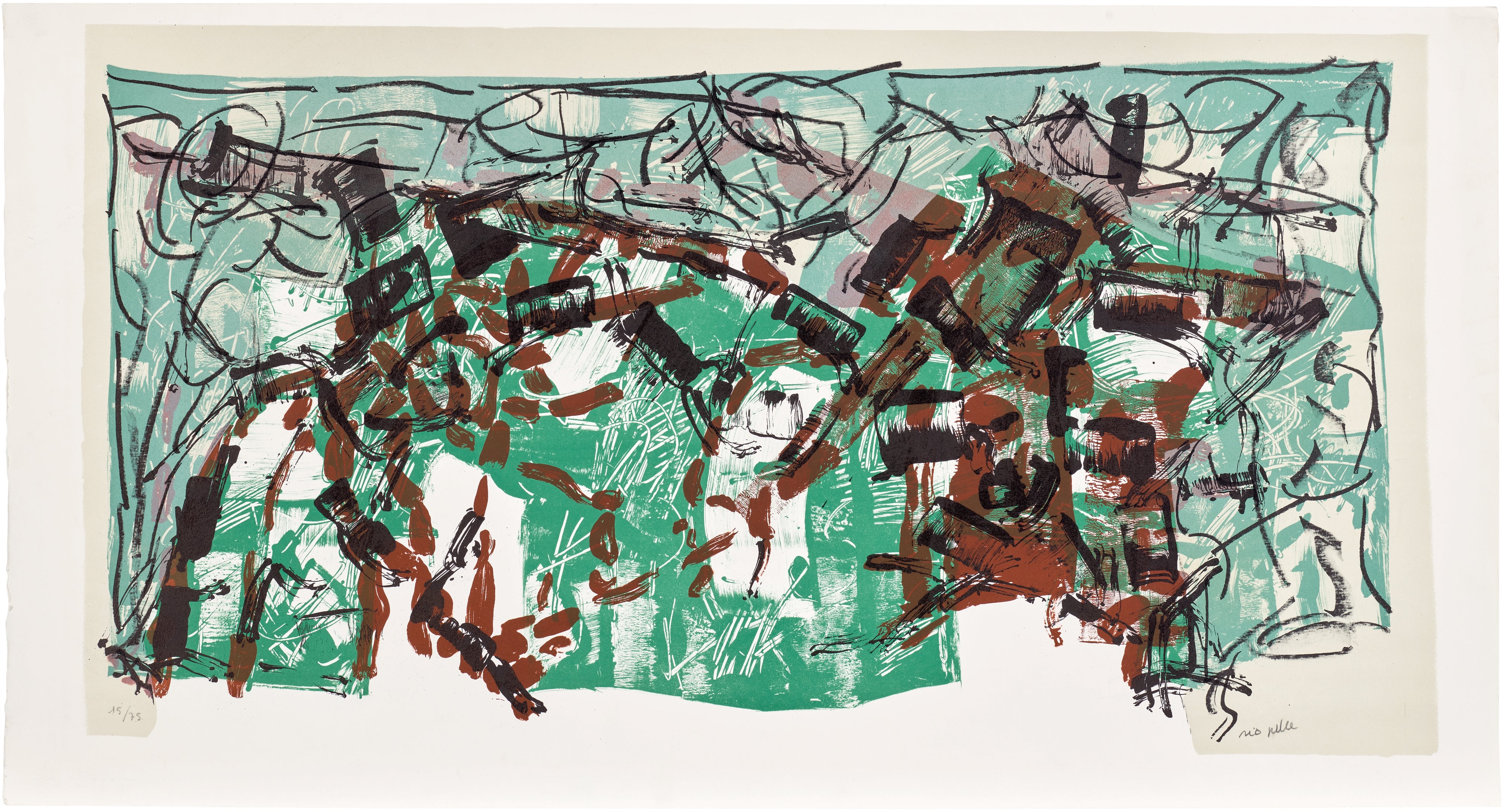
Brisées (Broken) (R. 1967.22EST.LI)
Riopelle was born in Montreal in 1923, and the landscape of Quebec shaped him in ways that would resonate through every canvas he ever made. He studied at the École des beaux arts de Montréal and later at the École du meuble, where he encountered the progressive ideas of Paul Émile Borduas, a teacher whose influence on an entire generation of Quebec artists cannot be overstated. Borduas introduced his students to Surrealism and to the liberating principle of automatism, the practice of allowing the unconscious to guide the hand across the canvas without rational interference. For a young painter already restless with academic convention, it was a revelation.
By the late 1940s, Riopelle had become a founding participant in Les Automatistes, the Montreal group that coalesced around Borduas and whose collective manifesto, Refus global, published in 1948, was one of the most radical cultural documents in Canadian history. The manifesto rejected the conservative, church dominated culture of Quebec and demanded creative and social freedom. Riopelle signed it, though he was already living in Paris by the time it caused its celebrated scandal back home. He had arrived in France in 1947, drawn by the magnetic pull of the School of Paris and the possibility of measuring himself against the full force of European modernism.
Jean-Paul Riopelle
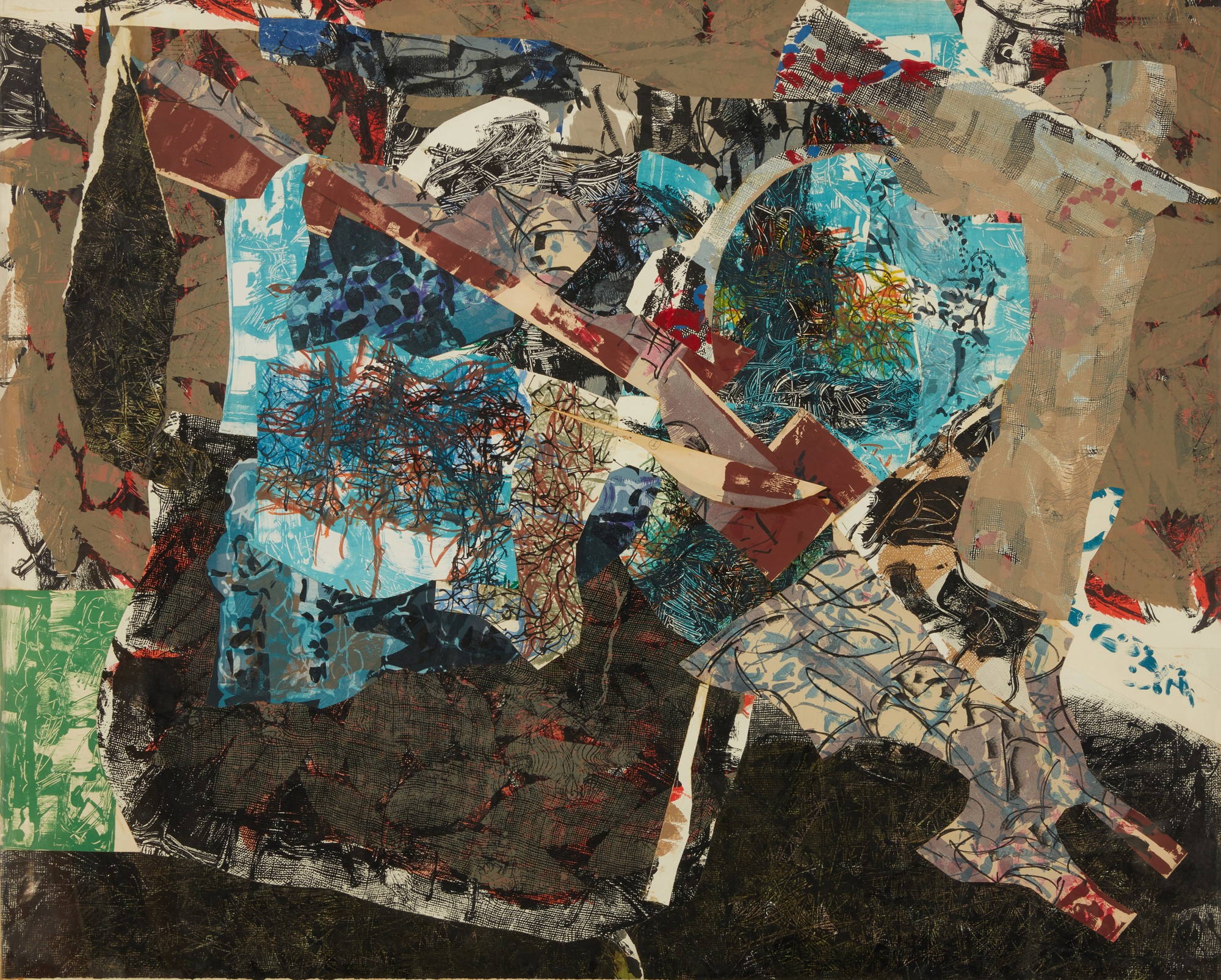
Départ Pour, 1967
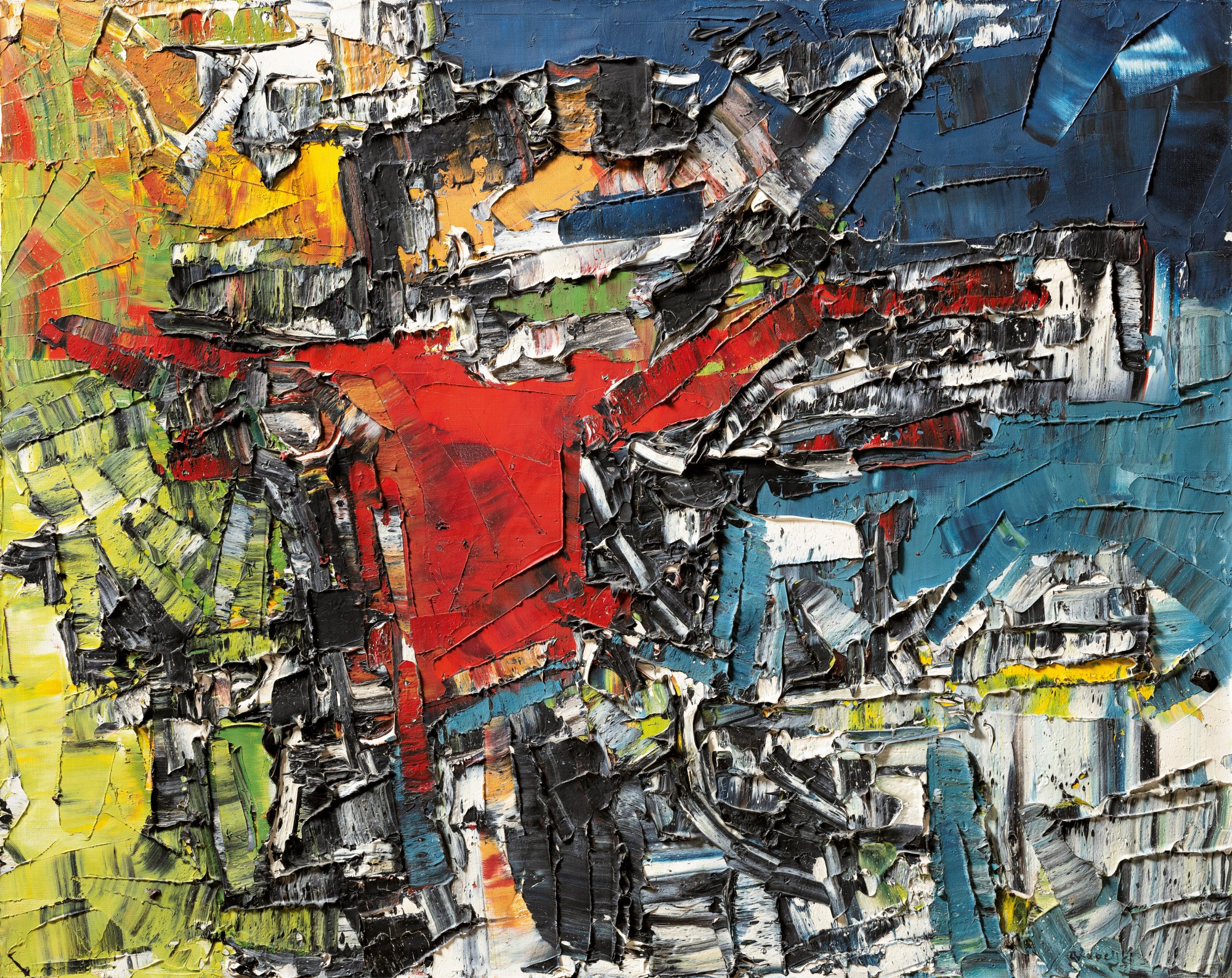
He would remain there for decades, building friendships with Joan Miró, Georges Mathieu, and notably with the American artist Sam Francis, becoming a central figure in the transatlantic conversation about gestural abstraction. It was in Paris that Riopelle developed the technique that would become his unmistakable signature. Working with palette knives rather than brushes, he built up dense, jeweled surfaces of paint, laying down thick impasto in interlocking fragments that read from a distance as shimmering, almost mosaic like fields of color and texture. The results were simultaneously wild and architecturally precise, evoking the forests, ice, and open skies of the Canadian north while remaining entirely committed to the formal language of abstraction.
His canvases from the 1950s, including major works such as the extraordinary large scale paintings that entered European museum collections during that decade, established him as a painter of the first rank. The Musée d'art moderne de la ville de Paris and the Guggenheim Museum in New York both collected his work during his lifetime, a distinction that few Canadian artists had achieved. Among the works that best illustrate his range and ambition, the oil paintings of the mid to late 1950s hold a special place. A canvas such as Sauzon from 1956 demonstrates how Riopelle could translate a specific place, in this case a harbor village in Brittany that he loved, into something that feels both entirely particular and utterly universal.
Jean-Paul Riopelle
Palais rustique, 1957
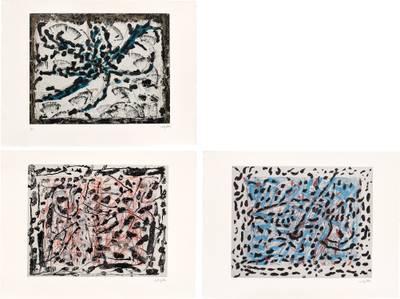
The paint is applied with urgent physicality, knife strokes building a surface that seems to vibrate, and yet the overall composition holds together with a sureness that speaks to his deep instinctual intelligence about pictorial structure. His lithographs, produced with great seriousness throughout his career, reveal another dimension of his sensibility: the printed works reward close attention and bring his gestural language into a more intimate register that many collectors find irresistible. Works such as Triptyque orange and the Brisées lithographs from 1967 demonstrate how fully he mastered the medium. Riopelle's market reflects both his historical importance and the relative scarcity of his finest works.
Major oil paintings from the 1950s and 1960s, when his palette knife technique was at its most powerful, command serious prices at auction and appear infrequently. His works have been sold at Christie's, Sotheby's, and Heffel Fine Art Auction House, where Canadian collectors in particular compete vigorously for significant examples. For collectors entering the market, the graphic work and smaller oils offer a meaningful point of access without sacrificing the essential qualities that define him. The bronze sculptures, such as the playful and tender Hibou pelle from 1969, reveal yet another facet of his imagination and are collected with considerable enthusiasm.
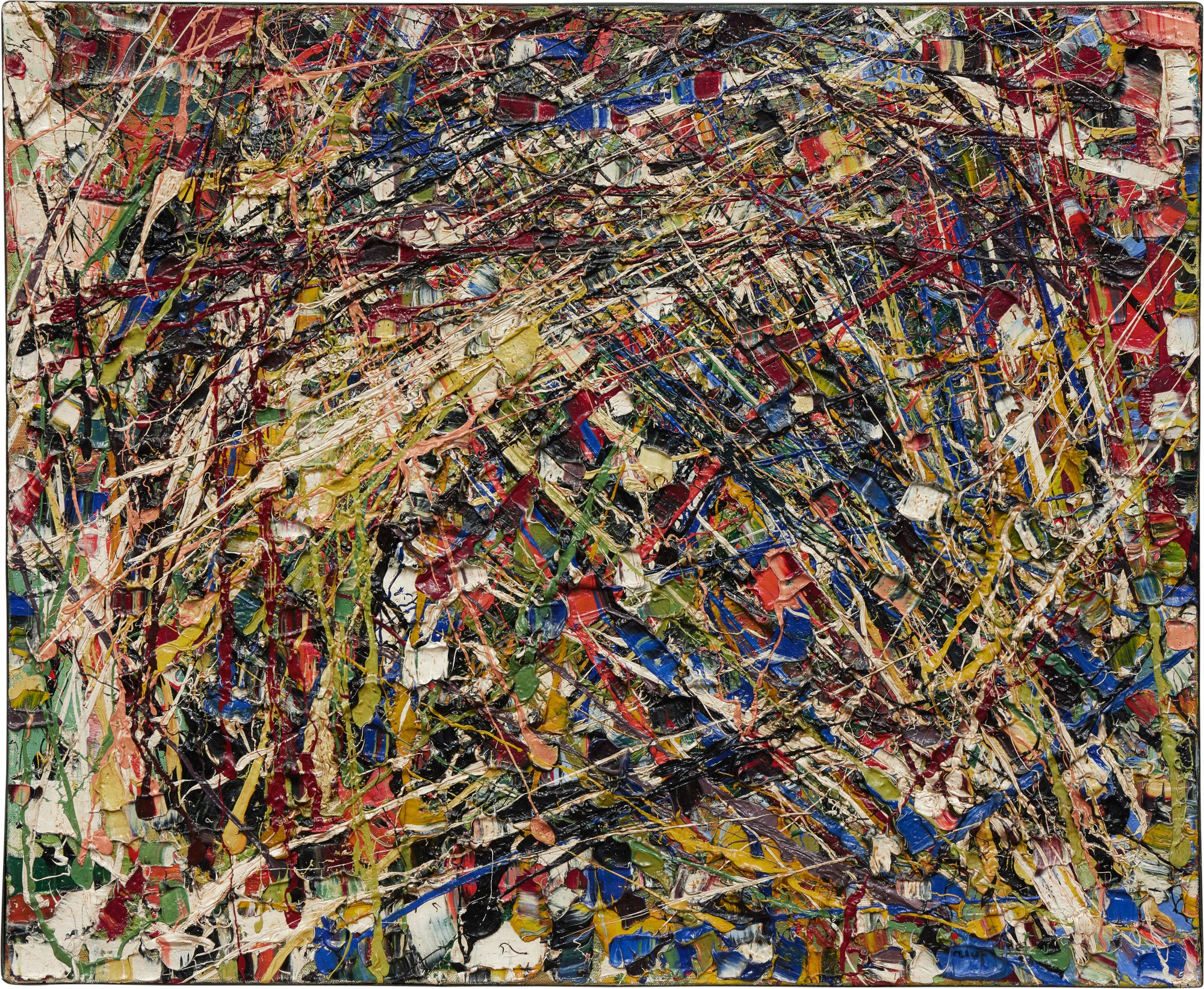
Jean-Paul Riopelle
Flèches, 1950
When evaluating a Riopelle, condition of the paint surface is paramount given the textural complexity of his technique, and provenance that traces a clear line back to his Paris years carries particular weight. To understand Riopelle fully it helps to place him in conversation with his peers. He shares with Franz Kline and Willem de Kooning a commitment to the loaded, decisive gesture, though his palette knife method produces a density and material richness that is entirely his own. His relationship to the natural world aligns him with landscape painters in spirit even as his means are wholly abstract, and in this sense he anticipates the concerns of later artists who sought to ground abstraction in lived experience.
Among Canadian painters, he stands alongside his Automatiste colleague Jean Paul Mousseau and the great colorist Guido Molinari, though his international profile ultimately exceeded that of his contemporaries. His long friendship and artistic dialogue with Joan Mitchell, who shared his love of both France and gestural painting with deep roots in the felt world, is one of the great stories of postwar art and has been the subject of increasing scholarly and curatorial attention. What endures in Riopelle is something that no amount of historical context can fully explain: the sheer physical joy of his best work. Standing before a large canvas from his mature years, one feels the force of a sensibility that trusted instinct completely, that was unafraid of abundance, and that found in the act of painting a way of being fully alive.
His legacy belongs to Canada, to France, and to the wider tradition of painting that insists on the primacy of direct experience and the irreplaceable intelligence of the hand. Collectors who live with his work report that it only deepens over time, offering new discoveries with every change of light. That quality of inexhaustible richness is, in the end, the mark of the truly great.
Explore books about Jean-Paul Riopelle

Jean-Paul Riopelle
François-Marc Gagnon
Riopelle: Catalogue Raisonné
Yseult Riopelle
Jean-Paul Riopelle: The Wanderer
Germain Lefebvre

Riopelle: Painter of the Abstract
Guy Robert
Jean-Paul Riopelle: Works on Paper
Pierre Théberge
Riopelle: Un maître québécois
Michel Thévoz
Jean-Paul Riopelle: 1923-2002
Musée des beaux-arts de Montréal