Jean-Michel Folon
Folon: The Poet Who Painted Freedom
Artist Spotlight · The Collection Editorial
“I try to give people a little hope, a little dream, a little poetry.”
Jean-Michel Folon
There is a particular kind of magic that belongs only to a handful of artists in any century: the ability to make the universal feel intimate, to render the loneliness of modern life not as despair but as a kind of tender, luminous wonder. Jean Michel Folon possessed this gift in abundance. When the Fondation Folon, housed in the breathtaking Château de La Hulpe in the Belgian countryside south of Brussels, welcomes its steady stream of devoted visitors each year, it offers something rare in the contemporary art world: a complete vision, a world entire unto itself, populated by the gentle, wandering figures that made Folon one of the most beloved and distinctive visual artists of the twentieth century. Folon was born in Uccle, a leafy commune on the southern edge of Brussels, in 1934.
Jean-Michel Folon
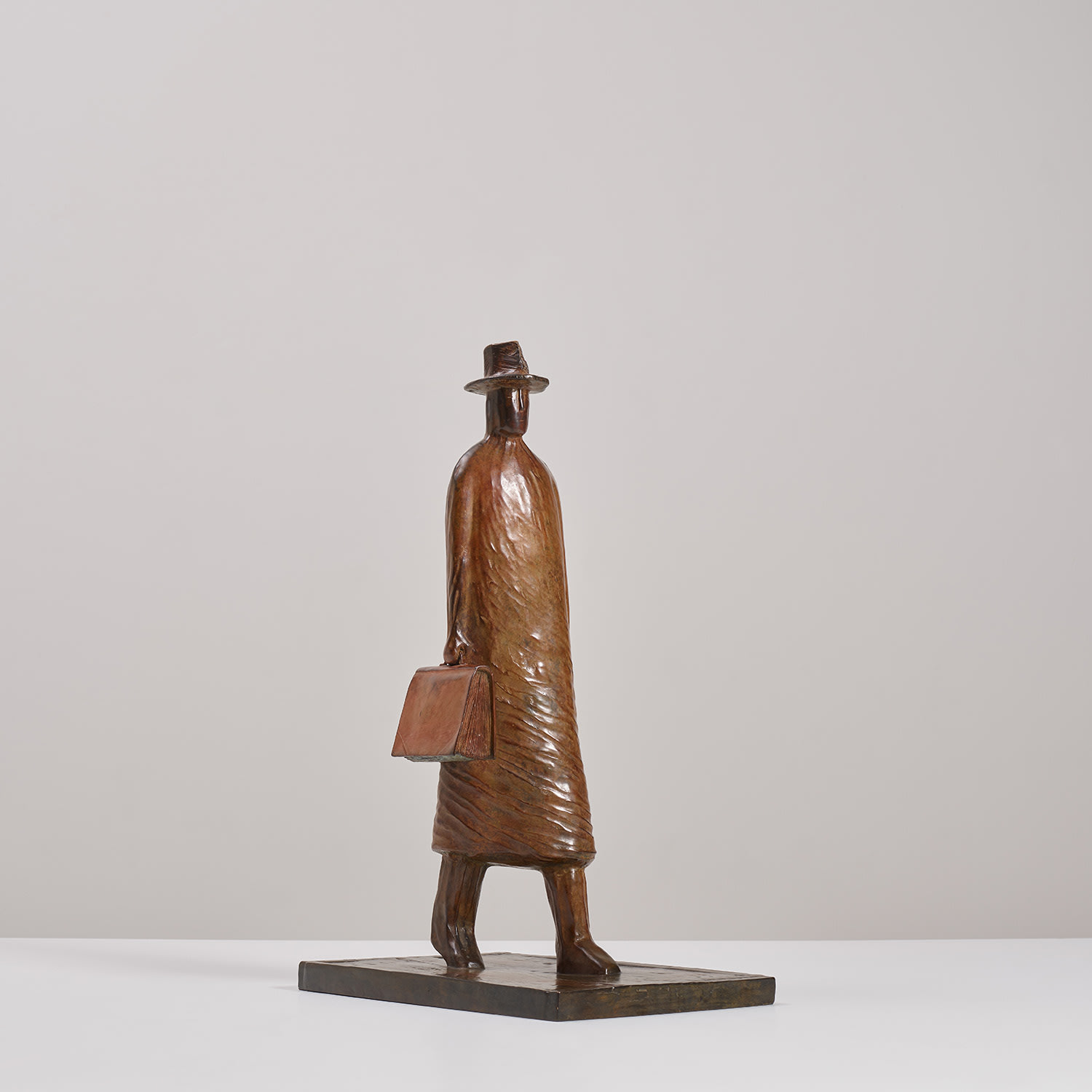
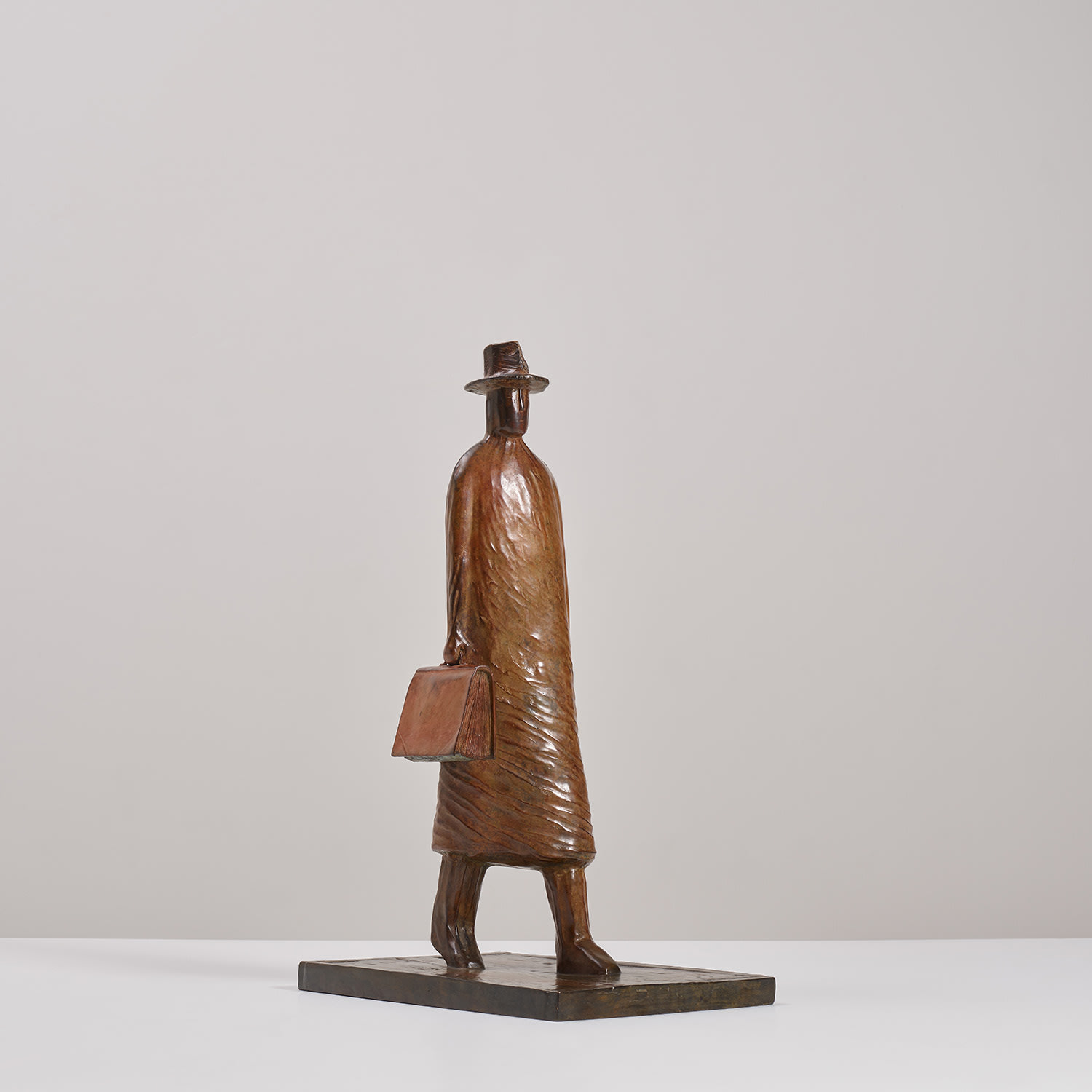
Sans bagage, 2005
His early formation was shaped by the particular atmosphere of postwar Belgium, a country with a deep tradition of surrealist imagination, from René Magritte to Paul Delvaux, and a culture that valued the poetic alongside the practical. Folon studied architecture at the Institut Saint Luc in Brussels, and while he never practiced as an architect, that training left permanent marks on his visual sensibility. His work would always carry a sense of constructed space, of figures set against horizons and within structures that felt both precise and dreamlike. He left Belgium for Paris in 1955, drawn by the city's creative vitality, and it was there that he began to develop his voice as an illustrator and artist.
The early years in Paris were formative and, at times, genuinely difficult. Folon submitted work relentlessly to publications and received rejection after rejection before the quality of his images began to find its audience. The breakthrough came through the world of editorial illustration, and it was an American one. The New Yorker published his work, and the relationship between Folon and that magazine became one of the defining partnerships in the history of illustration.
Jean-Michel Folon
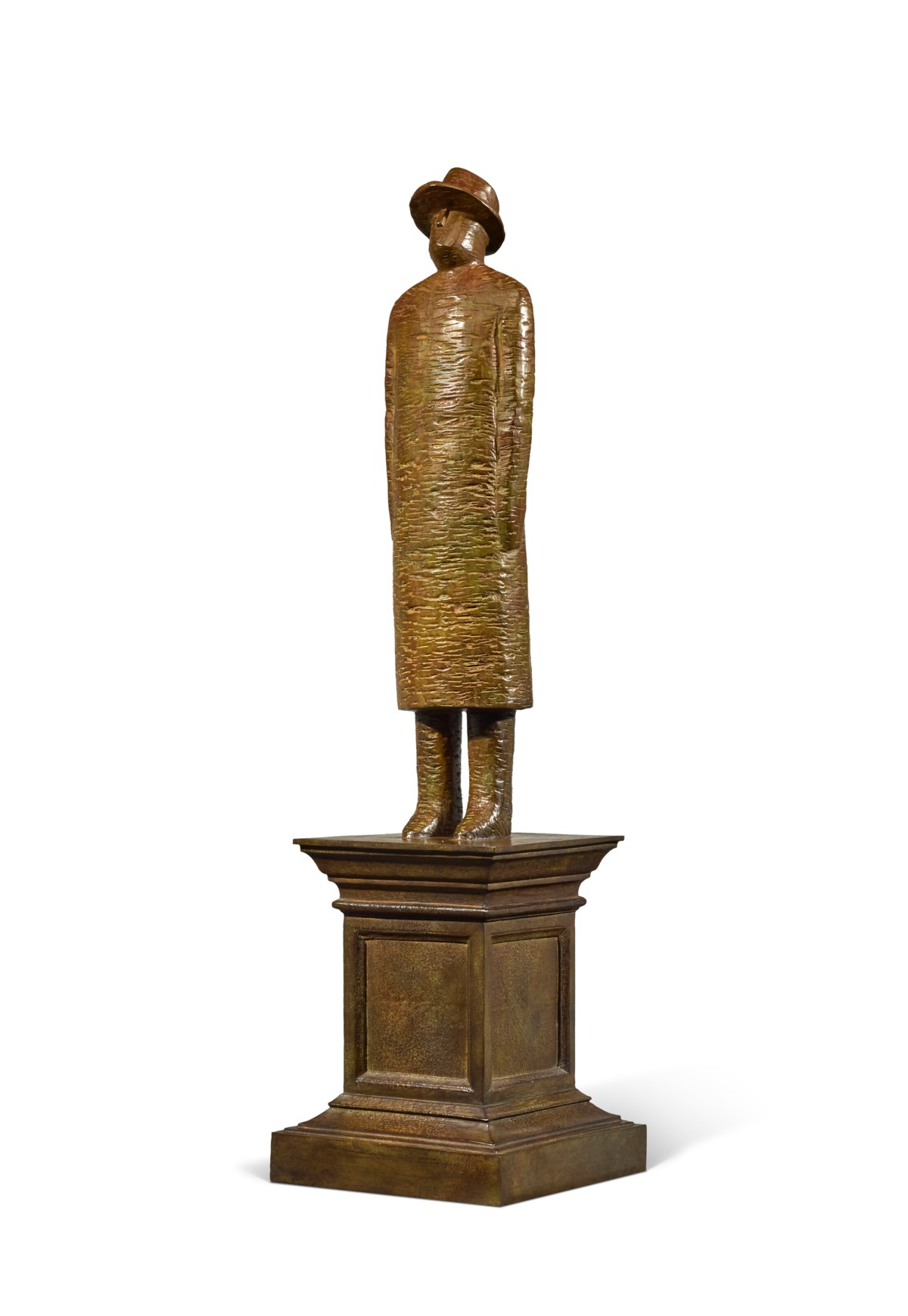
Loin, 2005
His covers and interior drawings brought his characteristic imagery to millions of readers: solitary figures in bowler hats or simple silhouettes, dwarfed by bureaucratic architecture, lost in fog, reaching toward skies that shimmered with watercolor light. Time magazine also published his work extensively, and his images for both publications established him as an international name through the 1960s and 1970s. What distinguished Folon from his contemporaries was the philosophical weight he carried without ever seeming heavy. His figures, so often alone, were never pathetic.
They were seekers. The landscapes they inhabited, vast and atmospheric, rendered in his signature washes of blue, violet, amber, and rose, felt like the interior geography of the human condition made visible. He worked across an extraordinary range of media throughout his career, moving fluidly between watercolor, printmaking, sculpture, mosaic, stained glass, and animation. Each medium seemed to unlock a different aspect of his vision.
Jean-Michel Folon
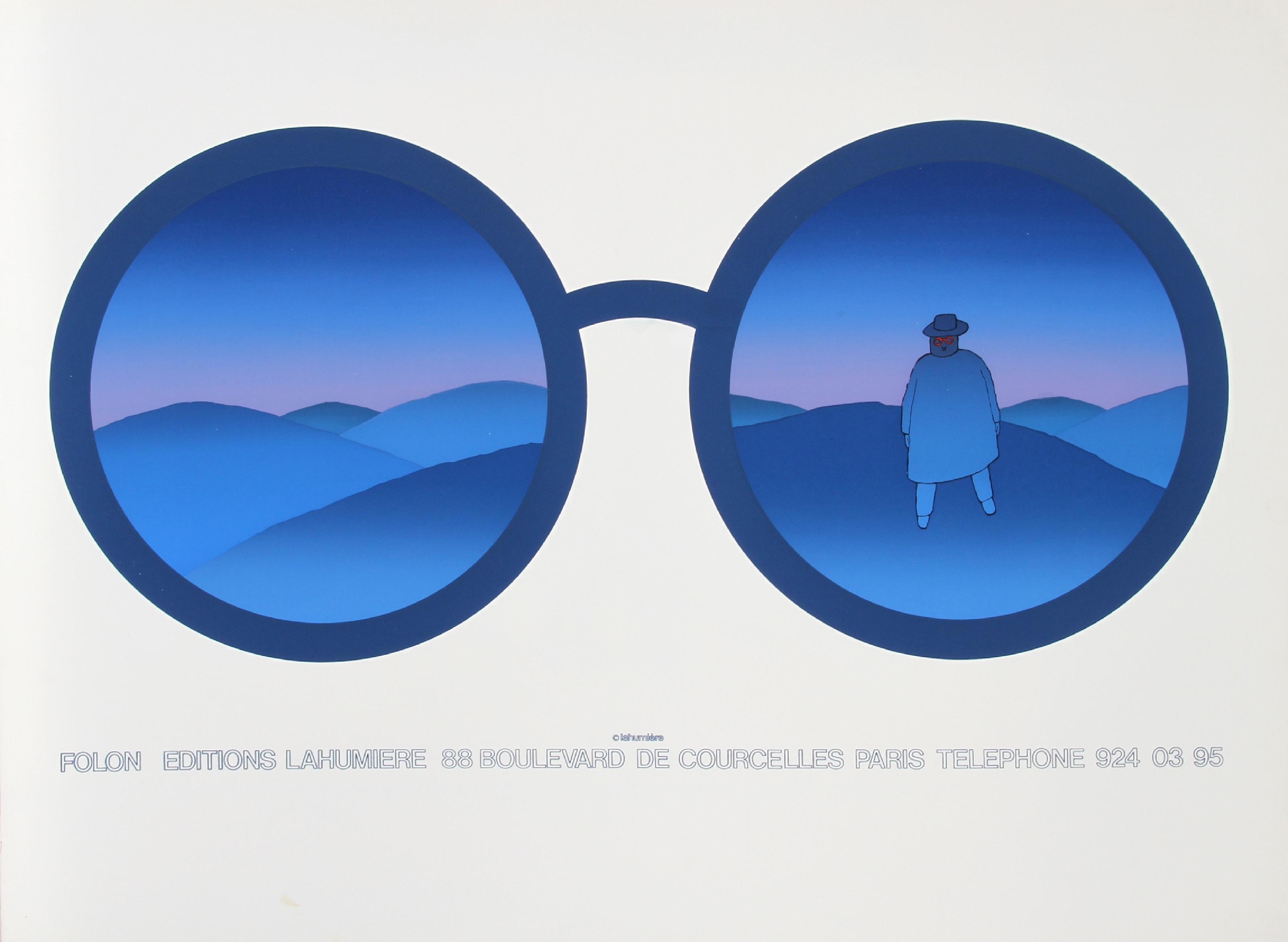
Editions Lahumiere
His animations brought his figures into movement with a gentle, melancholy grace, and his sculptures gave three dimensional weight to beings who had always seemed to exist somewhere between the material and the ethereal. Among the works that represent Folon at his most essential are his bronzes, particularly those produced in the final years of his life. Works such as "Sans bagage" and "Loin," both dated 2005 and cast by the prestigious Belgian foundry Bronze Romain et Fils, distill decades of artistic thinking into objects of quiet, aching beauty. "Sans bagage" translates as "without luggage," a title that captures the freedom and vulnerability at the heart of Folon's worldview: a figure unencumbered, traveling light through a world too large and too strange to fully comprehend.
These bronzes, produced in limited editions, carry the foundry stamp and Folon's signature, and they represent some of the most collectible objects in his entire output. His screenprints, including works produced through Editions Lahumière, the distinguished Parisian gallery that represented him, brought his imagery to a wider audience while maintaining the intimacy and luminosity that defined his work on paper. For collectors, Folon presents a genuinely compelling proposition. His market reflects the breadth of his practice: works on paper and watercolors tend to draw strong interest from collectors who love the directness of his draftsmanship and the lyrical quality of his color.
His sculptures, produced in limited bronze editions, have attracted particular attention as three dimensional expressions of a vision more commonly encountered in two dimensions, and they carry the added weight of his collaboration with skilled foundries. Editions Lahumière in Paris has long served as a point of entry for collectors interested in his print work, and the gallery's association with Folon lends his prints a provenance and context that serious collectors value. When Folon's works appear at auction, particularly his bronzes and major works on paper, they consistently attract bidders from Belgium, France, and well beyond, reflecting the genuinely international scope of his reputation. To understand Folon fully, it helps to place him within a broader constellation of artists working in the space between fine art and communication, between surrealism and humanism.
He shares certain sensibilities with the Belgian surrealist tradition, particularly the quiet strangeness of Magritte, though his emotional register is warmer and more explicitly concerned with feeling than with intellectual provocation. Among illustrators and artist poets of the postwar period, he stands alongside Saul Steinberg, whose work for The New Yorker also operated on a philosophical plane far above mere decoration. There are echoes too of Paul Flora and Roland Topor in his more sardonic moments, but Folon always returned to something more tender than satire could contain. Folon died in Monaco in October 2005, the same year he completed the bronzes that stand among his final and finest works.
The Fondation Folon, established during his lifetime, ensures that his vision remains alive and accessible, its gardens filled with his sculptures, its galleries with the full arc of a career that spanned half a century and touched virtually every medium available to a visual artist. His work continues to resonate not despite its gentleness but because of it. In an art world that often prizes difficulty and distance, Folon's achievement reminds us that art can be tender, that the solitary figure in the wide landscape is not a symbol of defeat but of the enduring human impulse to keep walking, keep wondering, keep reaching toward that luminous and open sky.
Explore books about Jean-Michel Folon
Jean-Michel Folon: Catalogue Raisonné
François Marquet
Folon
Alain Jouffroy
Jean-Michel Folon: The Man Who Paints Dreams
Gilbert Lascault
Folon: Watercolours and Drawings
Jean-Michel Folon
Jean-Michel Folon: Retrospective
Multiple authors