Jean-Michel Atlan
Atlan: Fire, Form, and Radiant Freedom
Artist Spotlight · The Collection Editorial
In the grand galleries of the Musée d'Art Moderne de Paris, where the postwar European avant garde still feels like a living conversation, the paintings of Jean Michel Atlan command a room the way very few works can. His canvases pulse with something ancient and urgent, their bold black contours cradling fields of color so alive they seem to breathe. For a generation of collectors and curators rediscovering the full breadth of the CoBrA moment and its extraordinary periphery, Atlan has emerged as one of the most singular and emotionally generous painters of the twentieth century. His work rewards looking, then rewards looking again.
Jean-Michel Atlan
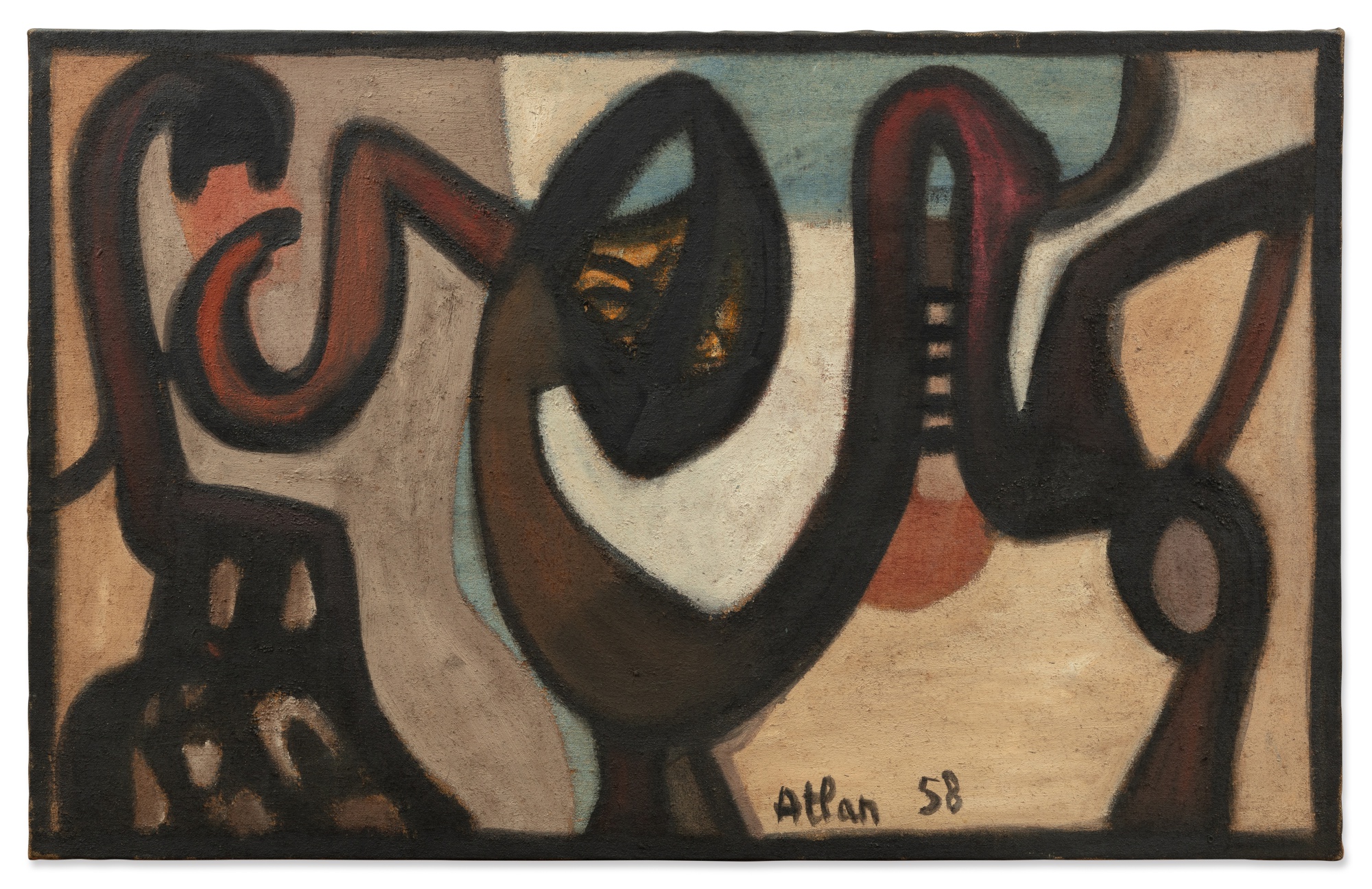
Ombres chinoises, 1958
Atlan was born in 1913 in Constantine, in northeastern Algeria, into a family of Jewish Berber heritage. That layered identity, rooted in North African culture, Jewish tradition, and the complex intellectual world of the Mediterranean, would prove foundational to everything he made. He arrived in Paris in 1930 to study philosophy at the Sorbonne, and his early formation was shaped far more by books, ideas, and the ferment of Parisian intellectual life than by the studios of the École des Beaux Arts. He was largely self taught as a painter, a fact that paradoxically gave his work a freedom from academic convention that more formally trained artists often spent careers trying to achieve.
The Second World War marked Atlan in ways both harrowing and transformative. Arrested by the Gestapo in 1942 after distributing anti Nazi pamphlets, he avoided deportation by feigning madness and spending time in the psychiatric wards of Sainte Anne hospital in Paris. It was during this period that he began to paint seriously, producing works in the hospital that were exhibited in 1944 at the Galerie de l'Arc en Ciel, one of his first public showings. The circumstances of that debut were extraordinary: a man painting his way through captivity and crisis, discovering in color and form a language that philosophy alone could not provide.
Jean-Michel Atlan
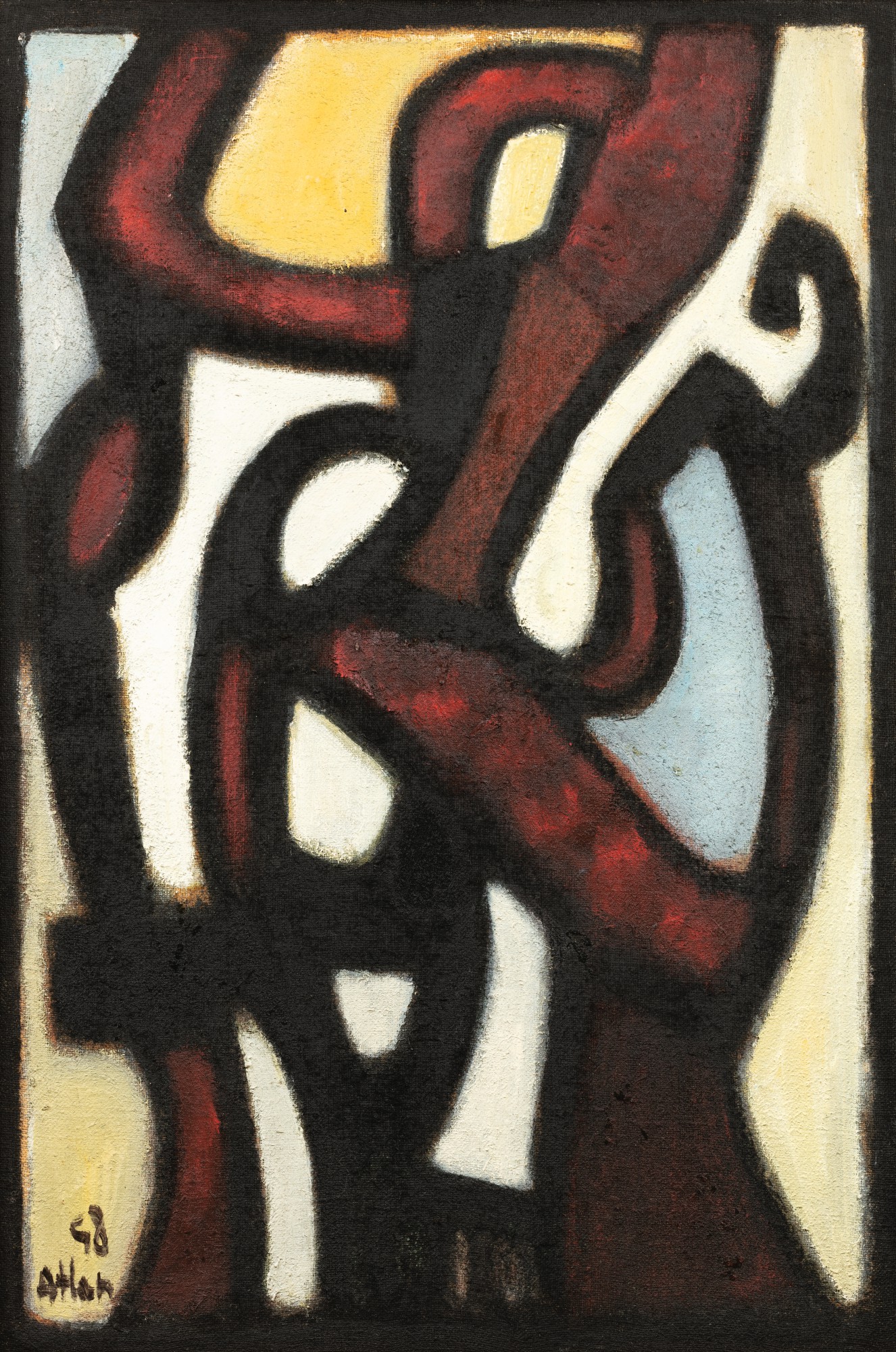
Babylone III, 1958
That charged origin story is not mere biography. It is written into every canvas he ever made. Through the late 1940s and into the 1950s, Atlan developed the visual language for which he is celebrated today. Working in Paris, he moved steadily toward an approach that fused abstraction with a deeply felt sense of myth and ritual.
His compositions are organized around thick, emphatic black lines that divide and define the picture plane, but these are not cold geometric divisions. They are more like the markings of cave paintings or the outlines of tribal masks, forms that carry memory and meaning beyond their immediate visual presence. Within those contours, color explodes: deep crimsons, burning oranges, earthy ochres, and sudden viridian greens. The effect is simultaneously primal and sophisticated, as though the painting is speaking two languages at once.
Jean-Michel Atlan
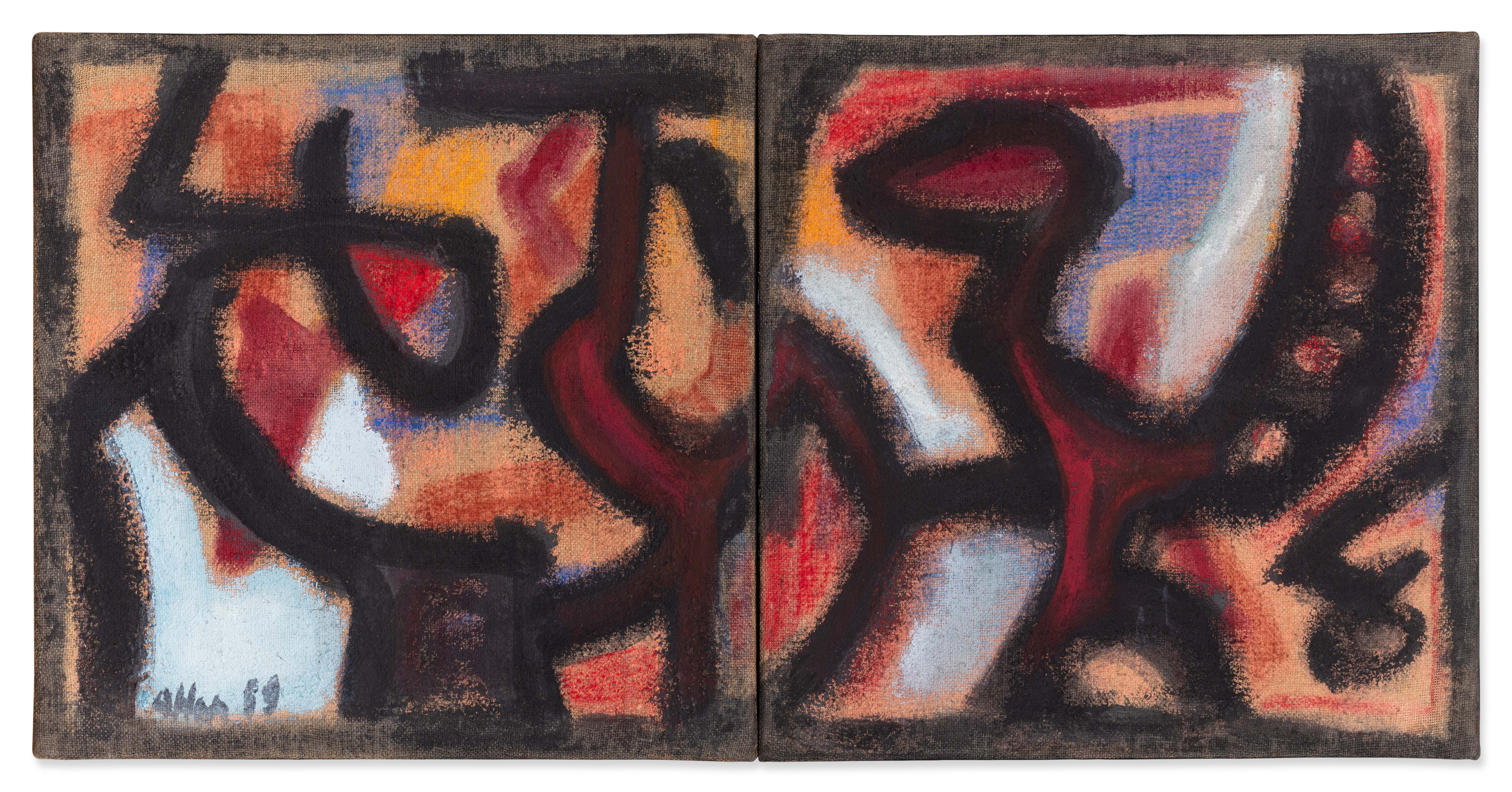
Diptyque, 1959
Atlan was associated with the CoBrA movement, the radical collective founded in 1948 by artists from Copenhagen, Brussels, and Amsterdam, whose members included Karel Appel, Asger Jorn, and Pierre Alechinsky. While Atlan was never a formal member of the group, his affinities with their project were profound. Like the CoBrA painters, he was drawn to the expressive power of raw mark making, to the vitality of non Western art forms, and to an aesthetic that prioritized feeling over refinement. His Algerian and African cultural inheritance gave his engagement with these ideas a particular authenticity and depth, rooting what might otherwise be primitivism in genuine lived experience and cultural memory.
Among the works that best represent his achievement, the late paintings from 1956 to 1960 stand in a class apart. "La jeune barbare" from 1956 announces itself with the confidence of an artist at full command, its figure dissolving into pattern and symbol even as it retains a fierce human presence. The 1958 works, including "Ombres chinoises," "Babylone III," "Guardaia," and "Chypre," form a remarkable constellation of late period paintings in which his vocabulary reaches a kind of luminous intensity. "Diptyque" from 1959 and "Sans Titre" from the same year show him pushing toward even greater chromatic richness in the final months of his working life.
Jean-Michel Atlan
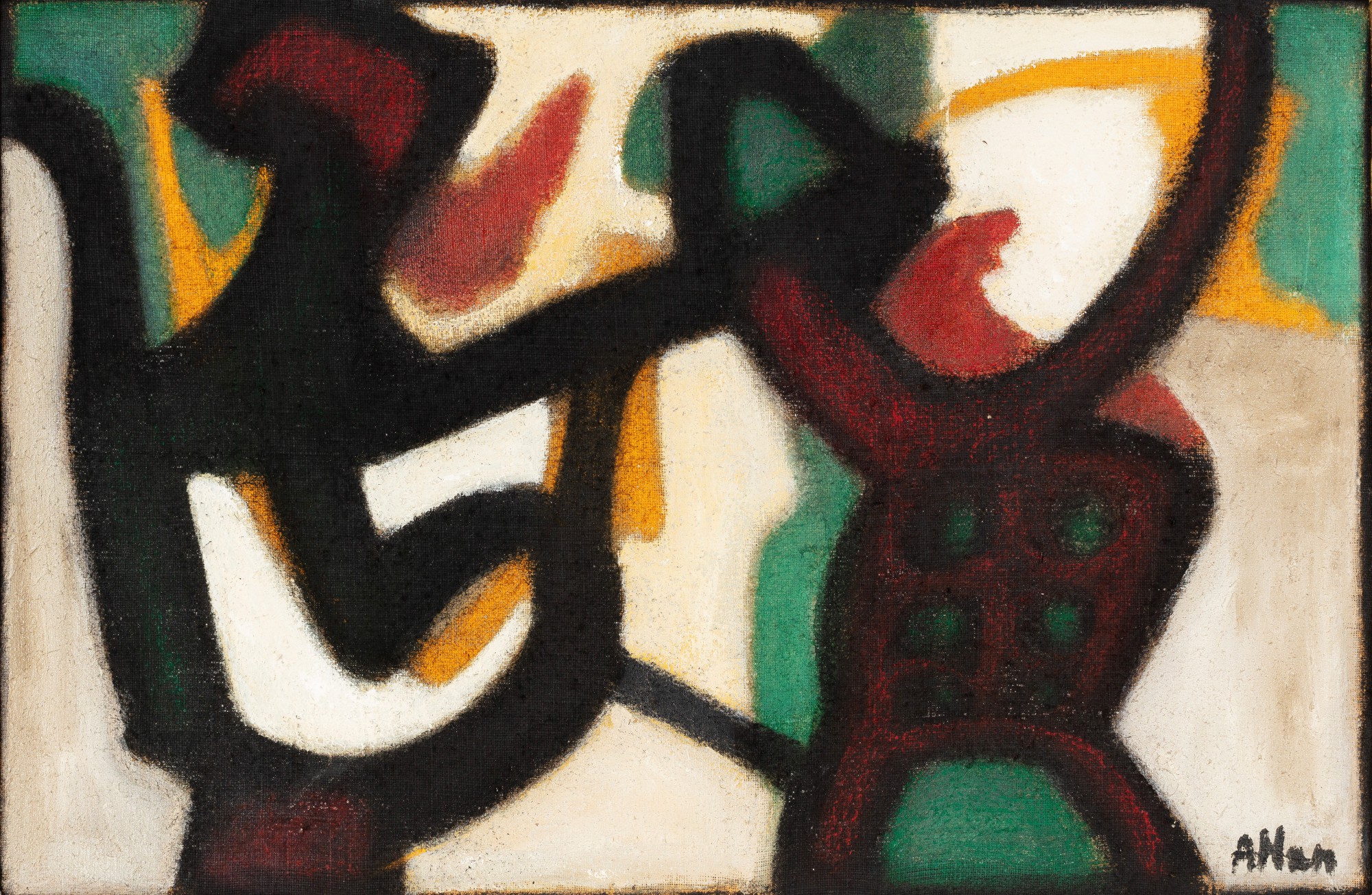
Ceylan
He died in Paris in 1960 at the age of forty six, and the loss to European painting was immense. For collectors, Atlan occupies an enviable position in the market. His works appear regularly at the major auction houses in Paris, London, and New York, where his large format oils consistently attract serious bidding from both European and international buyers. Collectors drawn to the postwar European scene, and particularly to the CoBrA adjacent world, find in Atlan a painter whose quality is undeniable and whose place in art history is secure without yet commanding the stratospheric prices of certain peers.
Works on paper and his paintings on unconventional supports, such as his oils on burlap, offer points of entry that reward both aesthetic and scholarly attention. The painting "Ceylan," executed on burlap, is a fine example of his willingness to let the material character of the support become part of the expressive equation. Earlier works such as "Sans titre" from 1954, painted on Masonite mounted on stretcher, similarly reveal an artist who thought carefully about surface and structure. To understand Atlan fully is to understand something important about postwar art in Europe.
He belongs in the same conversation as Wols, Hans Hartung, and Pierre Soulages on the French side, and alongside the CoBrA painters whose work he paralleled and at moments surpassed in raw emotional power. His North African heritage also places him in a lineage that connects to artists working across the Mediterranean world, and there is growing scholarly and curatorial interest in understanding his work within that broader frame. Major institutions including the Musée d'Art Moderne in Paris hold significant examples of his work, and retrospective attention to his career has deepened appreciably since the 1980s. The reason Atlan matters today is precisely because of what he refused.
He refused the cool detachment of certain strands of abstraction. He refused to sever painting from the body, from myth, from the deep human need for symbol and ritual. In an era when collectors and curators are thinking with renewed seriousness about whose voices shaped modern art and from where, Atlan's singular position as a Jewish Berber painter from Algeria who became a central figure in the Parisian avant garde feels not like a footnote but like a revelation. His paintings do not whisper.
They sing, they insist, they endure.
Explore books about Jean-Michel Atlan
Jean-Michel Atlan
Michel Tapié
Atlan
François Marquet
Jean-Michel Atlan: Catalogue Raisonné
Laurence Mattet
Atlan: Painter of Inner Worlds
Charles Estienne
Jean-Michel Atlan: Works on Paper
Musée d'Art Moderne