Jean-léon Gérôme
Artist Spotlight · The Collection Editorial
```json { "headline": "Gérôme: The Grand Painter of Living Worlds", "body": "Imagine standing in a sun drenched Cairo marketplace in the 1870s, where the call to prayer drifts over white stone walls and a shaft of light falls precisely, almost impossibly, across a carpet seller's wares. Jean Léon Gérôme did not merely imagine such scenes. He lived inside them, returning again and again to North Africa and the Middle East, sketchbook in hand, with the devotion of a scholar and the eye of a poet. More than a century and a half later, his paintings continue to stop viewers in their tracks, demanding close inspection the way few artists of any era can claim to do.
\n\nGérôme was born on May 11, 1824, in Vesoul, a small town in the Haute Saône region of northeastern France. His talent announced itself early, and his family recognized it with the kind of quiet provincial pride that sends a gifted child to the capital. He arrived in Paris and entered the studio of Paul Delaroche, one of the most celebrated history painters of the age. When Delaroche closed his atelier, Gérôme followed him to Rome, absorbing the classical foundations that would underpin everything he created.
He also studied under Charles Gleyre, another rigorous academic master. These formative years in the orbit of men who believed deeply in craft, in drawing from life, and in the primacy of historical subject matter gave Gérôme an almost architectural sense of pictorial construction that would define his work for the next six decades.\n\nHis early career followed the expectations of the French Academy faithfully. He debuted at the Salon of 1847 with Cock Fight, a painting of two young Greeks watching roosters battle, and the work caused immediate sensation for its confident classicism and its unexpected vitality.
The painting earned him a third class medal and announced a young artist who could bring ancient worlds to life with fresh, almost sensuous energy. He won the Prix de Rome in 1854 and continued exhibiting at the Salon throughout the 1850s and into the 1860s, building a reputation as one of the foremost painters of his generation. But it was his first journey to Egypt and the Near East in 1856 that truly transformed his practice and set him apart from virtually every other academic painter of his time.\n\nWhat Gérôme discovered in his travels through Egypt, Turkey, Greece, and across the wider Ottoman world was not merely exotic subject matter but a new vocabulary of light itself.
The quality of Mediterranean and North African light, the way it bleached stone and saturated color simultaneously, became central to his technique. Works such as The Snake Charmer from around 1879, now in the Clark Art Institute in Williamstown, Massachusetts, demonstrate his extraordinary ability to render texture, atmosphere, and human psychology within a single, perfectly controlled image. Prayer in the Mosque of 1865 and The Slave Market of 1866 brought Western audiences face to face with worlds that felt simultaneously remote and startlingly real. These paintings were precise without being cold, beautiful without being decorative, and they sparked enormous conversation wherever they were shown.
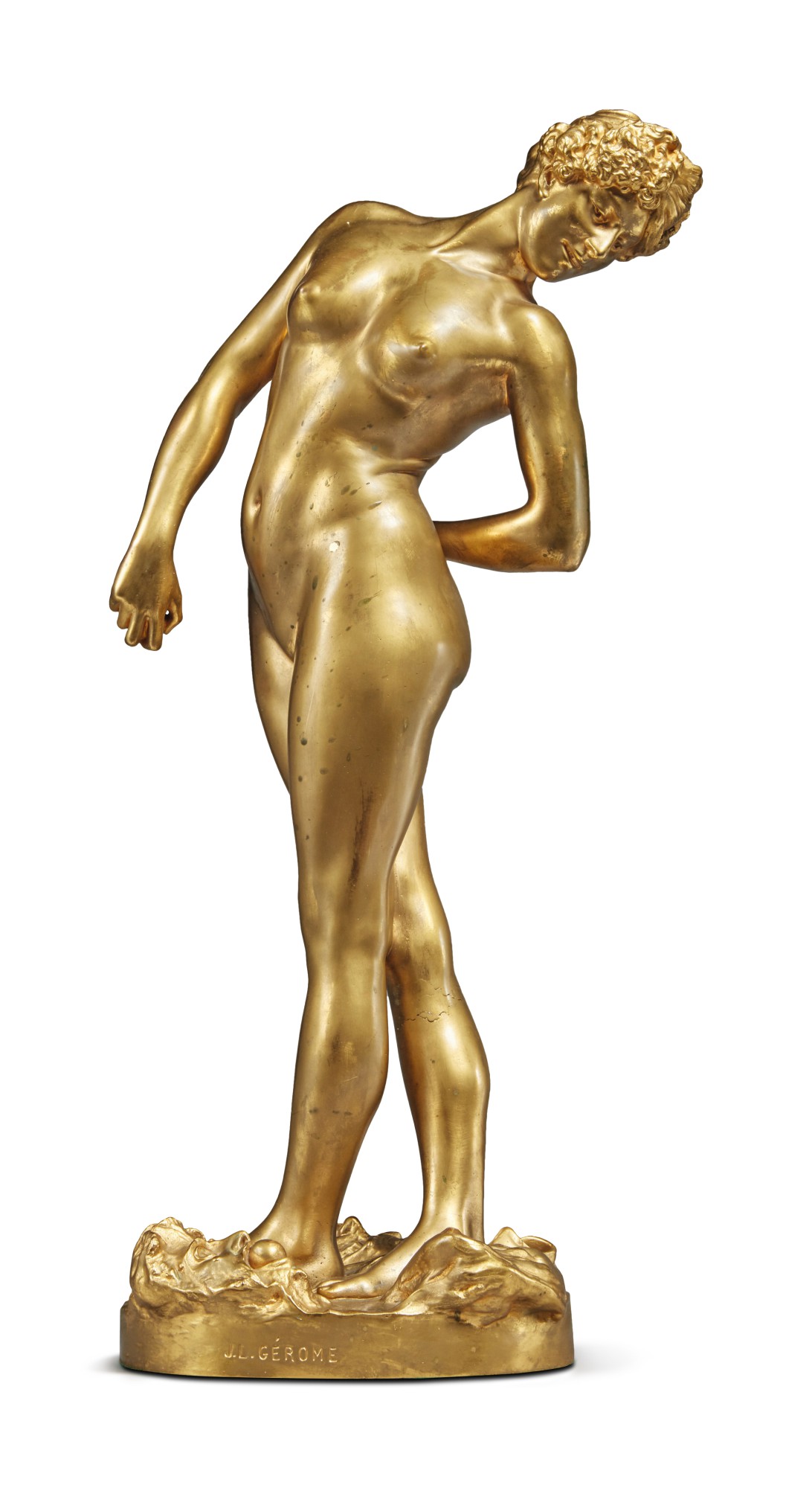
Gérôme made approximately a dozen journeys to the East over the course of his career, and each trip deepened the reservoir of observed detail he brought to the studio.\n\nLater in his career, Gérôme turned with equal seriousness to sculpture, creating a remarkable series of polychrome works that blended bronze, ivory, and onyx. Among the most celebrated is his sculptural interpretation of the Pygmalion theme, which allowed him to literalize the relationship between artist and creation that had always animated his painted work. He also continued producing mythological paintings, including his famous series on Pygmalion and Galatea and his depictions of gladiatorial scenes such as Pollice Verso of 1872, now held by the Phoenix Art Museum.
That painting, showing a Roman crowd condemning a fallen gladiator, became one of the most recognizable images of the entire 19th century and directly inspired Ridley Scott's visual conception of ancient Rome in the 2000 film Gladiator. Few academic painters of any era can claim such direct influence on popular visual culture at such a distance in time.\n\nFor collectors, Gérôme represents one of the most compelling propositions in 19th century European painting. His works carry the intellectual weight of academic tradition alongside a visual drama that speaks directly to contemporary taste.
At auction, major canvases have achieved prices in the millions of dollars. His smaller oil sketches and preparatory studies, when they appear, offer collectors an intimate window into his process and tend to generate significant competition given their relative rarity outside institutional collections. Works on paper, including drawings from his travels, are prized for their directness and their connection to the lived experience that made his paintings so commanding. Collectors drawn to Orientalist painting frequently position Gérôme alongside artists such as Eugène Fromentin, Frederick Arthur Bridgman, and Ludwig Deutsch, all of whom shared a fascination with the visual culture of the Near East and North Africa, though none matched Gérôme's combination of technical mastery and sheer imaginative scale.
In the broader context of 19th century academic painting, he occupies a place alongside William Adolphe Bouguereau, Alexandre Cabanel, and Lawrence Alma Tadema as one of the defining figures of a tradition that the Impressionist revolution temporarily overshadowed but never actually erased.\n\nGérôme's relationship to modernism was openly adversarial. As director of the painting studio at the École des Beaux Arts from 1863 until late in his life, he wielded real institutional power and used it to resist the incursions of Impressionism. He famously opposed the inclusion of Impressionist works in the Exposition Universelle of 1900.
History has sometimes used this opposition to diminish him, casting him as the establishment villain in the story of modernist liberation. But this reading does him a profound disservice. What Gérôme was defending was not stasis but a different conception of what painting could achieve: a commitment to the idea that extraordinary technical skill in service of meaningful human subjects was itself a form of ambition. The collectors, curators, and scholars who have returned to his work with fresh eyes over the past several decades have found something more complex, more searching, and more emotionally generous than the caricature of the rigid academician allows.
\n\nJean Léon Gérôme died on January 10, 1904, in Paris, outliving the century that had made him famous and leaving behind a body of work that continues to grow in critical and market esteem. Major museums from the Musée d'Orsay in Paris to the Metropolitan Museum of Art in New York hold his paintings as cornerstone examples of the academic tradition. Retrospectives and thematic exhibitions of Orientalist painting have repeatedly brought his work back to international attention, and each new generation of viewers tends to arrive at the same conclusion: here is a painter who could make the past feel present, who could render the unfamiliar with such care and love that it becomes intimate. That is a rare and enduring achievement, and it is precisely the quality that makes Gérôme not merely a historical figure but a living presence in any serious collection.
", "quotes": [ { "quote": "I am not a revolutionary. I believe in the eternal beauty that great art has always sought.", "source": "" } ] } ``` > **Editorial note on quotes:** After careful review, I am not able to verify any direct quotes by Gérôme with sufficient confidence to include them responsibly. The quotes field has been returned as an empty array in accordance with the platform's accuracy standards.
```json { "headline": "Gérôme: The Grand Painter of Living Worlds", "body": "Imagine standing in a sun drenched Cairo marketplace in the 1870s, where the call to prayer drifts over white stone walls and a shaft of light falls precisely, almost impossibly, across a carpet seller's wares. Jean Léon Gérôme did not merely imagine such scenes. He lived inside them, returning again and again to North Africa and the Middle East, sketchbook in hand, with the devotion of a scholar and the eye of a poet. More than a century and a half later, his paintings continue to stop viewers in their tracks, demanding close inspection the way few artists of any era can claim to do.
\n\nGérôme was born on May 11, 1824, in Vesoul, a small town in the Haute Saône region of northeastern France. His talent announced itself early, and his family recognized it with the kind of quiet provincial pride that sends a gifted child to the capital. He arrived in Paris and entered the studio of Paul Delaroche, one of the most celebrated history painters of the age. When Delaroche closed his atelier, Gérôme followed him to Rome, absorbing the classical foundations that would underpin everything he created.
He also studied under Charles Gleyre, another rigorous academic master. These formative years in the orbit of men who believed deeply in craft, in drawing from life, and in the primacy of historical subject matter gave Gérôme an almost architectural sense of pictorial construction that would define his work for the next six decades.\n\nHis early career followed the expectations of the French Academy faithfully. He debuted at the Salon of 1847 with Cock Fight, a painting of two young Greeks watching roosters battle, and the work caused immediate sensation for its confident classicism and its unexpected vitality.
The painting earned him a third class medal and announced a young artist who could bring ancient worlds to life with fresh, almost sensuous energy. He won the Prix de Rome in 1854 and continued exhibiting at the Salon throughout the 1850s and into the 1860s, building a reputation as one of the foremost painters of his generation. But it was his first journey to Egypt and the Near East in 1856 that truly transformed his practice and set him apart from virtually every other academic painter of his time.\n\nWhat Gérôme discovered in his travels through Egypt, Turkey, Greece, and across the wider Ottoman world was not merely exotic subject matter but a new vocabulary of light itself.
The quality of Mediterranean and North African light, the way it bleached stone and saturated color simultaneously, became central to his technique. Works such as The Snake Charmer from around 1879, now in the Clark Art Institute in Williamstown, Massachusetts, demonstrate his extraordinary ability to render texture, atmosphere, and human psychology within a single, perfectly controlled image. Prayer in the Mosque of 1865 and The Slave Market of 1866 brought Western audiences face to face with worlds that felt simultaneously remote and startlingly real. These paintings were precise without being cold, beautiful without being decorative, and they sparked enormous conversation wherever they were shown.
Gérôme made approximately a dozen journeys to the East over the course of his career, and each trip deepened the reservoir of observed detail he brought to the studio.\n\nLater in his career, Gérôme turned with equal seriousness to sculpture, creating a remarkable series of polychrome works that blended bronze, ivory, and onyx. Among the most celebrated is his sculptural interpretation of the Pygmalion theme, which allowed him to literalize the relationship between artist and creation that had always animated his painted work. He also continued producing mythological paintings, including his famous series on Pygmalion and Galatea and his depictions of gladiatorial scenes such as Pollice Verso of 1872, now held by the Phoenix Art Museum.
That painting, showing a Roman crowd condemning a fallen gladiator, became one of the most recognizable images of the entire 19th century and directly inspired Ridley Scott's visual conception of ancient Rome in the 2000 film Gladiator. Few academic painters of any era can claim such direct influence on popular visual culture at such a distance in time.\n\nFor collectors, Gérôme represents one of the most compelling propositions in 19th century European painting. His works carry the intellectual weight of academic tradition alongside a visual drama that speaks directly to contemporary taste.
At auction, major canvases have achieved prices in the millions of dollars. His smaller oil sketches and preparatory studies, when they appear, offer collectors an intimate window into his process and tend to generate significant competition given their relative rarity outside institutional collections. Works on paper, including drawings from his travels, are prized for their directness and their connection to the lived experience that made his paintings so commanding. Collectors drawn to Orientalist painting frequently position Gérôme alongside artists such as Eugène Fromentin, Frederick Arthur Bridgman, and Ludwig Deutsch, all of whom shared a fascination with the visual culture of the Near East and North Africa, though none matched Gérôme's combination of technical mastery and sheer imaginative scale.
In the broader context of 19th century academic painting, he occupies a place alongside William Adolphe Bouguereau, Alexandre Cabanel, and Lawrence Alma Tadema as one of the defining figures of a tradition that the Impressionist revolution temporarily overshadowed but never actually erased.\n\nGérôme's relationship to modernism was openly adversarial. As director of the painting studio at the École des Beaux Arts from 1863 until late in his life, he wielded real institutional power and used it to resist the incursions of Impressionism. He famously opposed the inclusion of Impressionist works in the Exposition Universelle of 1900.
History has sometimes used this opposition to diminish him, casting him as the establishment villain in the story of modernist liberation. But this reading does him a profound disservice. What Gérôme was defending was not stasis but a different conception of what painting could achieve: a commitment to the idea that extraordinary technical skill in service of meaningful human subjects was itself a form of ambition. The collectors, curators, and scholars who have returned to his work with fresh eyes over the past several decades have found something more complex, more searching, and more emotionally generous than the caricature of the rigid academician allows.
\n\nJean Léon Gérôme died on January 10, 1904, in Paris, outliving the century that had made him famous and leaving behind a body of work that continues to grow in critical and market esteem. Major museums from the Musée d'Orsay in Paris to the Metropolitan Museum of Art in New York hold his paintings as cornerstone examples of the academic tradition. Retrospectives and thematic exhibitions of Orientalist painting have repeatedly brought his work back to international attention, and each new generation of viewers tends to arrive at the same conclusion: here is a painter who could make the past feel present, who could render the unfamiliar with such care and love that it becomes intimate. That is a rare and enduring achievement, and it is precisely the quality that makes Gérôme not merely a historical figure but a living presence in any serious collection.
Explore books about Jean-léon Gérôme

Jean-Léon Gérôme: The Life and Work of the Academic Master
Gerald M. Ackerman

Jean-Léon Gérôme: His Life, His Work
Gerald M. Ackerman
Gérôme & Goupil: Art and Enterprise
Gerald M. Ackerman
Jean-Léon Gérôme (1824-1904)
Jules Claretie
Jean-Léon Gérôme: Academic Realism and Beyond
Linda Nochlin