Jean-françois Raffaëlli
The Poet of Paris Streets Endures
Artist Spotlight · The Collection Editorial
Imagine Paris in the early 1880s, a city crackling with modernity and contradiction. The grand boulevards Haussmann carved through the old city were gleaming and new, but just beyond their edges, in the peripheral neighborhoods and the trampled outskirts, another Paris breathed quietly. It was here, among ragpickers, absinthe drinkers, and laborers resting against iron fences, that Jean François Raffaëlli chose to plant his easel. His decision was not merely a stylistic preference; it was a philosophical one, and it gave nineteenth century painting some of its most honest and tender observations of human life.
Raffaëlli was born in Paris in 1844, and the city was essentially his biography. He showed early aptitude for the arts and received formal training, briefly studying under the academic painter Jean Léon Gérôme in the late 1860s. But the rigid conventions of academic painting never fully held him. His temperament was too restless, his curiosity about contemporary life too urgent.
He moved toward the Realist tradition that had been so powerfully championed by Gustave Courbet and Jean François Millet, artists who had insisted that ordinary people living ordinary lives were worthy subjects for serious painting. Raffaëlli absorbed that conviction deeply and made it his own. His breakthrough years came in the late 1870s and early 1880s, when Edgar Degas, recognizing something vital and distinctive in Raffaëlli's work, invited him to show with the Impressionists in their fifth and sixth group exhibitions, held in 1880 and 1881. This was no small gesture.
The Impressionist circle was selective and often fractious, and Raffaëlli's inclusion marked him as an artist whose vision commanded serious attention. His contributions to those exhibitions were celebrated for their unsentimental sympathy, their capturing of figures caught in the quiet dramas of poverty and working life in the zones between central Paris and its industrial suburbs. He was showing a Paris that polite society preferred not to examine too closely, and he was doing so with an elegant, assured hand. What distinguished Raffaëlli from his contemporaries was not simply his choice of subject but his technique.
He developed a method of working with a special oil formulation that produced a dry, matte surface quite different from the luminous impasto favored by many Impressionists. His palette could be subdued and earthy, perfectly suited to the grey skies and dust colored streets of the Parisian periphery, but he deployed color with great precision, using a pale figure or a patch of warm light to animate an otherwise sober scene. His compositions often placed solitary figures or small groupings in expansive environments, giving his subjects a kind of monumental dignity even within humble circumstances. Works like "The Absinthe Drinkers" and his many studies of figures along the banks of the Seine demonstrate this balance beautifully, offering the viewer a portrait of a world both specific in its detail and universal in its human feeling.
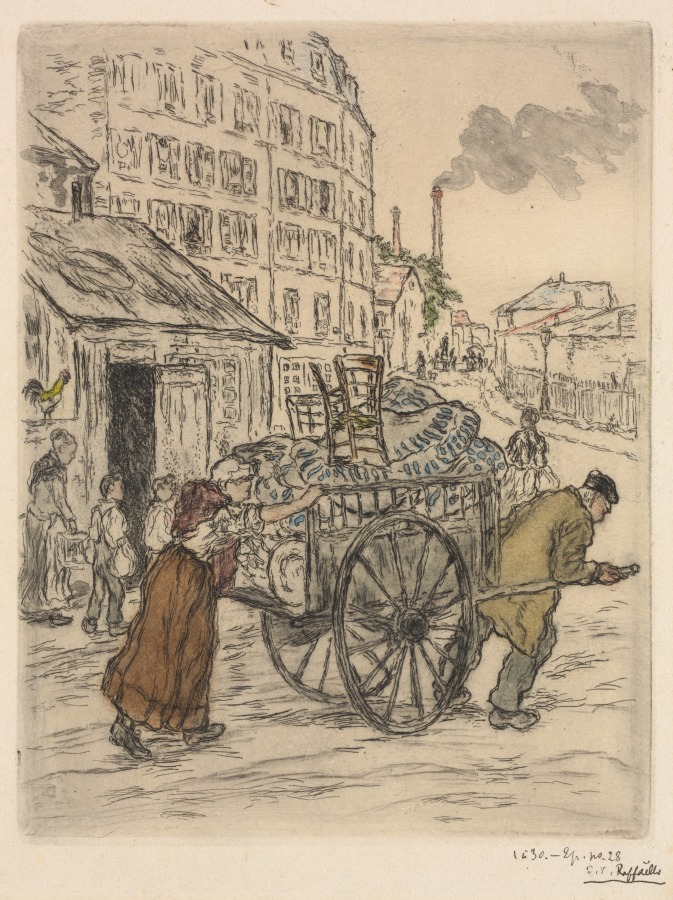
Raffaëlli was also a printmaker and sculptor of genuine distinction, and this range speaks to the breadth of his artistic intelligence. His etchings and drypoints brought the same attentive, compassionate eye to the printed medium, and they were collected with enthusiasm during his lifetime. As a sculptor he worked with that same directness, creating figures that shared the grounded, unromanticized quality of his painted subjects. This versatility across media makes him an especially interesting figure for collectors today, because it offers multiple points of entry into a single coherent artistic vision.
From a collecting perspective, Raffaëlli presents a compelling case. His market has long rewarded patient collectors who appreciate the historical significance of French Realism and the Impressionist circle without fixating only on the handful of canonical names. Works on paper, including his prints and drawings, have offered particular value relative to their art historical importance. His paintings appear at auction houses in Paris, London, and New York with enough regularity that serious collectors can build meaningful holdings over time, and the best examples, particularly those depicting his signature peripheral Parisian subjects with strong figural composition, carry both scholarly and aesthetic weight.
Collectors drawn to artists like Gustave Caillebotte, who also trained a socially observant eye on modern Parisian life, or to the gentle precision of Camille Pissarro's figure paintings, will find Raffaëlli a deeply satisfying adjacent discovery. Within the broader arc of art history, Raffaëlli occupies a fascinating position. He was associated with both Realism and Impressionism without being wholly absorbed by either, which is perhaps why his reputation has moved in and out of focus over the decades. Artists such as Honoré Daumier had already established a vocabulary of working class dignity in French art, and Raffaëlli extended that tradition into the specific social geography of late nineteenth century Paris.
He was also a contemporary and sometime peer of figures like Édouard Manet and Mary Cassatt, and while he did not achieve the sustained international celebrity of those artists, his work contributed meaningfully to the collective project of making modern life the true subject of modern painting. He was a founding member of the Société Anonyme des Artistes, an affiliation that aligns him with the reformist, independent spirit that defined progressive French art in this era. Raffaëlli died in 1924, having witnessed the extraordinary transformation of the art world from academic Salon culture through Impressionism, Post Impressionism, and into the early avant garde. His long life meant he outlasted many of his closest contemporaries, and there is something poignant and quietly triumphant about that persistence.
Today, as institutions and collectors continue to broaden the story of nineteenth century French art beyond its most familiar protagonists, Raffaëlli is increasingly recognized as an artist of real importance, one whose empathy, technical skill, and unwavering commitment to the lives of ordinary people produced a body of work that feels, more than a century later, remarkably alive. To encounter a Raffaëlli painting is to feel the texture of a specific moment in human history rendered with care and without condescension. That is a rare achievement, and it is one that rewards sustained attention.
Explore books about Jean-françois Raffaëlli
Jean-François Raffaëlli: 1850-1924
Galerie Schmit
Raffaëlli
Adolphe Bascher
Jean-François Raffaëlli: Catalogue Raisonné of Prints
Loys Delteil
Raffaëlli and the Impressionists
Anne Distel
Jean-François Raffaëlli: L'Œuvre Gravé
Michel Melot