Jean Cocteau
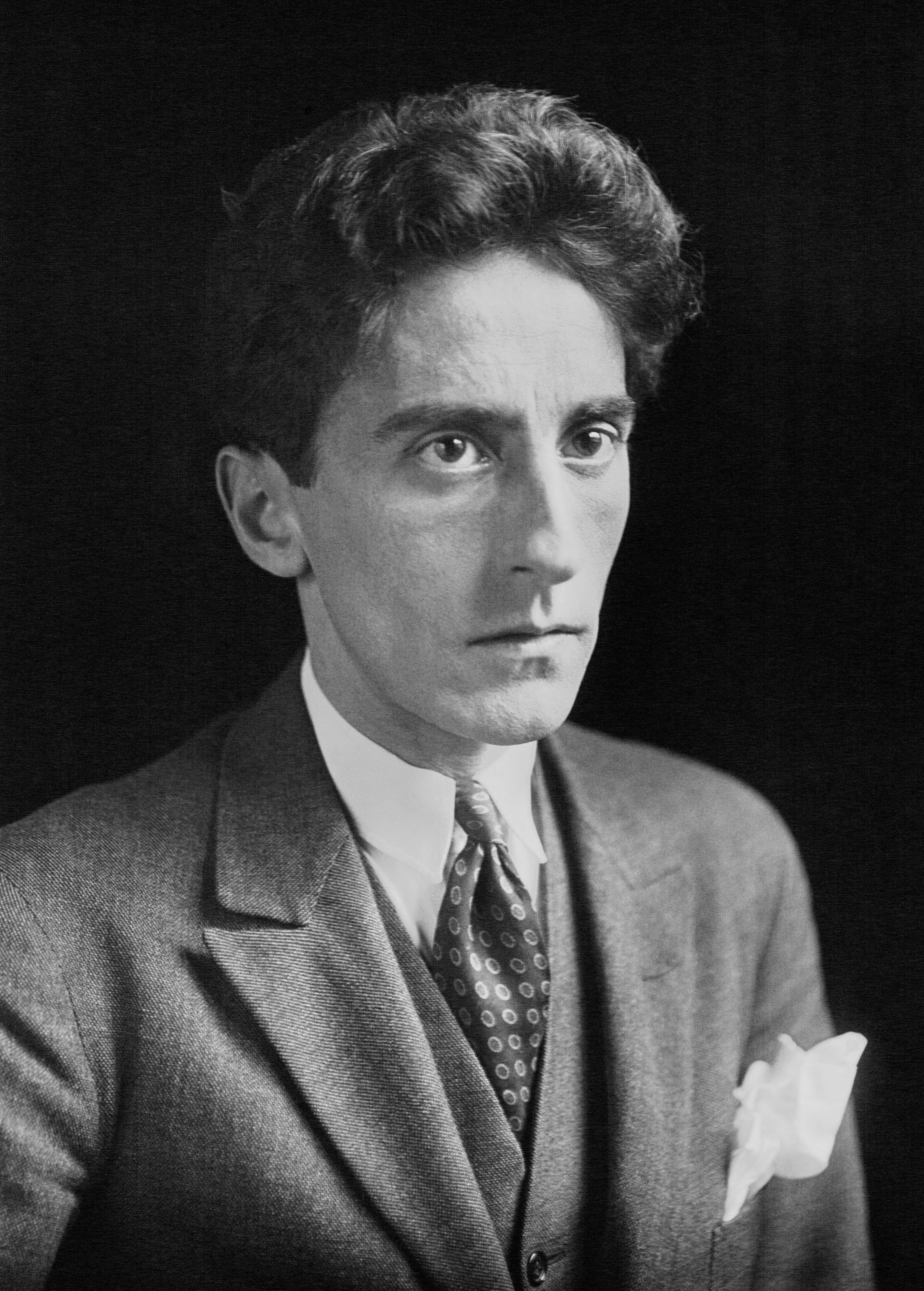
Jean Cocteau, The Poet Who Made Everything Art
Artist Spotlight · The Collection Editorial
“The poet never takes notes. You never take notes in a dream.”
Jean Cocteau
There is a particular kind of genius that refuses to be contained by a single medium, and Jean Cocteau embodied that restless creative energy more completely than almost any other figure of the twentieth century. In the permanent collections of the Musée Jean Cocteau in Menton, which opened in 2011 along the French Riviera that he so loved, visitors still encounter the full sweep of a life devoted to making beauty from every available material. The institution, housing over 1,800 works donated by collector Séverin Wunderman, offers the most sustained encounter with Cocteau's visual output available anywhere in the world. Standing in those sun filled galleries, it becomes clear that Cocteau was not a writer who dabbled in art, nor an artist who wrote on the side.
Jean Cocteau
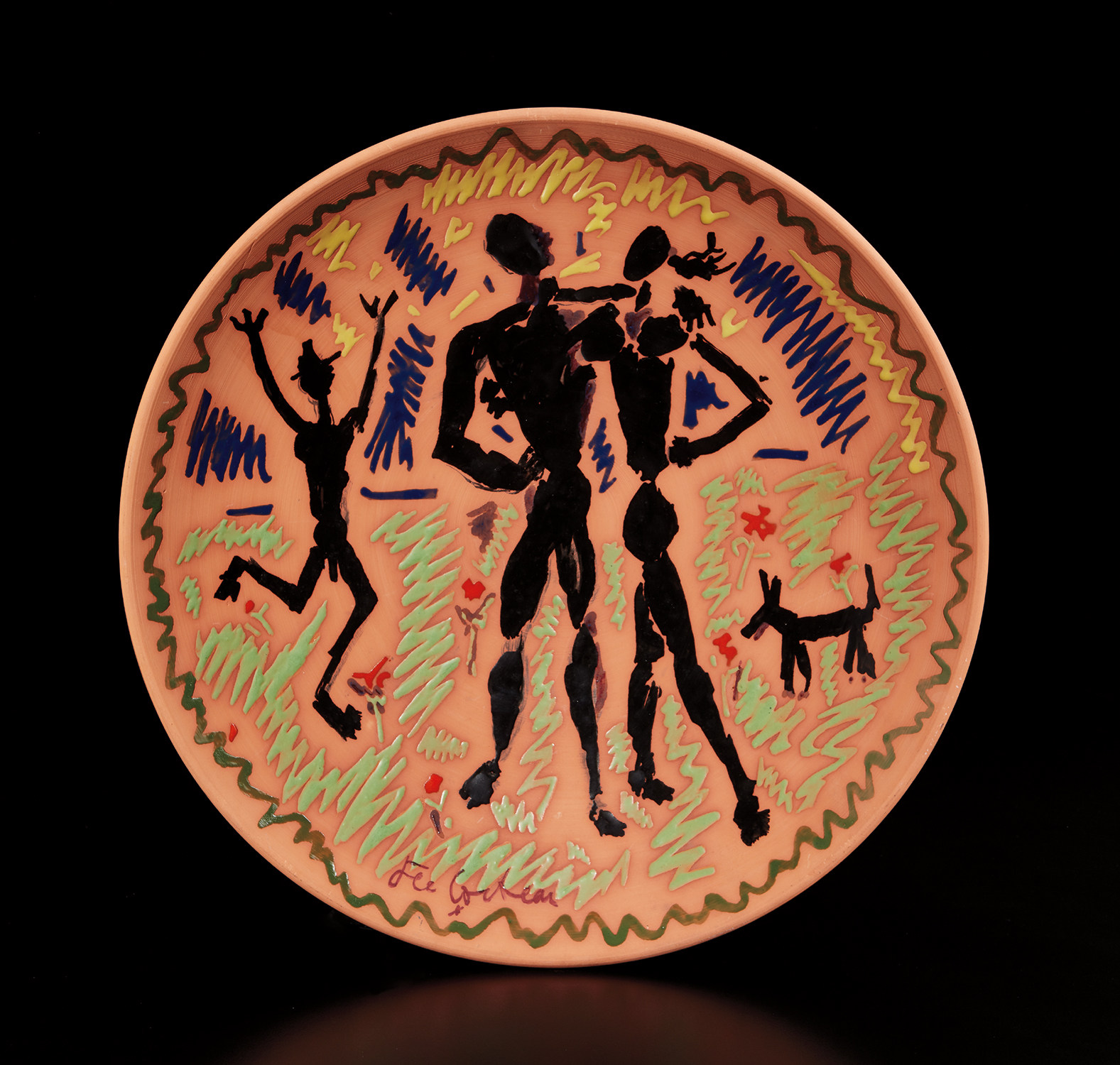
Le couple au chien (The Couple with Dog), from Le Satiricon
He was something rarer and more singular: a total creative presence whose every gesture was an act of imagination. Jean Maurice Eugène Clément Cocteau was born on July 5, 1889, in Maisons Laffitte, a prosperous town outside Paris. His father, Georges Cocteau, was an amateur painter and lawyer who took his own life when Jean was nine years old, an event that cast a long shadow over the boy's inner life even as he grew into one of the most socially dazzling figures in Paris. His mother, Eugénie, was devoted and cultivating, and the family moved fully into Parisian life.
By the time he was a teenager, Cocteau was already haunting the theater districts and literary salons of the city. At nineteen, he had already published his first collection of poems and attracted the attention of Sarah Bernhardt, one of the most celebrated actresses of the age. Paris in those years was the center of the world, and Cocteau walked straight into its heart. The formation of Cocteau's aesthetic sensibility reads like a map of early twentieth century modernism.
Jean Cocteau
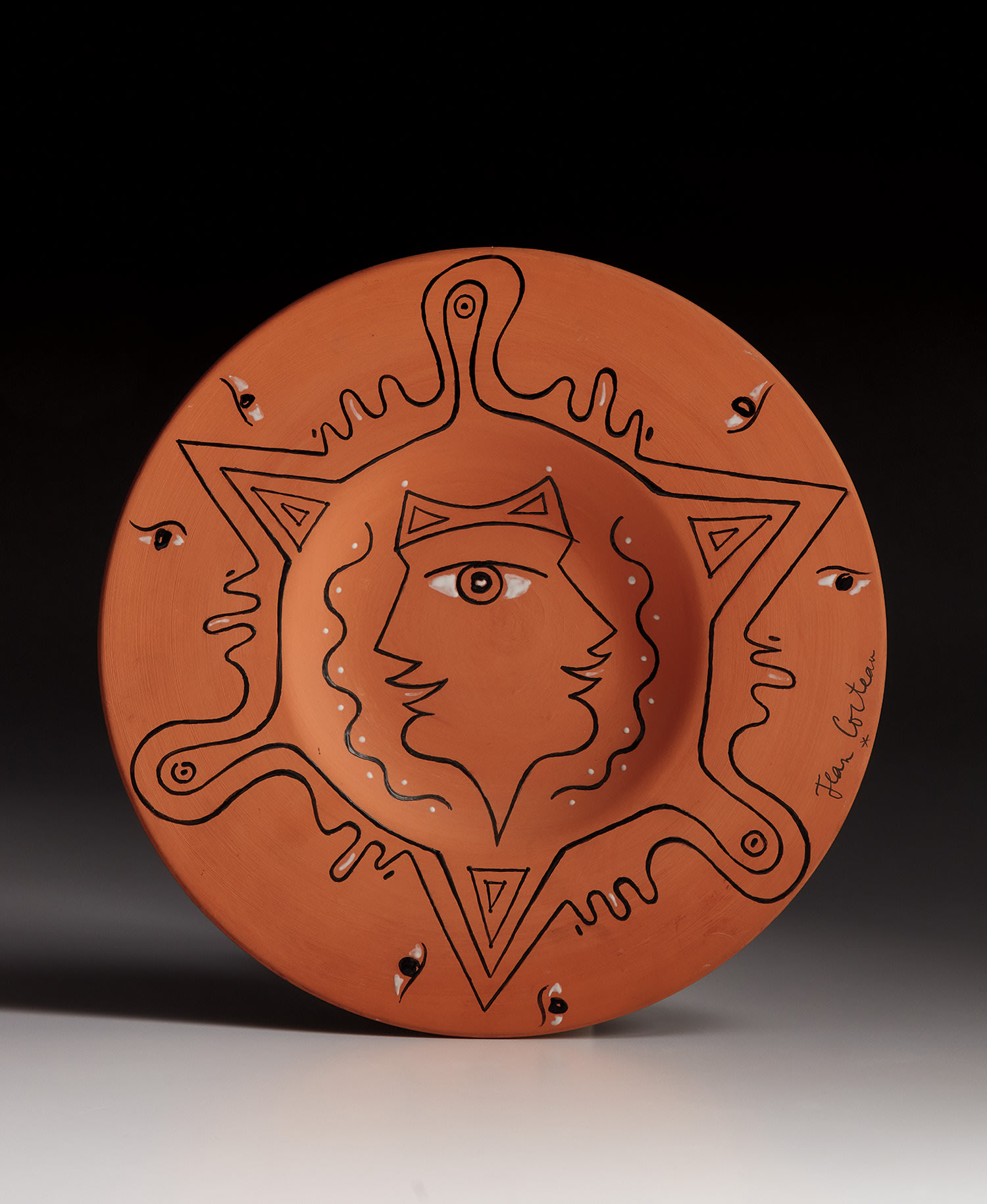
Hommage aux Étrusques (Homage to the Etruscans) (G. 2)
His friendship with Marcel Proust, his deep engagement with the Ballets Russes and Sergei Diaghilev, his collaboration with Erik Satie and Pablo Picasso on the 1917 ballet Parade: each of these encounters left permanent marks on how he understood the relationship between art, performance, and life. Diaghilev's famous challenge to the young Cocteau, urging him to astonish, became something of a personal motto. He did not simply observe the avant garde movements swirling around him. He participated in them, shaped them, and sometimes anticipated them.
“Art produces ugly things which frequently become more beautiful with time.”
Jean Cocteau
His 1923 novel Le Grand Écart and his extraordinary theatrical work Orphée in 1926 showed a mind equally at home in classical myth and modern anxiety. As a filmmaker, Cocteau achieved a level of poetic invention that still feels unmatched in its particular register. Le Sang d'un poète, made in 1930, and La Belle et la Bête, released in 1946, are not simply films. They are sustained dreams, in which mirrors become portals, hands emerge from walls, and time moves according to the logic of the unconscious.
Jean Cocteau
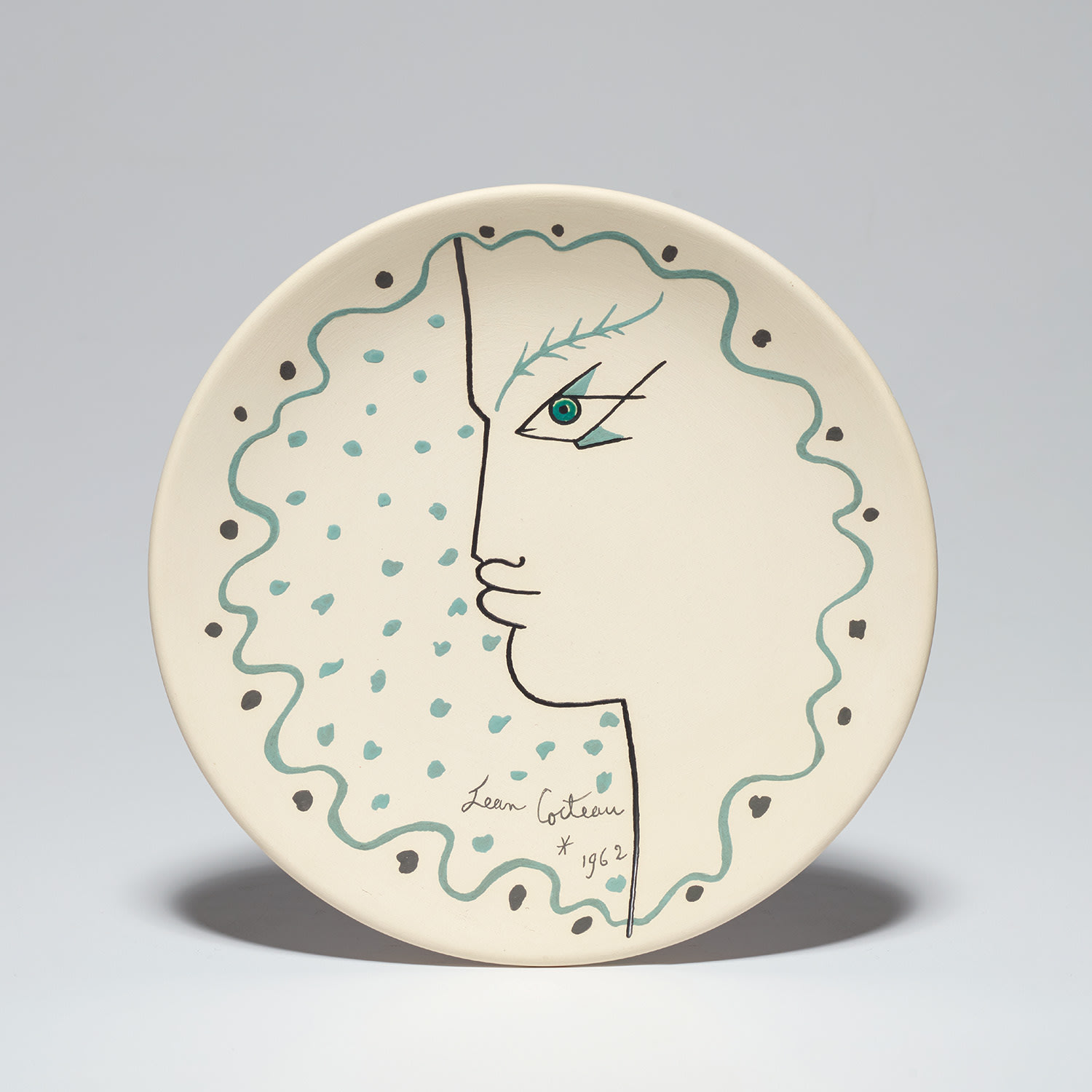
Nérée (Nereus) (G. 232)
His 1950 film Orpheus remains one of the most fully realized explorations of the artist's relationship to death and inspiration that cinema has ever produced. These works have continued to influence filmmakers, artists, and designers for generations, from the surrealists who claimed him as a fellow traveler to contemporary visual artists who return to his images as source material. It is in his ceramic work, however, that many collectors are discovering a Cocteau of unexpected intimacy and playful mastery. Working in the tradition rich environment of the French south, and engaged by techniques developed near Vallauris, Cocteau produced a body of ceramic work on earthenware plates and platters that draws on the full depth of his mythological imagination.
“We must believe in luck. For how else can we explain the success of those we don't like.”
Jean Cocteau
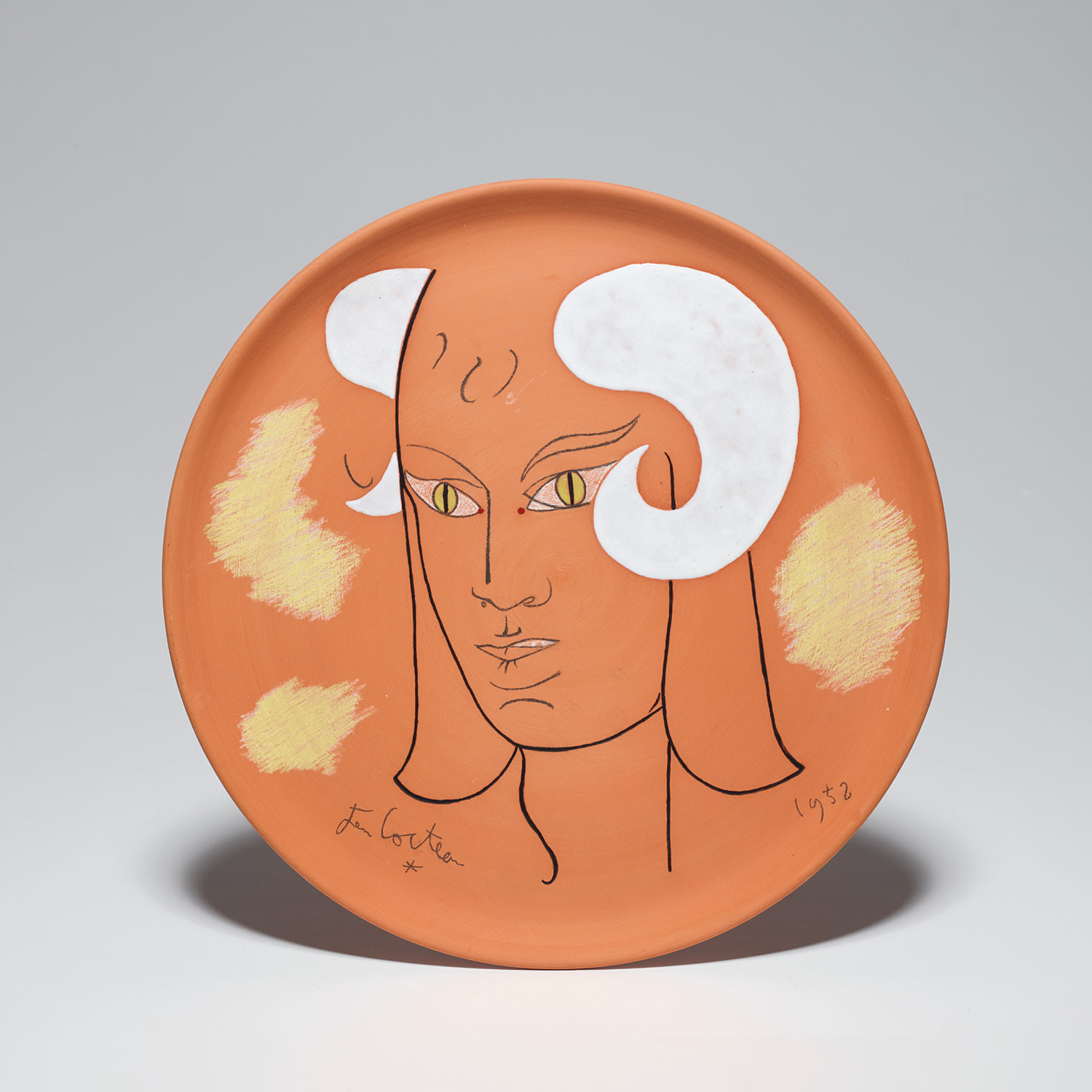
Works such as Faune séducteur aux cornes blanches, painted in coloured enamels on red earthenware, and L'après midi d'un faune, rendered in the same medium, show his line at its most assured: sinuous, economical, and unmistakably his own. The faun, the harlequin, the ancient Greek deity and the modernist profile appear again and again, connecting his visual world to the long Mediterranean tradition he loved so deeply. His Hommage aux Étrusques and the extraordinary series Le Satiricon, including the tender Le couple au chien, demonstrate how naturally he moved between the ancient and the contemporary, finding in old forms new reasons for feeling. For collectors, Cocteau's ceramics and works on paper represent an exceptionally rewarding area of focus.
Jean Cocteau
Faune séducteur aux cornes blanches (Seductive Faun with White Horns) (G. 57)
His signed and numbered editions, such as Visage ovale, annotated in his own hand with the word Villefranche and produced in limited runs through dedicated ateliers, combine the rarity and tactility of fine craft with the full authority of his artistic vision. The market for Cocteau has remained stable and appreciative across decades, supported by institutions, estates, and private collectors who understand that his work sits at a genuine crossroads of literary modernism and visual art. His lithographs and hand colored works on wove paper carry the directness of drawings made by someone who trusted his instincts completely, and they reward close, patient looking. Cocteau's place in art history is perhaps best understood in relation to the other polymaths and boundary crossers who defined the European avant garde.
Like Francis Picabia, he refused to be categorized. Like Giorgio de Chirico, he returned obsessively to mythological and theatrical imagery as a way of accessing deeper psychological truths. His friendship and occasional rivalry with Pablo Picasso is well documented, and there is a productive dialogue to be found between the two artists' approaches to classical subject matter treated with modernist freedom. Collectors drawn to the School of Paris, to Surrealism, or to the decorative traditions of the French south will find in Cocteau a figure who illuminates all of those contexts while belonging completely to none of them.
The lasting significance of Jean Cocteau lies not only in the individual works he produced but in the model he offered: that a life lived in full commitment to beauty and imagination is itself a kind of art. He died on October 11, 1963, just hours after learning of the death of his friend Édith Piaf, a coincidence so perfectly Cocteau that it feels almost scripted. He was seventy four years old and had spent more than half a century making poems, films, drawings, ceramics, murals, jewelry, and theater that continue to shimmer with life. To collect his work is to bring into your home a piece of one of the most extraordinary creative minds that Paris, or anywhere, has ever produced.
Explore books about Jean Cocteau
Jean Cocteau: A Life
James S. Williams
Cocteau: A Biography
Francis Steegmuller
Jean Cocteau and the French Scene
Douglas Cooper

The Opium Habit
Jean Cocteau
Professional Secrets: An Autobiography
Jean Cocteau
Cocteau: A Biography
Claude Arnaud
The Art of Cinema
Jean Cocteau
Jean Cocteau: The Man and the Mirror
Margaret Crosland