Jean Béraud
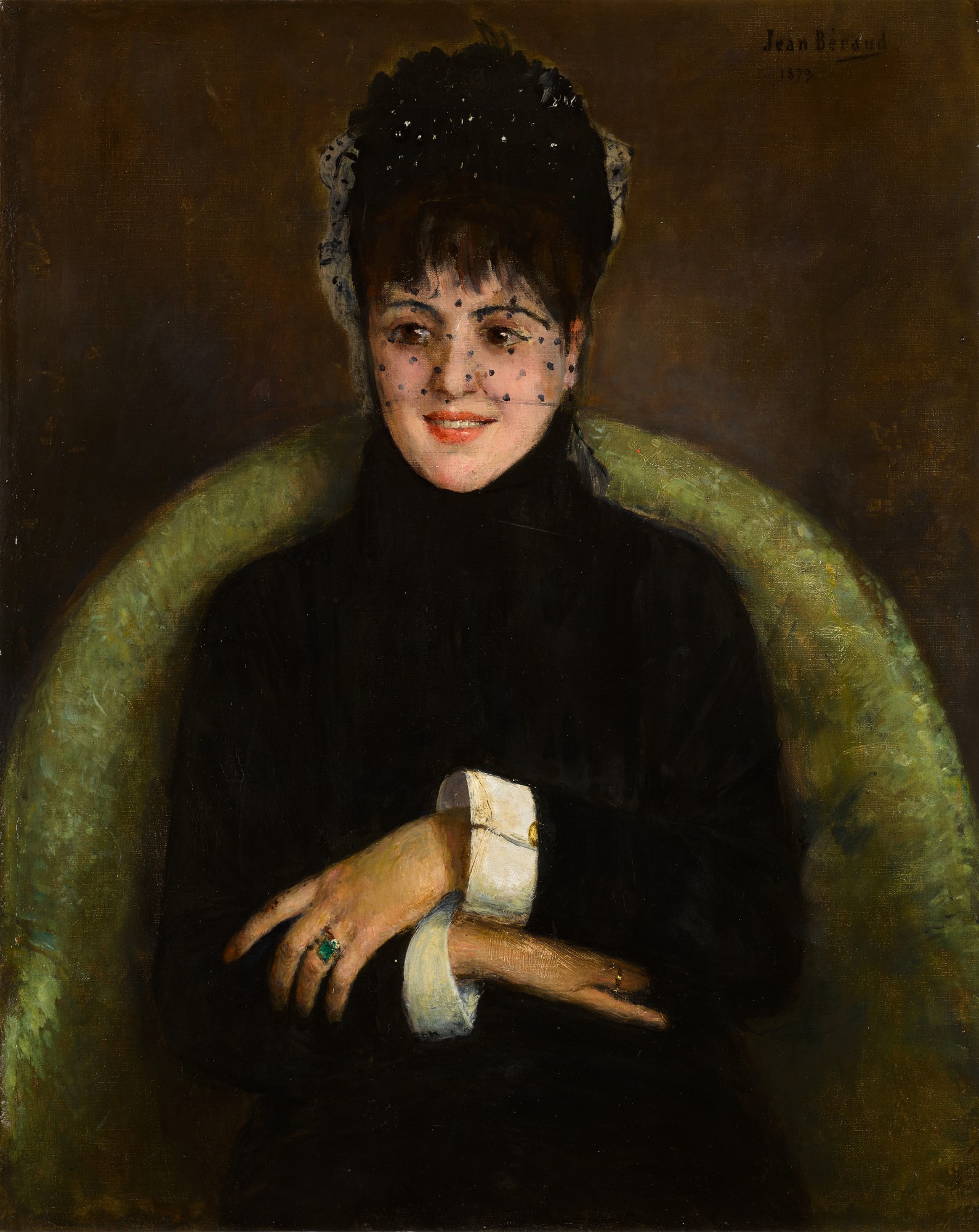
Jean Béraud, Paris Eternal and Alive
Artist Spotlight · The Collection Editorial
Picture the corner of a grand Parisian boulevard on a grey afternoon in the 1880s. A woman in a dark fitted coat pauses mid crossing, the cobblestones slick beneath her boots, carriages pressing close on either side. She is nobody in particular and everybody at once. This is the world Jean Béraud made his life's work, and it is a world that feels, more than a century later, astonishingly present.
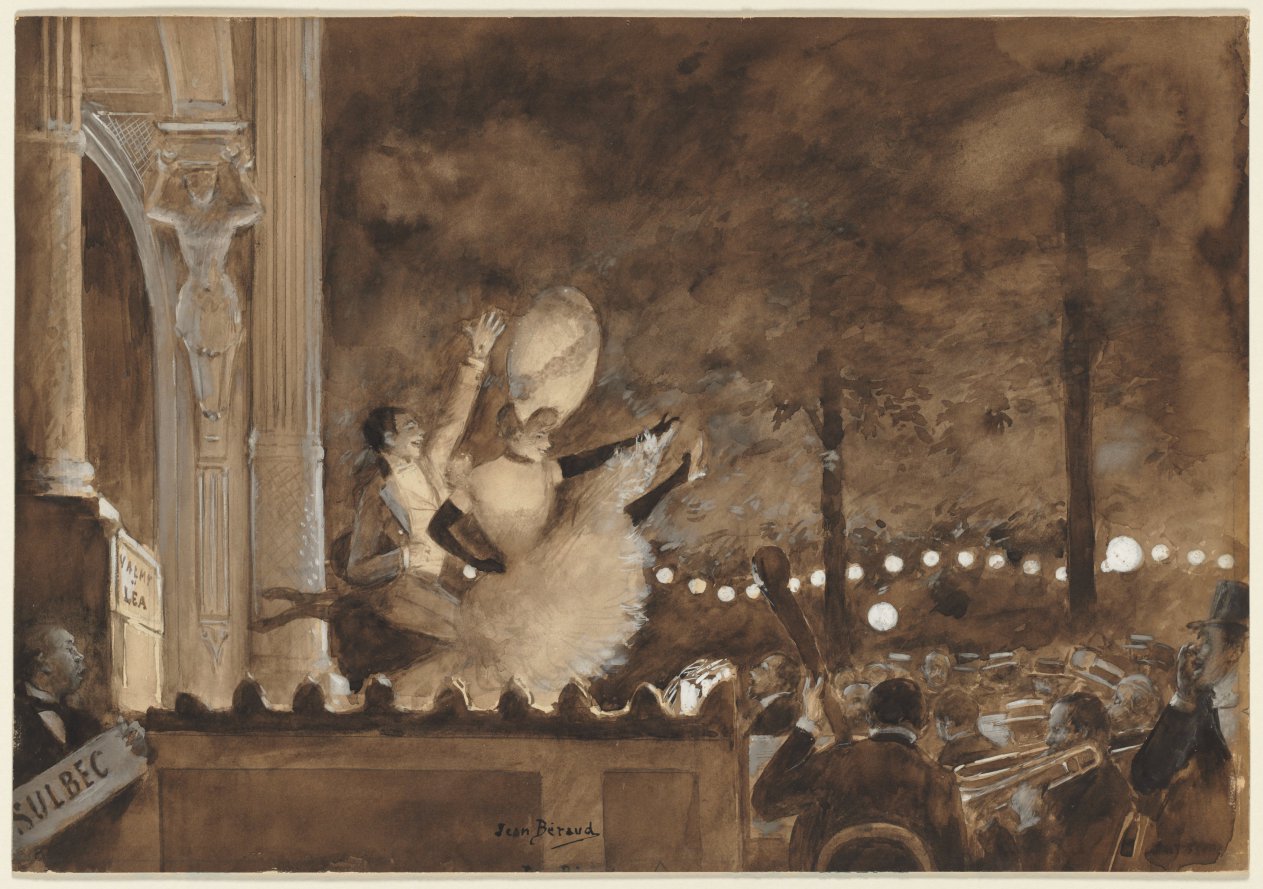
Jean Béraud
Valmy and Léa, 1885
As interest in Belle Époque painting continues to build across major auction rooms in Paris, London, and New York, Béraud's canvases have found a new and devoted generation of admirers who recognise in his work something rare: the feeling that the city is still breathing. Jean Béraud was born in Saint Petersburg in 1849, the son of a French sculptor, and the family returned to Paris following his father's death when Béraud was still a child. He grew up in the French capital during one of the most turbulent and transformative periods in its modern history, witnessing the upheaval of the Franco Prussian War and the violent convulsions of the Paris Commune in 1871. These formative years instilled in him both a deep love of Paris and a nuanced, unsentimental eye for its social textures.
The city was not merely backdrop for Béraud. It was subject, protagonist, and obsession. He trained under Léon Bonnat, the celebrated academic portraitist whose studio on the Rue de Douai attracted some of the most talented painters of the generation, and whose rigorous insistence on draughtsmanship left a permanent mark on Béraud's practice. The discipline is evident in every canvas: Béraud never lost himself in atmospheric dissolution the way the Impressionists often did, preferring instead to hold his figures in sharp, accountable focus while still conveying the shimmer and flux of modern life.
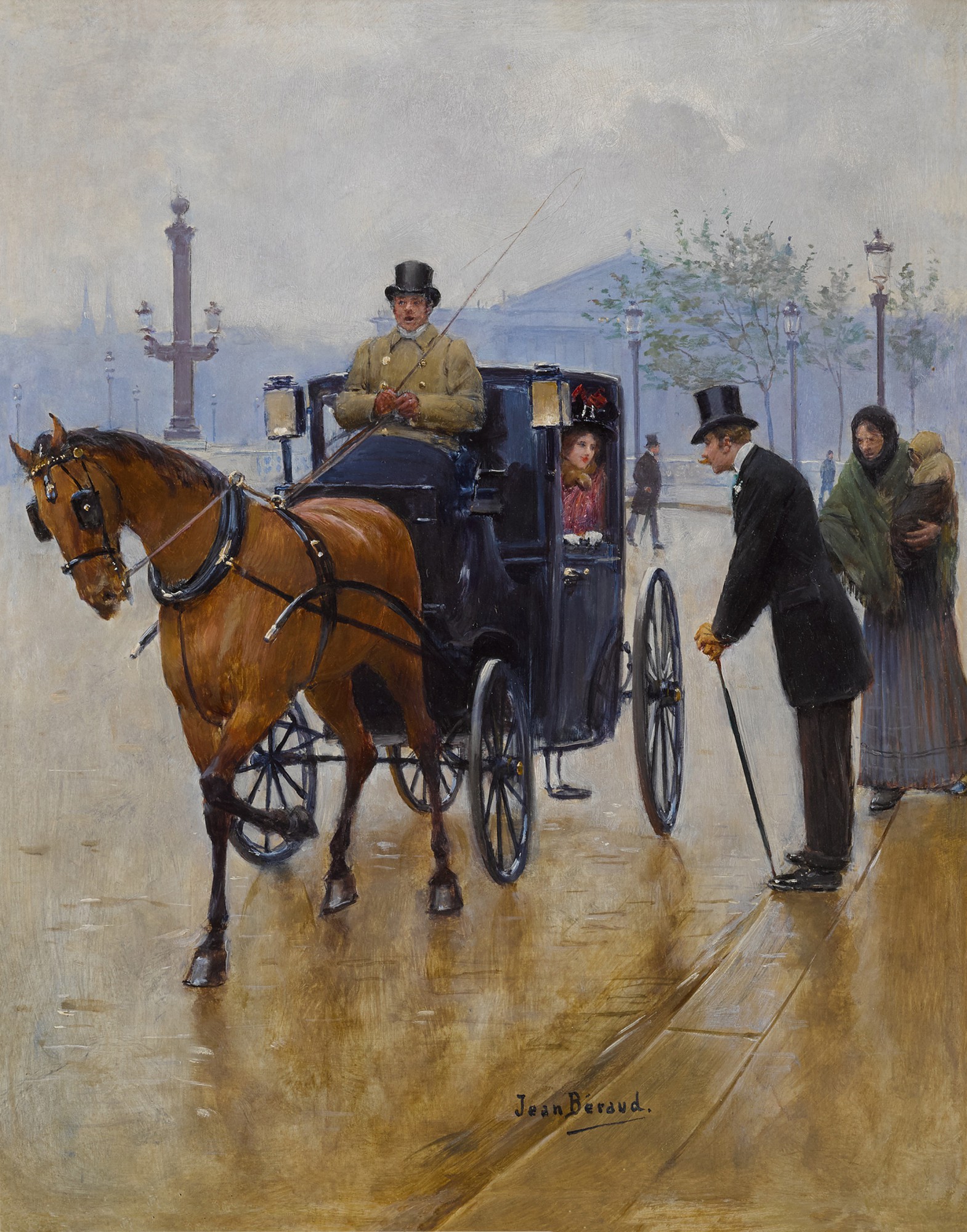
Jean Béraud
Fiacre, Place de la Concorde
He made his debut at the Salon in 1873, and over the following decades became one of its most consistent and celebrated contributors. By the early 1880s he was among the most visible painters in Paris, admired by critics and collected by the prosperous bourgeoisie whose rituals he so affectionately observed. Béraud's artistic development can be understood as a sustained act of witness. Where the Impressionists dissolved the social world into light and sensation, Béraud kept his gaze level and his intentions legible.
He painted the Grands Boulevards at dusk, the fashionable congregation outside the Café de la Paix, the hurrying seamstresses and the strolling flaneurs, the fiacres navigating the Place de la Concorde. His compositions are dense with observed detail: the precise cut of a jacket, the exact tilt of an umbrella, the particular quality of gaslit fog over wet stone. Yet for all this precision, his paintings never feel merely documentary. There is warmth in his observation, and a genuine delight in the spectacle of urban humanity going about its varied business.
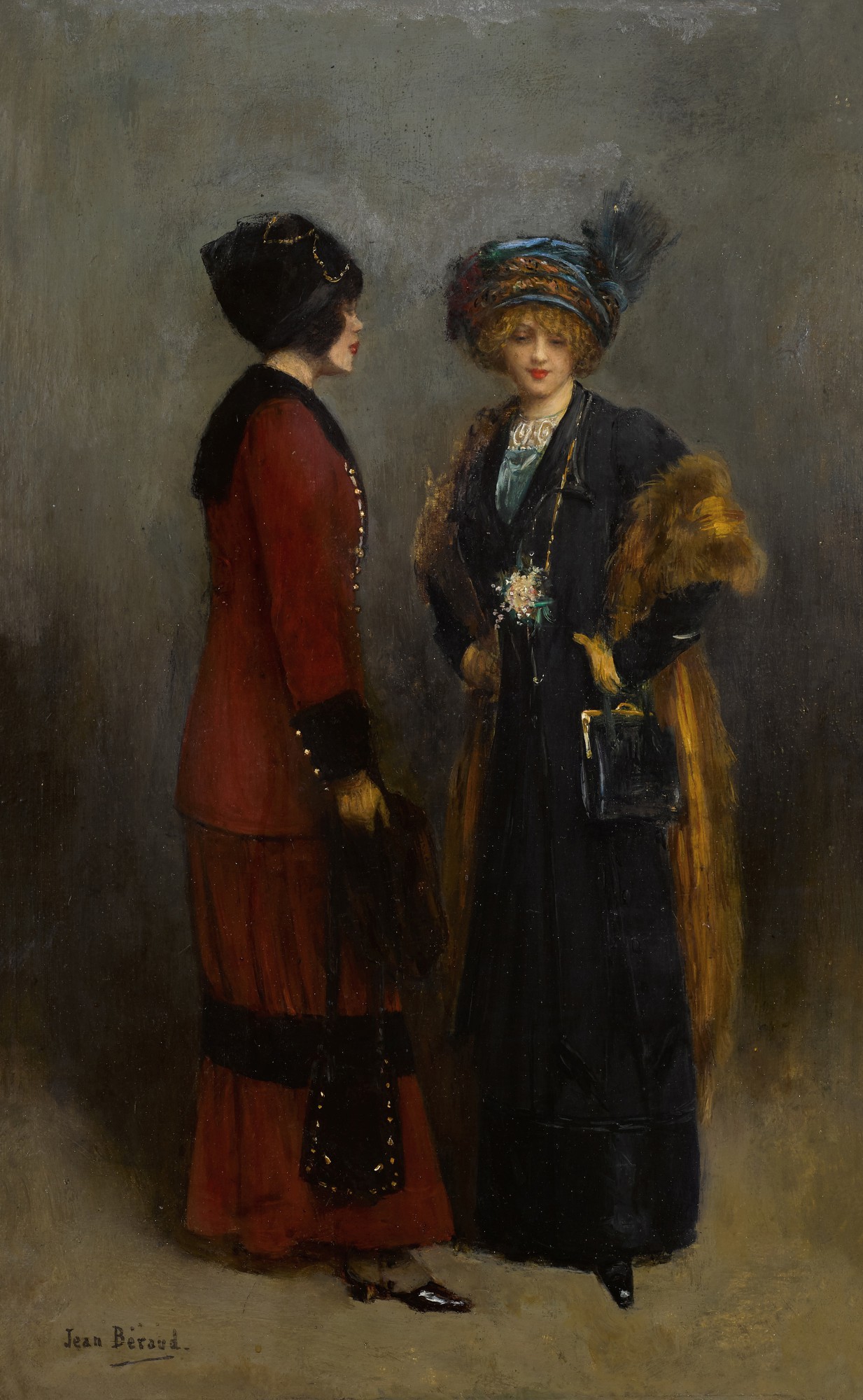
Jean Béraud
Les Midinettes (The Apprentice Girls)
Among the works that define his achievement, several stand out with particular clarity. "Le Pont Neuf" places the viewer at the centre of one of Paris's most beloved crossings, capturing the democratic flow of pedestrians from every station of life sharing the same ancient bridge. "Les Midinettes," painted on artist's board with characteristic economy, portrays the young apprentice dressmakers who were a beloved fixture of Belle Époque street life, hurrying between ateliers with their packages and their laughter. "Jeune femme traversant le boulevard" distils his signature subject to its purest form: a solitary woman navigating the urban current, suspended between the social worlds on either side of the street.
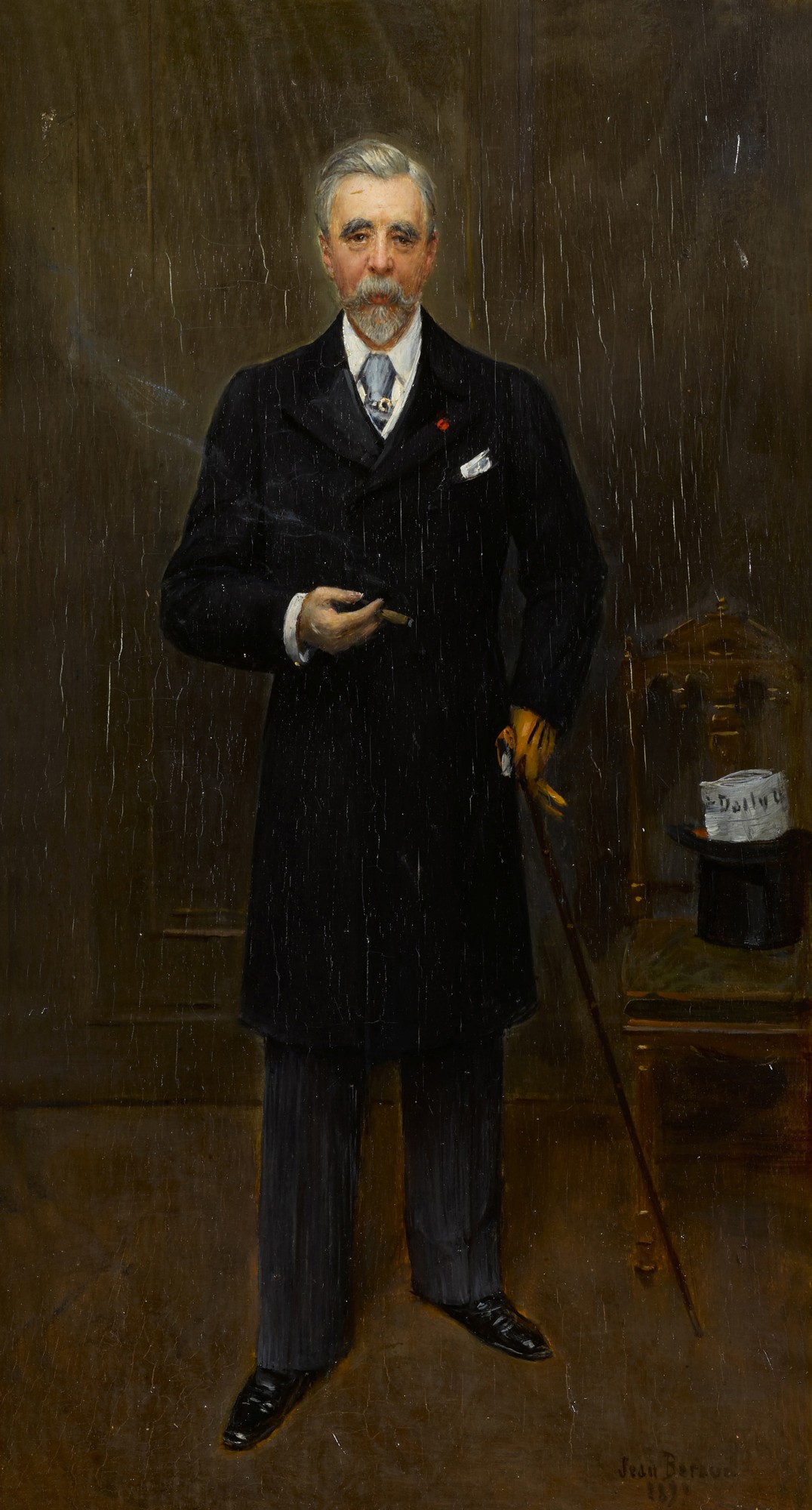
His portraits, among them the stately "Portrait De Madame Delphine Deligné" with its striking use of oil and gold leaf on panel, reveal a more intimate register, one in which the careful observation of character replaces the panoramic sweep of the street scene. And his drawings, such as the luminous "Valmy and Léa" of 1885, executed in brush and brown wash heightened with white gouache over graphite, demonstrate that his gifts extended well beyond paint alone. For collectors, Béraud presents a compelling and coherent proposition. His work sits at the intersection of the academic tradition and the modern spirit, making it accessible to admirers of both Salon painting and the broader Impressionist era without being reducible to either.
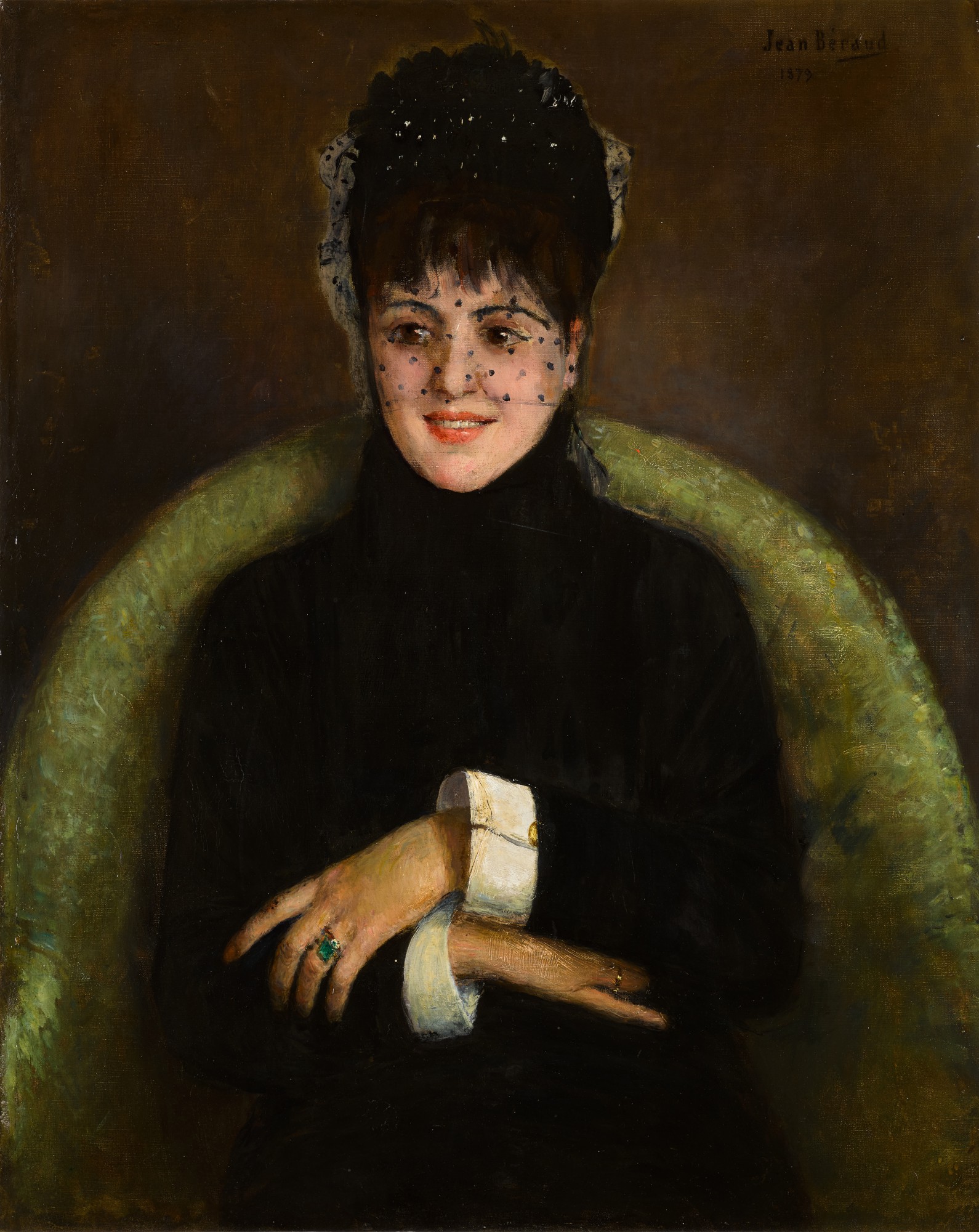
Jean Béraud
Elegante à l'Emeraude
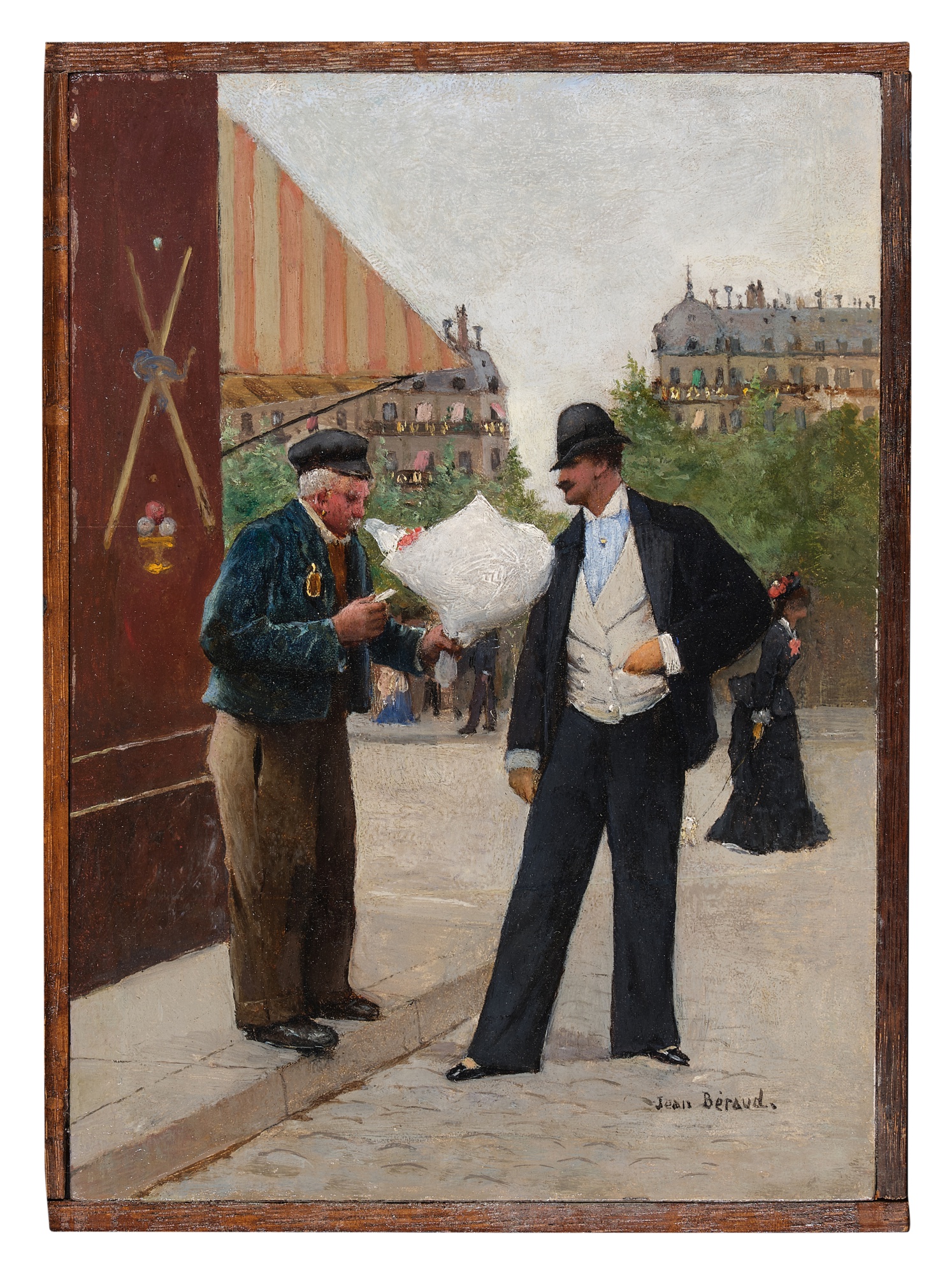
Collectors are drawn to the specificity of his vision: each painting is a genuine document of a world that has vanished, rendered with enough precision to feel historical and enough life to feel immediate. His panel paintings in particular, small in scale but immense in atmosphere, have proven especially sought after in the saleroom, where works such as "The Flower Delivery," "Fiacre, Place de la Concorde," and "Le Buggy" attract serious bidding from private collectors across Europe and North America. His work commands strong and consistent prices at auction, with dedicated buyers drawn to his combination of technical excellence, narrative richness, and the sheer pleasure his paintings give. Those building a collection in this area would do well to pay attention to condition and provenance, and to the particular quality of the light in any given work, as his treatment of Parisian illumination ranges from the quietly luminous to the genuinely spectacular.
Within art history, Béraud occupies a distinct and important position. He is sometimes grouped with the generation that includes Giuseppe De Nittis and Giovanni Boldini, fellow admirers of Parisian modernity who brought an outsider's intensity to their love of the French capital. Like them, he was drawn to the theatre of the street rather than to the countryside and leisure gardens that preoccupied many of his Impressionist contemporaries. Édouard Manet's unflinching engagement with modern Parisian types was a presence he could not have ignored, and Gustave Caillebotte's architectural vision of the new Haussmann boulevards shares certain structural preoccupations with Béraud's own compositions.
Yet Béraud's voice remains distinctly his own: more socially rooted than Manet, warmer than Caillebotte, and always oriented toward the human figure as the central fact of urban experience. Béraud lived until 1935, long enough to see the world he had painted so devotedly transformed beyond recognition by war, technology, and social upheaval. That longevity gives his work an additional poignancy, though it is not melancholy he leaves behind but something closer to a gift. He preserved Paris at its most vibrant and socially alive, at the moment when the modern city was still young enough to astonish its own inhabitants.
To spend time with his paintings today is to understand that the best art of social observation does not merely record its moment but argues, quietly and compellingly, for the permanent value of paying close attention to the world immediately around us. That argument remains as persuasive now as it was when Béraud first made it on the boulevards of the Belle Époque.
Featured Works
Explore books about Jean Béraud
Jean Béraud: 1849-1935
Madeleine Fidell-Beaufort
Jean Béraud: The Painter of Modern Paris
Gabriel P. Weisberg
Jean Béraud: 1849-1935, Un Peintre de la Belle Époque
Musée de Montmartre
Jean Béraud: Painter of the Parisian Scene
Belinda Thomson
Jean Béraud: The Image of Paris
Richard R. Brettell