Jean-baptiste Pillement
Pillement's Wandering Eye Enchants the World
Artist Spotlight · The Collection Editorial
Imagine standing in the grand salon of a Lisbon palace in the 1780s, sunlight filtering through tall windows and catching the gilded edges of a painted screen. Across its lacquered surface, improbable flowers bloom in impossible colors, and fantastical figures move through misty groves that belong to no geography anyone has ever visited. This is the world Jean Baptiste Pillement conjured, a world so seductive and so technically accomplished that courts and collectors across Europe competed for his attention. More than two centuries after his death, that seduction has not faded.
His works appear regularly at major European auction houses, and museum curators from Paris to Warsaw continue to reassess his place not merely as a decorative artist but as one of the most inventive visual imaginations of the eighteenth century. Pillement was born in Lyon in 1728, into a family already embedded in the textile and decorative arts trades of that great manufacturing city. Lyon was, at the time, the silk capital of Europe, and the visual language of pattern, surface, and ornament was as natural to young Jean Baptiste as speech. His father was a painter and designer, and the household was saturated with the practical aesthetics of applied art.
This origin shaped everything that followed. Pillement would never be purely a fine artist in the academic sense, and he never sought to be. He understood from childhood that beauty could live on a bolt of fabric or a painted ceiling just as surely as it could live on a gallery wall, and he treated these realms with equal seriousness and equal joy. His early training took him to Paris, where he absorbed the Rococo idiom then at the height of its elegance and influence.
But Pillement had an essentially restless temperament, and Paris could not contain him for long. By his twenties he had already begun the extraordinary itinerant career that would define his life. He traveled to Spain, to England, where he spent significant time in London and found a ready market for his prints and designs, and eventually to Poland, Portugal, and Austria. In Vienna he worked for the imperial court.
In Lisbon he painted for the Portuguese royal family in the years following the catastrophic earthquake of 1755, contributing to the cultural renewal of a city rebuilding its identity. In Warsaw he charmed the court of Stanislaw Augustus Poniatowski, one of the great enlightened royal collectors of the age. Each city left its mark on his vision, and he left his mark on each city in return. The signature achievement of Pillement's career is the body of work he produced in the chinoiserie mode.
Chinoiserie, the European fantasy of China filtered through imagination and desire rather than direct knowledge, was fashionable across the continent throughout the eighteenth century. But Pillement brought to it a quality of genuine poetic invention that set him apart from his contemporaries. His Chinese figures do not merely parody or imitate an exotic ideal. They inhabit invented gardens and pavilions with a kind of internal consistency and atmospheric tenderness that makes them feel real on their own terms.
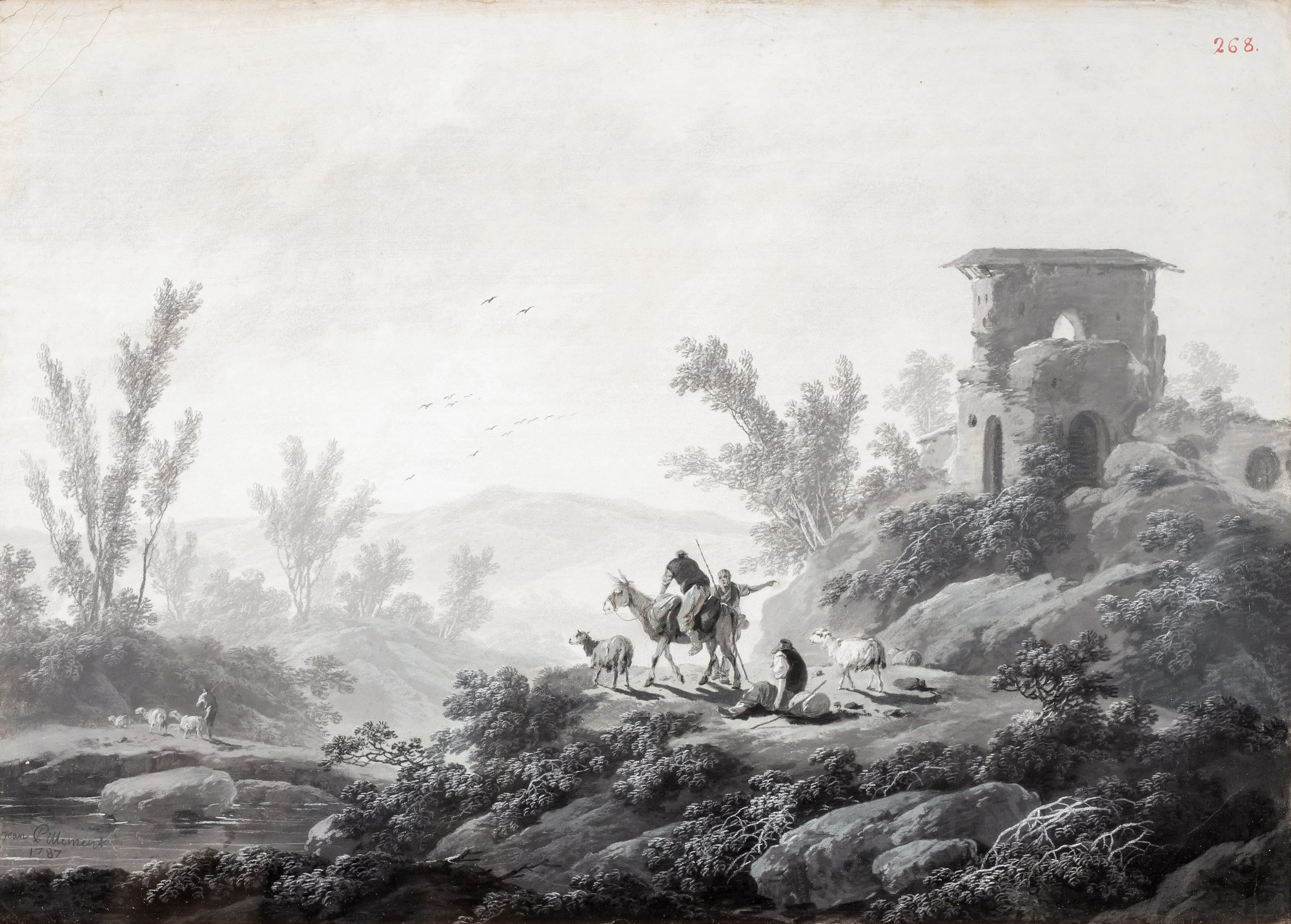
His engraved designs, widely circulated through print collections including the influential series published in London in the 1750s and 1760s, shaped the visual vocabulary of Rococo decoration across Europe and were eagerly copied by craftsmen working in silk, porcelain, wallpaper, and lacquerwork. He was, in the most literal sense, a designer of worlds that other hands then brought into three dimensions. Beyond the chinoiserie work, Pillement was a landscape painter of genuine distinction. His pastoral scenes, many depicting the Portuguese and Austrian countryside, demonstrate a sensitivity to atmospheric light and a loose, confident handling of foliage that anticipates the naturalism of the following century.
He was not a Romantic in any programmatic sense, but there is something in his best landscapes, an attention to the mood of a particular hour in a particular kind of light, that looks forward to the concerns that would preoccupy painters like Hubert Robert and eventually the early Romantics. His drawings in particular, executed in chalk and wash with remarkable fluency, reveal an artist who thought on paper with exceptional speed and confidence. For collectors, Pillement presents a compelling and relatively accessible opportunity within the broader field of eighteenth century French and European art. His works appear regularly at auction in Paris, London, and across the Continent.
Drawings and works on paper tend to offer strong points of entry and often display his inventive line to great advantage. Paintings vary considerably in scale and ambition, from intimate cabinet pictures to larger decorative compositions intended for installation in specific architectural settings. Provenance is worth careful attention, as his wide travels mean that works entered collections across many countries and passed through diverse hands over the centuries. Scholars and specialist dealers in Old Master works have grown increasingly attentive to his output in recent decades, and institutional interest, reflected in acquisitions by museums including the Musee des Beaux Arts in Lyon and collections in Lisbon and Warsaw, has helped to firm both his reputation and his market standing.
To understand Pillement fully it helps to place him among his contemporaries and near contemporaries. He shares certain qualities with Francois Boucher, whose Rococo sensibility and delight in decorative fantasy he echoes, though Pillement is less sumptuous and more wandering in spirit. His landscapes invite comparison with those of Hubert Robert, though Pillement's touch is lighter and his mood less melancholic. In the chinoiserie tradition he stands alongside artists such as Jean Baptiste Oudry and the designers who supplied the great porcelain manufacturers at Meissen and Sevres, though Pillement's prints gave his influence a reach and a longevity that few of those contemporaries could match.
He was a connector of visual cultures, a translator between traditions, and that role, unfashionable in an era that prized singular genius, now looks remarkably modern. Pillement died in Lyon in 1808, returning at the end of his long life to the city where his visual education had begun. He had outlived the Rococo style he helped to define, survived revolution and the overturning of the aristocratic world that had sustained him, and arrived in the nineteenth century still painting, still drawing, still finding the world worth looking at with patient and affectionate attention. That quality of sustained, generous curiosity is perhaps the deepest thing his work offers to those who spend time with it today.
In an age of rapid movement and fragmented attention, there is something quietly radical about an artist who traveled so far and looked so carefully, and who found in every garden and every misty hillside something worth celebrating.
Explore books about Jean-baptiste Pillement
Jean-Baptiste Pillement: Catalogue Raisonné of the Paintings and Drawings
Alastair Laing
Pillement: Master of the Rococo
Michael Levey
The Decorative Schemes of Jean-Baptiste Pillement
Marianne Roland Michel
Pillement and the Chinoiserie Movement
Hugh Honour
Jean-Baptiste Pillement 1728-1808: Life and Works
Gabriel Badea-Päun