Jean Alexandre Joseph Falguière
Falguière: Where Marble Meets Living Breath
Artist Spotlight · The Collection Editorial
There is a moment, standing before a bronze by Jean Alexandre Joseph Falguière, when the metal seems to exhale. The surface catches light in ways that feel almost biological, as though the figure within has only just stilled itself for your arrival. That sensation is not accidental. It is the product of a lifetime spent interrogating the boundary between academic discipline and sensory truth, and it is precisely why Falguière's work continues to draw serious attention from collectors, curators, and scholars who understand that the great tradition of French Salon sculpture has never truly gone out of fashion.
Jean Alexandre Joseph Falguière
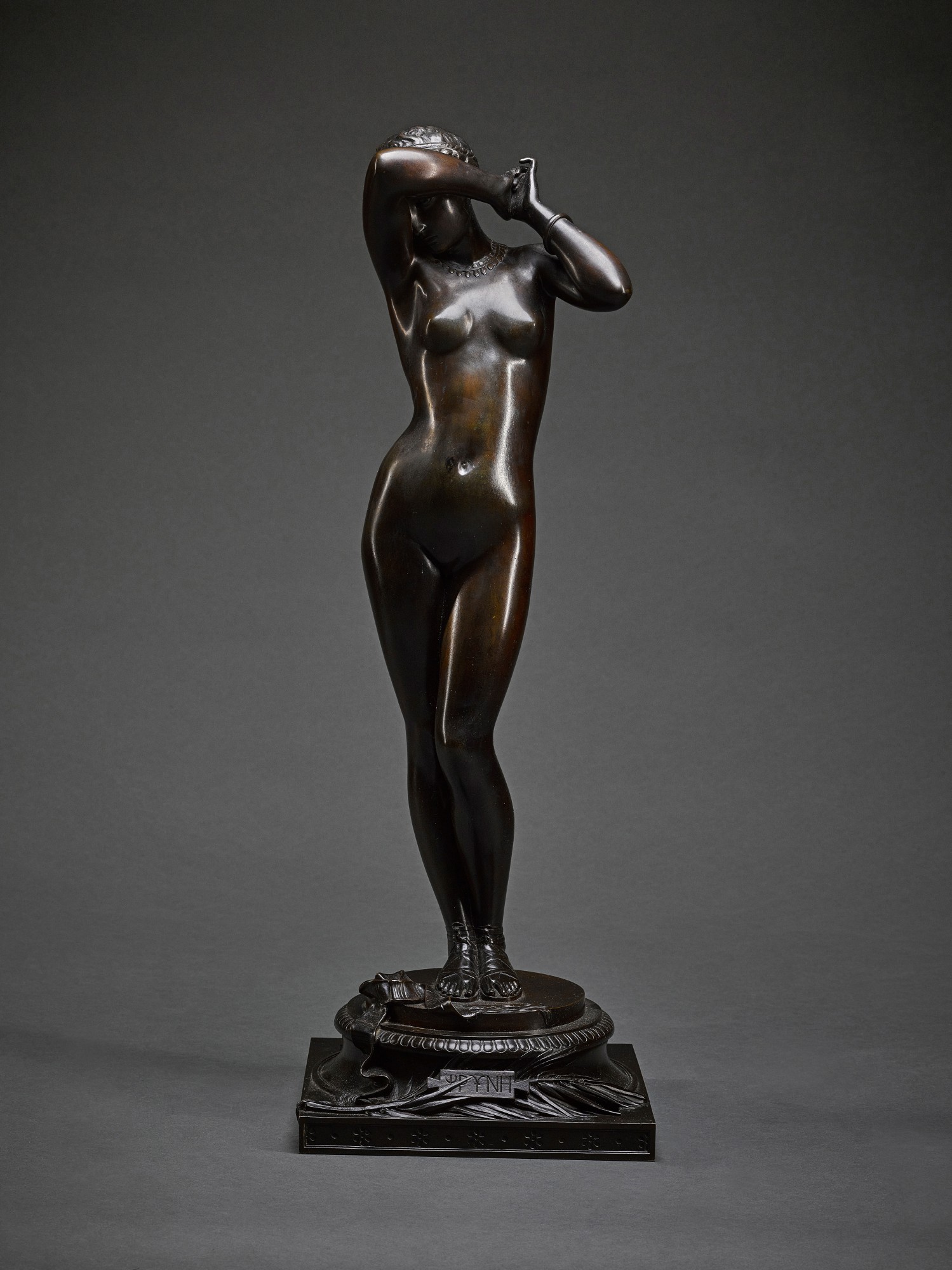
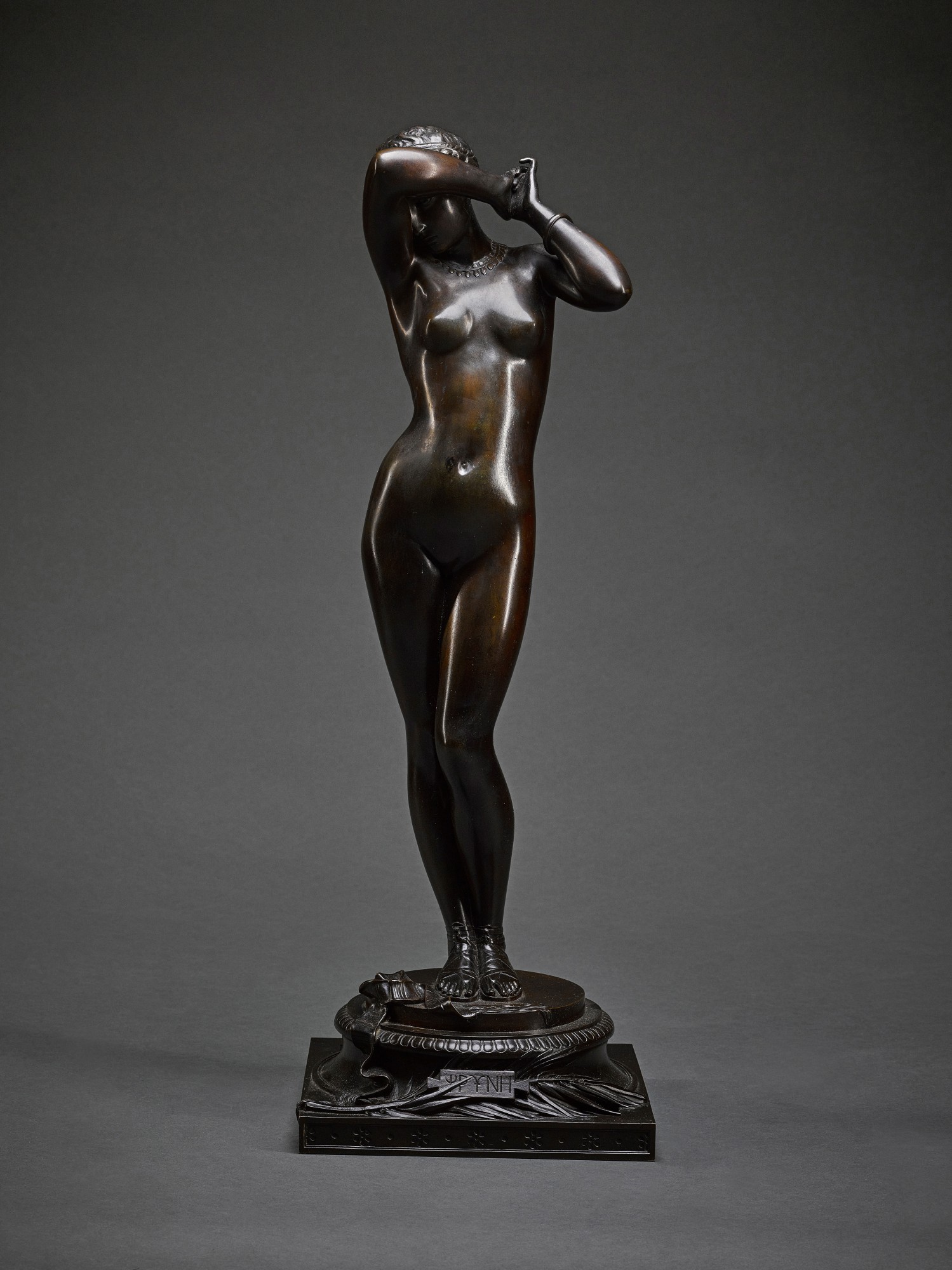
Phryne
Falguière was born in Toulouse in 1831, into a city with a proud artistic heritage and a deep instinct for the classical. He showed early aptitude for drawing and modelling, and his path to Paris was shaped by the kind of determined provincial ambition that produced so many of the Third Republic's most significant cultural figures. He entered the École des Beaux Arts and studied under the celebrated sculptor Jouffroy, absorbing the rigorous anatomical and compositional foundations that would underpin everything he made. In 1859, he won the Prix de Rome, the most prestigious prize in French academic art, which sent him to the Villa Medici for years of study among the antique casts and Renaissance masterworks that confirmed his instinct for monumental form.
Rome did not simply polish Falguière. It transformed him. Where many Prix de Rome recipients returned to Paris more conservative than they left, Falguière came back with an expanded sense of what the human figure could carry emotionally. His 1864 work Winner of the Cockfight, which brought him immediate recognition at the Salon, announced a sculptor capable of marrying academic correctness with genuine warmth and narrative energy.
Jean Alexandre Joseph Falguière
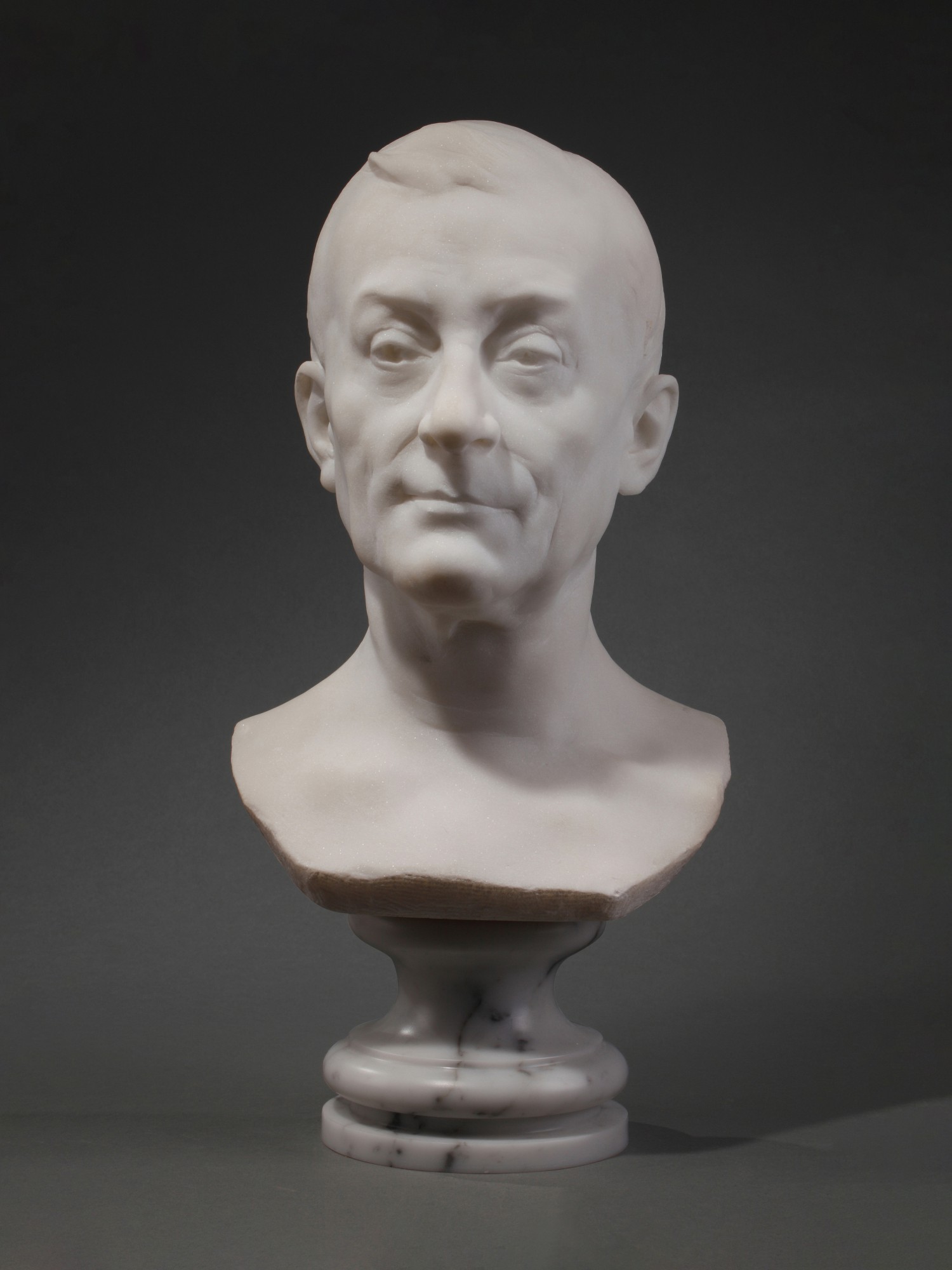
Portrait bust of Jules Quesnay de Beaurepaire
The piece showed a young boy in a moment of unselfconscious triumph, and its combination of classical pose with contemporary feeling was immediately understood as something fresh. Falguière had found his register: the universally human, rendered through the highest technical means available. His development through the 1860s, 1870s, and 1880s traces the arc of French sculpture at its most ambitious and self assured. He worked across an enormous range of subjects, from mythological figures drawn from antiquity to portraits of the politicians, writers, and civic leaders who defined the life of the Third Republic.
He was also a painter of some distinction, exhibiting canvases at the Salon alongside his sculptural works, a versatility that was admired by his contemporaries and that gave his three dimensional work an unusually painterly sensitivity to surface and atmosphere. His friendship and professional association with Auguste Rodin is one of the defining relationships of the period: the two men represented complementary poles of late nineteenth century French sculpture, and their mutual respect illuminates both practices. Among the works available on The Collection, Phryne stands as perhaps the most illuminating entry point into Falguière's sensibility. The subject, drawn from antiquity, was one that several artists of the period returned to, but Falguière's treatment in dark brown patinated bronze is notable for its psychological presence.
Jean Alexandre Joseph Falguière
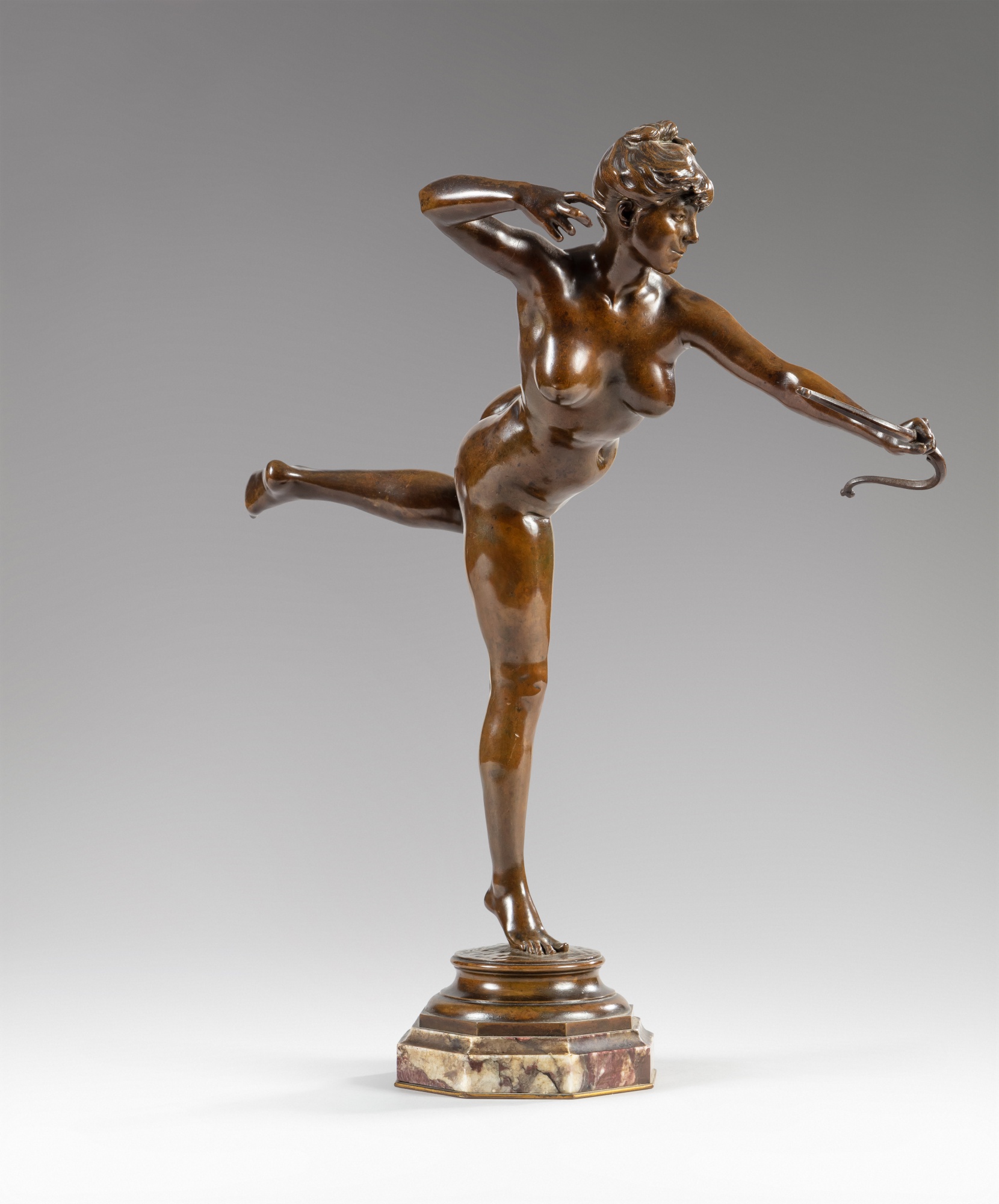
The Hunting Nymph
Phryne is not merely a posed nude but a figure caught in a moment of self possession, her posture suggesting both vulnerability and a quiet, internal authority. The dark patina deepens the sense of weight and gravity in the bronze, giving the surface a richness that rewards extended looking. Collectors drawn to the great tradition of French academic bronze will find in this work a particularly fine example of how Falguière synthesised classical precedent with something more immediate and alive. The Hunting Nymph, also in bronze with a warm brown patina and presented on an octagonal marble plinth, shows the sculptor at ease with mythological subject matter that allowed him the greatest freedom of compositional invention.
The nymph is a subject that carries centuries of art historical freight, from Hellenistic originals through Renaissance and Baroque interpretations, and Falguière brings to it the full authority of his academic training while injecting a forward momentum and lightness of touch that feel entirely his own. The octagonal plinth is itself worth noting as a considered presentational choice that frames the figure with a formality that suits the work's ambitions. The Portrait Bust of Jules Quesnay de Beaurepaire, carved in white marble on a veined white marble socle, demonstrates the other essential dimension of Falguière's practice: the portrait. This is not a work of flattery but of penetrating observation, the kind of likeness that captures professional authority alongside the particular human being who carries it.
For collectors approaching Falguière's market, there are several considerations worth keeping in mind. His public monuments, including the monument to Lafayette in Washington D.C. and numerous important Parisian commissions, mean that his name carries institutional weight that many of his contemporaries cannot claim.
His bronzes appear regularly at major French auction houses as well as at Christie's and Sotheby's in their nineteenth century sculpture sales, where quality examples command sustained interest from both European and American buyers. The market distinguishes carefully between lifetime casts and later foundry editions, and condition of patina is a significant factor in valuation. Marble works of the calibre of the Quesnay de Beaurepaire bust are rarer on the market and tend to attract serious collector attention when they appear. Falguière sits in productive company alongside contemporaries such as Alexandre Falguière's fellow Salon sculptors including Antonin Mercié, Emmanuel Frémiet, and Henri Chapu, artists who collectively defined the high academic tradition and whose reputations have all benefited from the ongoing critical rehabilitation of nineteenth century French sculpture.
The legacy of Jean Alexandre Joseph Falguière is one of earned distinction. He was elected to the Académie des Beaux Arts, taught a generation of younger sculptors who would carry aspects of his practice into the twentieth century, and produced a body of public and private work that still organises space, commands attention, and generates feeling in those willing to stand before it with patience. In a moment when the nineteenth century is being reconsidered with fresh eyes and genuine critical seriousness, Falguière represents an outstanding opportunity for collectors who want to engage with the full richness of the Western sculptural tradition. His work is not a period piece.
It is a living argument for the expressive power of the human form, made by an artist who believed absolutely in what his hands could do.
Explore books about Jean Alexandre Joseph Falguière