Javier Calleja

Javier Calleja: Wonder, Wit, and Wide Eyes
Artist Spotlight · The Collection Editorial
Something quietly extraordinary has been happening in the contemporary art world over the past decade, and its epicentre is a sun drenched studio in Málaga, Spain. Javier Calleja, the artist whose oversized, doe eyed figures have become among the most recognisable and emotionally resonant characters in international contemporary art, has ascended from regional cult favourite to genuine global phenomenon. His works now appear in significant private collections across Europe, Asia, and the Americas, commanding serious attention at auction houses and drawing devoted followings at galleries from Tokyo to London. For collectors who discovered him early, the feeling is one of quiet vindication.

Javier Calleja
Do Not Touch
For those arriving now, the conversation is only just beginning. Calleja was born in Málaga in 1971, a city whose blazing Mediterranean light and layered cultural history have left a visible imprint on his sensibility. Andalusia, with its traditions of folk art, devotional imagery, and a certain philosophical melancholy baked into its popular culture, provided an unlikely but formative backdrop for an artist who would go on to synthesise those influences with the visual languages of Japanese manga, Western pop art, and contemporary street culture. He trained in fine arts in Málaga, developing a technical fluency in drawing and painting that underpins even his most seemingly effortless compositions.
That academic grounding matters: the apparent simplicity of his figures is hard won, a studied economy of line that communicates volumes through a single arched brow or a downturned mouth. Calleja spent years developing his practice in relative obscurity, the kind of sustained, unglamorous studio work that eventually produces a fully formed artistic vision. His early works showed an artist wrestling productively with influences: the deadpan irony of conceptual art, the flat graphic clarity of Japanese character design, the emotional directness of outsider imagery. What emerged, gradually and then unmistakably, was a signature that belonged entirely to him.
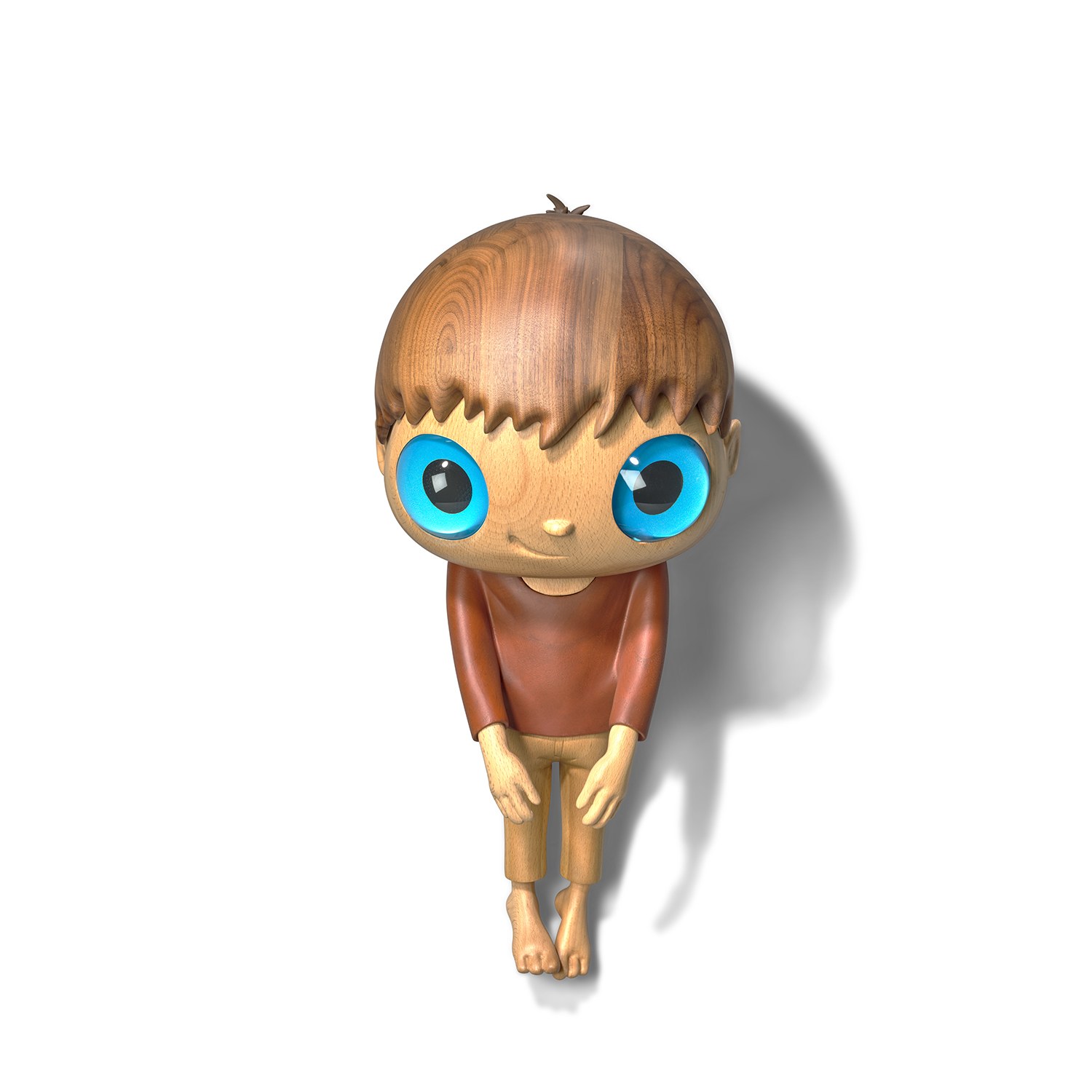
Javier Calleja
Little Maruzio, 2019
His characters, small and pale and wide eyed, occupy sparse environments and carry short, cryptic texts that function less as captions than as emotional coordinates. They feel found rather than invented, as though Calleja had simply looked inward and rendered what he encountered with disarming honesty. The breakthrough into serious international recognition came through an unlikely route: the passionate embrace of collectors and institutions in Japan and across East Asia, where his visual vocabulary resonated deeply with audiences already fluent in the emotional register of manga and character based art. Gallery shows in Japan generated significant excitement and introduced his work to a new generation of collectors who responded to the synthesis of Western painterly tradition and Eastern pop sensibility.
European galleries followed, and Calleja began showing with Almine Rech, the internationally regarded gallery with spaces in Brussels, Paris, London, and New York, a partnership that helped position his work within a serious contemporary art context and opened doors to major international fairs and institutional attention. Among his most celebrated works, the sculpture and painting multiple known as Do Not Touch stands as a kind of manifesto object. Presented in a wooden crate with the care and ceremony of a luxury product, the work plays knowingly with ideas of collectibility, desire, and the paradox of owning something that insists on its own untouchability. It is characteristic Calleja: formally impeccable, conceptually layered, and shot through with a gentle humour that never undermines the emotional sincerity at its core.
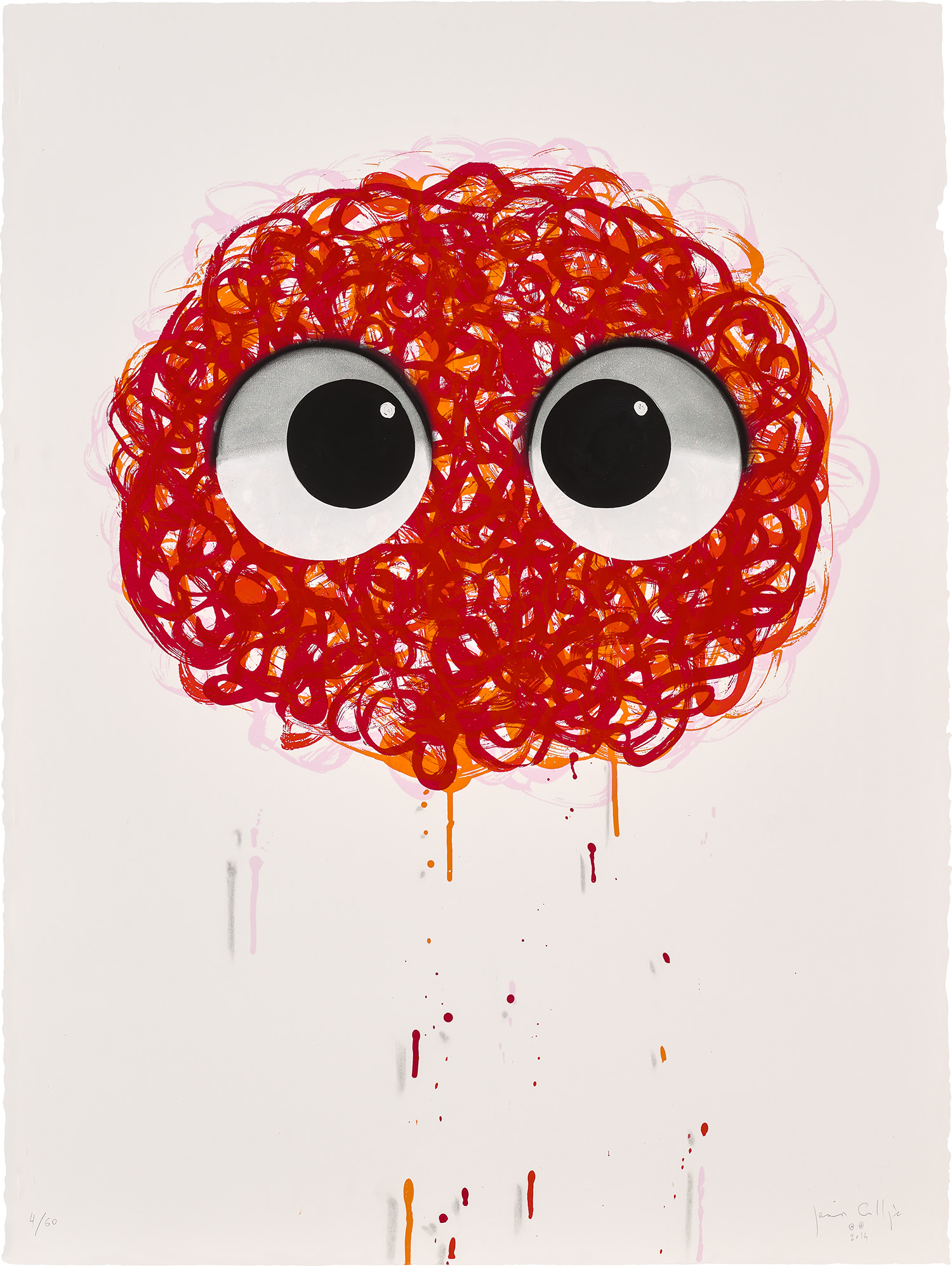
Javier Calleja
Redhead
His paintings on canvas, works such as Waiting for You from 2018 and Don't Take It All to Heart from the same year, pair his signature figures with acrylic fields of quiet colour, the texts operating like fragments of overheard thought. His works on paper, including drawings in charcoal, gouache, and coloured pencil, reveal the intimacy of his practice and the directness of his mark making at its most unguarded. For collectors, Calleja presents a compelling proposition that goes beyond the immediate appeal of his imagery. His practice spans multiple mediums and formats, from large scale canvas paintings to intimate works on paper, from cast resin sculptures to screen prints with hand applied mark making, meaning that entry points exist at a range of price levels while the conceptual coherence of the body of work remains consistent throughout.
The works in editions, produced with the same attention to presentation and concept as his unique pieces, have proven particularly popular and have appreciated meaningfully in the secondary market. Auction results over recent years have reflected sustained and growing collector confidence, with prices for desirable works regularly exceeding estimates. Collectors drawn to artists such as Yoshitomo Nara, whose large eyed child figures occupy a similarly affecting emotional territory, or to the playful conceptual wit of artists like Maurizio Cattelan, will find in Calleja an artist who engages comparable questions with a distinctly personal answer. The comparison to Nara is instructive and frequently made, but it risks obscuring what is genuinely distinctive about Calleja's contribution.
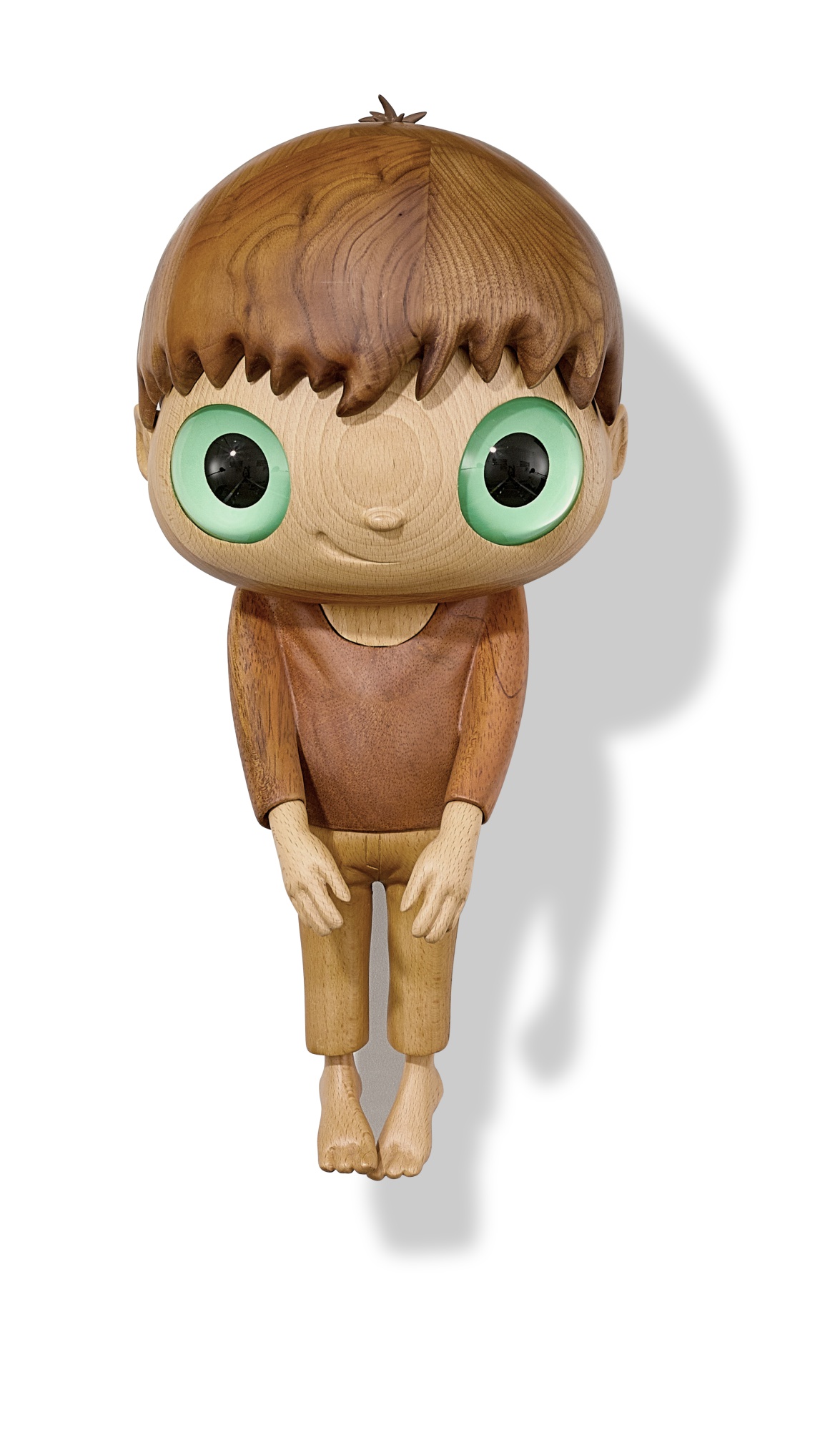
Javier Calleja
小莫瑞吉奧, 2019
Where Nara's figures carry an undercurrent of defiance and even menace, Calleja's characters are more purely suspended in ambiguity, neither innocent nor knowing, neither happy nor bereft. They sit with their condition rather than pushing against it. The text elements in his work owe something to the tradition of conceptual artists who have interrogated the relationship between word and image, but Calleja uses language not to destabilise meaning but to create a second emotional frequency running alongside the visual one. The result is work that rewards sustained looking in a way that purely decorative art does not, work that changes slightly depending on what the viewer brings to the encounter.
Calleja's significance within contemporary art history is still being written, which is precisely what makes this a compelling moment to engage with his work. He occupies a rare position: genuinely beloved by a broad international public while remaining intellectually substantial enough to satisfy serious collectors and curators. His practice asks real questions about vulnerability, longing, and the performance of emotional states, questions that feel urgently relevant in a cultural moment defined by surfaces and self presentation. The large eyes of his characters are not naïve; they are attentive, watching the world with a patience that borders on wisdom.
In a career already marked by remarkable achievement, the sense among those who know his work well is that the most significant chapter is still unfolding.