Jammie Holmes
Jammie Holmes Paints the World He Knows
Artist Spotlight · The Collection Editorial
“I want people to feel seen. I want them to feel like their story matters.”
Jammie Holmes, Théodore Art
In the summer of 2020, as cities across America grappled with grief and uprising, an unexpected intervention appeared on billboards across Los Angeles and New York. The message read simply: "Nobody Cares, Work Harder." The campaign, conceived by Jammie Holmes and realized in partnership with Théodore Art gallery, cut through the noise of that fractured moment with a kind of defiant intimacy. It was not a corporate slogan or a motivational cliché but a personal philosophy worn on the skin of the city, a quiet provocation from a painter from the bayou country of Louisiana who had spent years building something extraordinary in near silence.
Jammie Holmes
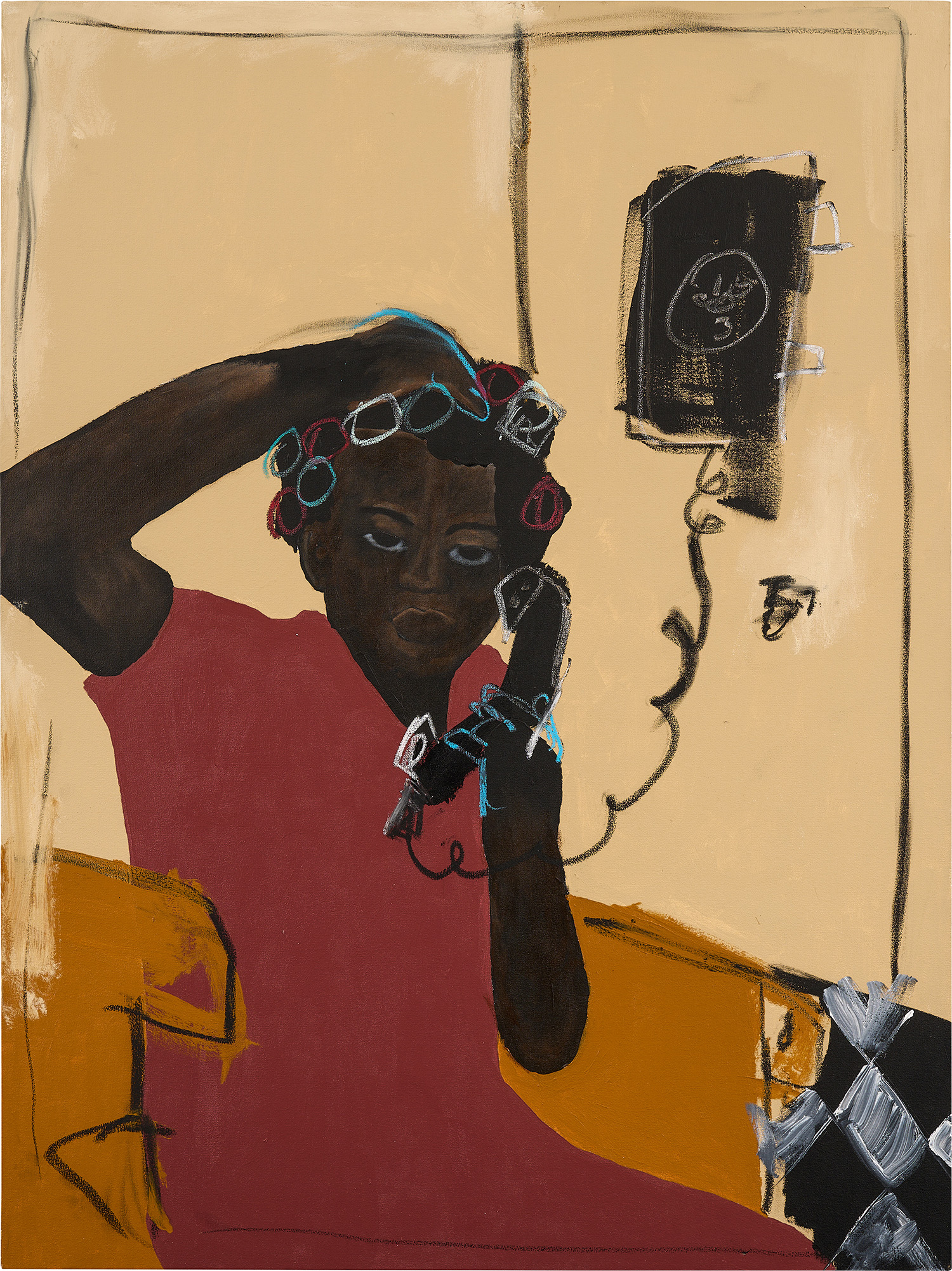
Calling, 2020
Holmes was born in 1988 in Thibodaux, Louisiana, a small city set in the sugarcane flatlands of the Lafourche Parish, roughly sixty miles southwest of New Orleans. The landscape there is lush and saturated, the social fabric tight and layered with the particular textures of Black Southern life: church ushers in white gloves, front porches thick with heat and conversation, the particular quality of light that falls on children playing before dark. Holmes grew up absorbing all of it, storing it with the attentiveness of someone who would one day need to paint it back into existence. He has spoken of his grandmother and the community around her as formative presences, figures who embodied a kind of dignified everyday heroism that he would return to again and again on canvas.
His development as a painter was not the product of elite institutional pathways or early critical attention. Holmes worked to refine his practice with discipline and focus, drawing on the traditions of American figurative painting while grounding his imagery entirely in the world he had lived. The influence of artists like Kerry James Marshall and Henry Ossawa Tanner hovers productively around his work, that same commitment to centering Black figures in compositions suffused with warmth and psychological depth. But Holmes arrived at his own voice through the specificity of place.
Jammie Holmes
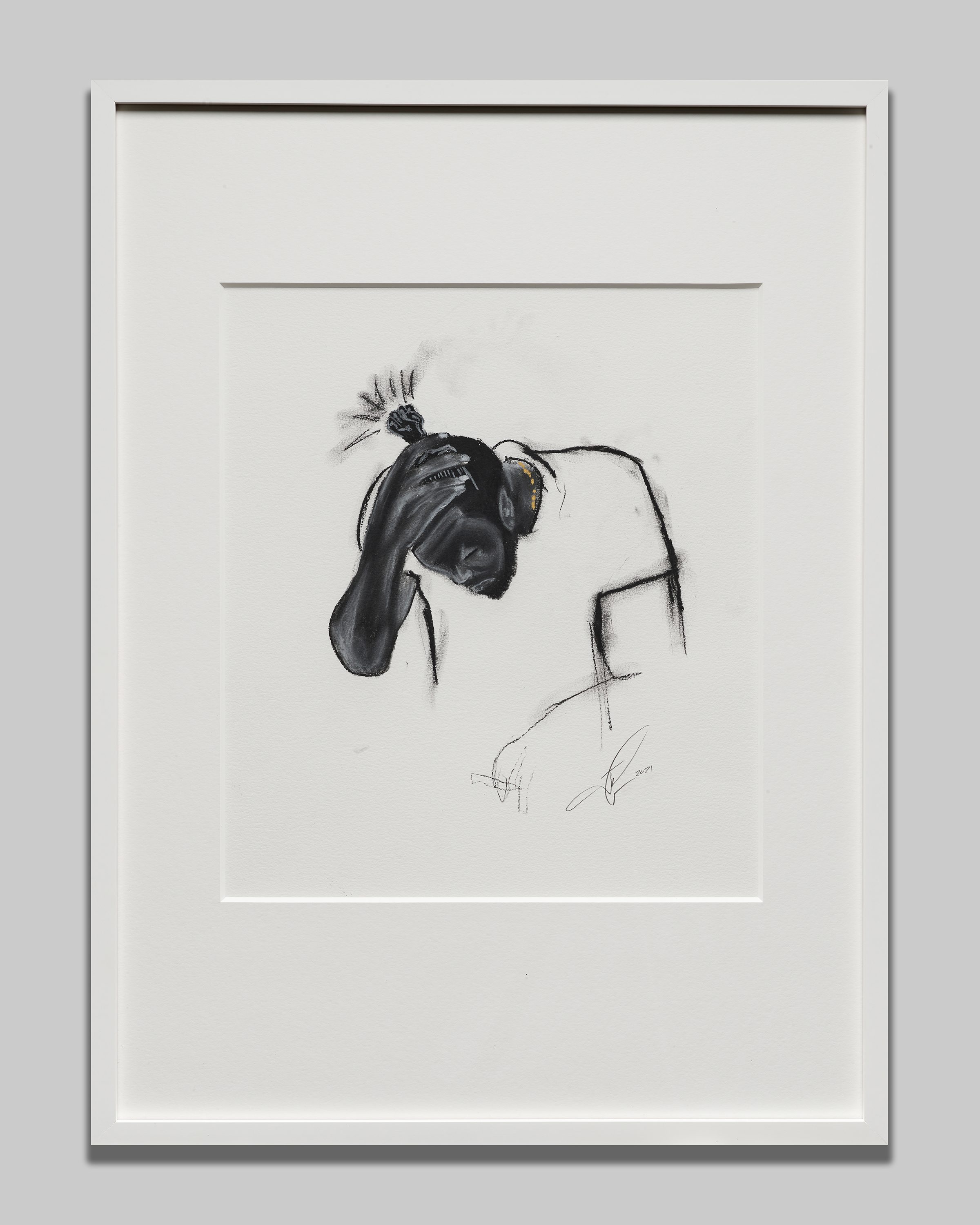
Untitled, 2021
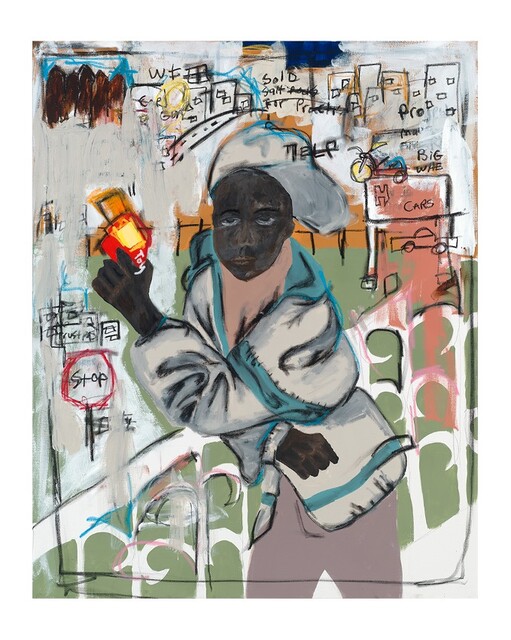
Thibodaux is not a generic setting; it is a named, particular world, and his insistence on painting from within it rather than at a distance gives his work an emotional authority that is immediately felt. The paintings themselves operate through accumulation, through layers of acrylic, oil pastel, oilstick, and in some cases glitter, materials that catch light and hold it in unexpected ways. Works like "My Grandmother was an Usher" (2020) and "Bus Stop at the White House" (2019) anchor grand emotional stakes in ordinary situations. The figure of the grandmother, rendered with tenderness and precision, becomes a meditation on inheritance and love.
The bus stop, an unremarkable civic fixture, becomes a charged site of waiting and dignity. In "Calling" (2020), one of the most quietly powerful canvases in his body of work, Holmes brings together the spiritual and the domestic in a composition that feels both deeply personal and somehow universal. These are paintings that ask you to slow down, to stay, to look. Holmes has also embraced printmaking as an extension of his practice rather than a secondary concern.
Jammie Holmes
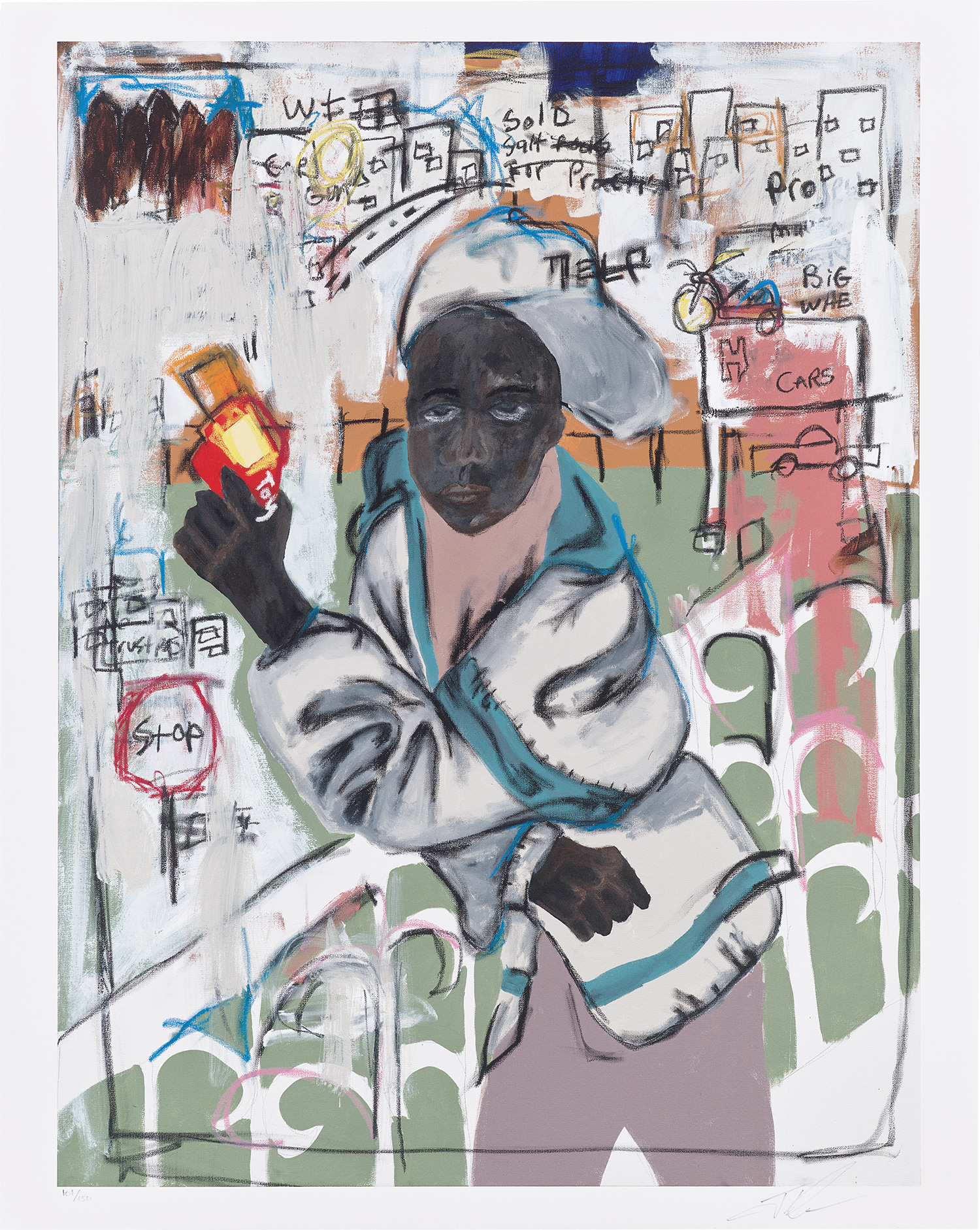
Pop Gun
His archival pigment prints, including the "Pop Gun" series (2019), demonstrate the same compositional intelligence as his canvases, with color and form carrying the full weight of his storytelling. The screenprint "A Self Portrait of an Artist on Narrow Street," produced on Mohawk Superfine paper, reveals an artist thinking carefully about scale, surface, and the life of an image beyond the unique object. Works on paper such as the 2021 chalk drawing "Untitled" and "On My Own," an acrylic and glitter canvas from the same year, show the breadth of his material curiosity and his willingness to find meaning in unexpected registers. From a collecting perspective, Holmes represents one of the most compelling opportunities in contemporary American figurative painting.
His work sits at the intersection of art historical seriousness and genuine emotional access, the kind of painting that rewards both scholarship and feeling. Galleries including Thierry Goldberg in New York have recognized the significance of his practice, and interest from institutional collectors and museums has grown steadily since the visibility brought by the 2020 billboard campaign. Works from his 2019 and 2020 series in particular represent pivotal moments in his development and are increasingly sought after by collectors building thoughtful holdings in contemporary Black American art. The range of media he works across, from large painted canvases to intimate works on paper to limited edition prints, also makes his practice accessible at various points of entry.
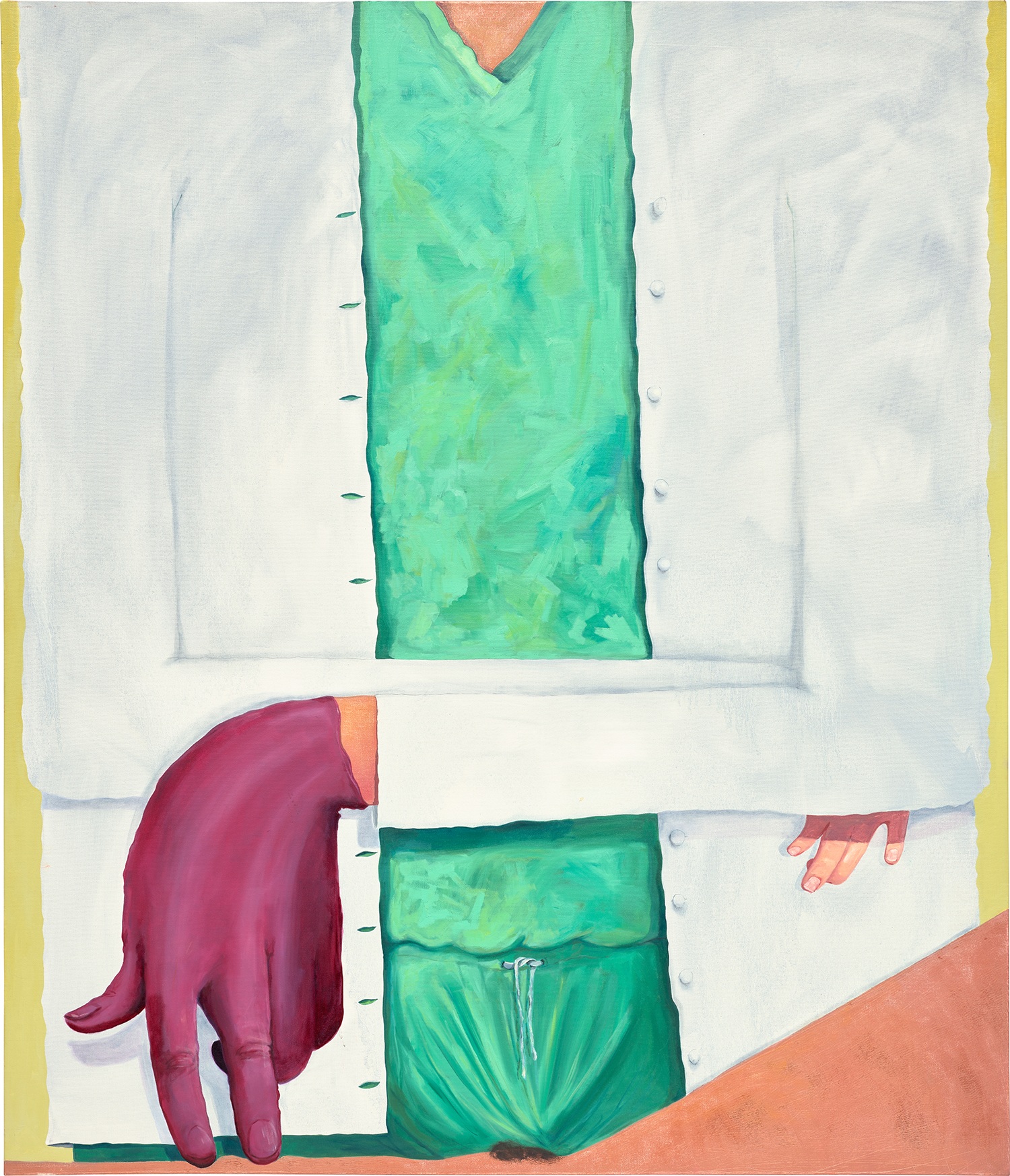
Jammie Holmes
Two works: (i–ii), 2019
To place Holmes within a broader art historical conversation is to understand something about the richness of the tradition he is working within and extending. The lineage of American figurative painting that runs through Tanner, Jacob Lawrence, and Marshall finds in Holmes a painter who has absorbed those lessons and brought them somewhere new, somewhere specific to his own generation and geography. There are also resonances with artists like Derrick Adams and Jordan Casteel, contemporaries who share his investment in Black everyday life as a subject of radical and necessary beauty. Where Holmes distinguishes himself is in the particular quality of Southern light and memory that saturates his canvases, a quality that is not easily replicated and not easily forgotten.
What Holmes has built, work by work and year by year, is a body of painting that insists on the fullness of life as he has known and loved it. His people are not symbols or types but fully inhabited presences, individuals caught in moments of prayer, play, waiting, and togetherness. In an art world that sometimes mistakes complexity for obscurity, Holmes offers something rarer: depth that is also clarity, ambition that is also warmth. He is painting toward something lasting, and the record already suggests he is well on his way.