Jacques-Émile Blanche
The Painter Who Knew Everyone Worth Knowing
Artist Spotlight · The Collection Editorial
Picture Paris at the turn of the twentieth century: gaslit salons thick with cigarette smoke and brilliant conversation, a young painter moving between the literary drawing rooms of Auteuil and the artists' studios of Montmartre with equal ease. Jacques Émile Blanche occupied this world not as a peripheral figure but as one of its most perceptive witnesses, armed with a brush and an extraordinary instinct for the inner life of his sitters. His portraits constitute nothing less than a painted archive of the Belle Époque at its most luminous, a gallery of faces that shaped modern European culture and whose legacies continue to reverberate through art, literature, and music to this day. Blanche was born in Paris in 1861 into a milieu that virtually guaranteed cultural immersion.
Jacques-Émile Blanche
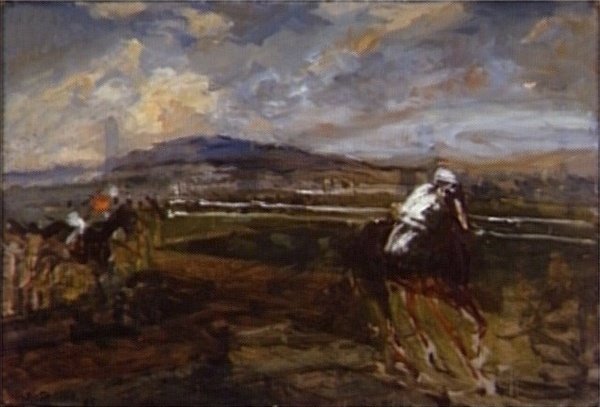
Courses, 1935
His father, Esprit Blanche, was a celebrated psychiatrist whose clinic in Passy and later in Auteuil attracted some of the most remarkable figures in French intellectual life, including the poet Gérard de Nerval. Growing up in this charged atmosphere, surrounded by artists, writers, and thinkers who came as much for the conversation as for the care, Blanche absorbed the rhythms of creative society from childhood. He trained under the painter Henri Gervex and later under the tutelage of Édouard Manet, an association that would prove decisive in shaping his commitment to capturing contemporary life with directness and psychological candor. Blanche's formation took a further crucial turn through his repeated visits to England, where he forged friendships with Walter Sickert and became a devoted admirer of the English portrait tradition.
He exhibited at the New English Art Club in London, aligning himself with a generation of painters determined to push portraiture beyond stiff formality toward something more searching and alive. This cross channel sensibility gave his work a distinctive openness, a willingness to let the sitter's personality breathe within the composition, that set him apart from many of his French contemporaries. He spent long summers at Dieppe, that beloved retreat of artists and writers, where the light off the Channel softened forms and the social world compressed itself into an almost ideal laboratory for observation. The resulting portraits are among the most compelling social documents in the history of French painting.
Jacques-Émile Blanche
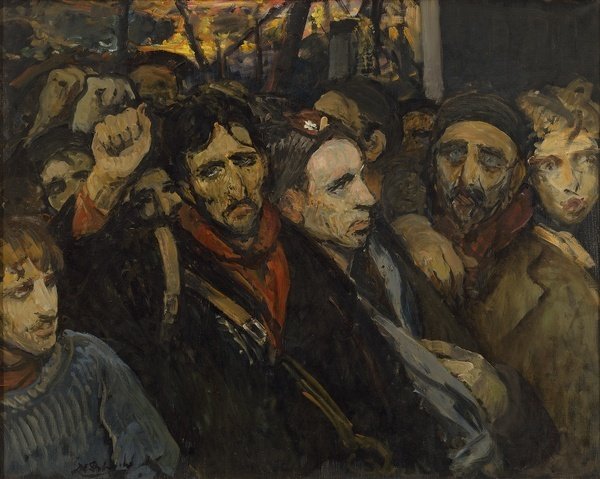
Miliciens, 1939
Blanche painted Marcel Proust in 1892, producing an image of the young writer that remains one of the most reproduced likenesses in all of literary portraiture, capturing a dreamy, slightly melancholic elegance that seems entirely in sympathy with the future author of À la Recherche du Temps Perdu. He painted Claude Debussy, Igor Stravinsky, Thomas Hardy, W. B. Yeats, Aubrey Beardsley, and Jean Cocteau, among many others, assembling over decades a portrayal of an era that no photograph could quite replicate.
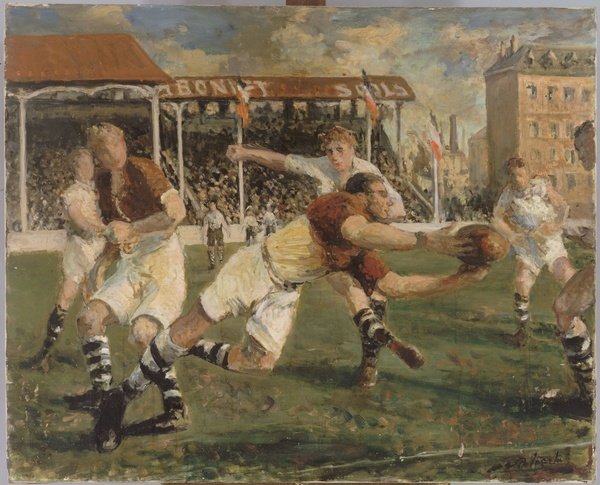
What distinguishes these works is not merely their documentary value but their painterly intelligence: Blanche understood that a great portrait must reconcile likeness with interpretation, surface with interiority. The works available on The Collection offer a revealing and perhaps surprising window into a dimension of Blanche's practice that is less frequently discussed than his famous portraits: his engagement with contemporary social and political life in the 1930s and late 1930s. Works such as Courses from 1935 and Gymnopédies modernes from the same year, painted in oil, suggest an artist still vitally engaged with the spectacle of modern life, finding in leisure and movement the same energy that had animated his early society scenes. More sobering are Miliciens from 1939 and Manifestation populaire from 1938, painted as Europe moved toward catastrophe.
Jacques-Émile Blanche
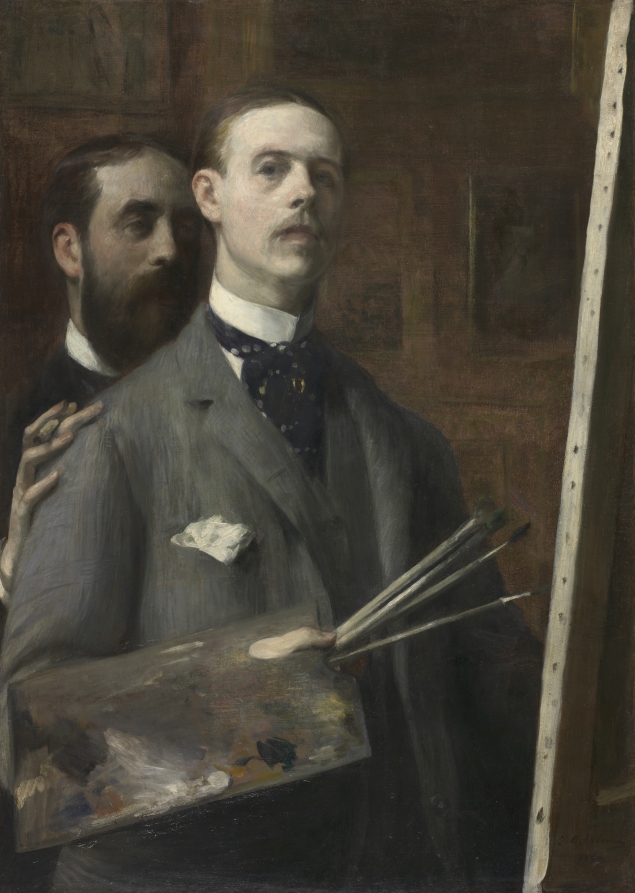
Self-Portrait with Raphael de Ochoa, 1890
These canvases reveal a painter watching his world transform with clear eyes, unwilling to retreat entirely into the comfortable aestheticism of his earlier decades. Self Portrait with Raphael de Ochoa from 1890 offers yet another register entirely, an intimate and confident declaration of artistic identity at a moment when Blanche was consolidating his reputation on both sides of the Channel. For collectors, Blanche presents a genuinely compelling proposition. His works occupy a space between the grand tradition of academic portraiture and the looser, more psychologically penetrating approach of the Impressionist generation, making them versatile companions to collections that range across late nineteenth and early twentieth century European painting.
Artists such as Giovanni Boldini, John Singer Sargent, and Walter Sickert share something of his territory, each navigating the tension between likeness and atmosphere, between social performance and private truth. Collectors drawn to Sargent's bravura or to Boldini's electric linearity will find in Blanche a cooler, more introspective counterpart, one whose works reward sustained looking rather than immediate dazzle. His late paintings of public life and social upheaval add a dimension of historical seriousness that gives a collection genuine depth. Blanche was also a prolific writer, producing memoirs and critical essays that remain valuable sources for understanding the cultural life of his era.
Jacques-Émile Blanche
Gymnopédies modernes, 1935
His books, including Propos de peintre, offer firsthand accounts of the studios and salons he frequented with a combination of wit, affection, and sharp critical intelligence. This dual practice as painter and writer was not unusual among artists of his generation, but Blanche brought to it an unusual consistency of sensibility: the same quality of attention that animates his painted portraits runs through his prose, a desire to fix the essential character of a person or a moment before it dissolves. He died in 1942, having witnessed the full arc from the confident splendors of the Belle Époque through the catastrophes of two world wars, a witness of rare continuity. Blanche's importance to art history is increasingly recognized by scholars and curators who understand that the great social portraits of the Belle Époque are not merely decorative achievements but primary historical documents.
The Musée des Beaux Arts de Rouen holds significant works, and major French institutions have periodically returned to his practice as a touchstone for understanding the cultural networks of the era. As interest in the period around 1900 continues to grow, and as collectors and institutions look more carefully at the figures who connected its many brilliant individuals into something coherent, Blanche stands out as an artist whose full stature is still being appreciated. To acquire a work by Jacques Émile Blanche is to welcome into a collection not merely a beautiful object but a piece of living cultural memory, painted by someone who was genuinely, irreplaceably there.