Italian, in 17th century style
Bronze, Gold, and the Glory of Motion
Artist Spotlight · The Collection Editorial
There is a particular kind of electricity that moves through a room when a pair of rearing horses cast in gilt bronze catch the light. The metal seems almost to breathe, the sinew and muscle of each animal caught at the precise summit of movement, hooves lifted, necks arched, every ounce of energy suspended in permanent golden tension. This is the world of the Italian Baroque sculptor working in the grand tradition of the seventeenth century, a tradition that understood bronze not merely as a material but as a language, and horses not merely as subjects but as embodiments of sovereign power, celestial ambition, and the eternal drama of nature restrained by art. The seventeenth century in Italy was among the most consequential periods in the history of Western sculpture.
Italian, in 17th century style
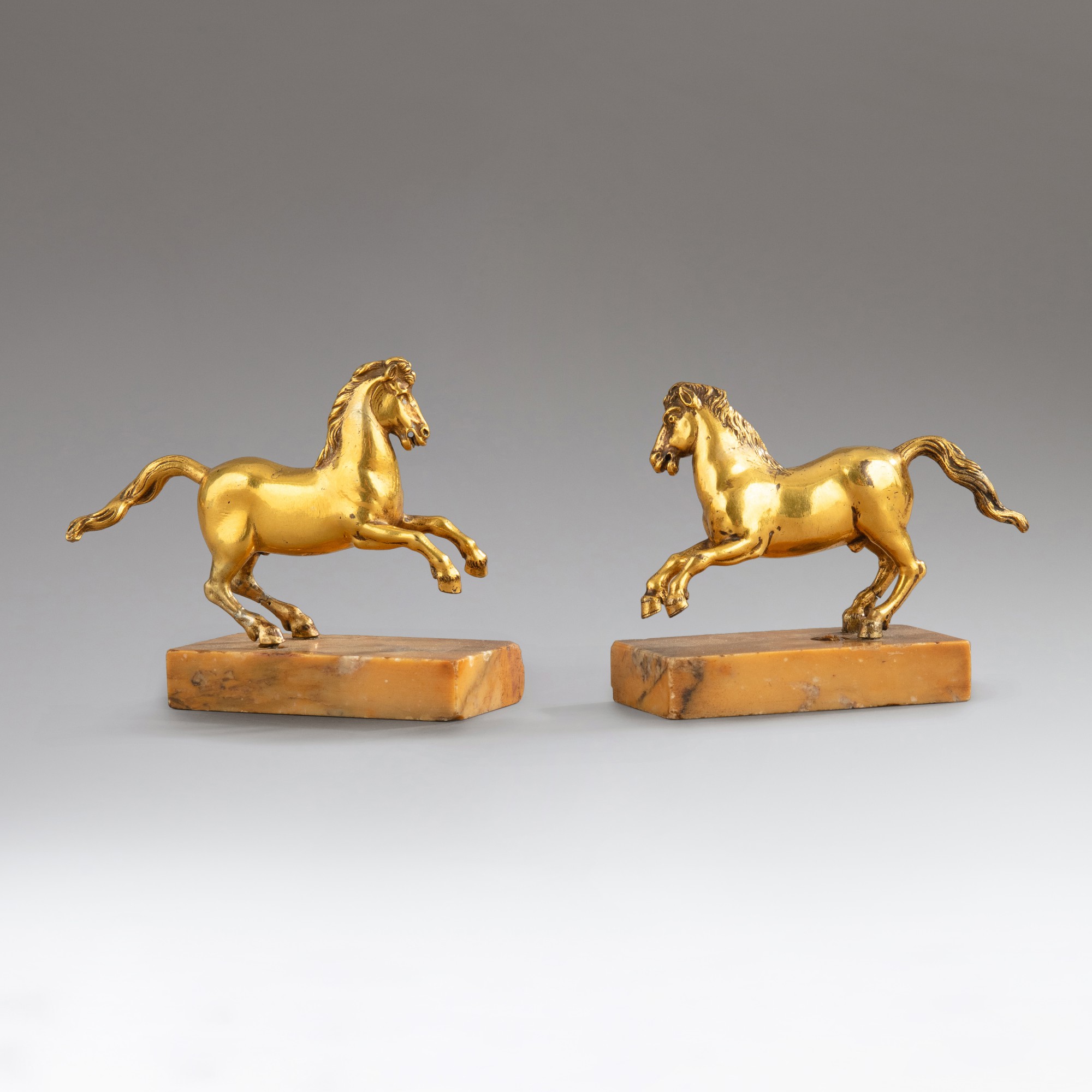
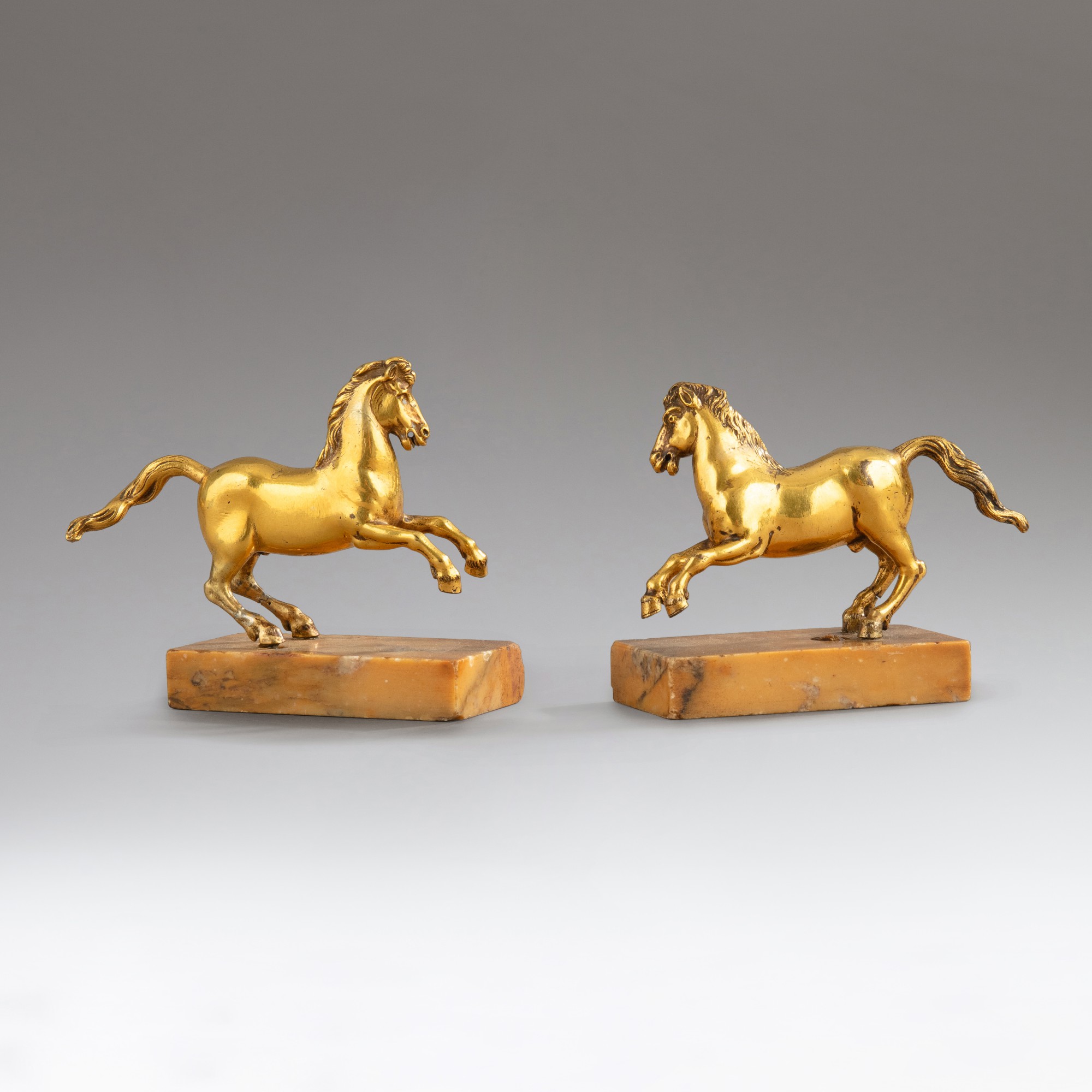
Paire de chevaux cabrés
From Rome to Florence, from Naples to Bologna, workshops hummed with the demands of popes, princes, and the newly wealthy merchant classes, all of whom understood that bronze could confer a kind of immortality unavailable to paint or marble. The period produced figures of towering influence: Gian Lorenzo Bernini reshaped Rome itself with his theatrical vision, while Giambologna's legacy continued to pulse through generations of sculptors who trained in his Flemish and Florentine synthesis. It was into this charged atmosphere that the tradition of the small bronze, the statuette intended for the cabinet and the studiolo, reached its most sophisticated expression. The rearing horse, or cavallo cabré, occupied a singular place within this sculptural vocabulary.
The motif had roots stretching back to antiquity, to the great equestrian monuments of Rome and the idealized horses of the Parthenon frieze, but the Baroque period gave it a new psychological intensity. Where Renaissance sculptors had favored a certain serene command in their equine subjects, the seventeenth century embraced the moment of wildness, the instant before control is reasserted, the horse at its most magnificent and most dangerous. To render this in gilt bronze, with its warm amber glow, was to transform volatility into treasure. The works now held within The Collection speak directly to this tradition at its most refined.
Italian, in 17th century style
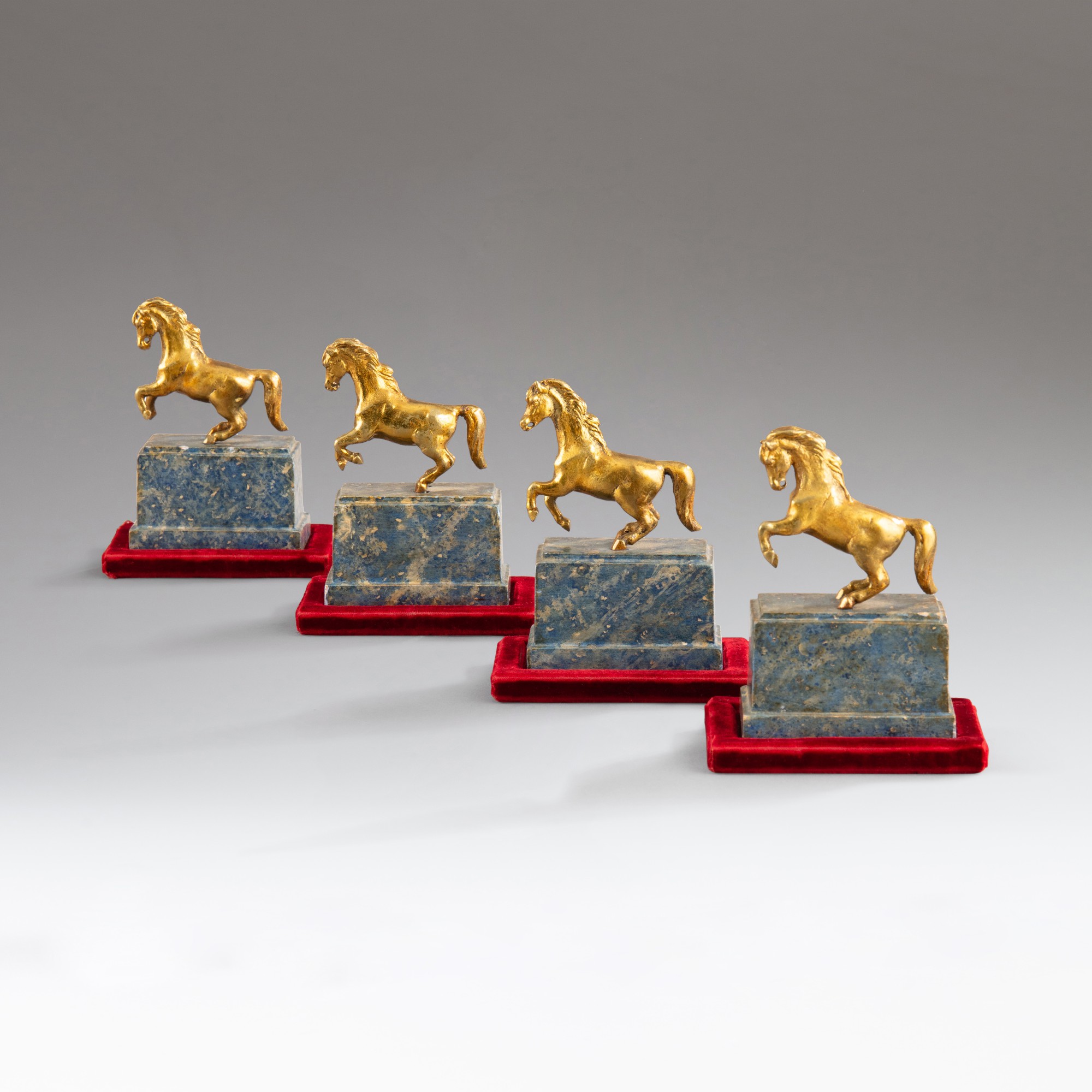
Ensemble de quatre chevaux cabrés
The Paire de chevaux cabrés, a pair of rearing horses in gilt bronze mounted on rectangular bases of yellow Sienna marble, demonstrates the period's sophisticated understanding of presentation as part of the artwork itself. Sienna marble, with its deep ochre warmth, was among the most prized decorative stones of the era, favored by collectors and patrons across Italy and France precisely because its color harmonized with the golden tones of gilt bronze, creating an ensemble that felt less like an object and more like a concentrated piece of the sun. The choice of rectangular bases also speaks to a classicizing sensibility, the horses elevated above the world of the viewer, placed on platforms that echo the plinths of Roman triumphal monuments. Equally remarkable is the Ensemble de quatre chevaux cabrés, a grouping of four gilt bronze rearing horses mounted on painted wooden bases crafted to imitate lapis lazuli.
Here the ambition is even more theatrical. Lapis lazuli, that deep celestial blue quarried in the mountains of Afghanistan and traded across the known world at enormous expense, was among the most symbolically loaded materials available to any seventeenth century patron or artist. To simulate it in painted wood and then place golden horses upon that blue ground was to invoke the heavens themselves, to set the drama of these animals against the color of the Madonna's robe and the firmament beyond. As a group of four, the ensemble also carries dynastic and allegorical weight, calling to mind the four horses of antiquity, the quadriga of Roman triumphal arches, and the ancient symbolism of horses as carriers of the divine.
The sculptors and workshops responsible for objects of this quality in the seventeenth century were deeply embedded in networks of patronage and connoisseurship that stretched across European courts. The tradition of the Italian bronze had by the 1600s become genuinely international, with collectors in France, Spain, the Holy Roman Empire, and England all competing for works produced by Italian hands. Figures like Francesco Fanelli, who brought the Italian bronze tradition to the court of Charles I of England, and Massimiliano Soldani Benzi, whose late Baroque bronzes set new standards for finish and psychological depth, remind us how widely this tradition traveled and how eagerly it was received. The gilt bronze horse in particular became a kind of universal currency of sophistication, appearing in the cabinets of cardinals and the country houses of English lords with equal comfort.
For collectors approaching works of this period today, several considerations define quality and desirability. The patina and gilding on seventeenth century bronzes tell a story of their own: original fire gilding, applied through a process that bonded mercury and gold to the bronze surface before the mercury was burned away, has a depth and warmth that later electroplating cannot replicate. The modeling of the mane, the articulation of the hooves, the treatment of the eyes and nostrils, all of these details reveal the skill and ambition of the atelier responsible. Works mounted on period bases, whether genuine marble or sophisticated painted wood simulating precious stone, represent an additional layer of rarity, as these ensembles so rarely survived intact across four centuries.
The Collection's examples, with their original bases preserved, represent precisely the kind of complete, uninterrupted survival that connoisseurs prize most highly. The Baroque tradition of Italian bronze sculpture sits in a compelling relationship with the broader history of European art as it is understood today. Collectors drawn to this period often find their interests extending naturally toward the work of Bernini's contemporaries in painting, toward Pietro da Cortona's exuberant ceilings or Luca Giordano's luminous mythologies, works that share the same appetite for movement, drama, and sensuous material richness. There is also a natural conversation to be had with the French Baroque tradition, which absorbed so many lessons from Italy and produced its own distinguished line of bronze sculptors working in the generation of Louis XIV.
What the seventeenth century Italian tradition offers a collector in the present moment is something that no subsequent period has quite replicated: a perfect alignment between technical mastery, philosophical ambition, and material splendor. These objects were made to be handled, to catch candlelight, to be turned in the hands of their owners during long evenings of conversation about philosophy, history, and the nature of beauty. They carry within them the warmth of those rooms, the intelligence of those conversations, and the skill of hands that understood bronze as a living thing. To bring them into a collection today is not merely to acquire an object of historical significance.
It is to continue a dialogue that began in the workshops of seventeenth century Italy and has never, in truth, fallen silent.
Explore books about Italian, in 17th century style
Le vite de' più eccellenti pittori, scultori, et architettori
Giorgio Vasari
Idea del tempio della pittura
Federico Zuccaro
Considerazioni sulla pittura
Michelangelo Amerighi
Trattato della pittura
Leonardo da Vinci
Vita di Caravaggio
Giovanni Baglione
Le meraviglie dell'arte
Carlo Cesare Malvasia
Arti per ben vivere
Giovan Pietro Bellori
Vite de pittori, scultori ed architetti moderni
Giovan Pietro Bellori