Ilya Sergeevich Glazunov
Ilya Glazunov: Russia's Grand Visual Storyteller
Artist Spotlight · The Collection Editorial
In the vast hall of the Russian Academy of Arts in Moscow, where Ilya Glazunov served as rector for decades, visitors still gather before his monumental canvases with something close to reverence. His death in 2017 did not diminish the conversation around his work. If anything, the distance of years has allowed a more measured appreciation of what he achieved: a singular, sustained attempt to paint the soul of Russia at a moment when that soul was under extraordinary pressure. For collectors approaching his work today, the opportunity is to engage with a painter who was never minor, never peripheral, and never anything less than fully committed to his vision.
Ilya Sergeevich Glazunov
Russian Beauty
Ilya Sergeevich Glazunov was born in Leningrad in 1930, into a family that would be devastated by the Siege of Leningrad during the Second World War. He lost much of his family to the blockade, an experience that marked him permanently and gave his later art its characteristic intensity. He survived by being evacuated to relatives in the countryside, and those early years in rural Russia instilled in him a deep attachment to the Orthodox tradition, the wooden architecture of old Russian villages, and the landscapes of the Russian interior. These were not nostalgic affectations but genuine formative experiences that he carried into every studio for the rest of his life.
He trained at the Leningrad Institute of Painting, Sculpture and Architecture, known as the Repin Institute, where he studied under Boris Ioganson and graduated in 1957. His emergence as a painter coincided with the Khrushchev Thaw, a cultural loosening that allowed Soviet artists some room to breathe, though never entirely freely. Glazunov occupied an unusual and at times controversial position within Soviet culture. He was neither a dissident in the conventional sense nor a straightforward instrument of state ideology.
Ilya Sergeevich Glazunov
Suzdal
His fierce attachment to pre Revolutionary Russian identity, to the Orthodox Church, and to historical painting placed him outside the mainstream of Socialist Realism without ever placing him in open opposition to the authorities who, at various moments, both celebrated and regarded him with suspicion. Through the 1960s and 1970s Glazunov developed what would become his signature approach: large scale figurative painting that drew on the traditions of the Russian Wanderers, the Peredvizhniki movement of the nineteenth century, while incorporating something more expressionistic and emotionally charged. He was deeply influenced by the Old Masters of European painting, and made extended studies in Italy, where he absorbed the compositional grandeur of Renaissance fresco traditions. This synthesis gave his work its distinctive quality: paintings that feel at once ancient and urgent, as though the history they depict is still happening somewhere just out of sight.
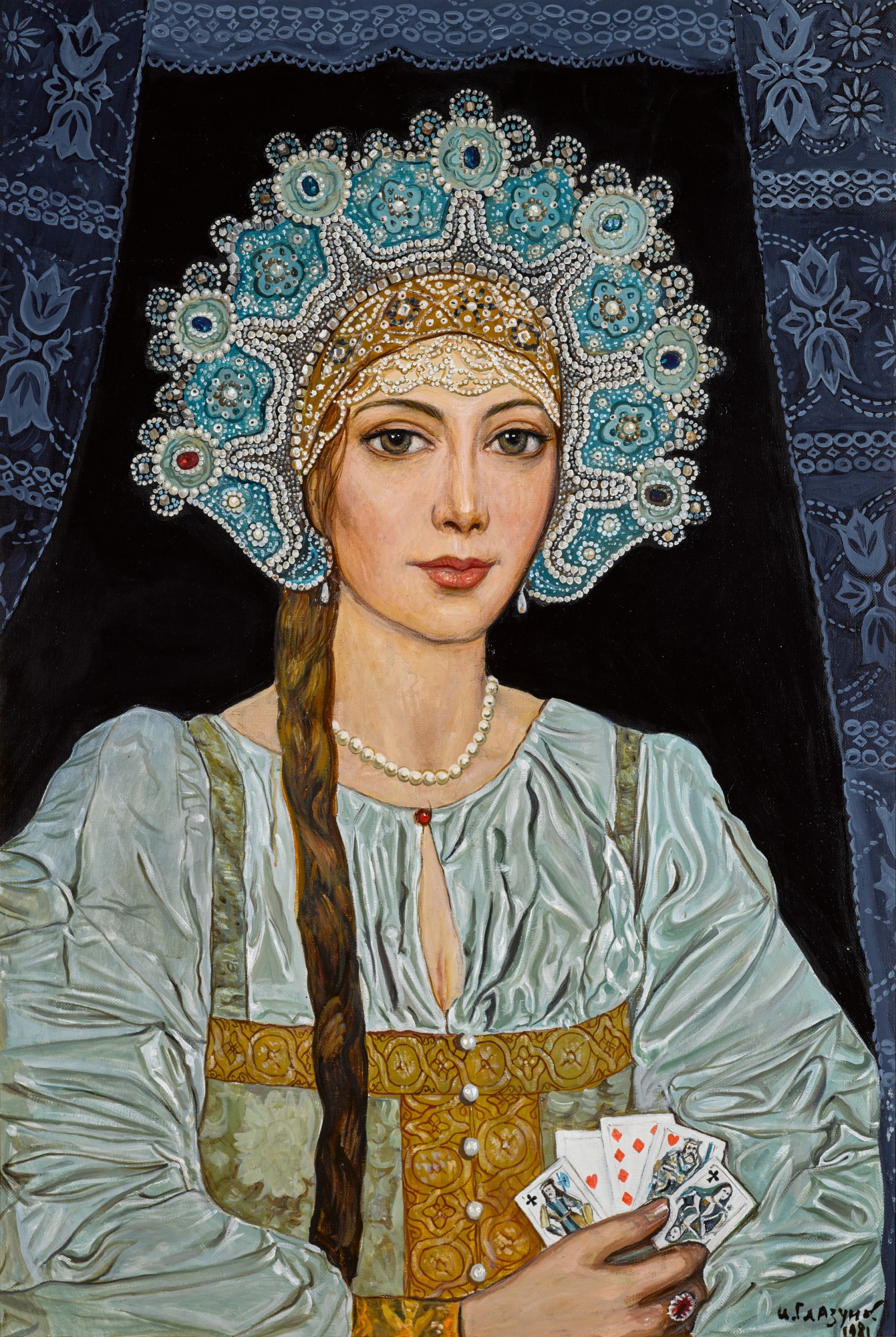
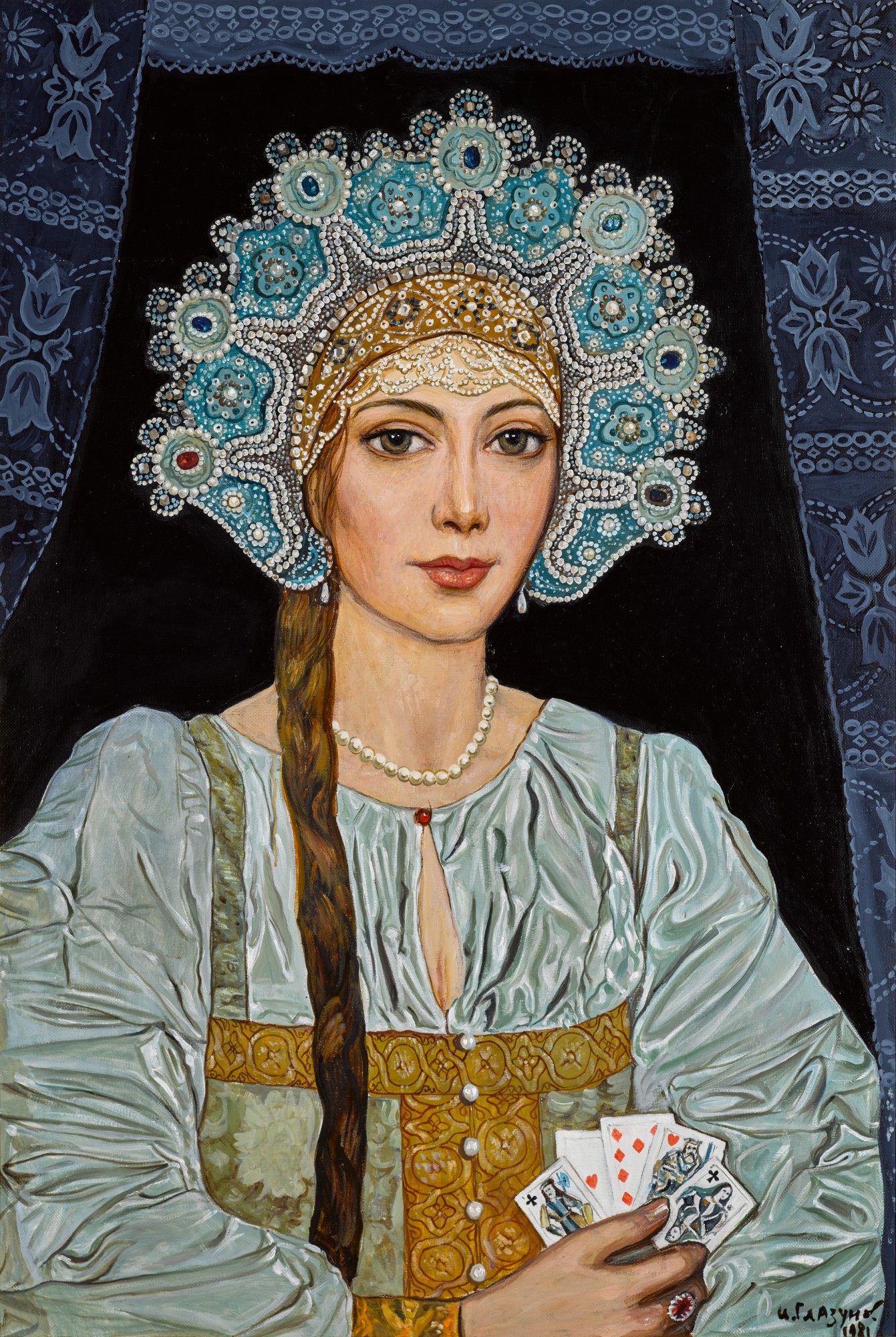
He received commissions for official portrait work, painting figures including Indira Gandhi and Federico Fellini, which brought him international visibility at a time when Soviet artists rarely crossed those boundaries. Among his most celebrated works, Russian Beauty stands as one of the most recognisable images in his body of work. The painting captures an idealized vision of Russian feminine identity rooted in folk tradition, rendered with a craft that is simultaneously intimate and iconic. It belongs to a series of works in which Glazunov explored what he understood as the essential character of Russian culture, using the female figure as a vessel for historical memory.
Ilya Sergeevich Glazunov
Landscape with a Wooden Chapel
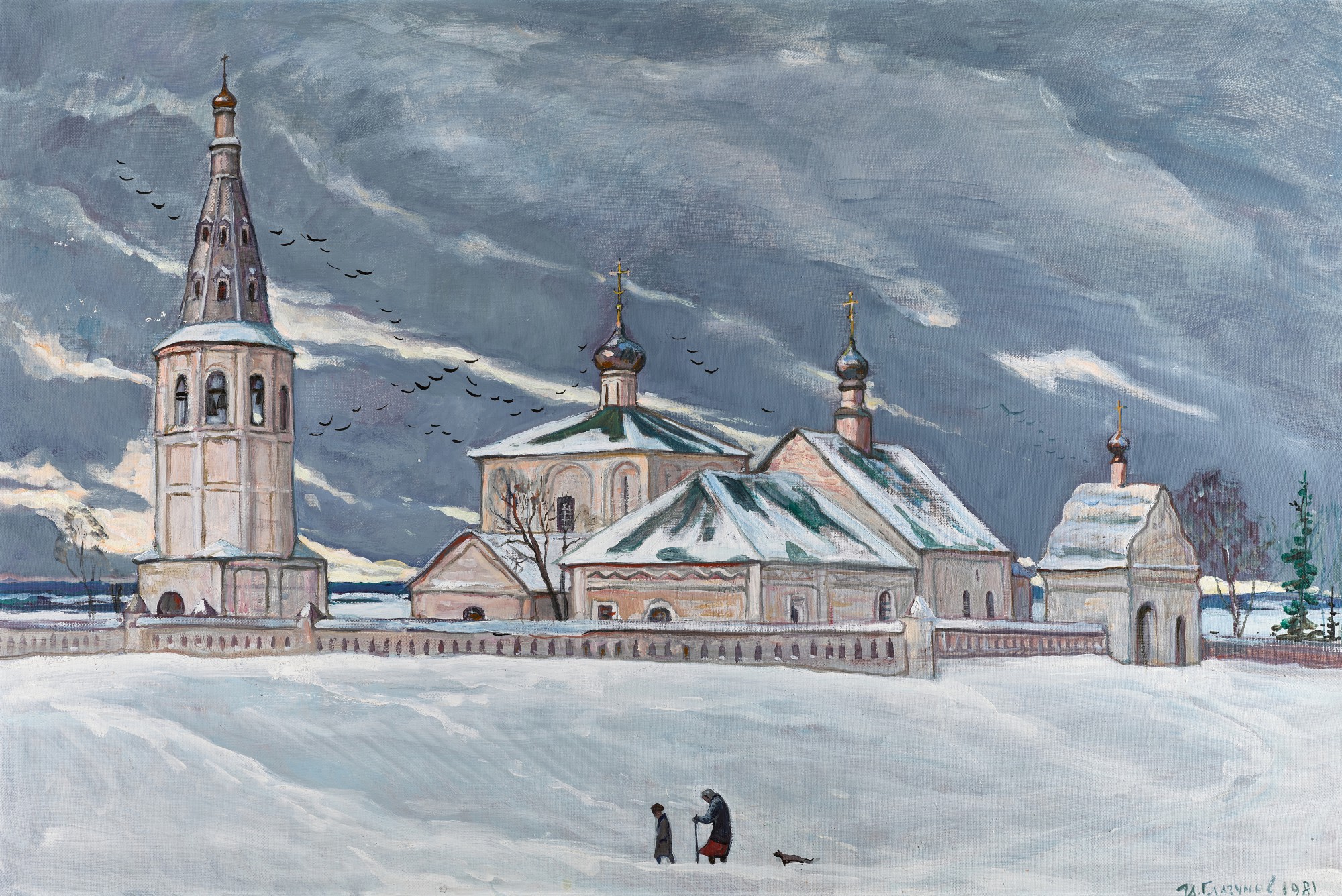
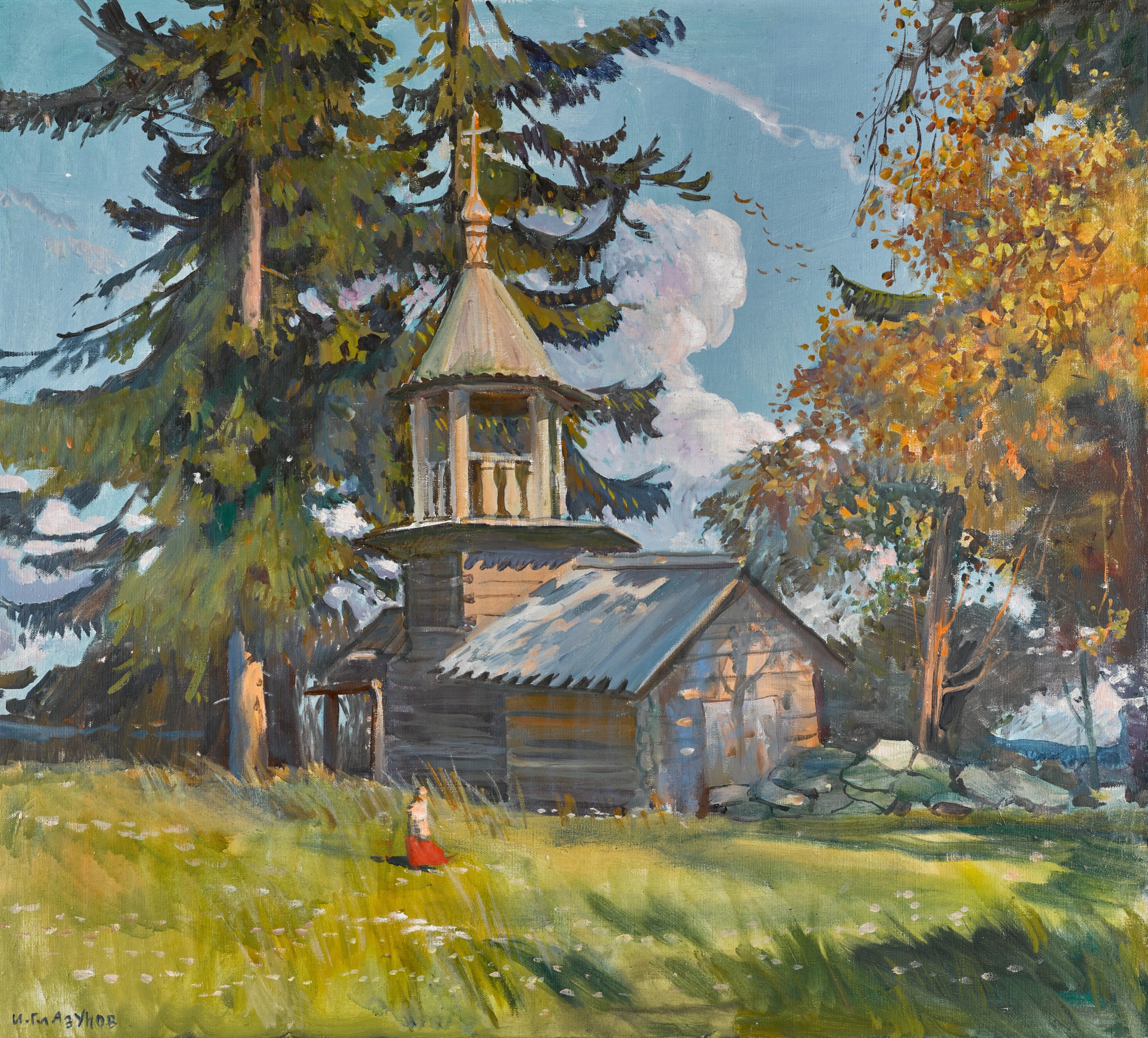
Suzdal, his oil painting of the ancient city, demonstrates his mastery of landscape as a form of cultural argument. Suzdal was one of the jewels of the Golden Ring, the string of medieval Russian towns northeast of Moscow, and Glazunov's treatment of it is both documentary and devotional, a record of a place and an act of homage to its survival. Landscape with a Wooden Chapel, the third major work available through The Collection, reveals another register entirely: quieter, more personal, rooted in the kind of rural Russian scene he first encountered as a child evacuated from the siege. The wooden chapel rising from the landscape carries the full weight of his belief in the continuity of Russian spiritual life.
For collectors, Glazunov presents a genuinely compelling proposition. His work operates at the intersection of several serious traditions: Russian figurative painting, European classical technique, and a distinctly twentieth century urgency about national identity and historical memory. These are themes that resonate across cultures and that art historical scholarship is increasingly taking seriously. His portraits of international figures brought him into contact with a global network of collectors and institutions, and his works are held in Russian state museums including the Tretyakov Gallery as well as in private collections across Europe.
The Ilya Glazunov Gallery in Moscow, which opened in 2004 and is dedicated entirely to his work, stands as one of the few institutions in the world devoted to a single living or recently living Russian artist of the twentieth century, a measure of the esteem in which he is held domestically. Placing Glazunov within a broader art historical context, one finds natural companions in the tradition of Russian figurative painting that runs from Ivan Shishkin and Ilya Repin through to the Soviet period. His concern with landscape and national identity invites comparison with contemporaries who worked in other national traditions but with similar preoccupations: the kind of commitment to place and cultural continuity that one also finds in certain strands of American realism or in the work of European painters who responded to the disruptions of the twentieth century by rooting themselves more deeply in history. His monumental scale and allegorical ambition also place him in dialogue with the great mural traditions of the twentieth century, though his allegiances were always to canvas rather than wall.
Glazunov's legacy is still being written. The distance from the political controversies that sometimes surrounded him in life allows a cleaner view of the paintings themselves, and what those paintings reveal is a body of work of extraordinary ambition and genuine craft. He spent his career arguing, through paint, that Russian culture had a deep past worth preserving and celebrating, and he made that argument with more skill and more consistency than almost anyone else working in that tradition. For a collector who values figurative painting with historical depth and spiritual weight, his work offers something that is increasingly rare: a complete world, rendered with total conviction.
Explore books about Ilya Sergeevich Glazunov