Huang Junbi
Mountains, Mist, and Timeless Mastery
Artist Spotlight · The Collection Editorial
There are painters who document a landscape, and there are painters who inhabit it so completely that the boundary between artist and mountain dissolves entirely. Huang Junbi belonged emphatically to the second category. Born in 1898 in Panyu, Guangdong province, he came of age during one of the most turbulent and creatively fertile periods in Chinese history, and he responded not with anxiety but with extraordinary attentiveness to the natural world. His brushwork carries a quality of stillness that feels, in our present moment of relentless distraction, almost revolutionary in its patience.
Huang Junbi
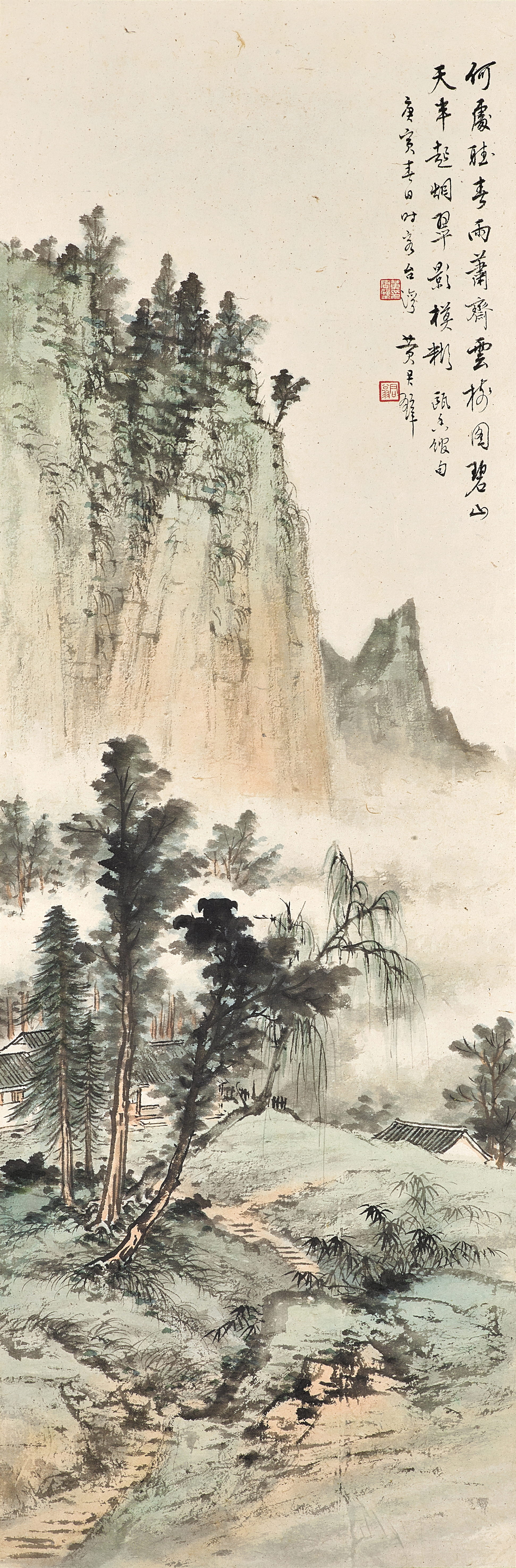
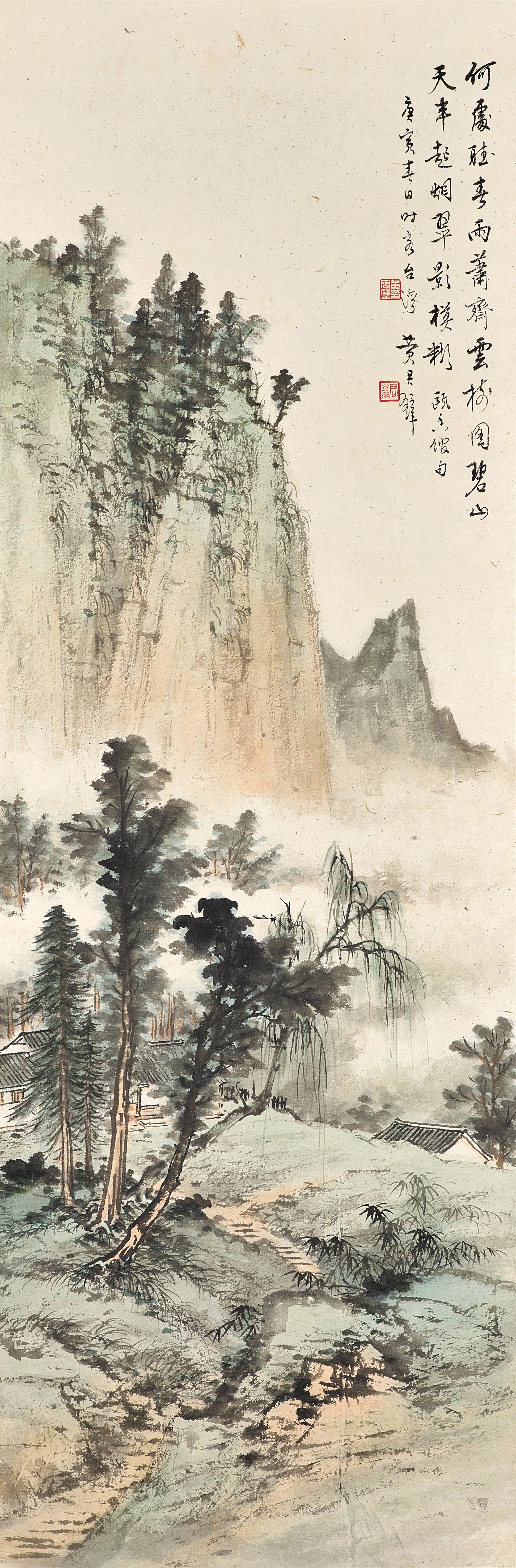
Huang Junbi, Misty Spring Mountains
Huang Junbi grew up in Guangdong at a time when southern China's artistic culture was vibrant and contested. The Lingnan School of painting, rooted in Guangzhou and championing a synthesis of Chinese and Japanese techniques with a willingness to engage Western influence, was reshaping what it meant to paint in a Chinese idiom. Huang absorbed these debates deeply. He studied under masters who valued the classical Four Masters of the Yuan dynasty as touchstones, yet he was equally drawn to the living landscape around him, the wet hills and cloud threaded gorges of southern China that demanded a looser, more atmospheric approach than the northern monumental tradition allowed.
From his earliest years, he understood that tradition was not a cage but a conversation. His artistic education took him across China and eventually abroad. In the 1920s and 1930s he traveled extensively, sketching from nature in a practice that was, at the time, a deliberate methodological statement. Where an earlier generation might have copied master scrolls in a studio, Huang sat before actual mountains and rivers, his brush responding to light and weather in real time.
Huang Junbi
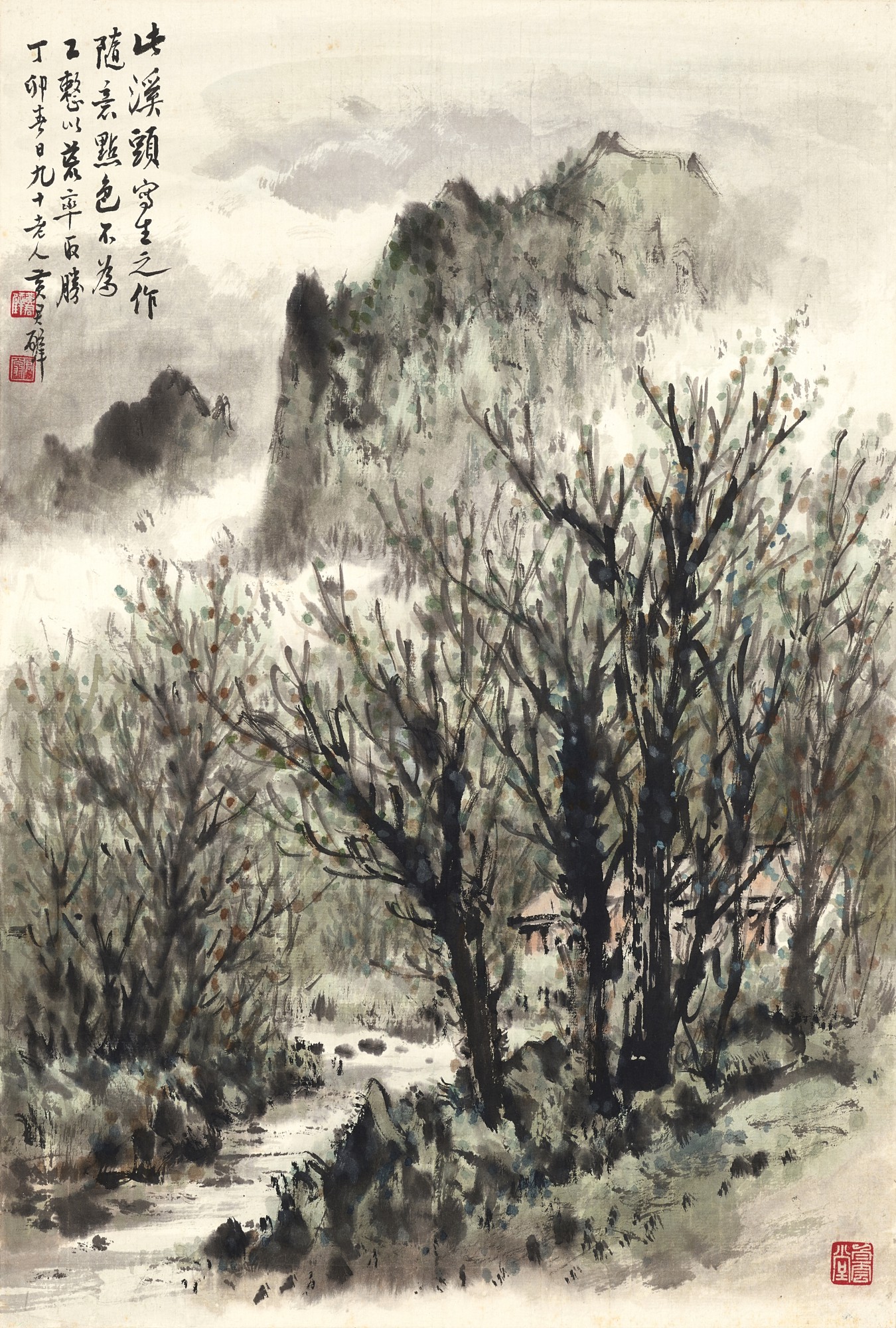
Huang Junbi, Creek in Distant Woods
This commitment to direct observation gave his compositions a vitality that distinguishes them immediately from academic imitation. By the time he relocated to Taiwan in 1949, following the broader movement of many Republic of China cultural figures, he had already developed a mature voice rooted in ink and colour on paper that was unmistakably his own. In Taiwan, Huang's influence expanded enormously. He joined the faculty of National Taiwan Normal University, where he taught for decades and shaped generations of painters who would carry his synthesis of classical structure and modern sensibility forward into the late twentieth century and beyond.
His teaching was legendarily rigorous yet deeply generous. Students recalled a man who insisted on the primacy of looking, who believed that no technique was meaningful unless it arose from genuine encounter with the world. His classroom was less a place of rules than a place of sustained attention. The institution became, under his presence, one of the most important centres for ink painting education in the Chinese speaking world.
Huang Junbi
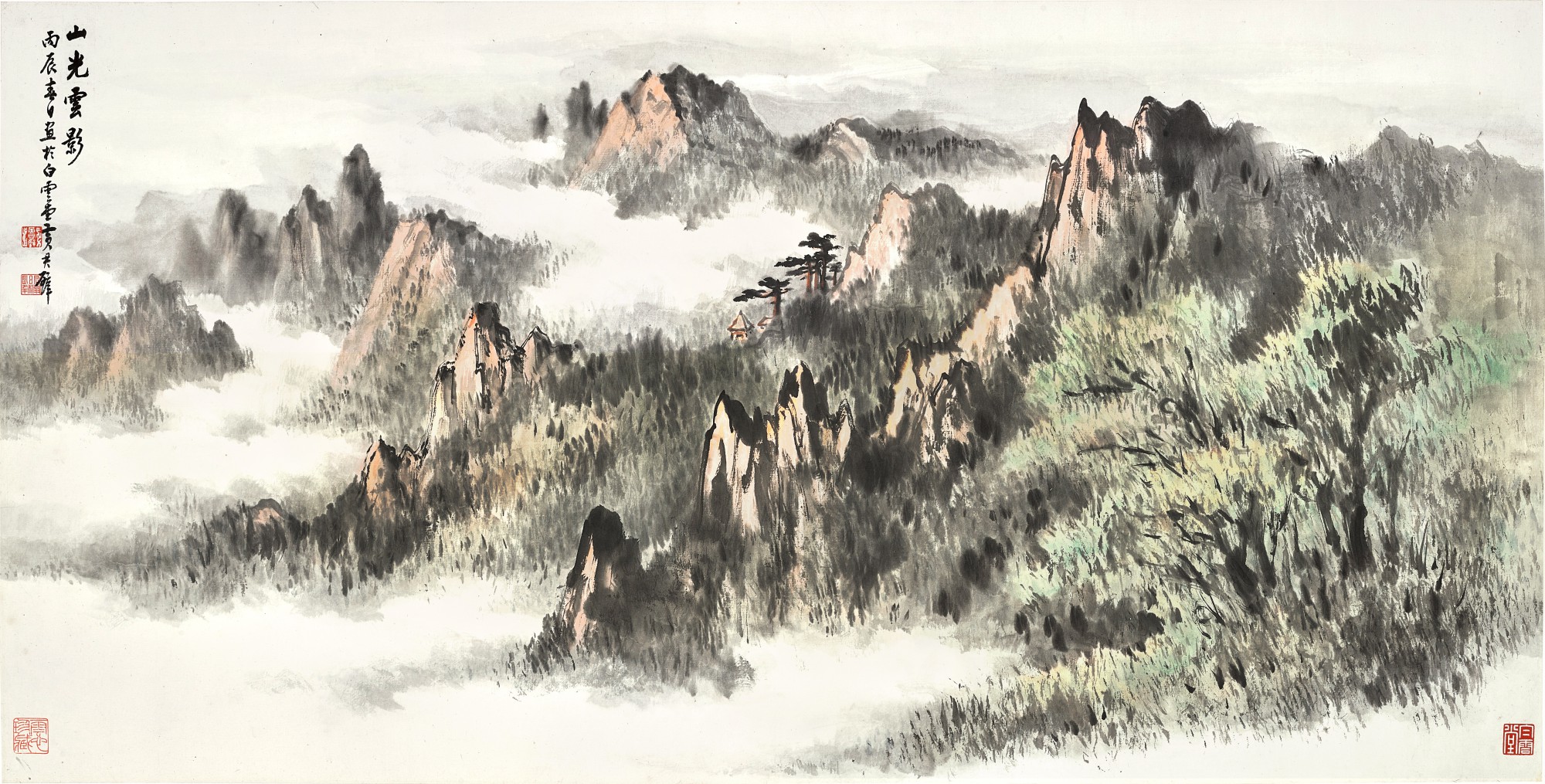
Huang Junbi, Mountains in Mist
The works that define Huang's legacy share a distinctive quality of suspended atmosphere. In pieces such as Misty Spring Mountains and Mountains in Mist, the ink does not simply describe topography but seems to conjure weather itself, the paper breathing with moisture and quiet light. His command of the wet brush technique, deploying washes that bleed and pool with controlled deliberation, creates landscapes that feel simultaneously ancient and immediate. Creek in Distant Woods and Clear Stream by Autumn Woods demonstrate his gift for spatial poetry: the eye is led through layers of recession without ever feeling manipulated, the journey through the picture plane unfolding as naturally as a walk through actual terrain.
Even more intimate works such as Pumpkin, rendered in ink on paper with affectionate directness, reveal an artist who brought the same quality of observation to a garden vegetable as he did to a mountain range. For collectors, Huang Junbi represents one of those rare figures whose work rewards both aesthetic engagement and historical appreciation. His paintings occupy a meaningful position in the broader narrative of twentieth century Chinese art, bridging the classical literati tradition and the modern period without sacrificing the depth of either. Works on paper and hanging scrolls from across his career appear at major auction houses and in specialist Asian art sales in Hong Kong, Taipei, and beyond, where they consistently attract serious attention from collectors who understand the value of genuine mastery.
Huang Junbi
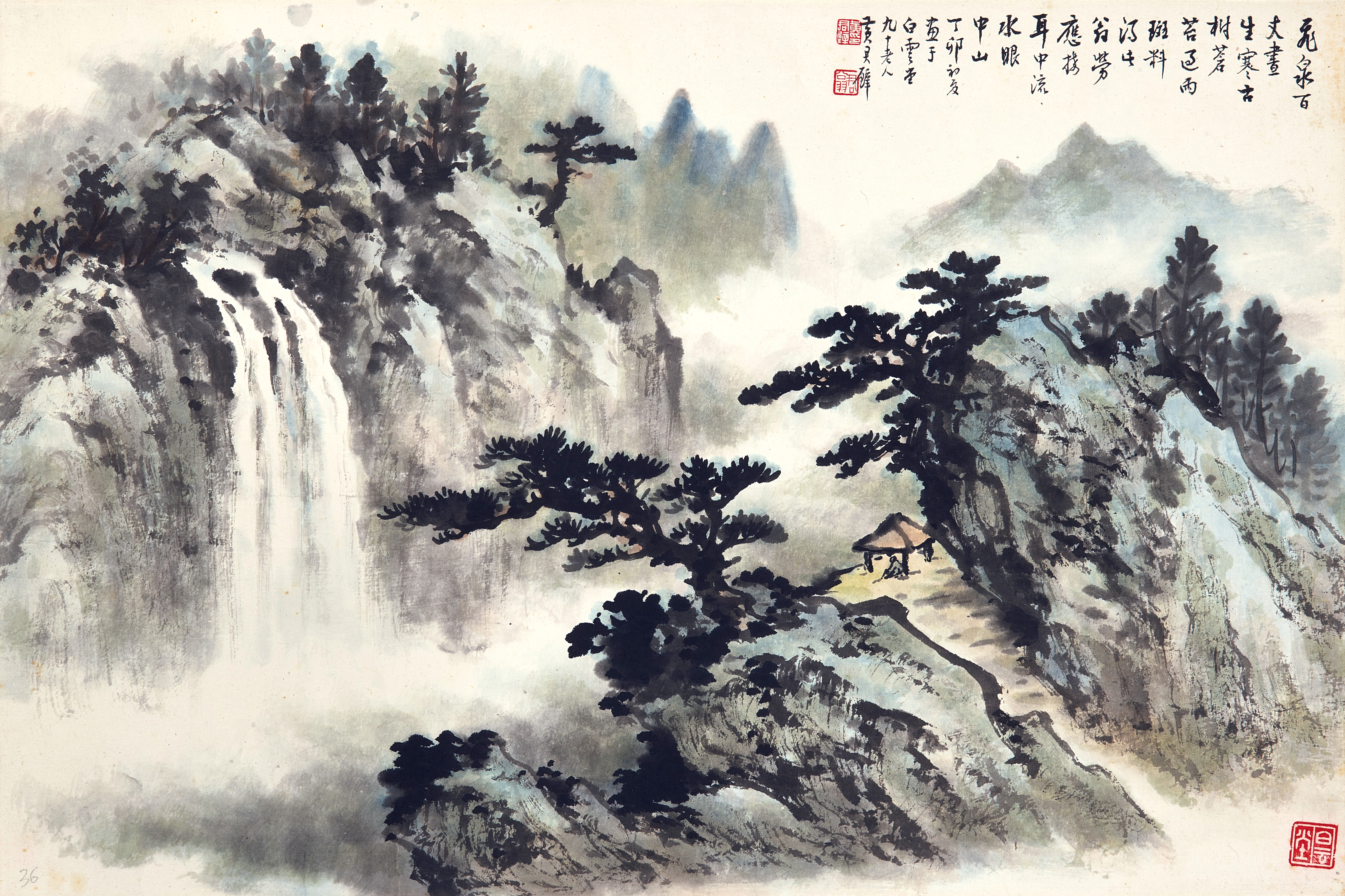
Huang Junbi, Waterfall in Secluded Ravine
Strolling in Spring Mountains, dated 1952, and Waterfall in Secluded Ravine from 1987, spanning nearly four decades of his practice, illustrate how his sensibility deepened and refined over time without losing its essential warmth. Dating is significant with Huang: early Taiwan period works carry particular historical resonance, while later works from the 1980s often display an even freer, more expansive brushwork born of absolute confidence. To understand Huang Junbi fully it helps to place him alongside contemporaries and near contemporaries who were navigating similar questions. Zhang Daqian, another towering figure of twentieth century Chinese ink painting, pursued a bold and sometimes theatrical synthesis that contrasted instructively with Huang's more lyrical restraint.
Fu Baoshi brought an expressionistic urgency to landscape that Huang balanced with greater compositional serenity. In Taiwan specifically, Huang existed within a community of artists committed to the continuation and evolution of guohua, traditional Chinese painting, at a moment when its future was genuinely uncertain. His steadiness in that context was not conservatism but courage: a belief that the language of ink and brush had more to say, and that it was his responsibility to keep that conversation alive. Huang Junbi died in 1991 in Taipei, leaving behind an enormous body of work and an equally significant legacy of teaching.
His students and their students now populate universities, museums, and studios across Taiwan, mainland China, and the diaspora, carrying forward a practice he helped define. In an era when the global art world increasingly values ink painting as a living form rather than a historical curiosity, his work feels not merely relevant but essential. To encounter one of his hanging scrolls is to be reminded that certain artistic problems, how to hold mist in a brush, how to make stillness feel like presence, how to let a mountain be both a mountain and a feeling, are inexhaustible. The Collection is proud to present a selection of his works for the discerning collectors who already understand this, and for those who are about to discover it.
Explore books about Huang Junbi
Huang Junbi: A Master of Chinese Landscape Painting
Michael Sullivan
The Art of Huang Junbi
James Cahill
Huang Junbi and Modern Chinese Painting
Alfreda Murck
Collected Works of Huang Junbi
National Palace Museum
The Landscapes of Huang Junbi
Richard M. Barnhart