Hippolyte-Camille Delpy
Where the River Meets the Light
Artist Spotlight · The Collection Editorial
There is a particular quality of morning mist that settles over the Seine and Oise river valleys of northern France, a soft, diffuse luminosity that seems to dissolve the boundary between water and sky. It is this quality, at once fleeting and eternal, that Hippolyte Camille Delpy spent his life chasing. In recent years, as collectors and institutions have turned with renewed appetite toward the Barbizon tradition and its Impressionist offshoots, Delpy has emerged as one of the most quietly compelling figures in that lineage, a painter whose work rewards sustained looking and whose pastoral vision feels, in our anxious present, almost urgently restorative. Delpy was born in 1842 in Joigny, a small town in the Burgundy region of north central France, set along the banks of the Yonne river.
Hippolyte-Camille Delpy
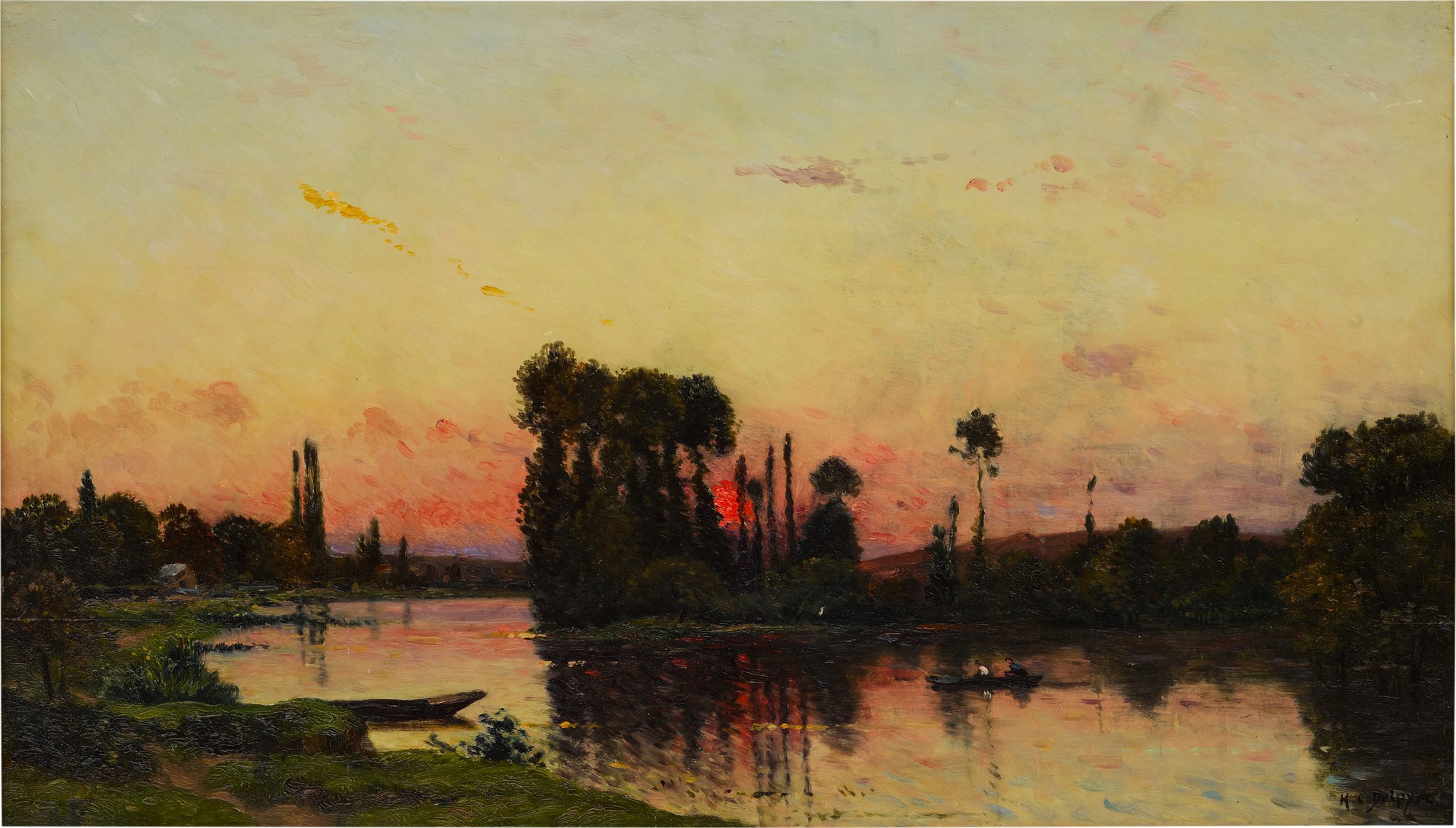
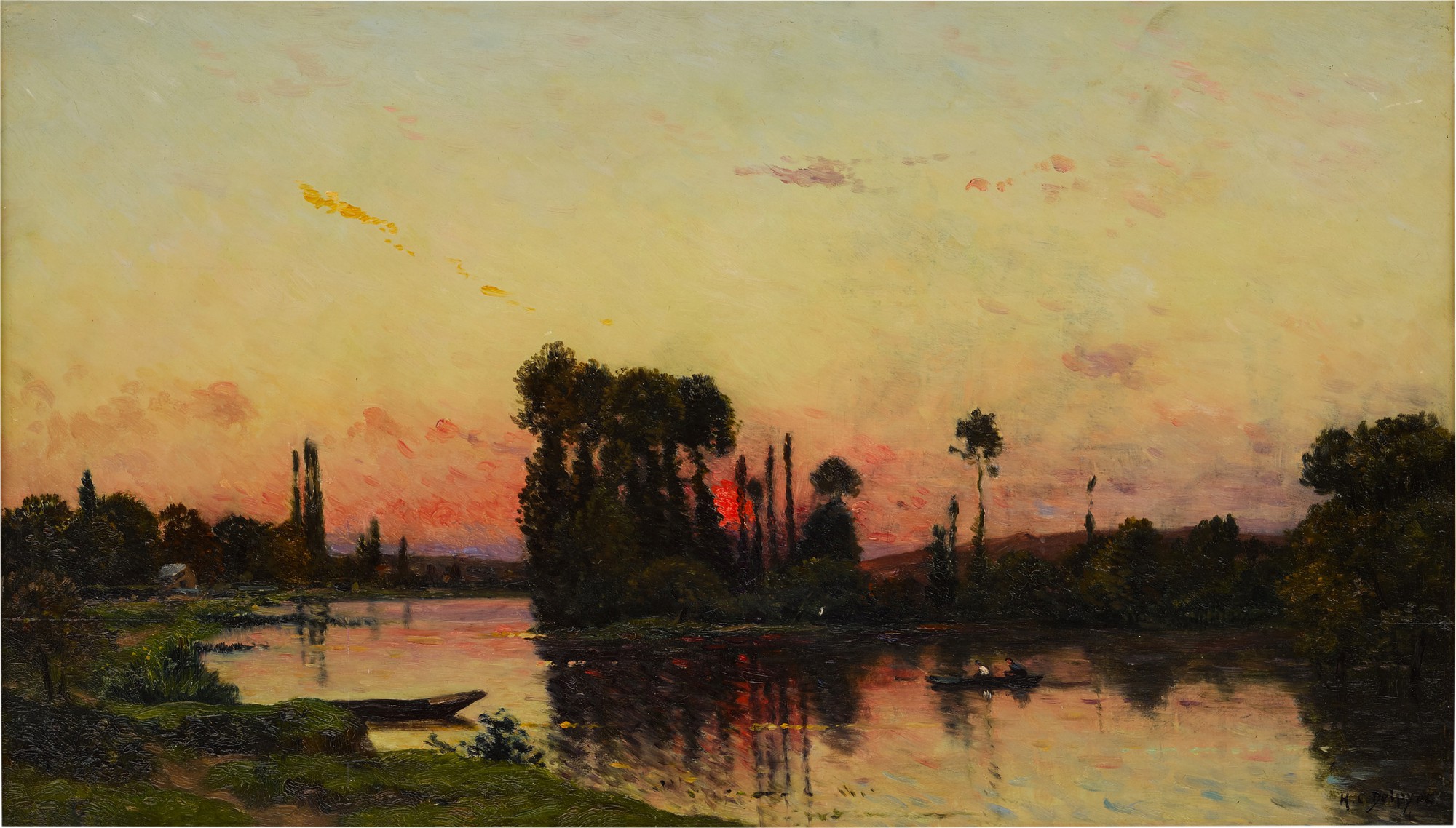
Coucher du soleil sur le rivage
Growing up in a landscape shaped by moving water and seasonal light, he absorbed from an early age the rhythms of a countryside that was neither dramatic nor remote but intimately, tenderly present. This provincial formation would prove foundational. When Delpy eventually made his way to Paris and entered the studios of the two great masters of naturalistic landscape painting, Jean Baptiste Camille Corot and Charles François Daubigny, he brought with him not merely ambition but an already formed sensibility, a genuine feeling for the emotional register of rural France. To study with Corot and Daubigny in the 1860s was to receive one of the most extraordinary educations available to a landscape painter in Europe.
Corot, already a legendary figure, instilled in his students a devotion to tonal unity and to the poetry of atmosphere over topographical precision. Daubigny, whose studio boat the Botin became a symbol of plein air dedication, taught Delpy to work directly before the motif, to trust the evidence of the eye over the conventions of the studio, and to find formal beauty in the unheroic, everyday landscape of the river bank. Delpy absorbed both lessons and synthesized them into a practice that was wholly his own. The arc of Delpy's artistic development over the following decades traces a deepening rather than a dramatic reinvention.
Hippolyte-Camille Delpy
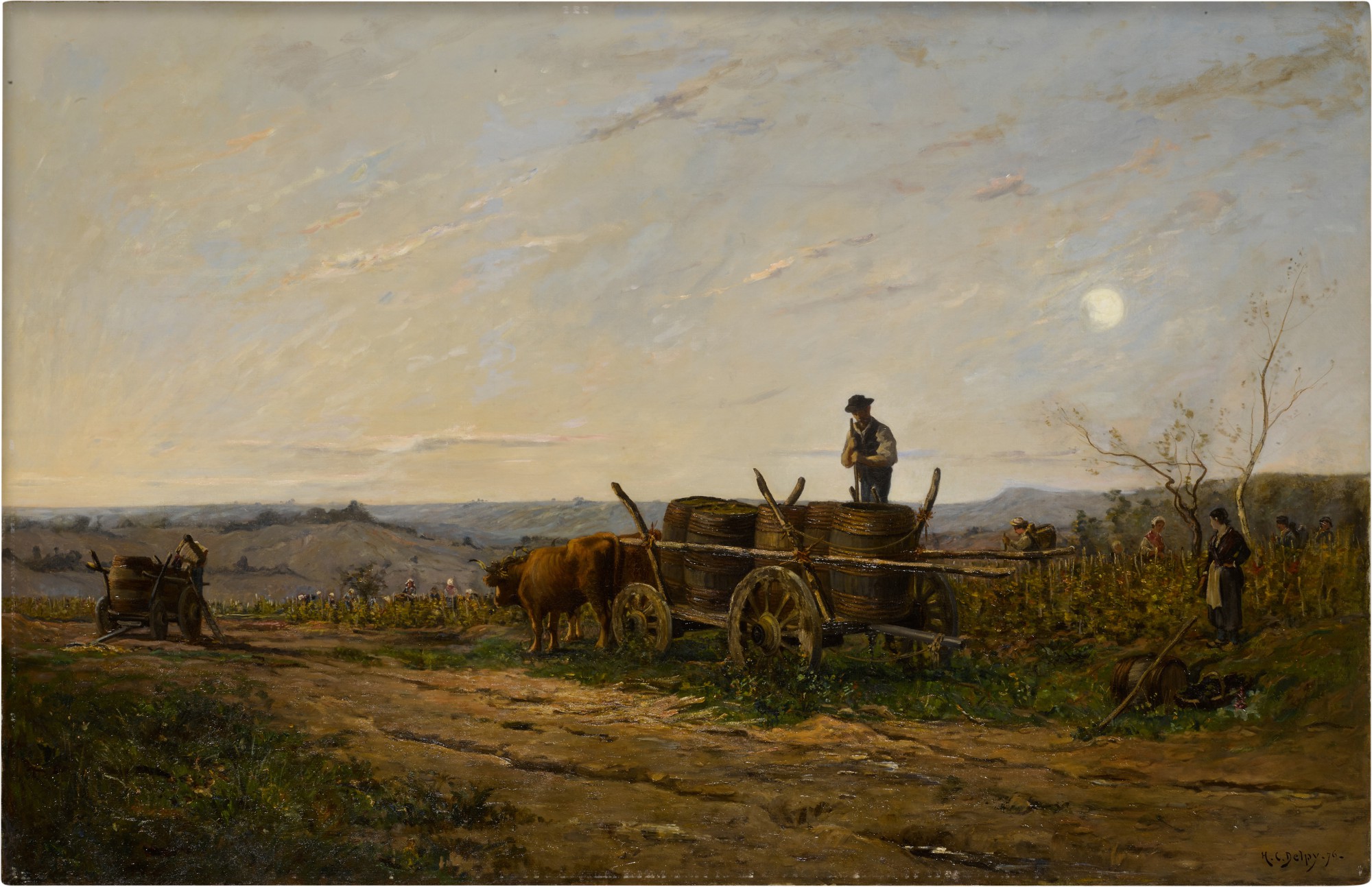
Vendange nivernaise - effet de matin
He exhibited regularly at the Paris Salon from the 1870s onward, and his canvases found an audience among collectors who prized exactly the qualities his teachers had championed: truth to observed light, compositional restraint, and an emotional warmth that never collapsed into sentimentality. His mature work settled along the Seine and the Oise, two rivers whose moods he returned to across hundreds of paintings. He painted them at dawn and at dusk, in summer haze and autumn stillness, in the company of fishermen and washerwomen and, very often, in the absolute solitude of early morning. The accumulation of this sustained attention produced a body of work of remarkable coherence and depth.
Among the works that best represent his achievement, his oil on panel titled Coucher du soleil sur le rivage stands as a luminous example of everything Delpy did with the waning light of evening. The panel format, favored for outdoor studies, lends the surface a particular intimacy, and the sunset he depicts is rendered not as spectacle but as a slow, tender dissolution of color, amber and rose bleeding softly into the water's reflection. Equally significant is Vendange nivernaise, effet de matin, an oil on canvas that captures the morning atmosphere of the Nivernais region during the grape harvest, demonstrating Delpy's range beyond strictly riverine subjects. The soft morning light described in that title is not incidental but absolutely central: Delpy consistently understood that the time of day was not a backdrop but the very subject of the painting.
For collectors, Delpy occupies a genuinely attractive position in the market. His work connects directly to the most celebrated names in nineteenth century French landscape painting, Corot, Daubigny, and by extension the broader Impressionist tradition, while remaining accessible in a way that his more famous contemporaries are not. Works by Delpy appear regularly at auction houses in both Europe and North America, and prices have shown steady appreciation as the Barbizon school has been reassessed and celebrated by a new generation of collectors. When evaluating a Delpy, informed collectors look for the characteristic softness of his atmospheric treatment, the coherence of tonal relationships across the composition, and the almost meditative quality of stillness that distinguishes his strongest works.
Oils on panel, particularly those with plein air directness, tend to command particular interest. To place Delpy within art history is to situate him at one of the most generative junctures in European painting. He belongs to the generation that served as the hinge between the Barbizon naturalism of Corot and Daubigny and the full Impressionist revolution of Monet and Sisley. Artists such as Johan Barthold Jongkind, Louis Gabriel Eugène Isabey, and Antoine Chintreuil occupy similar positions in this continuum, painters who committed themselves to observed nature and atmospheric truth without entirely abandoning the compositional inheritance of the classical tradition.
Delpy shares with these figures a kind of principled modesty, a conviction that the ordinary French countryside, properly seen and honestly painted, was worthy of the full resources of the painter's art. The legacy of Hippolyte Camille Delpy, who died in 1910 having devoted nearly half a century to his patient, loving observation of French rivers and fields, is one that continues to grow in recognition. As contemporary audiences seek out artists who worked with depth and sincerity rather than flash and novelty, Delpy's quiet authority speaks with increasing clarity. His canvases do not demand; they invite.
They ask the viewer to slow down, to attend to the particular quality of light on water at a specific hour, to find in that attention something that feels, however briefly, like peace. In a collecting landscape that prizes authenticity and sustained vision, there are few artists of his era more deserving of discovery.