Hervé Di Rosa
Hervé Di Rosa, A World Painted With Joy
Artist Spotlight · The Collection Editorial
In the spring of 2023, the Musée International des Arts Modestes in Sète, the institution Di Rosa co founded in 2000 alongside fellow artist Bernard Belluc, mounted a celebration of its two decades dedicated to the art of everyday life and popular culture. For those who follow the story of Hervé Di Rosa, this moment felt entirely fitting. Sète, the luminous Mediterranean port town where he was born in 1959, has always been both his point of origin and the spiritual center of a practice that reaches, restlessly and joyfully, across every continent on earth. To understand Di Rosa is to understand that art, for him, has never been a rarefied or exclusive pursuit.
Hervé Di Rosa
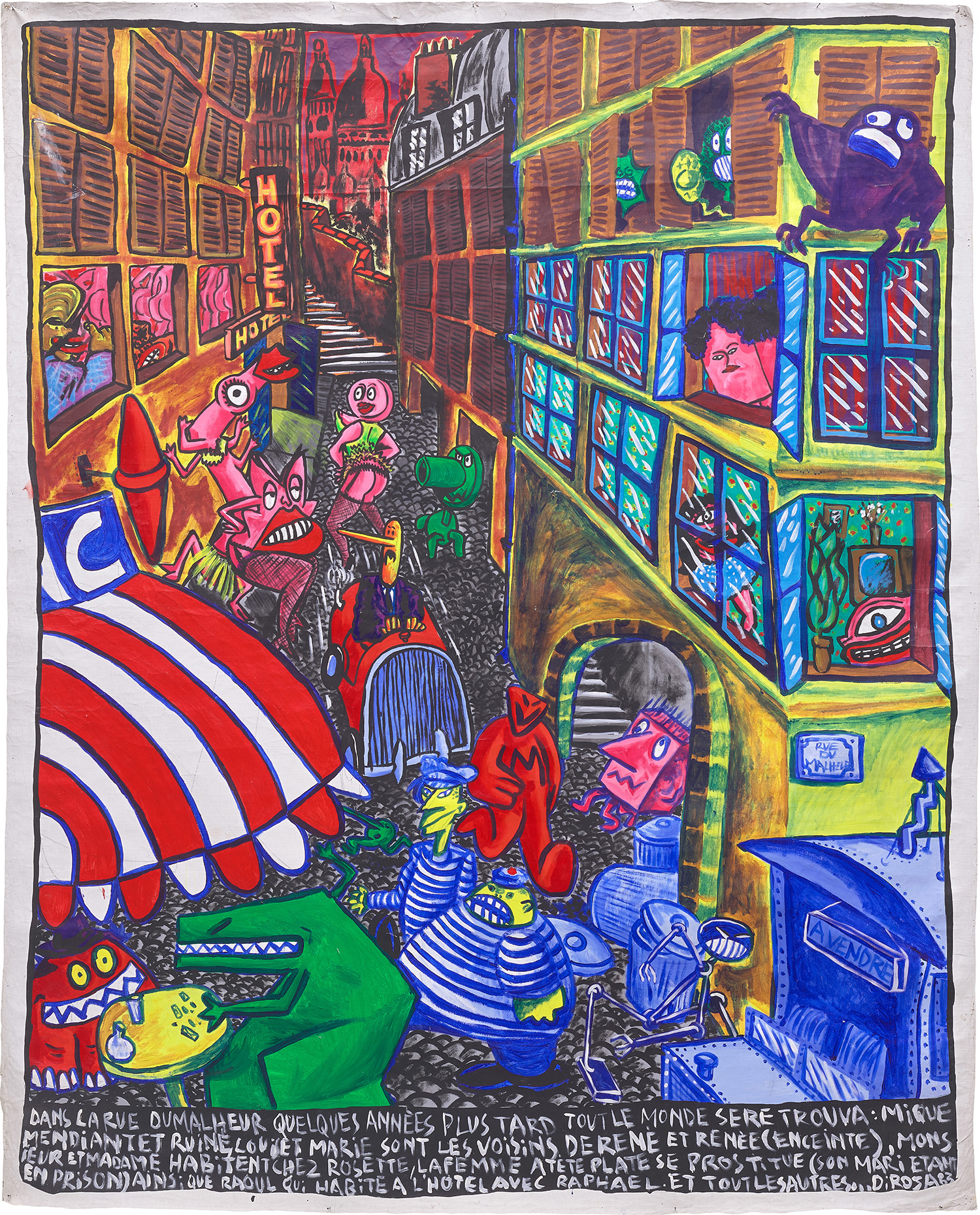
La rue du malheur, 1983
It is something alive in the street, in the comic book, in the marketplace, in the hands of a craftsman in Senegal or a ceramicist in Mexico. Di Rosa grew up in Sète surrounded by a culture that prized color, humor, and the vernacular pleasures of popular imagery. The city itself, perched between the sea and the étang de Thau, has a proud tradition of producing artists who wear their Mediterranean roots openly. His early formation was shaped as much by comic books and American pop culture filtered through a French sensibility as by any formal academic training.
He moved to Paris to study at the École Nationale Supérieure des Arts Décoratifs, and it was there, in the charged atmosphere of the early 1980s, that his artistic identity crystallized with unusual speed and conviction. The movement that would define a generation emerged around 1981 and 1982, when Di Rosa joined forces with Robert Combas, François Boisrond, and Rémi Blanchard to articulate what became known as Figuration Libre. The name itself announced a manifesto: figuration set free from the strictures of Minimalism, Conceptual Art, and the long dominance of abstraction that had shaped the postwar French art world. Figuration Libre arrived as a French answer to movements stirring simultaneously in New York, where Jean Michel Basquiat and Keith Haring were painting on subway walls, and in Germany, where the Neue Wilde were reclaiming the expressive figure with raw urgency.
Di Rosa and his colleagues shared this international hunger for images that were immediate, unashamed, and rooted in the visual languages ordinary people actually lived with. Di Rosa's particular contribution to Figuration Libre was a vocabulary of rounded, cartoonish figures rendered in thick, confident lines and flooded with color that felt both instinctive and deliberate. His characters inhabited chaotic, densely populated canvases that rewarded extended looking, each square inch contributing to a larger narrative energy. Works from this period, including the remarkable La rue du malheur from 1983, a graphite and acrylic composition on unstretched canvas, capture the raw immediacy that made the movement so electrifying to gallerists and collectors who encountered it fresh.
The unstretched canvas itself was a gesture of informality and directness, a refusal of the pretension that had sometimes surrounded contemporary painting. These early works now carry significant art historical weight as primary documents of one of the most vital moments in late twentieth century French art. What distinguishes Di Rosa from many of his contemporaries is the trajectory his career took after the initial burst of the Figuration Libre moment. Where others consolidated a signature style, Di Rosa embarked on a decades long series of journeys and collaborations that remade his practice from within.
Beginning in the late 1980s and accelerating through the 1990s and 2000s, he traveled to countries including Senegal, Mexico, India, China, Haiti, and the United States, working alongside local artisans, craftspeople, and folk artists to create works that absorbed and responded to each specific cultural context. He painted on glass in West Africa, collaborated with ceramic traditions in Mexico, and engaged with santería imagery in the Caribbean. The results were never merely exotic borrowings. Di Rosa approached each context with genuine curiosity and humility, allowing the encounter to change both his work and, in some cases, the local traditions he touched.
For collectors, Di Rosa's career presents a rich and layered landscape. His early 1980s works on paper and canvas, produced during the height of the Figuration Libre movement, represent some of the most historically significant opportunities. These pieces connect directly to a documented cultural moment and share a broader conversation with works by Combas and Boisrond that have found their place in major museum collections across France and beyond. The Musée d'Art Moderne de Paris and the Centre Georges Pompidou both hold works that testify to the institutional recognition the movement has received.
For collectors attracted to international scope and conceptual depth, the later travel based collaborations offer something rarer: objects that exist at the intersection of contemporary art and living craft traditions, produced in genuine dialogue rather than appropriation. The scale of Di Rosa's output across mediums and geographies means that thoughtful entry points exist at multiple price levels, making him accessible to collectors building with discernment as well as those pursuing significant acquisitions. In the broader context of art history, Di Rosa occupies a position that is still coming into full focus. Figuration Libre is increasingly recognized not as a minor regional movement but as a genuinely international phenomenon that anticipated the globalized, pop inflected, image saturated visual culture we now inhabit fully.
His peers in the figurative revival of the early 1980s, from Basquiat and Haring in New York to Martin Kippenberger and Albert Oehlen in Cologne, are now firmly canonical. Di Rosa's work belongs in that conversation, and the growing scholarly attention to his travel based practice has added a dimension that many of those peers simply do not possess. His work anticipated the discourse around cultural exchange and global contemporaneity that would occupy critics and curators a full generation later. What makes Di Rosa a figure of enduring importance is precisely the quality of openness that has driven every phase of his career.
He built an institution dedicated to modest, popular, and vernacular objects because he genuinely believes that art lives in the widest possible sense of that word. He has made work in mediums and contexts that offered no guarantee of prestige, driven by curiosity rather than strategy. The paintings, ceramics, sculptures, and collaborative works that have accumulated across four decades form a body of evidence for a particular kind of artistic life, one committed to pleasure, to encounter, to the idea that the visual world is inexhaustible if you are willing to keep moving through it with eyes wide open. For collectors who seek not just objects but the sensibility of an artist whole and fully realized, Hervé Di Rosa offers something genuinely rare.