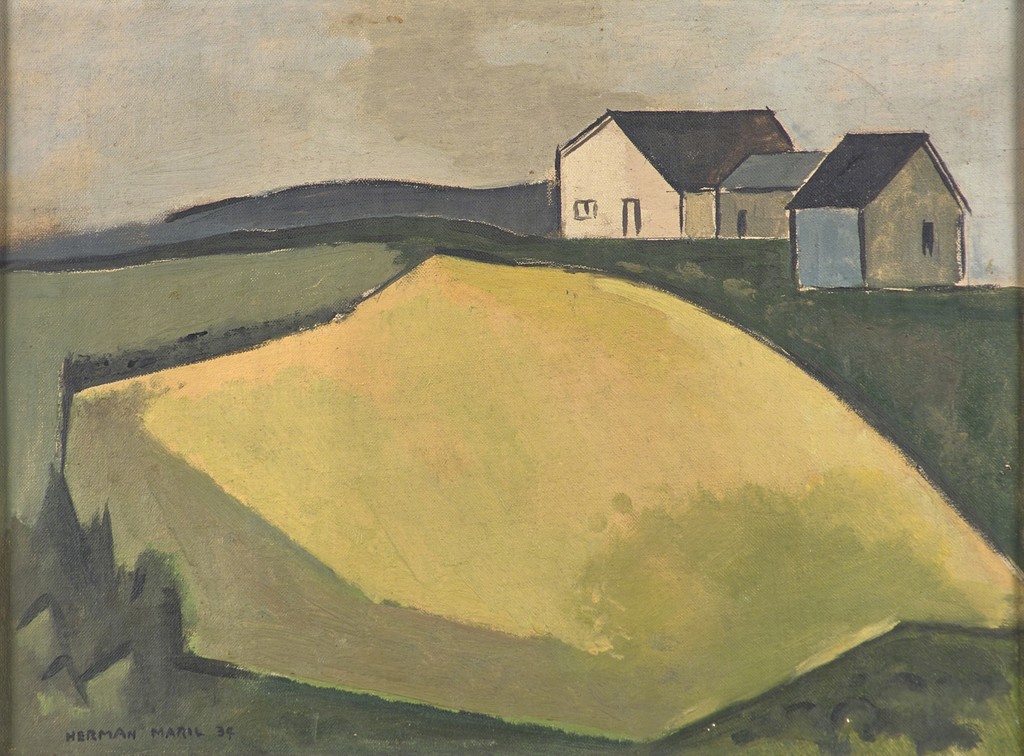
Herman Maril
Herman Maril, Where Light Finds Its Form
Artist Spotlight · The Collection Editorial
There are painters who chase the zeitgeist, and there are painters who build a world so internally coherent, so quietly radical, that the world eventually comes to them. Herman Maril was the latter. Born in Baltimore in 1908, he spent a long and productive career constructing a visual language that felt wholly his own: part modernist geometry, part intimate observation, always suffused with a warmth that made even the most formally daring compositions feel like a welcome. As collectors and institutions revisit the mid century American tradition with fresh eyes, Maril emerges as one of its most rewarding and undersung figures, an artist whose paintings reward sustained looking in a way that few of his contemporaries can match.
Herman Maril
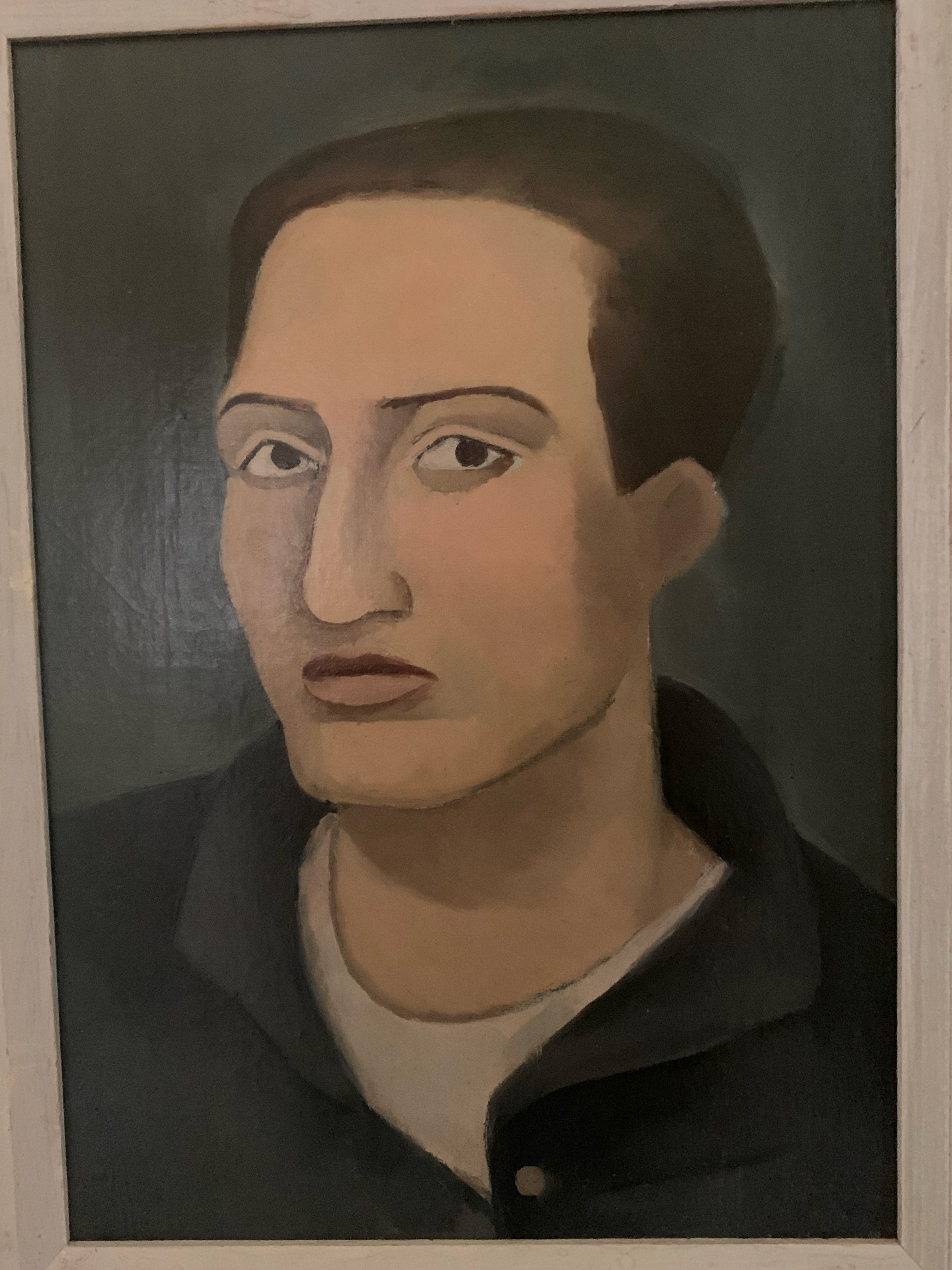
Portrait of a Man, 1935
Maril grew up in Baltimore at a moment when American art was undergoing seismic transformation. The influence of European modernism, carried back across the Atlantic by artists who had studied in Paris and absorbed the lessons of Cézanne, Picasso, and Matisse, was reshaping what it meant to make a picture. Maril absorbed these lessons deeply and on his own terms, enrolling at the Maryland Institute of Art and later studying in New York, where the energy of the emerging American scene was palpable. He was never a pure abstractionist, nor was he a straightforward realist.
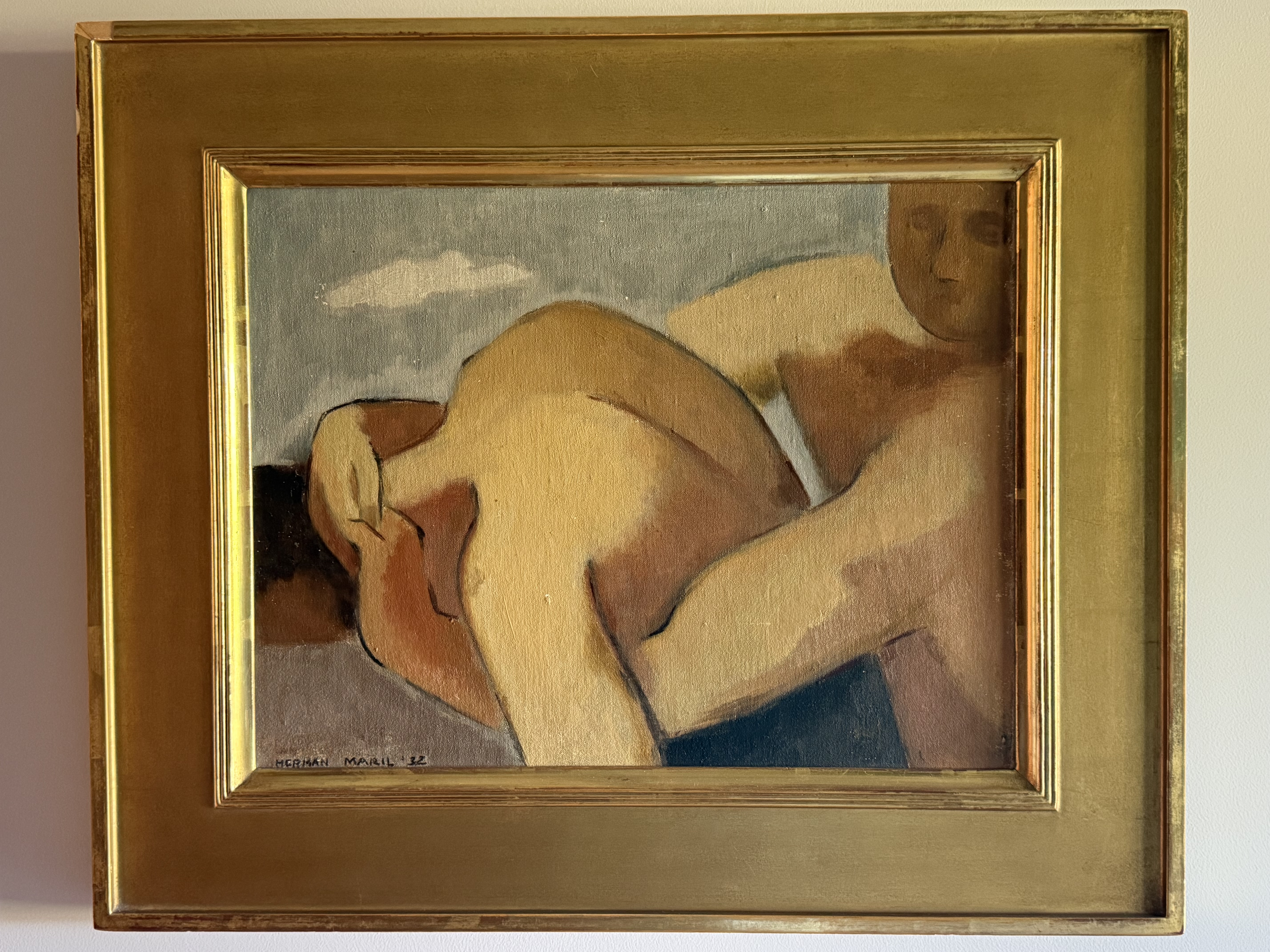
He occupied a more interesting and more difficult middle ground: a painter committed to the observable world but equally committed to the logic of form, color, and plane. The earliest works in the present body of evidence make the ambition of his formation instantly legible. "The Wrestlers" from 1932 is a revelation. Two figures are locked together in physical contest, their bodies rendered in simplified, muscular forms that owe a clear debt to Cubist influence while remaining thoroughly readable as human presence.
Herman Maril
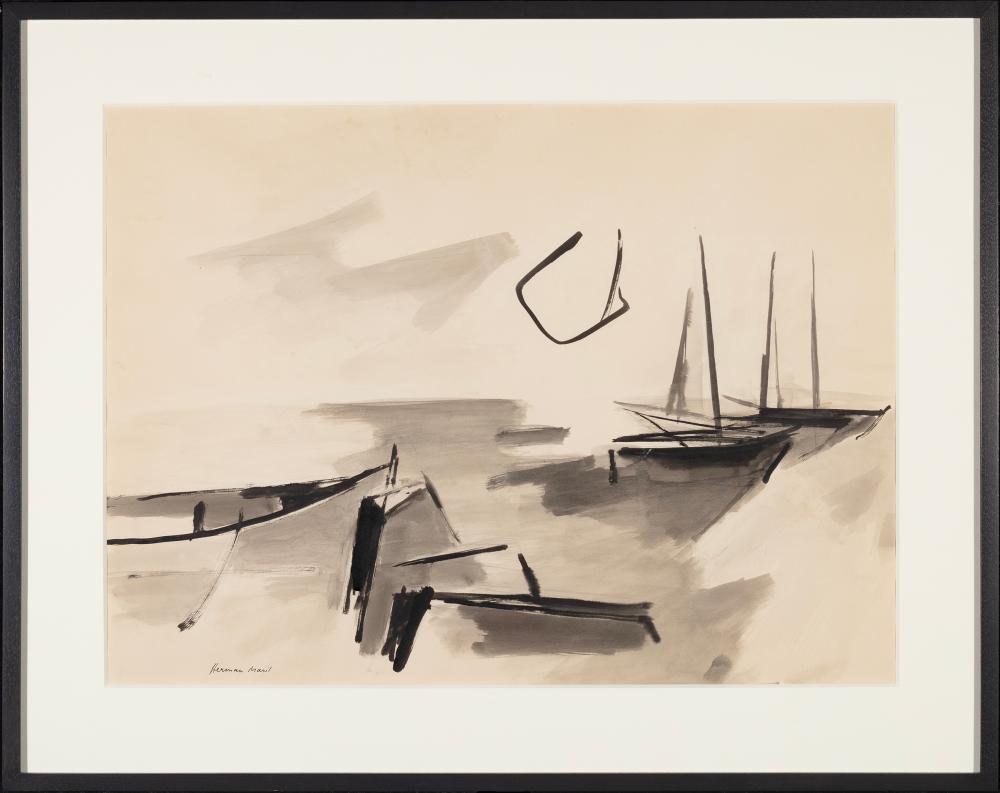
Untitled (Boats in a Harbor)
The palette is warm and earthy, ochres and tawny siennas against a muted ground, and the silhouettes carry a sculptural weight that suggests Maril had looked hard at both Picasso's classical period and the American regionalist tradition simultaneously. This is not a student exercise. It is the work of a young painter who already knows what he wants to say and is searching confidently for the grammar to say it. By the mid 1930s, Maril had turned to portraiture with equal seriousness.
"Portrait of a Man" from 1935 shows a young figure rendered against a deep blue grey ground, the face constructed in broad, flattened planes rather than illusionistic modeling. The eyes are slightly asymmetric in the manner of artists working consciously against academic convention, not from lack of skill but from a deliberate commitment to expressive truth over optical accuracy. The palette is restrained and cool, dark jacket, pale shirt, ochre skin tones lifted against the moody background, and the result is a painting that feels simultaneously of its moment and strangely timeless. There is a gravity here, a psychological seriousness, that marks Maril as a portraitist of genuine ambition.
Herman Maril
The Wrestlers, 1932
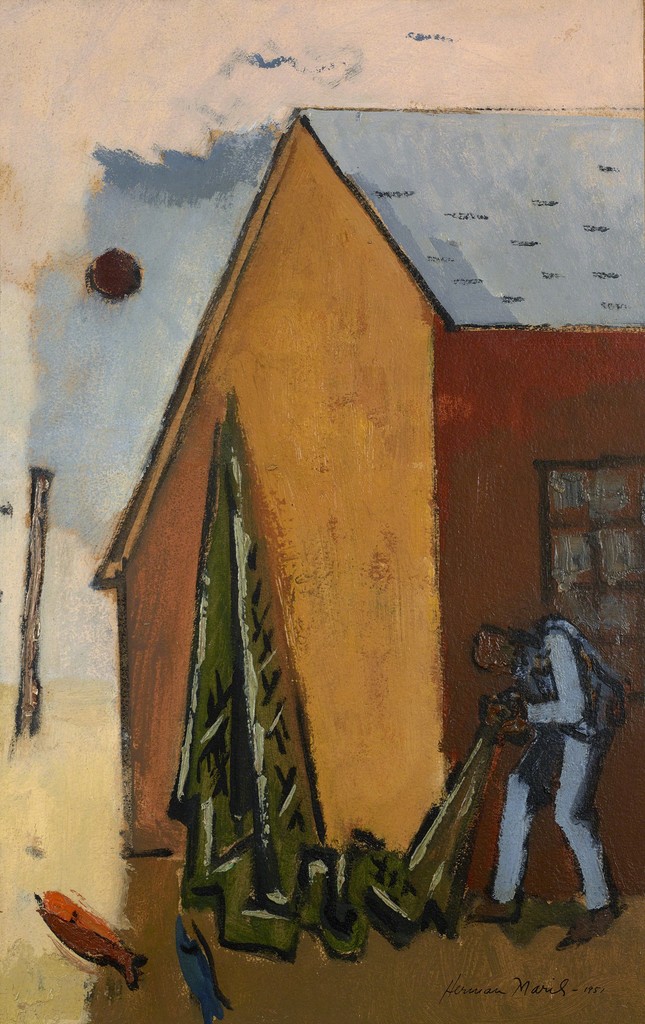
The decades that followed saw Maril extend his practice into landscape and the everyday rural and coastal scenes that would become his most beloved subjects. "Barnyard" from 1950 is one of his most joyful and compositionally daring paintings. A chicken coop occupies the pictorial center at a slightly vertiginous angle, laundry hanging on a line above in flat rectangles of green, grey and orange that function almost as pure color fields. A rooster strides through the foreground in a burst of red and amber, alive with forward momentum.
The painting pulses with color and wit. Maril has taken the most ordinary of subjects and transformed it through the logic of modernist composition into something genuinely exhilarating, a painting about geometry and light and the pleasure of looking as much as it is about a barnyard. The "Untitled (Boats in a Harbor)" ink wash brings a different register entirely. Here Maril works in monochrome, and the restraint is magnificent.
Herman Maril
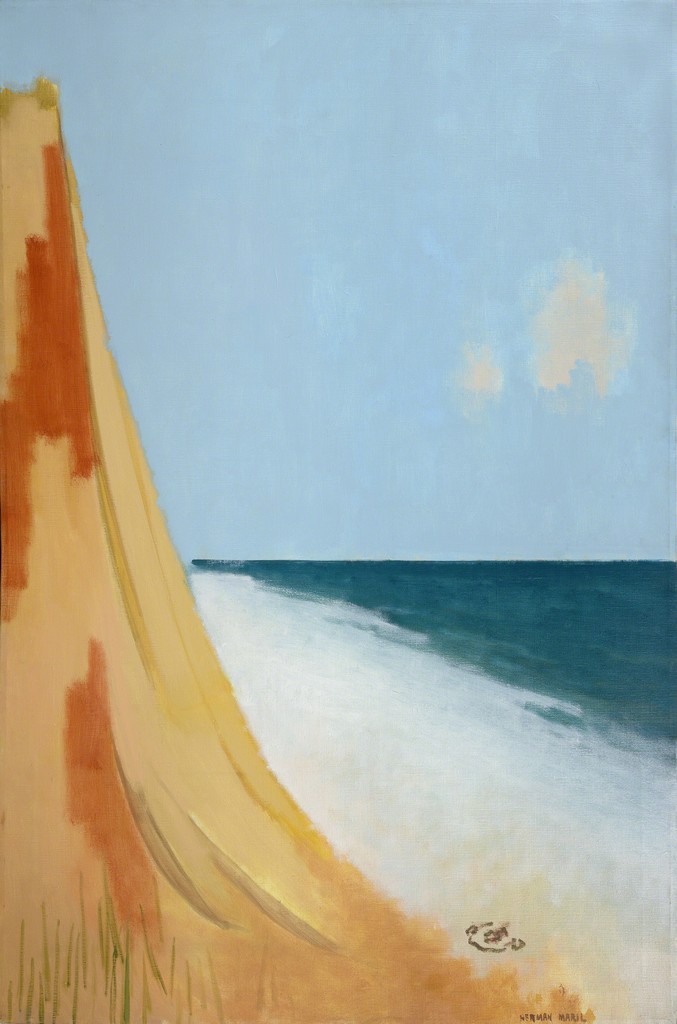
High Dune, 1977
Sailboat masts rise against a pale ground, rendered with the economy of a master draughtsman. A single looping abstract mark floats in the upper register like a kite or a flag caught in the wind, the one gesture that breaks from pure observation into something more freely invented. The spatial recession is suggested rather than described, mist and water rendered through tonal washes of remarkable subtlety. This is a painter who understood that drawing and painting were not separate disciplines but continuous investigations into the same fundamental questions of form and space.
Maril taught for many years at the University of Maryland, and his influence on subsequent generations of American painters extended well beyond the walls of any gallery. Like his contemporaries Milton Avery and Fairfield Porter, he occupied a position that resisted easy categorization, too committed to the visible world for the Abstract Expressionist mainstream, too formally sophisticated for the illustrative tradition. Collectors who admire the lyrical restraint of Avery's mature work, the domestic intimacy of Porter, or the coastal light studies of John Marin will find in Maril a kindred sensibility with a distinctly individual voice. He belongs in that conversation as a full and important participant, not a footnote.
From a collecting perspective, Maril represents precisely the kind of artist that rewards patient attention. His work spans a wide range of media and scale, from intimate ink washes to full oil canvases with genuine physical presence, and the breadth of his subject matter means that there is almost certainly a Maril for every sensibility: the figurative collector drawn to the early works, the landscape enthusiast captivated by the harbor scenes, the colorist who will not be able to look away from the sheer chromatic confidence of "Barnyard." Works from the 1930s through the 1950s represent the core of his achievement, and works from this period that carry clear provenance and condition represent some of the most compelling value in the mid century American market. Herman Maril died in 1986, having spent nearly six decades building a body of work that still asks more of us than we sometimes expect from art of its moment.
He was not interested in spectacle. He was interested in the quality of attention that a great painting demands and rewards. In an art world that sometimes prizes noise over depth, his quiet, rigorous, deeply pleasurable paintings feel more necessary than ever. To spend time with a Maril is to be reminded that painting, at its best, is an act of generous and exacting love directed at the world.
Featured Works