Herb Ritts
Herb Ritts: Light, Form, and Pure Beauty
Artist Spotlight · The Collection Editorial
“I never think of myself as a fashion photographer. I think of myself as a photographer who works in fashion.”
Herb Ritts
To stand before a vintage gelatin silver print by Herb Ritts is to understand, immediately and physically, why his work endures. The surfaces are luminous, the shadows precise, and the human body rendered with a sculptural confidence that feels closer to ancient Greek marble than to the fashion pages where many of these images first appeared. Ritts occupies a singular position in the history of photography: a commercial artist who never stopped being a fine artist, and a fine artist who never condescended to the popular world that made him famous. Decades after his best work was made, museum audiences and serious collectors alike are discovering that what once seemed like glamour was always, underneath, something far more considered and lasting.
Herb Ritts
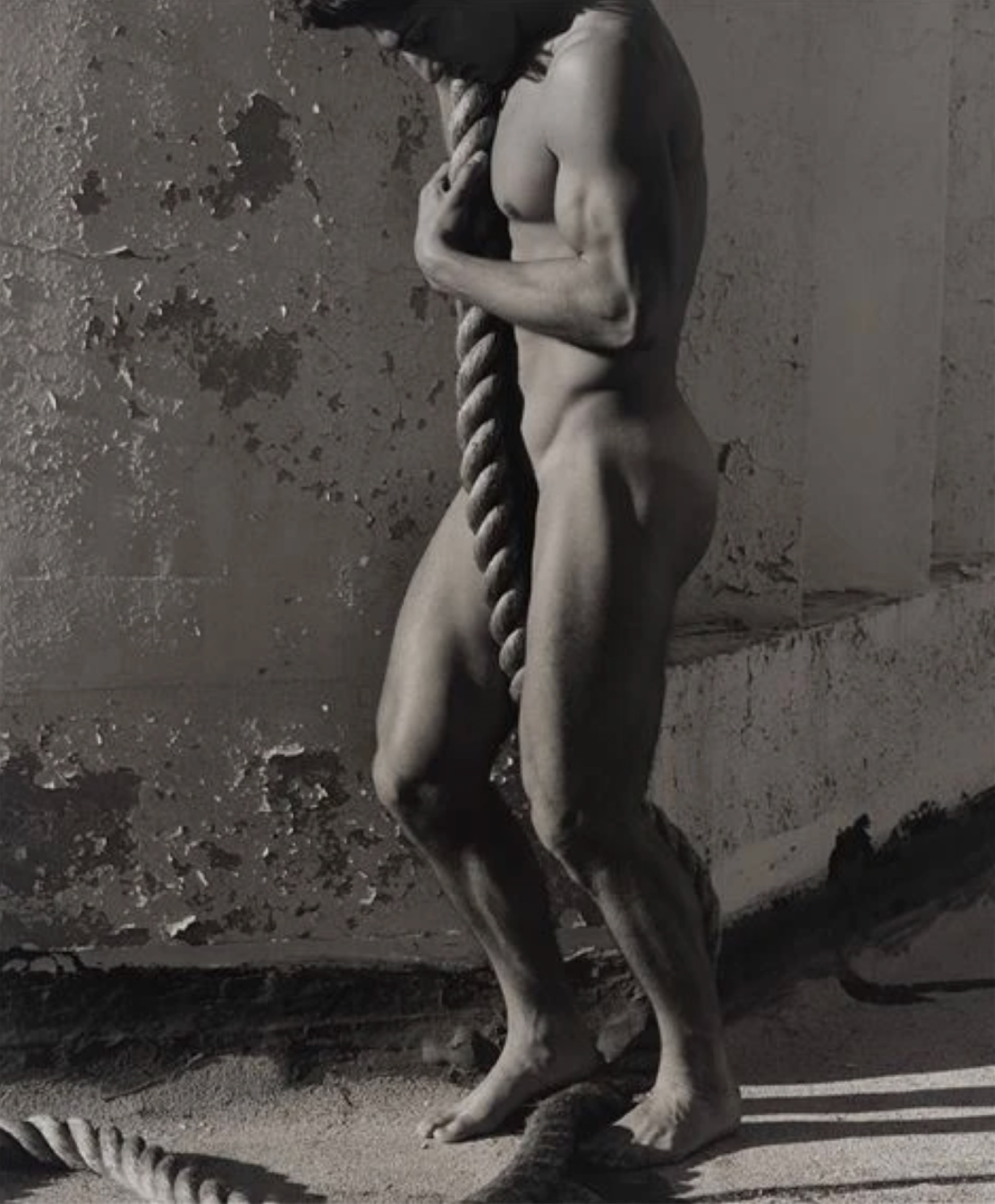
Tony with Rope, 1986
Herb Ritts was born in Los Angeles in 1952, into a family with deep roots in the furniture business. That Californian upbringing proved formative in ways that go beyond the obvious. Growing up in a city defined by the interplay of bright sun and deep shade, by bodies on beaches and skin against sand, Ritts absorbed an intuitive understanding of natural light that would later become the foundation of his entire visual language. He studied economics at Bard College in New York, with no formal training in photography, a fact that seems almost impossible when you consider the technical assurance of his mature work.
His entry into photography was famously unplanned: a roadside stop with his friend Richard Gere in 1976, a borrowed camera, and a series of photographs taken near a gas station in the California desert. Those images circulated quietly but widely, and doors began to open. What followed through the late 1970s and into the 1980s was a rapid and self directed education in the possibilities of the medium. Ritts absorbed influences from classical sculpture and from the tradition of modernist photography, drawing on the formal purity of figures like Edward Weston and the bold graphic sensibility of Irving Penn, while developing something unmistakably his own.
Herb Ritts
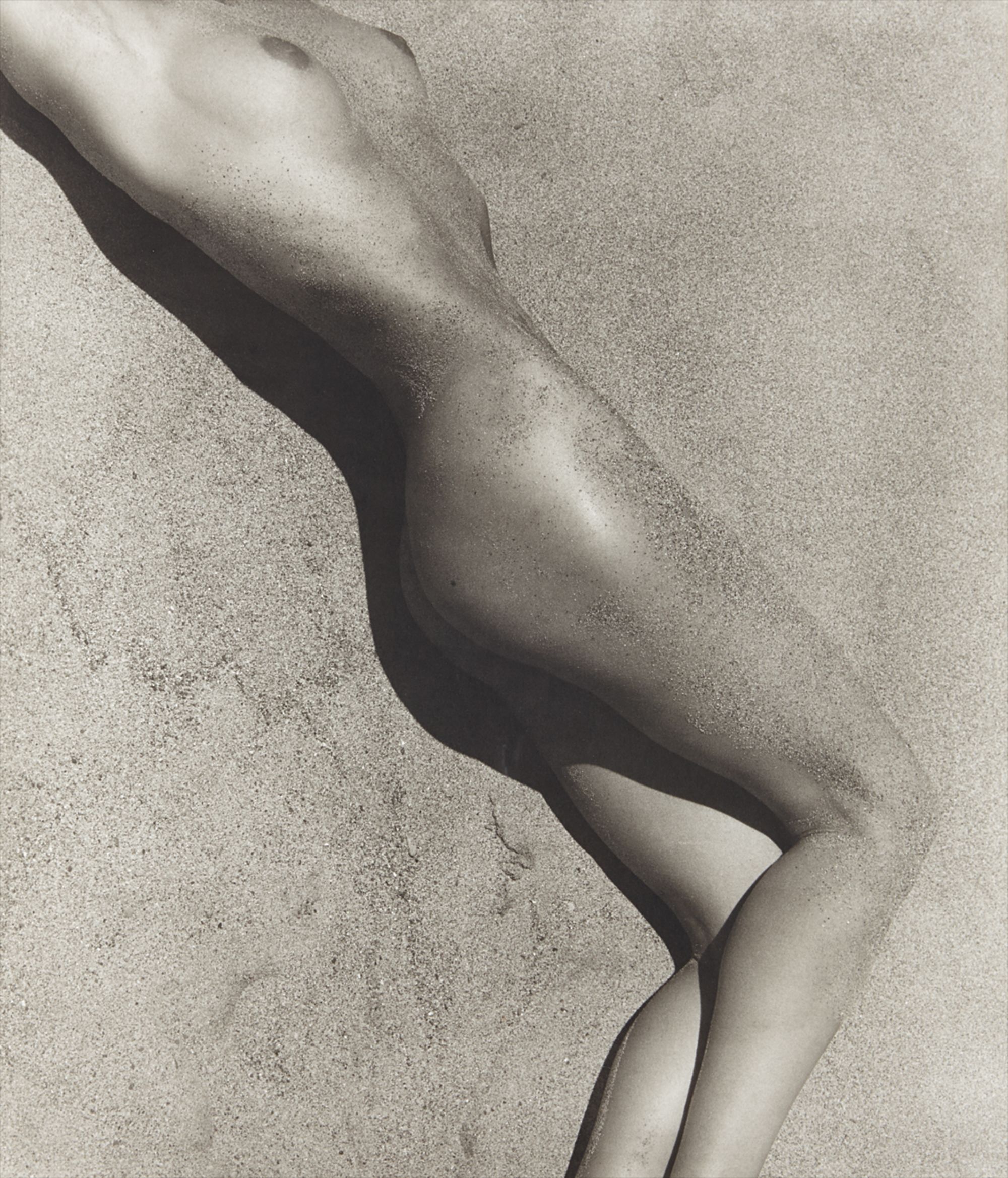
Carrie in Sand (Detail), Paradise Cove
His move toward black and white was not nostalgic but structural: stripping away color allowed him to concentrate everything on form, texture, and the relationship between light and shadow. He worked frequently outdoors, using the unfiltered California sun as his primary studio tool, letting it carve the human figure into something almost architectural. By the mid 1980s he had arrived at a fully realized aesthetic that was being recognized both commercially and critically. The years between roughly 1984 and 1992 represent the peak of Ritts's creative output, and the works from this period are the ones that collectors and institutions return to again and again.
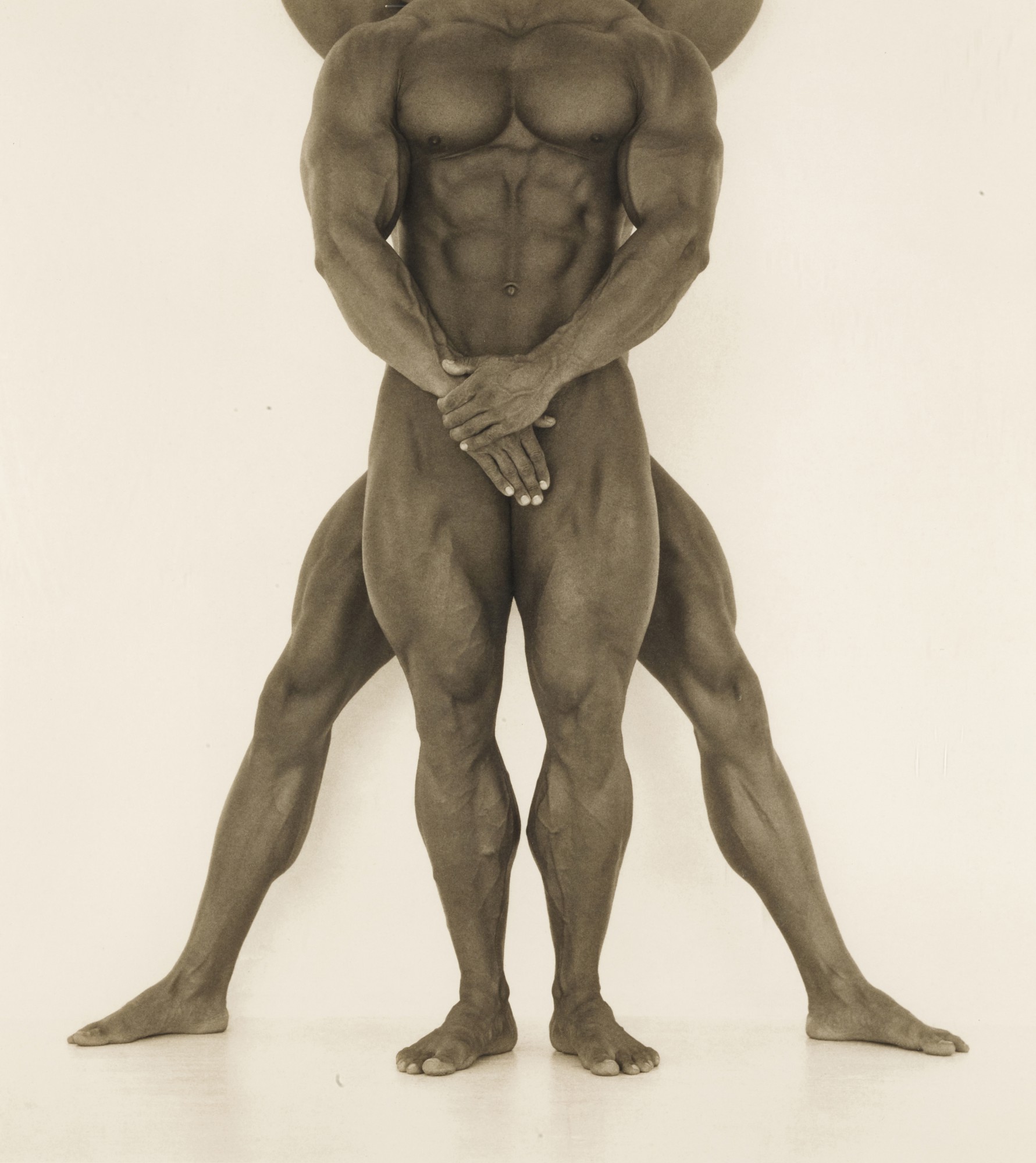
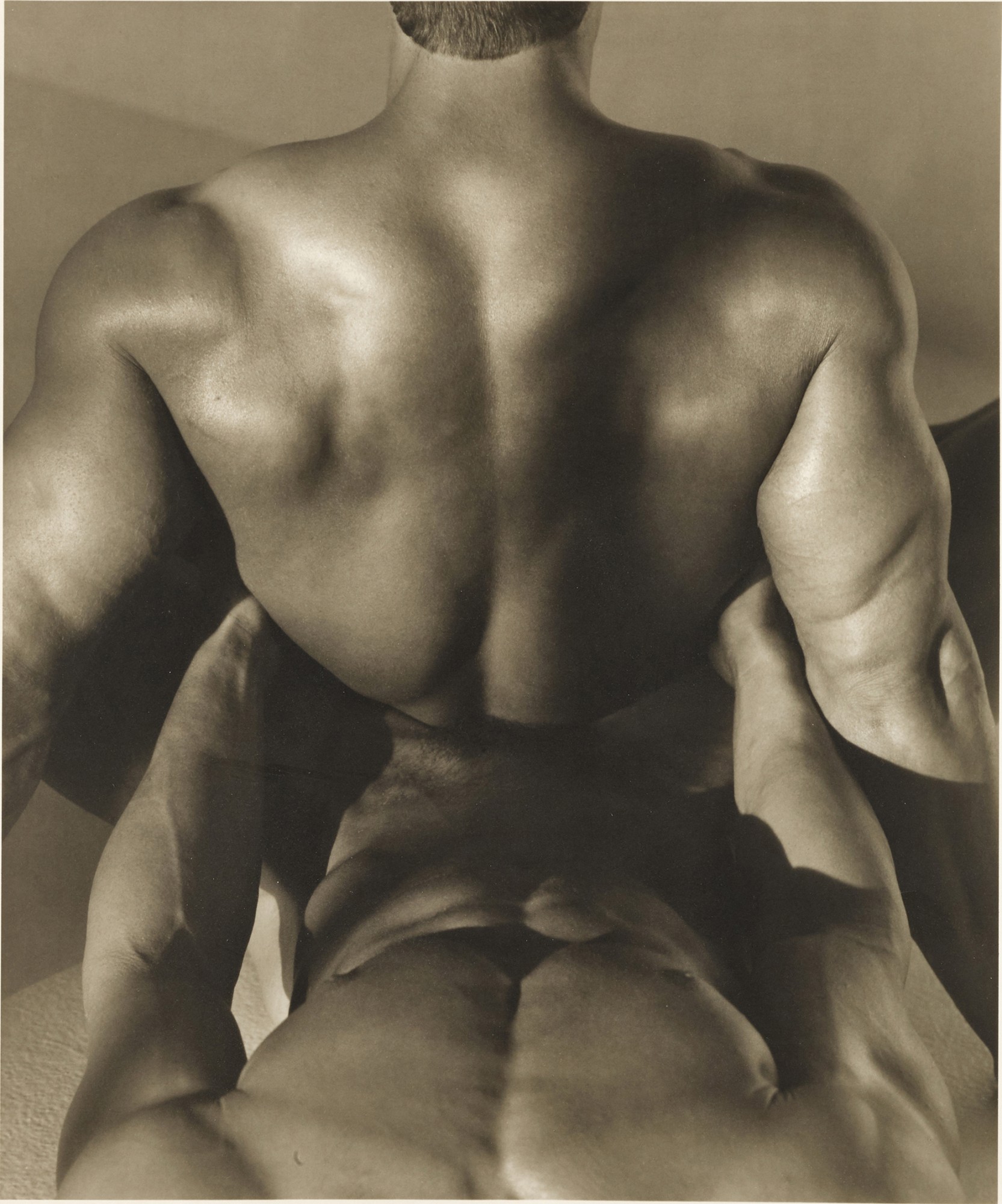
"Tony with Rope," made in 1986, is among the most requested and recognized works in his catalogue: a gelatin silver print in which the human body becomes pure line and volume, the rope a compositional device as much as a narrative one. The "Duo" series, made in Los Angeles in 1990, demonstrates his ability to orchestrate multiple figures into compositions of extraordinary balance, works that feel simultaneously ancient and modern. His portraits of celebrities, from Cindy Crawford photographed at Costa Careyes to Mick Jagger in London, belong in a different register but are no less artistically serious. These images have a stillness that separates them from the work of photographers who merely documented the famous; Ritts shaped his subjects, asked something of them, and received in return a quality of presence that transcends the moment of sitting.
Herb Ritts
'Duo VIII', Los Angeles, 1990
The market for Ritts's work has grown substantially in the years since his death in December 2002, following complications from pneumonia. Collectors have come to understand that his edition sizes, while not tiny, reflect the discipline of a photographer who understood the distinction between a work made for reproduction and a work made as an object. Signed, numbered vintage prints, particularly those with handwritten notations on the verso, command serious attention at auction and in the secondary market. Works such as "Carrie in Sand (Detail), Paradise Cove," with its pencil signature, title, date, and edition number on the verso, represent exactly the kind of provenance and specificity that serious collectors seek.
His prints on gold paper, including "Cordula, Hollywood," and his mounted silver gelatin portraits offer collecting entry points at a range of price levels, but the most significant vintage prints from the mid to late 1980s are where institutional and major private collectors focus their attention. To place Ritts within art history is to appreciate how productively he sat between worlds. He worked in the same decades as Robert Mapplethorpe, with whom he shares an interest in the male figure, formal severity, and the elevation of the body to the level of fine art. He overlaps with Bruce Weber in his sun drenched California sensibility and his ease with celebrity culture.
Herb Ritts
'Duo VI', Los Angeles, 1990
Yet Ritts was never quite the same as either of these contemporaries. His work is warmer than Mapplethorpe's, less polemical, more openly pleasurable. It is more classically composed than Weber's, more interested in stillness than in narrative or spontaneity. He belongs alongside these figures in the great conversation about what photography became in the late twentieth century, and collectors who hold his work are participants in that conversation.
Ritts identified openly as gay, and his work reflected a loving attention to bodies and identities that mainstream culture was only beginning to accommodate during the years of his greatest productivity. This dimension of his practice, which connects him to a broader tradition of LGBTQ+ artists reshaping representation in American art, adds historical weight to work that was already formally distinguished. His legacy is increasingly understood not only as one of glamour and technical brilliance but as one of genuine cultural contribution: a photographer who used beauty as a form of argument, and who made that argument with such grace that it reached audiences far beyond the art world. To collect Herb Ritts now is to hold something that keeps growing in meaning, a body of work whose surfaces are perfect and whose depths are still being discovered.
Explore books about Herb Ritts