Henri Lebasque
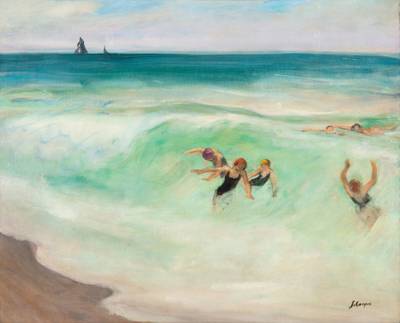
Henri Lebasque, Painter of Pure Radiant Joy
Artist Spotlight · The Collection Editorial
There is a particular quality of afternoon light that falls across a sun warmed terrace, the kind that makes the world feel briefly, perfectly suspended. Henri Lebasque spent a lifetime chasing that sensation, and in canvas after canvas he managed to capture it with a tenderness that few painters of his generation could match. His work has been quietly celebrated in French collections for decades, and today, as collectors increasingly seek art that carries genuine warmth and sophisticated chromatic intelligence, Lebasque is experiencing a well deserved resurgence of serious attention. Major French institutions and international auction houses have returned to his work with fresh appreciation, recognizing in his luminous tableaux a painter who was not merely recording leisure but elevating it into something quietly philosophical.
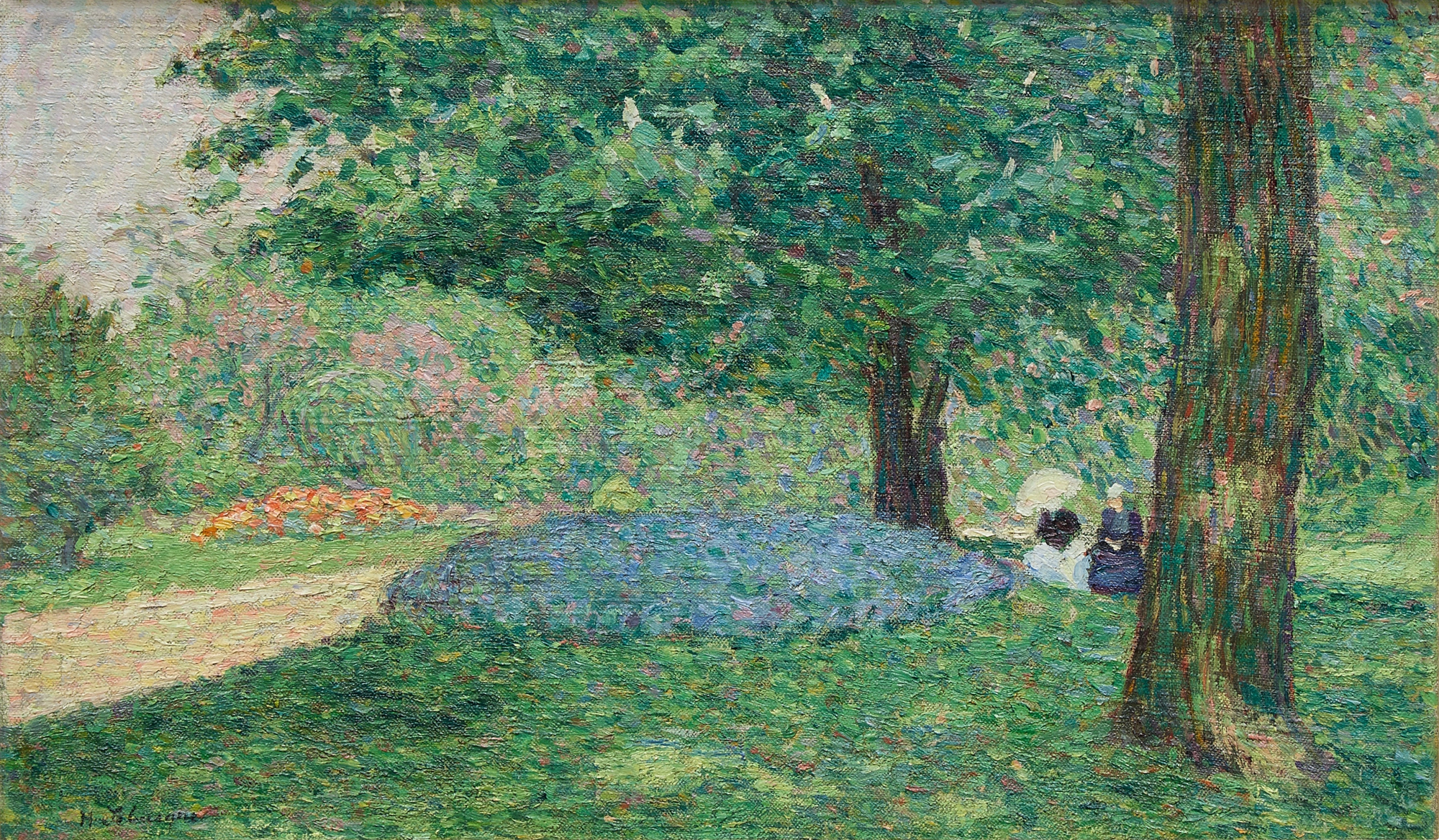
Henri Lebasque
Conversation dans le parc, 1898
Henri Lebasque was born in 1865 in Champigné, a small town in the Maine et Loire region of western France. His early formation was rigorous and classically grounded. He trained in Paris at the École des Beaux Arts under Léon Bonnat, absorbing the discipline of academic drawing while remaining restlessly curious about the new energies moving through the Parisian art world. His most formative relationship in those early years was with Camille Pissarro, whose commitment to painting directly from nature and whose generous, mentoring spirit left a lasting impression on the younger artist.
Through Pissarro, Lebasque absorbed the Impressionist lesson not as a set of rules but as a liberation, an invitation to treat the painted surface as a living, breathing thing responsive to sensation. By the 1890s, Lebasque had found his footing in the Parisian avant garde. He became a founding member of the Société du Salon d'Automne in 1903, alongside figures including Henri Matisse, Pierre Bonnard, and Édouard Vuillard. This alignment is telling.
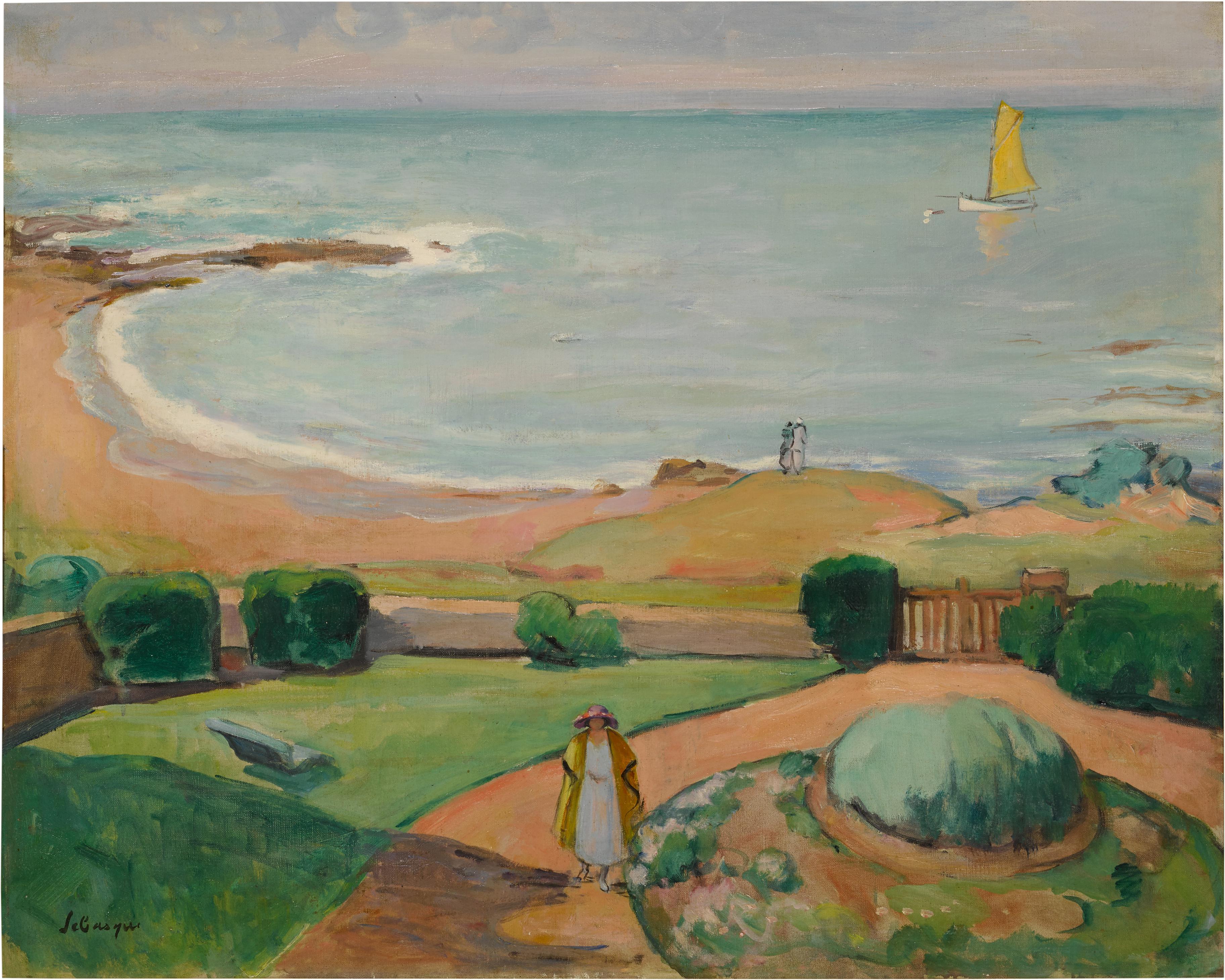
Henri Lebasque
La Terrasse à Préfailles, 1922
Lebasque was not a peripheral figure but a central participant in one of the most consequential conversations in early twentieth century art. His friendship with Matisse in particular was creatively nourishing, and the two artists shared a deep preoccupation with color as an expressive force rather than a merely descriptive one. Yet Lebasque always retained something distinctly his own, a softness and intimacy that set him apart from the more declarative boldness of Matisse or the jewel like intensity of Bonnard. The arc of Lebasque's artistic development follows the pull of light southward.
His earlier Parisian canvases, including the quietly observed "Conversation dans le parc" of 1898, already demonstrate his gift for placing figures within dappled, luminous settings with an ease that feels effortless but is in fact the product of immense sensitivity. As the new century progressed, he increasingly sought the intensified light of the Atlantic coast and later the Mediterranean. Works created at Préfailles on the Loire Atlantique coast, such as the beautifully composed "La Terrasse à Préfailles" of 1922, show his palette brightening and loosening, the brushwork becoming more confident and joyful. He eventually settled in the South of France, drawn irresistibly to the clarity of light around the Côte d'Azur and the Alpes Maritimes, a region that also captured the imaginations of Matisse and Pierre Auguste Renoir.
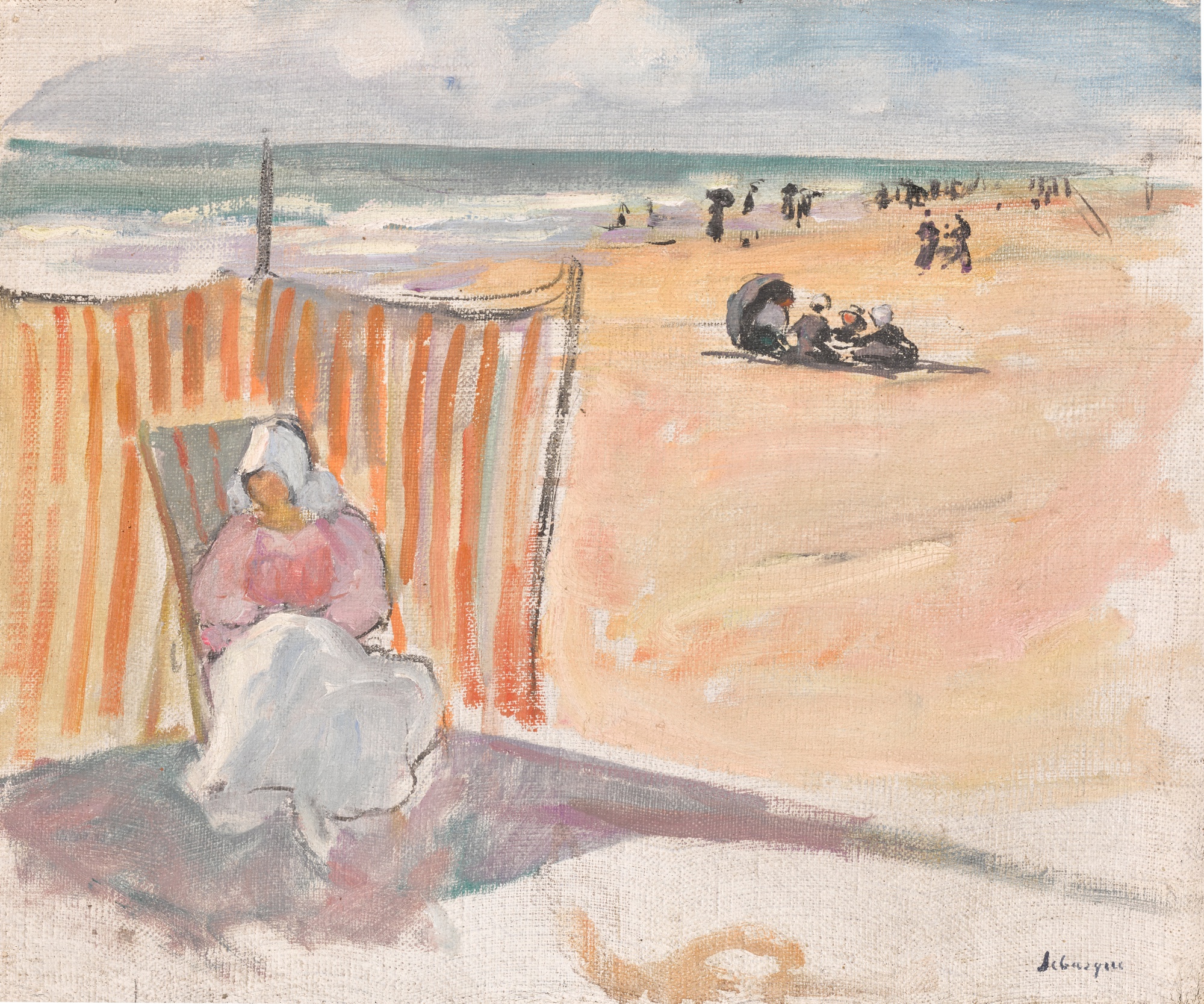
Henri Lebasque
Sur la plage de Saint-Jean de Monts, 1917
Those Mediterranean years produced some of his most celebrated canvases. "Baigneurs dans la vague" from 1922 is exemplary: figures in the surf dissolve into a shimmer of blues, greens, and whites, the boundary between body, water, and light becoming productively uncertain. It is a painting that rewards long looking. His nudes, including the magnificent "Grand nu aux draps blancs" of 1935 and the serene "Nu assis" of 1930, reveal a painter working with supreme confidence in his later years, the figure placed against luminous white with a simplicity that recalls the great classical tradition while remaining entirely of its moment.
"Jeune fille en jaune" from 1915 demonstrates his extraordinary feel for color relationships, the warm yellow of a dress vibrating against cooler tones in a way that is both visually thrilling and emotionally generous. Regional landscapes like "Le Baou de Vence" and "Paysage au cabanon" show the same quality of devotion to place that characterized the Intimists, a deep, patient looking that transforms the familiar into something luminous and charged with presence. For collectors, Lebasque occupies an enviable position in the market. He is recognized and respected by institutions and serious private collectors, particularly in France, while still offering opportunities that might be harder to find with some of his more universally famous contemporaries.
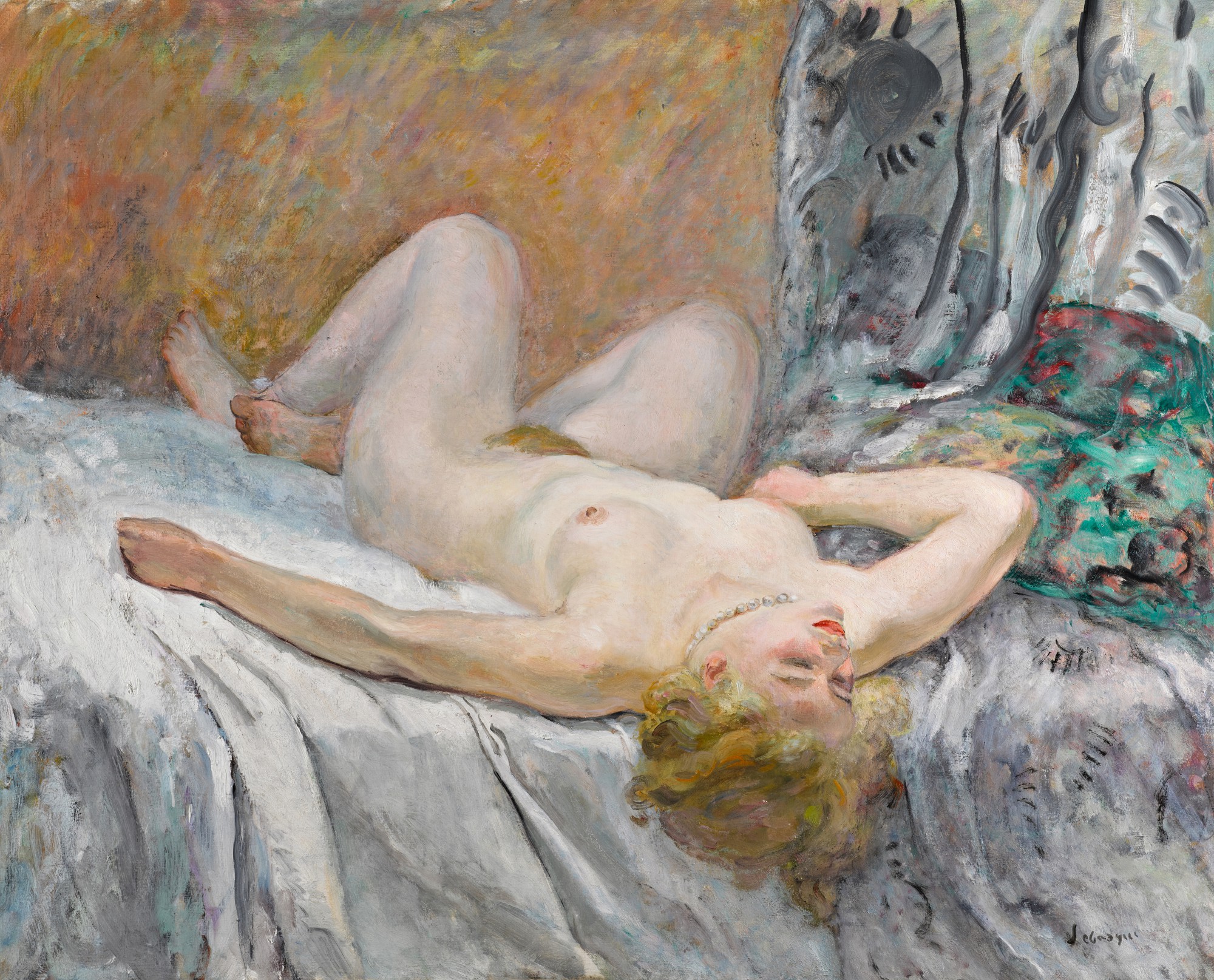
Henri Lebasque
Grand nu aux draps blancs, 1935
His works appear regularly at major auction houses including Christie's, Sotheby's, and Artcurial, where his beach scenes and garden compositions in particular generate consistent, strong interest. Collectors drawn to the Post Impressionist tradition who admire the warmth of Renoir's late work, the color intelligence of Bonnard, or the spatial intimacy of Vuillard will find in Lebasque a painter who synthesizes those qualities with his own distinctive poetry. Works on paper, including watercolors such as the graceful "Paysage" in watercolor and pencil, offer a more accessible entry point into his practice while revealing the same sensitivity to light and atmosphere that animates his oils. Lebasque's place in art history is that of a painter who chose depth over drama, intimacy over spectacle, and sustained beauty over avant garde disruption.
He was not interested in manifestos. He was interested in the particular way light falls on a child's shoulder, the color of a garden in full summer, the pleasure of being alive in a body in a warm place on a specific afternoon. That commitment to lived experience, rendered with exceptional painterly intelligence, is precisely what makes his work feel so resonant today. In an era saturated with irony and conceptual distance, there is something genuinely radical about a painter who looked at the world and found it, again and again, worthy of gratitude and care.
The sobriquet attached to Lebasque, le peintre de la joie et de la lumière, the painter of joy and light, might sound simply decorative but it points to something more serious. Joy in Lebasque is not naivety. It is a considered, hard won position, the artistic equivalent of saying that the pleasures of ordinary life, a terrace in the afternoon, children at the shore, a woman reading in a garden, are not minor subjects but the very substance of what it means to be human. He died in 1937, leaving behind a body of work that has only grown richer with time.
For collectors who understand that warmth and intelligence are not opposites but allies, Henri Lebasque remains one of the most rewarding discoveries that Post Impressionism has to offer.
Explore books about Henri Lebasque