Henri Fantin-latour
Flowers, Light, and Quiet Mastery
Artist Spotlight · The Collection Editorial
There is a particular room in the National Gallery in London where visitors tend to slow down without quite knowing why. It is the room where several of Henri Fantin Latour's floral still lifes are hung, and the effect is almost involuntary: the pace of gallery going simply changes. The roses seem to breathe. The light falls as if through an actual window rather than from a painted source.
It is a sensation that has drawn collectors, museum curators, and quiet devotees to Fantin Latour's work for over a century and a half, and it shows no sign of fading. If anything, the appetite for his paintings has deepened in recent decades, as collectors increasingly seek work that rewards sustained looking rather than immediate spectacle. Ignace Henri Jean Théodore Fantin Latour was born in Grenoble, France, on January 14, 1836, the son of a Russian born mother and a French painter father, Théodore Fantin Latour, who gave him his earliest instruction. The family moved to Paris when Henri was young, and he enrolled at the École des Beaux Arts, though he found his most formative education in the Louvre, where he spent long hours copying the Old Masters.
He was particularly drawn to Titian, Veronese, and the Northern European tradition of careful, luminous still life painting. This dual inheritance, the warmth of the Italian Renaissance and the meticulous observation of Dutch and Flemish painters, would become the bedrock of everything he made. His friendship with Gustave Courbet and later with Édouard Manet placed him at the center of the Realist and early Impressionist circles in Paris, though Fantin Latour always maintained a certain independence from any single camp. He exhibited at the Salon des Refusés in 1863, the legendary exhibition that gathered work rejected by the official Paris Salon and announced the arrival of a new sensibility in French art.
He was also a regular at the Café Guerbois, the gathering place of the avant garde, and his large group portraits from the 1860s and 1870s serve today as irreplaceable documents of that extraordinary moment. His 1864 painting Homage to Delacroix, now in the Musée d'Orsay in Paris, gathered Manet, Whistler, Baudelaire, and others around a portrait of the recently deceased Romantic master, and it remains one of the defining images of nineteenth century artistic community. Yet it is the still lifes and the flower paintings for which Fantin Latour is most cherished, and rightly so. He developed an extraordinary practice of painting flowers from life, working quickly to capture blooms at their peak before they faded.
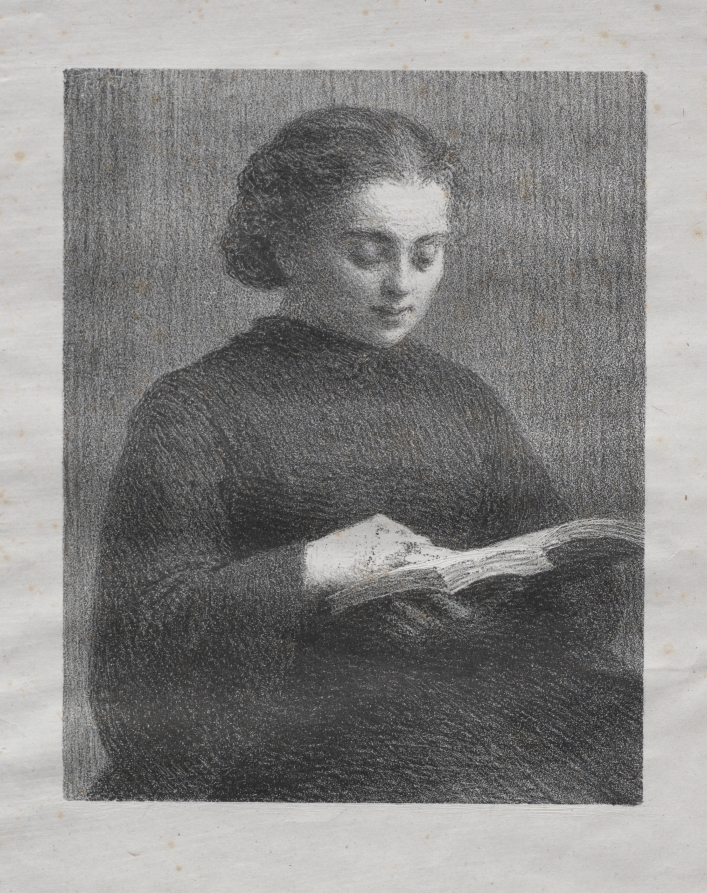
His roses, peonies, and chrysanthemums are rendered with a softness that never sacrifices structure, and his arrangements have a quality of natural inevitability, as though the flowers simply chose to group themselves that way. His connection to England was significant here: his work found an enthusiastic audience among British collectors from the 1860s onward, thanks in part to the dealer Edwin Edwards and his wife Ruth, who introduced his paintings to London and helped establish the loyal following he maintained there throughout his life. The Victoria and Albert Museum and numerous British private collections hold important examples of his work, a testament to how deeply he was embraced across the Channel. Alongside his paintings, Fantin Latour developed a remarkable parallel practice as a lithographer, creating dreamlike, symbolist compositions inspired by the music of Wagner, Berlioz, and Schumann.
These prints, which bear little surface resemblance to his luminous still lifes, reveal the depth of his inner imaginative life. Figures drift through clouds and mythological landscapes, and the handling of tone in his lithographic work is considered among the finest of the nineteenth century. This dual practice, the grounded materiality of paint and the airy fantasy of lithography, speaks to a complexity in Fantin Latour that collectors who know him only through his flower paintings sometimes find revelatory. In the auction market, Fantin Latour occupies a position of reliable and genuine desirability.
His floral still lifes have consistently attracted strong results at Christie's, Sotheby's, and Bonhams, with significant examples regularly achieving six figure sums in pounds and dollars. Collectors are drawn to the intimacy of his smaller works as much as to the grandeur of his larger compositions, and the entry point across his career offers something for a range of collectors. Works on paper, including his lithographs, represent a particularly thoughtful collecting opportunity, combining art historical significance with a beauty that holds up against the paintings themselves. When evaluating a Fantin Latour, condition and provenance are paramount, as with any nineteenth century work, and the presence of a distinguished collection history adds meaningfully to a work's appeal.
To place Fantin Latour within art history is to understand how capacious the nineteenth century truly was. He was a peer of Manet and a friend of Whistler, yet he pursued a vision entirely his own. His relationship to the Impressionist movement is one of sympathetic independence: he admired the energy of Monet and the others, but he never abandoned the careful structure that painting from the Old Masters had instilled in him. Collectors who love Gustave Caillebotte, Odilon Redon, or even the intimist works of Édouard Vuillard will find in Fantin Latour a kindred spirit, one who believed that the domestic and the beautiful were worthy of the most serious artistic ambition.
His work also resonates with admirers of the Dutch Golden Age, particularly Jan van Huysum and Rachel Ruysch, whose floral tradition he absorbed and transformed. Fantin Latour died in Buré, Normandy, on August 25, 1904, at the age of sixty eight, having worked with remarkable consistency across four decades. His reputation has never truly dimmed, and there is a sense in the current collecting climate that his moment of fullest appreciation may still be ahead. In an era when the art world's appetite for spectacle and scale is increasingly tempered by a desire for depth and intimacy, Fantin Latour's quiet authority feels not merely historical but urgently present.
To own a Fantin Latour is to possess a kind of beauty that does not age, does not tire, and does not ask for anything from you except your full attention.
Explore books about Henri Fantin-latour
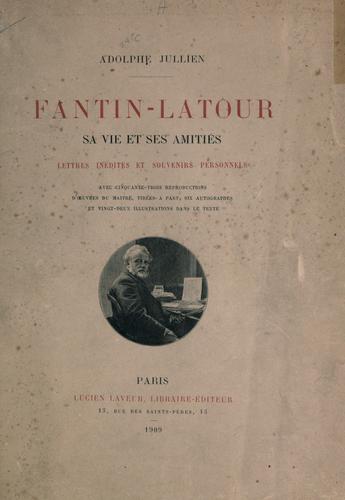
Fantin-Latour
Adolphe Jullien
Fantin-Latour
Jacques-Émile Blanche
Fantin-Latour: His Life and Work
Madeleine Fidell-Beaufort and Janine Bailly-Herzberg
Fantin-Latour
Douglas Druick and Michel Hoog
Henri Fantin-Latour: Master of Intimacy
Kathryn Moore
The Correspondence of Fantin-Latour
Janine Bailly-Herzberg

Fantin-Latour: Paintings and Drawings
Pierre Miquel