Henri-Edmond Cross
Sun, Sea, and Shimmering Southern Light
Artist Spotlight · The Collection Editorial
“I work slowly and I need solitude. The south gives me both.”
Henri-Edmond Cross
There are painters who find their subject matter, and then there are painters who find their light. Henri Edmond Cross belongs emphatically to the second category. When the Musée de l'Annonciade in Saint Tropez gathers its permanent collection under the Mediterranean sun, Cross appears as something close to a patron saint, a figure whose decision to relocate to the south of France in 1891 set in motion one of the most luminous transformations in the history of Post Impressionist painting. His canvases glow with a warmth that feels almost audible, as if the cicadas and salt air have been pressed directly into the pigment.
Henri-Edmond Cross
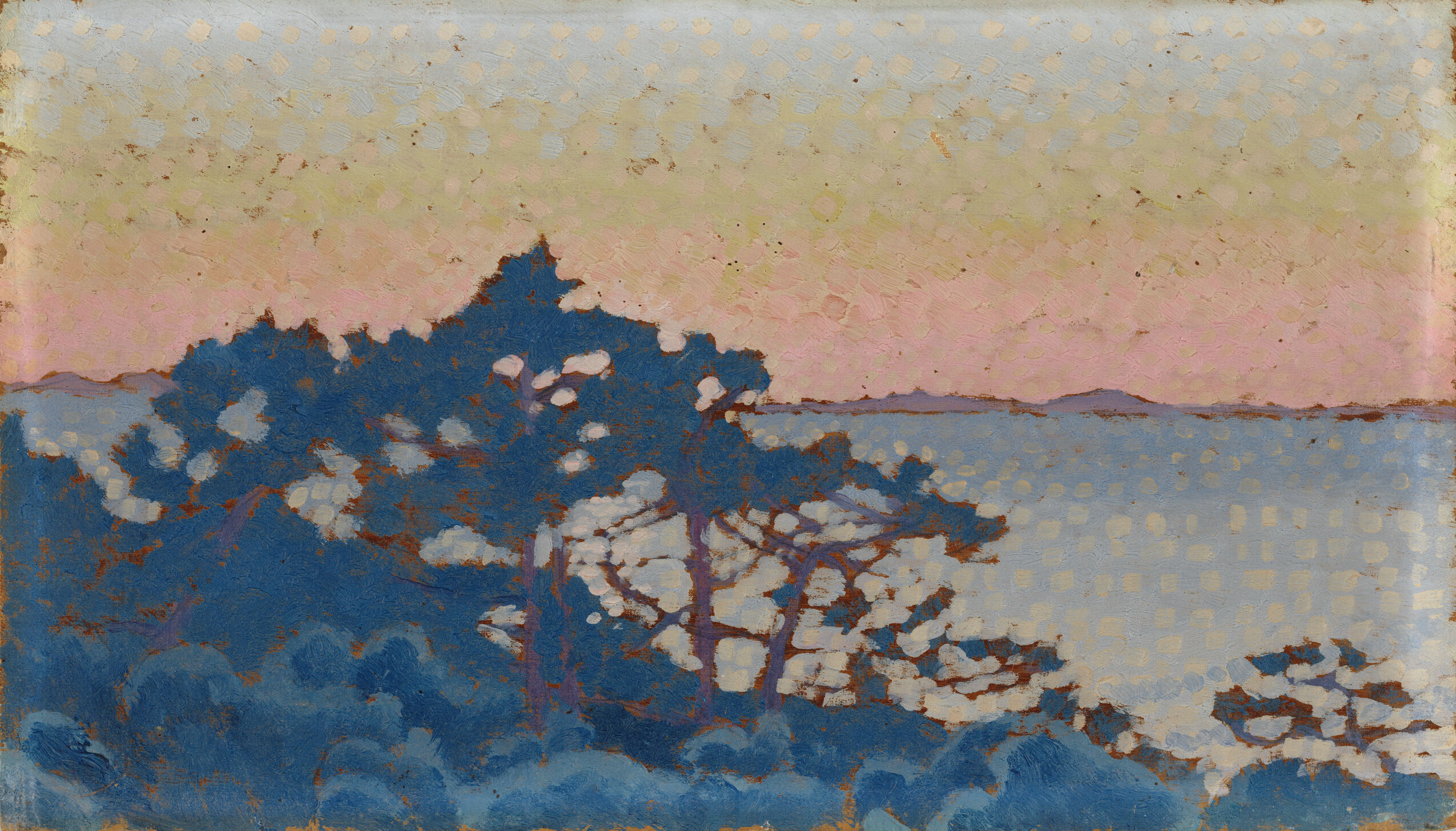
Seascape, 1891
To encounter his work today, whether in a museum gallery or through the carefully assembled holdings on a platform like The Collection, is to understand why collectors across generations have returned to him with such devotion. Cross was born Henri Edmond Joseph Delacroix in Douai, in northern France, in 1856. He adopted the name Cross early in his career, partly to distinguish himself from the towering legacy of Eugène Delacroix, a practical and quietly confident act that says something about his character. He trained first in Lille, then made his way to Paris, where he absorbed the lessons of the academic tradition before turning his attention to the Realist painters whose work dominated the Salon in the 1870s and early 1880s.
His early portraits and figure studies show a technically assured hand, careful in observation and restrained in palette. Nothing in those early works quite prepares you for what was coming, and yet in retrospect the precision was always there, waiting for the right system to unlock it. The great catalyst arrived through friendship. Cross became close to Paul Signac and, through him, to Georges Seurat, and in the mid 1880s he encountered the theoretical framework of Divisionism, the method of applying small, distinct touches of pure colour to the canvas so that the eye performs the blending rather than the brush.
Henri-Edmond Cross
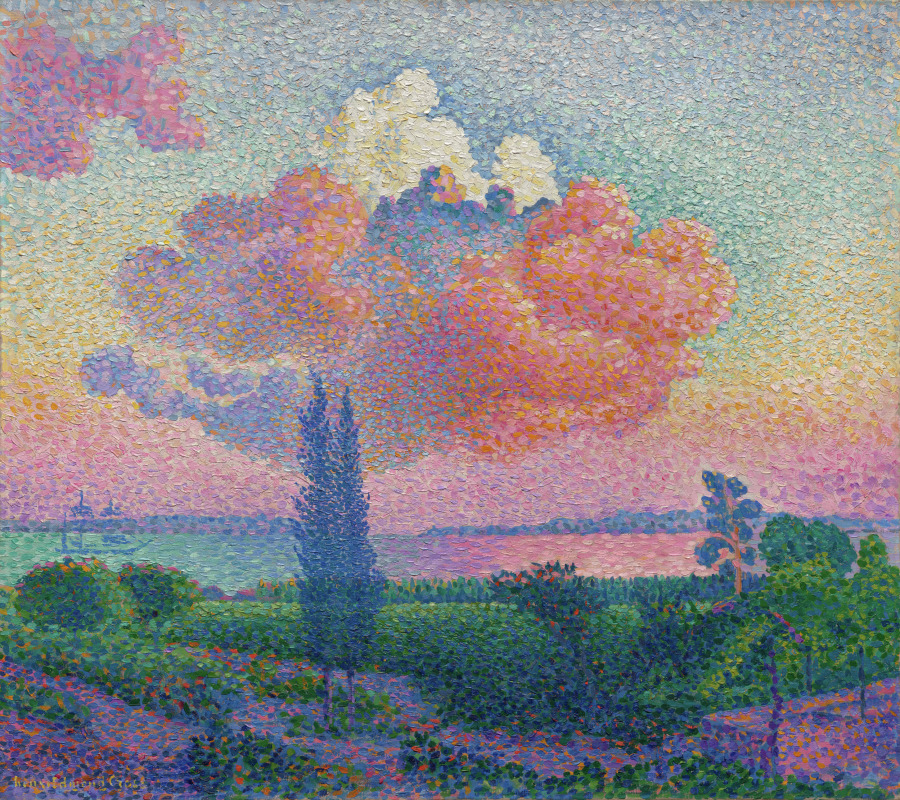
The Pink Cloud, 1891
He exhibited with the Société des Artistes Indépendants from 1884 onward, placing himself firmly within the avant garde circle that was rewriting the rules of French painting. By the late 1880s he had committed fully to the Neo Impressionist method, and his palette began its slow, thrilling brightening. The move south accelerated everything. Saint Clair, near Le Lavandou on the Var coast, became his permanent home, and the quality of light there, fierce, golden, refracted off limestone and seawater, demanded colours that his northern training had never contemplated.
What Cross did with Divisionism was subtly but importantly different from what Seurat had done. Where Seurat remained devoted to a certain classical gravity, his figures monumental and his compositions architecturally controlled, Cross allowed warmth and sensuality to enter the system. His brushwork grew bolder and more mosaic like through the 1890s and into the early 1900s, the individual touches of paint becoming larger, more assertive, sometimes approaching the scale of a decorative tile. Works like The Pink Cloud from 1891 demonstrate this quality beautifully: the sky dissolves into layered passages of rose, violet, and pale gold, each stroke distinct and yet inseparable from its neighbours.
Henri-Edmond Cross
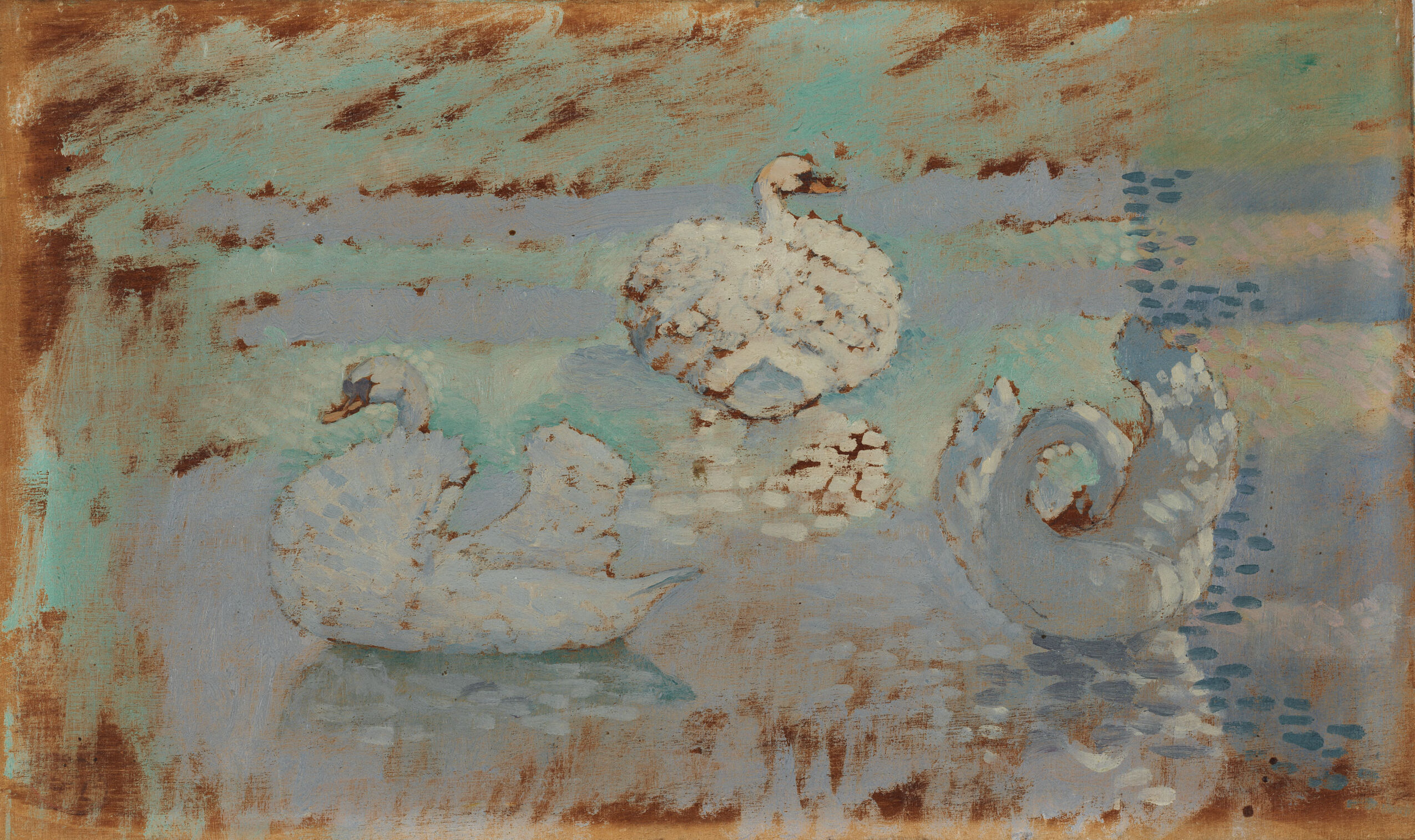
Three Swans, 1899
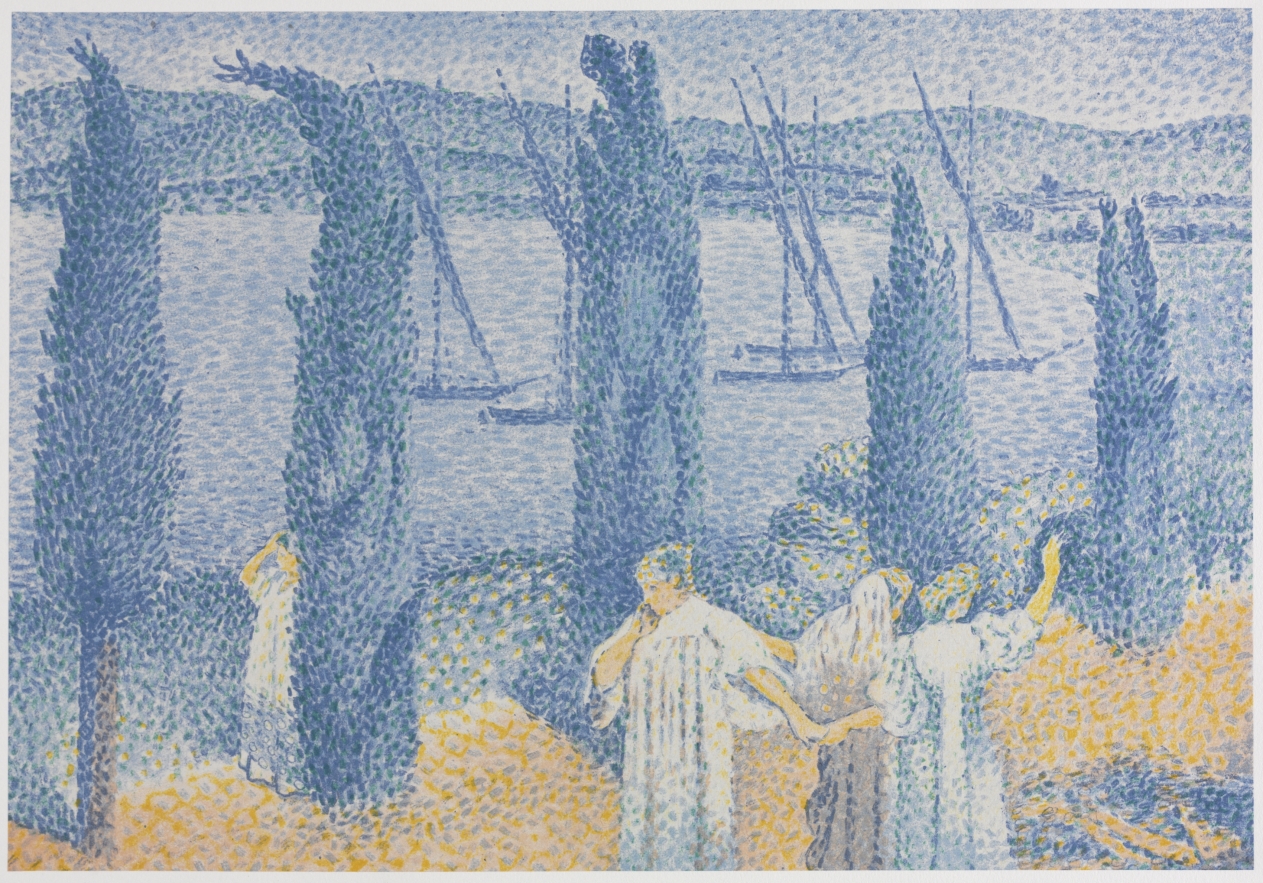
His Seascape, also from that pivotal year of 1891, shows the Mediterranean as something close to pure sensation, the surface of the water broken into jewelled fragments that shimmer between green and ultramarine. Both works announce a painter who has found not just a method but a calling. The 1897 colour lithograph The Promenade, known also as Landscape with Cypresses, reveals another dimension of his practice. Cross was a gifted printmaker, and his lithographs carry the same chromatic intelligence as his oils, demonstrating that his interest was always in the fundamental architecture of colour relationships rather than in any single medium.
Three Swans from 1899 and On the River from 1895 extend his vision to still water and reflected light, subjects that reward the Divisionist touch with almost mathematical precision. The study for Jardin en Provence, dated 1901 and executed on canvasboard, shows him working out problems of dappled shadow and sunlit foliage with the focused attention of a composer sketching a passage before committing it to a full score. These smaller scale works and studies are among the most sought after by serious collectors precisely because they show the intelligence behind the finished surfaces. From a collecting standpoint, Cross occupies a position of genuine distinction.
Henri-Edmond Cross
The Promenade (Landscape with Cypresses), 1897
His works appear regularly at the major auction houses, Christie's and Sotheby's among them, and prices for strong examples on canvas have risen steadily as the market for classic Post Impressionism has matured. Panel works and works on paper offer compelling entry points, retaining all of the chromatic vitality of his larger canvases while reflecting the intimacy of his working process. Collectors drawn to Signac, to Camille Pissarro's late Divisionist period, or to the early works of Henri Matisse and André Derain will find in Cross a figure who is not peripheral to those narratives but central to them. His influence on the Fauves is well documented: Matisse and Derain both spent time in the south of France in the early 1900s absorbing lessons that Cross had already worked out, and the freedom with which they wielded colour owes a recognizable debt to the groundwork he laid.
The legacy of Henri Edmond Cross is inseparable from the idea that method and feeling are not opposites. He took one of the most systematic approaches in the history of painting and used it to produce work of extraordinary emotional immediacy. The discipline of Divisionism, which in lesser hands can produce pictures of a certain mechanical tidiness, becomes in his canvases a vehicle for joy, for the specific pleasure of southern afternoons and sea cooled evenings. He died in 1910, in Saint Clair, the light he had spent two decades painting still outside his window.
His influence moved outward through the twentieth century in waves, from Fauvism to the colour field painters who would later find in his broken surfaces an unexpected kinship. To collect Cross today is to participate in one of the most generous traditions in European painting, a tradition that insists, with every shimmering stroke, that colour itself is a form of knowledge.
Explore books about Henri-Edmond Cross
Henri-Edmond Cross: A Pioneer of Modern Art
Françoise Cachin
Henri-Edmond Cross: Catalogue Raisonné
Isabelle Compin
Cross: Master of Color and Light
Jean-Paul Morel
Henri-Edmond Cross: Drawings and Pastels
Cécile Debray
The Letters of Henri-Edmond Cross
Michel Hoog