Hendra Gunawan
Hendra Gunawan: Indonesia's Painter of Living Souls
Artist Spotlight · The Collection Editorial
There is a moment, standing before a Hendra Gunawan canvas, when the noise of the contemporary art world falls away entirely. His figures press forward from the picture plane with an urgency that feels less like composition and more like encounter. A fishmonger negotiates her price on a sun bleached beach. A mother steadies her child against the pull of a kite string.
Hendra Gunawan
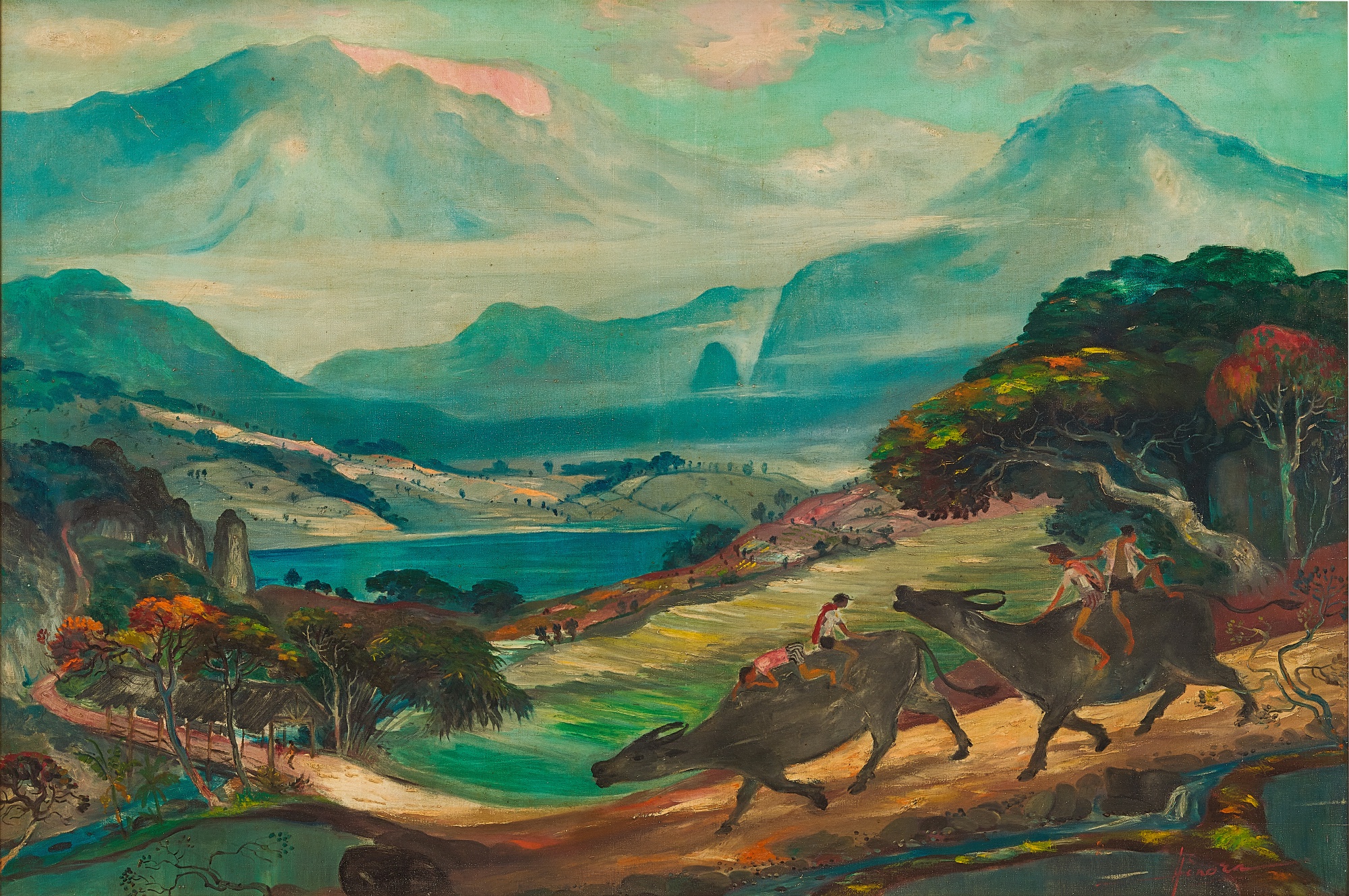
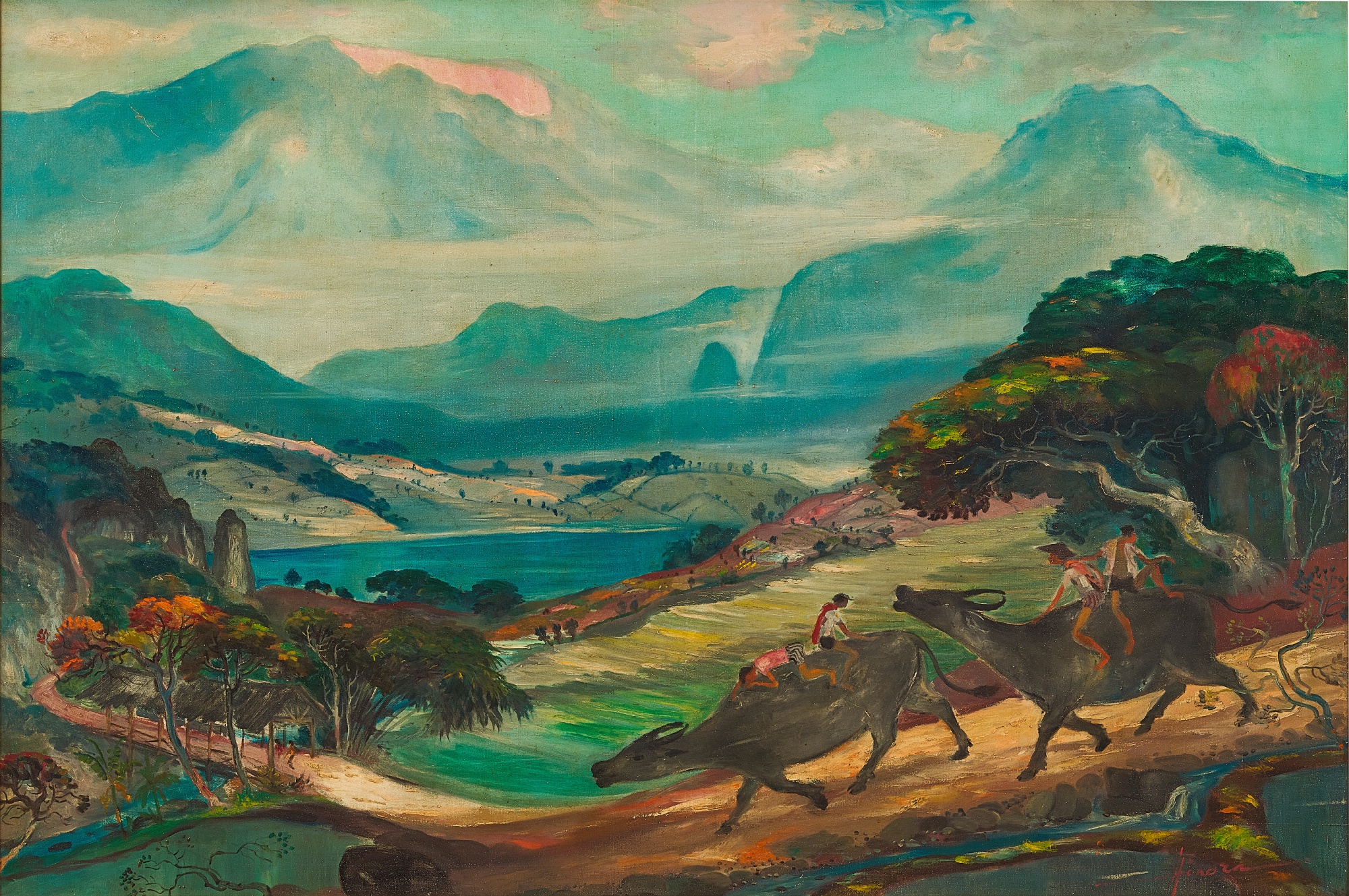
Landscape with Buffaloes 風景與水牛
Women rinse fabric in water the color of twilight. These are not genre scenes. They are declarations of a civilization's beauty, painted by a man who understood, with uncommon certainty, that the ordinary life of the Indonesian people was among the most worthy subjects art had ever been given. Hendra Gunawan was born in Bandung, West Java, in 1918, during the final decades of Dutch colonial rule, and that context shaped everything about who he would become.
Bandung in the early twentieth century was a city of competing modernities, where colonial architecture met Sundanese tradition and the first stirrings of Indonesian nationalism were beginning to take cultural form. Gunawan came of age in this charged atmosphere, and he found his way to painting through a combination of self directed study and the mentorship of the pioneering Indonesian artist Affandi, with whom he formed a close friendship and working relationship that would prove foundational. Affandi's expressive, emotionally direct approach to painting left a lasting imprint on Gunawan, though the younger artist would ultimately develop a voice that was entirely his own, rooted more firmly in collective social life than in individual psychological drama. Gunawan's early development coincided with Indonesia's revolutionary period.
Hendra Gunawan
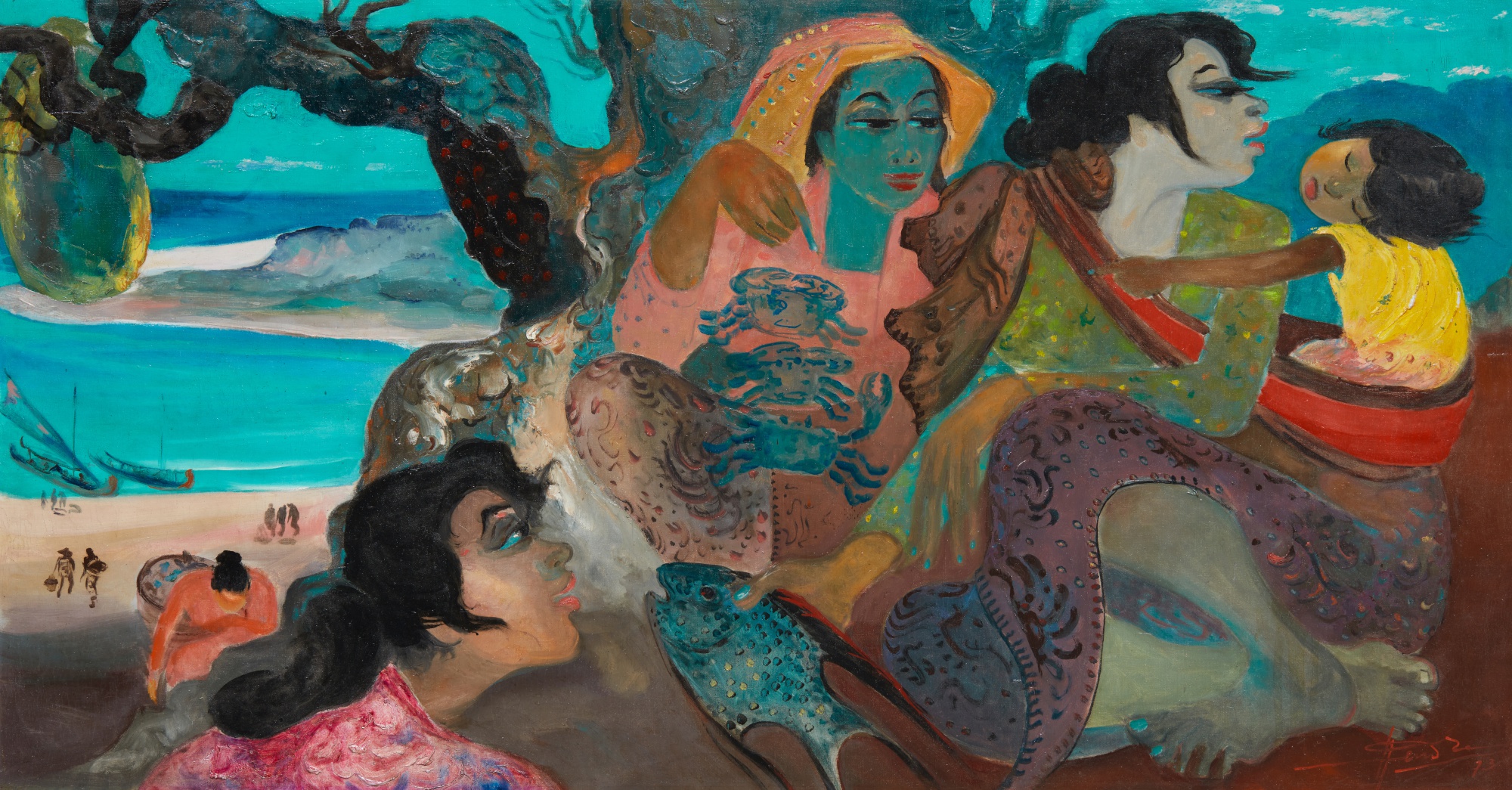
Women and Child on a Beach 海灘上的女人與小孩, 1973
He was not a passive observer of history. An ardent supporter of independence, he participated directly in the struggle against Dutch colonial authority following the Second World War, and his political commitments ran deep into the texture of his art. He co founded the Pelukis Rakyat, or People's Painters association, in 1947, a collective that aligned artistic practice with the aspirations of ordinary Indonesians rather than with the tastes of colonial elites or foreign markets. This was a radical act of cultural positioning, and it gave Gunawan's subsequent body of work its moral seriousness.
He was painting for his people, and they could see it in every stroke. The work that emerged from the 1950s and 1960s is among the most distinctive in all of Southeast Asian modernism. Gunawan developed a style of striking formal originality, drawing on the expressive distortion he had absorbed from Affandi while layering in references to Javanese wayang shadow puppetry, Balinese decorative tradition, and the muscular energy of folk performance. His figures are never idealized in a classical Western sense.
Hendra Gunawan
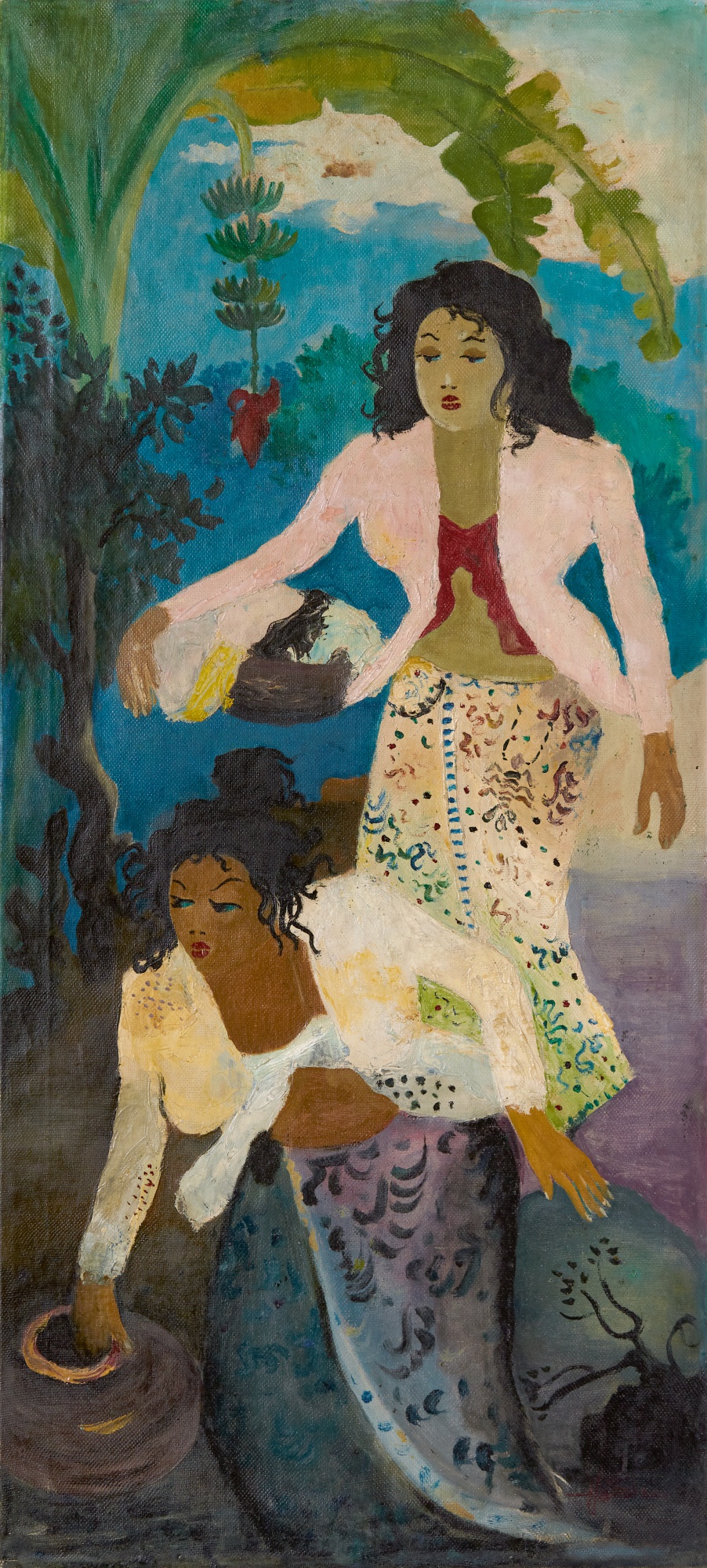
Two women after washing 洗滌中的少女, 1956
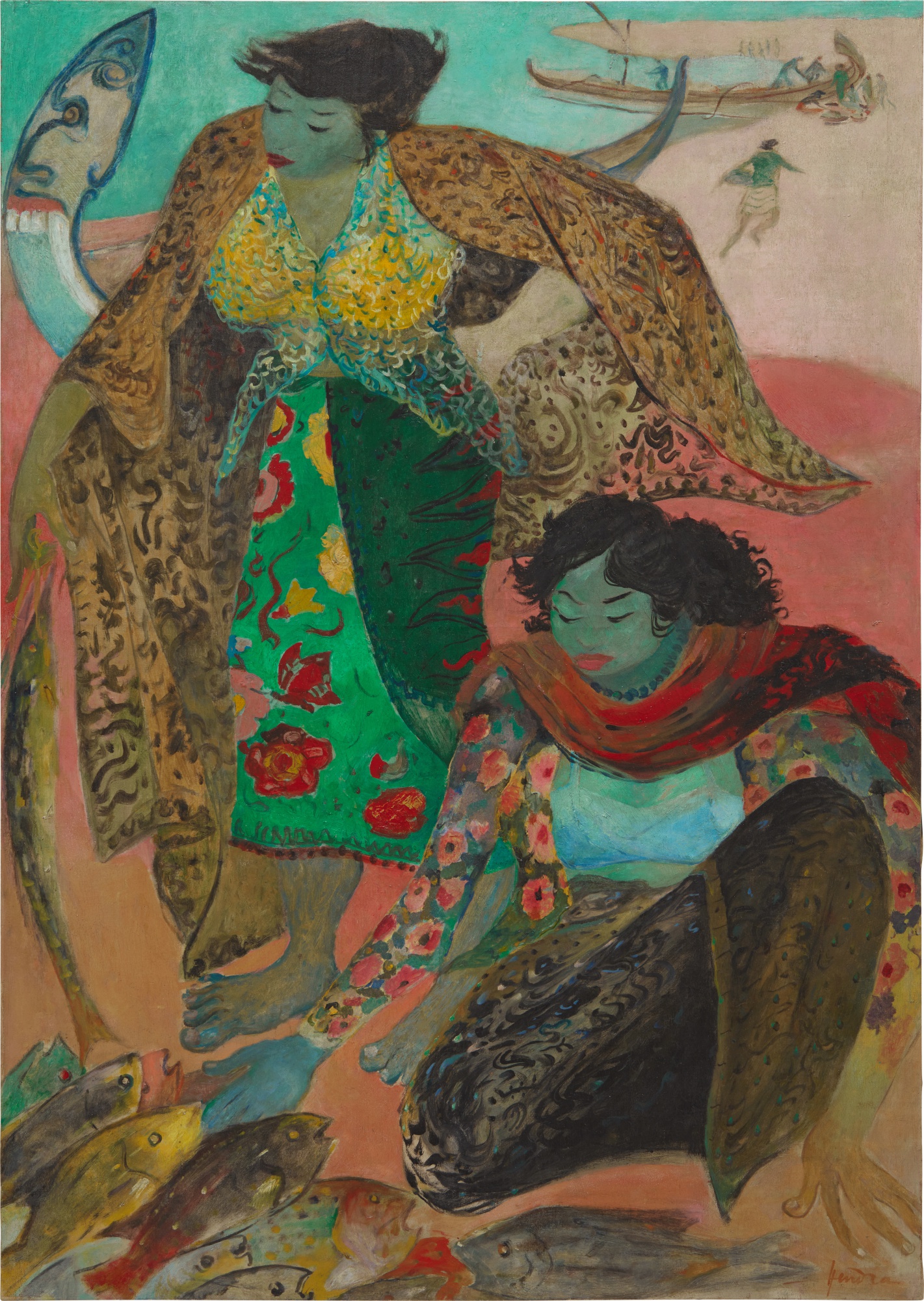
They are broad shouldered and grounded, their bodies given weight and dignity by his insistence on physical presence. Works like Two Women After Washing from 1956 and Women Buying Fish Along the Beach from 1960 reveal an artist at the height of his technical confidence, composing with an almost architectural boldness while keeping the emotional temperature intimate and warm. The colors are extraordinary: deep tropical greens, raw earth reds, the bleached gold of coastal sand, all applied with a freedom that never tips into chaos. In 1965, following the political upheaval that brought General Suharto to power and led to one of the most violent anti communist purges of the twentieth century, Gunawan was arrested.
His associations with left leaning cultural organizations made him a target of the new regime. He would spend thirteen years in prison, first in Jakarta and later in Bali, without ever being formally tried or convicted. For a lesser spirit, this might have meant the end of creative life. For Gunawan, it became another chapter of extraordinary productivity.
Hendra Gunawan
Women Buying Fish Along the Beach 海邊買魚的女人, 1960
He continued to paint throughout his imprisonment, using whatever materials he could obtain, and the works from this period carry a particular luminous intensity, as though the act of painting had become both resistance and lifeline. The Balinese years in particular seemed to open his palette further, infusing his canvases with a spiritual light that became one of the defining qualities of his later style. Released in 1978, Gunawan returned to his practice with undiminished energy. The works from his final years, including the beach scenes and market tableaux that now appear among the most sought after examples of his output, show an artist who had lost nothing to time or hardship.
Paintings like Women and Children from 1975 and Penjual Petai from 1974 reveal a mature vision in full command, where the figurative language he had spent decades building could carry enormous emotional freight with apparent ease. His treatment of the kuda lumping, the Javanese folk performance involving trance and symbolic horsemanship, offered a particular synthesis of his interests: spectacle, community, spiritual intensity, and the deep roots of Javanese cultural identity all fused in compositions of considerable power. For collectors, Gunawan presents one of the most compelling cases in the entire canon of Asian modernism. His works appear regularly at the major Southeast Asian sales held by Christie's and Sotheby's in Singapore and Hong Kong, where they consistently attract serious attention from both regional and international buyers.
The combination of historical importance, formal originality, and sheer visual pleasure that his canvases offer is rare. Works from the late 1950s and through the 1970s represent the full range of his achievement and are the periods most prized by serious collectors. Oil on canvas works depicting his signature subjects, women at the beach, market sellers, folk performances, and maternal tenderness, carry particular resonance. As Indonesian modernism continues to attract broader global recognition, Gunawan's position within that story can only strengthen.
In the broader context of art history, Gunawan belongs to a generation of artists across the global South who were developing vigorous modern traditions entirely independent of the Western European mainstream. He invites comparison with artists like S. Sudjojono, his compatriot and fellow nationalist painter, as well as with figures like the Filipino artist Vicente Manansala, who similarly transformed European modernist vocabulary into something rooted in the textures of local life. Further afield, there are resonances with Diego Rivera's celebration of working people, though Gunawan's formal language is wholly his own and his scale is almost always intimate rather than monumental.
Hendra Gunawan died in Bali in 1983, leaving behind a body of work of remarkable breadth and consistency. He was sixty five years old. The distance between the colonial Bandung of his childhood and the canvases he completed in his final years is enormous, yet it is all legible in the work: the political conviction, the joy in color, the reverence for the people around him. His paintings do not ask for sympathy.
They offer something rarer and more sustaining. They offer recognition. To encounter a Gunawan canvas today is to understand, with quiet certainty, why painting matters.
Explore books about Hendra Gunawan