Helen Levitt
Helen Levitt: Poetry Found on Every Corner
Artist Spotlight · The Collection Editorial
There is a photograph that stops you cold. Two children face each other on a cracked New York sidewalk, their postures weighted with a seriousness that no adult staged or directed. A moment later it was gone, dissolved back into the noise of the city. Helen Levitt was there, camera in hand, and she understood that this was enough.
Helen Levitt
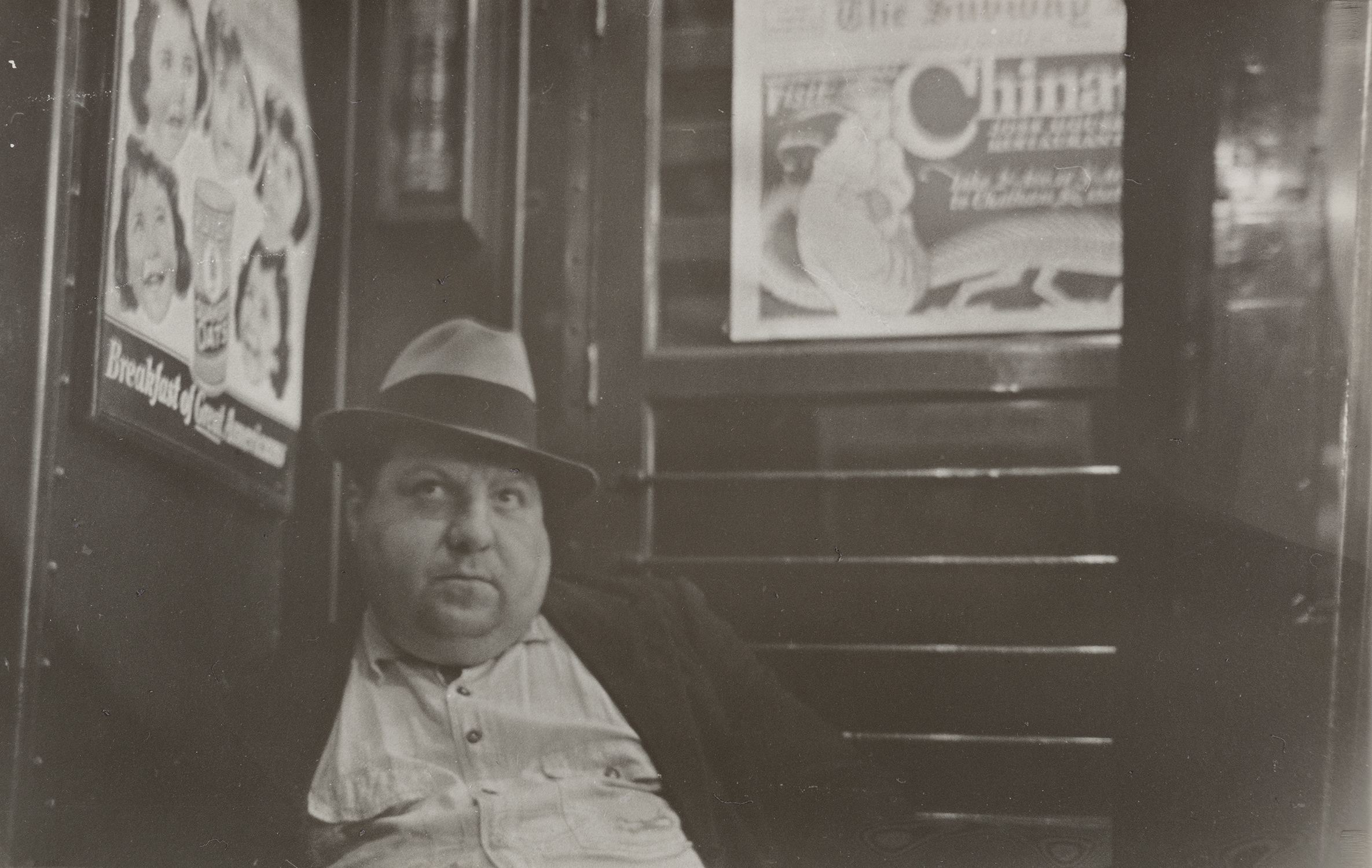
Subway Portrait (man with hat)
More than enough. Across a career spanning six decades, Levitt produced a body of work that stands among the most humane and visually precise achievements in the history of American photography, and her prints continue to command devoted attention from collectors and museum curators alike. Levitt was born in Brooklyn in 1913 and grew up in the Bensonhurst neighborhood, the daughter of a dry goods businessman. She left school at fifteen and found her way into photography through commercial portraiture work in the Bronx during the early 1930s.
The turning point came when she encountered the work of Henri Cartier Bresson, whose ideas about the decisive moment and the geometry of unguarded life gave form to instincts she already possessed. She purchased a Leica, the small and unobtrusive camera that would become her essential tool, and began walking the streets of New York City with a clarity of purpose that belied her age. The city itself was her classroom, and she proved an extraordinarily gifted student. Her friendship with Walker Evans proved formative.
Helen Levitt
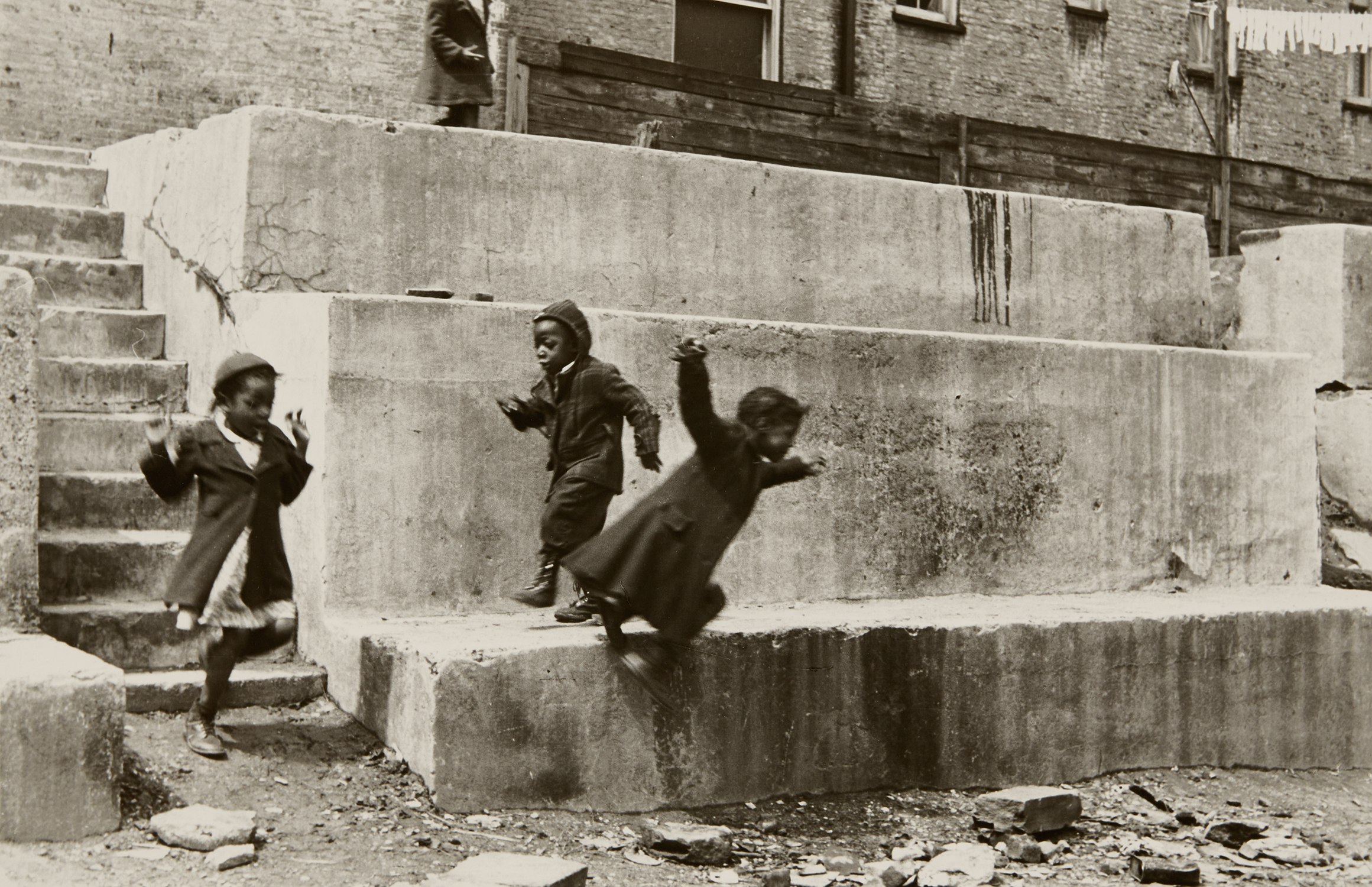
New York (children playing)
Evans, who had already established himself as the defining documentarian of Depression era America, recognized in Levitt a talent that operated on a different frequency from his own. Where Evans sought the monumental and the emblematic, Levitt pursued the fleeting and the tender. Evans lent her a right angle viewfinder, a device that allowed her to appear to point the camera in one direction while photographing in another, preserving the spontaneity of her subjects. The writer James Agee, Evans's collaborator on the landmark book Let Us Now Praise Famous Men, became another ardent champion, writing with eloquence about her ability to find within ordinary street life a kind of lyric intensity that most observers simply walked past.
Their endorsement was significant, but what Levitt had found in the streets of East Harlem, the Lower East Side, and Spanish Harlem needed no external validation to assert its power. The work she produced through the late 1930s and 1940s is the foundation of her reputation. Levitt focused obsessively on children, not because she was making a sociological argument about poverty or urban neglect, but because children in play occupy a state of pure imaginative freedom that photographs could briefly hold in place. In works such as New York (children playing) and N.
Helen Levitt
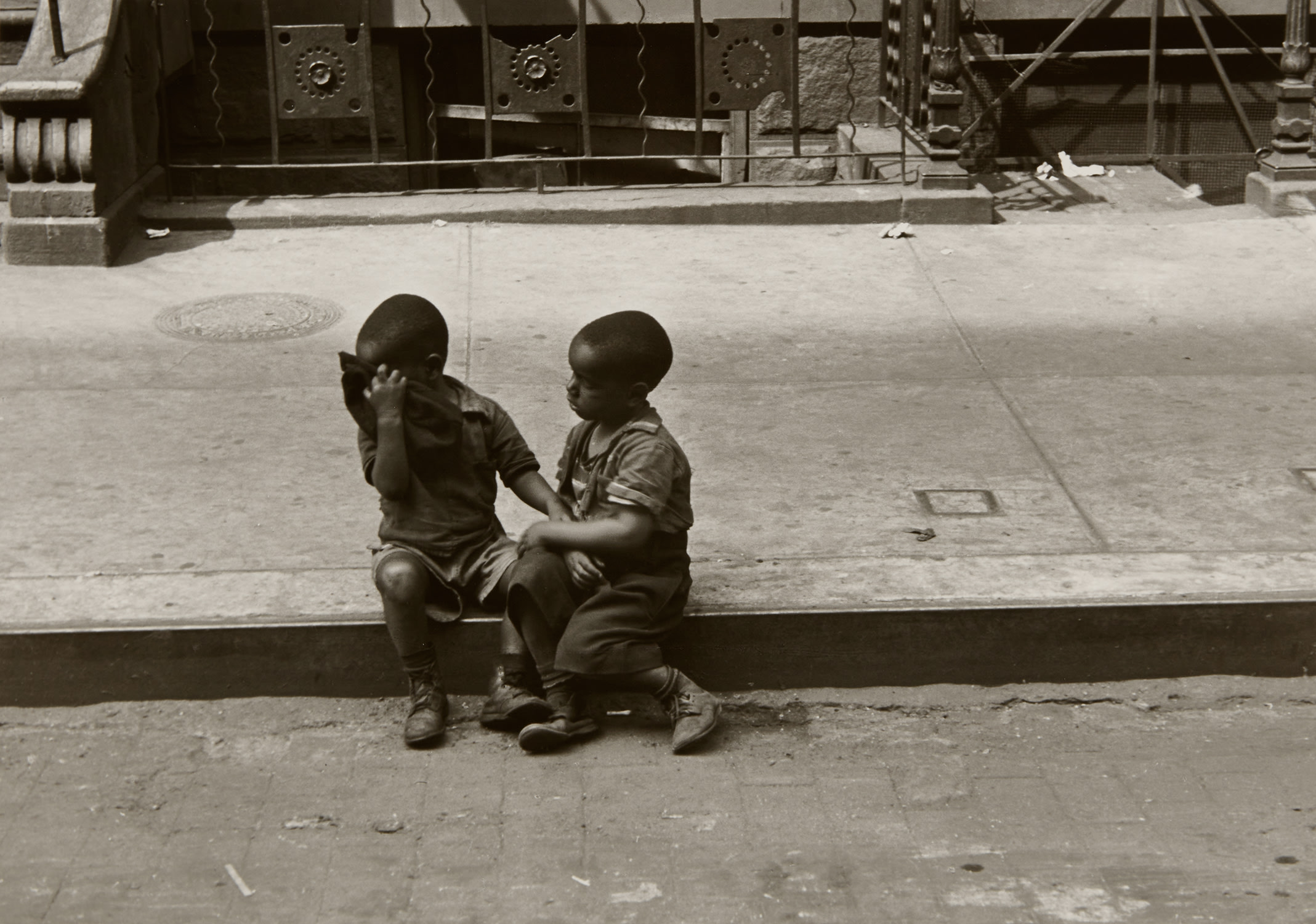
New York (two boys sitting)
Y. (children with doll and flowers), the children become performers in an unselfconscious theater of their own devising, their faces and bodies articulating emotional states of startling complexity. The wet streets, the stoops, the chalked sidewalks and worn tenement doorways form a stage set of extraordinary richness. A 1943 exhibition at the Museum of Modern Art introduced her work to a broader public, and MoMA has remained a custodian of her legacy ever since, holding major examples of her prints in its permanent collection alongside the Metropolitan Museum of Art and the San Francisco Museum of Modern Art.
In the early 1950s, Levitt made a significant departure, turning to color photography at a time when color was considered a commercial medium unsuitable for serious artistic purposes. Working with Kodachrome film, she produced images whose palette felt simultaneously heightened and true, the electric greens and warm ochres of city life rendered with a fidelity that gelatin silver could never approximate. These color photographs remained largely unseen for decades. When a body of them was stolen from her apartment in 1970, along with a second theft of additional work, she lost an irreplaceable archive.
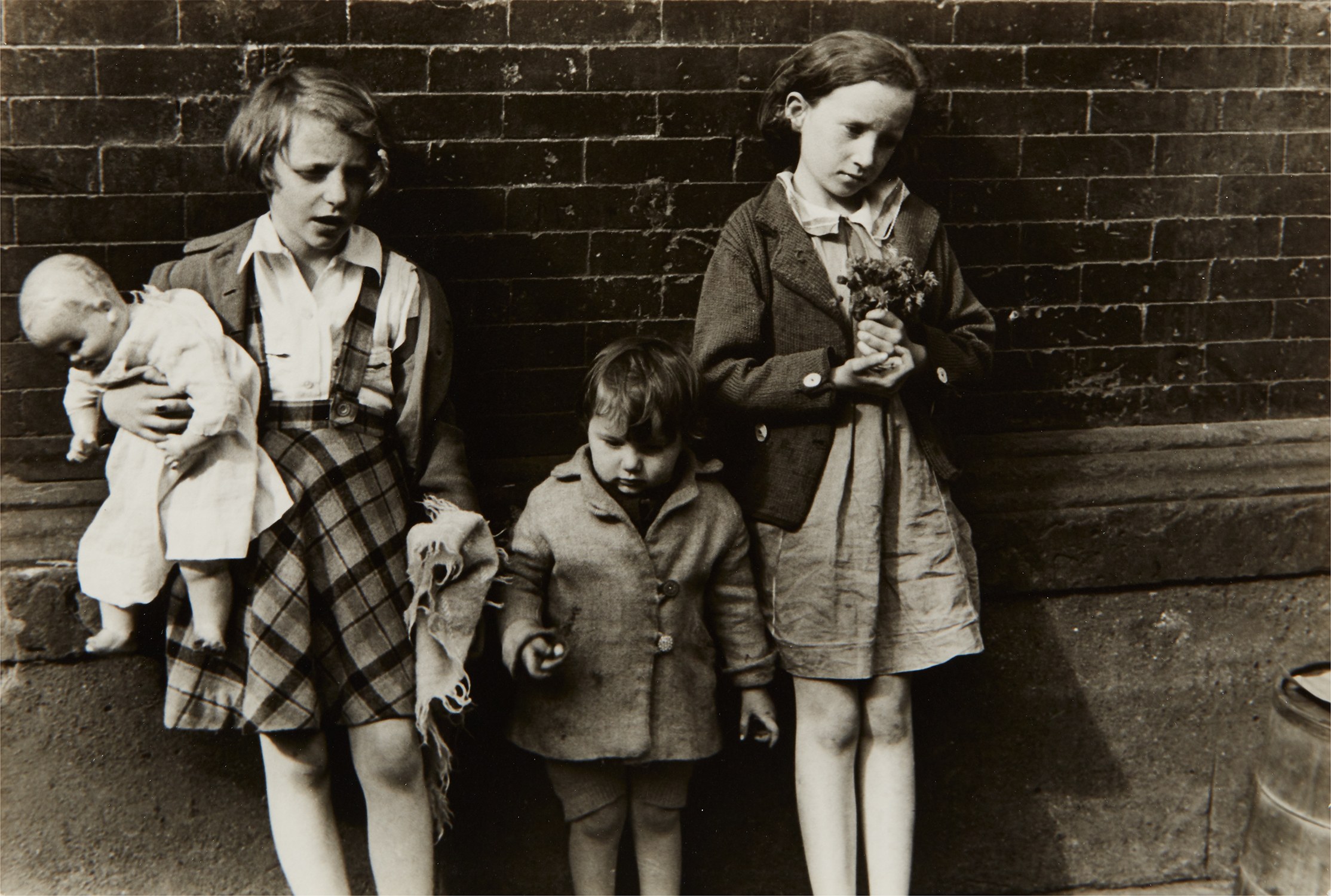
Helen Levitt
N.Y. (children with doll and flowers)
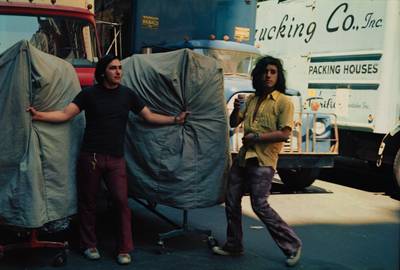
What survived, however, including the dye transfer prints made in the 1990s such as New York (Garment District), printed 1991, demonstrates that her color vision was as sophisticated and emotionally attuned as her black and white work. The dye transfer process, a meticulous and technically demanding printing method favored for its luminosity and archival stability, gives these images a jewel like presence on the wall that collectors have come to prize enormously. From a collecting perspective, Levitt's prints occupy a position of genuine importance in the market for twentieth century photography. Gelatin silver prints, particularly those printed later under her supervision, represent an accessible point of entry into her work, offering the full expressive range of her street imagery at a scale suitable for domestic spaces as well as institutional settings.
Works such as Subway Portrait (man with hat), New York (two boys sitting), and New York City (young boy) demonstrate the range of her attention, moving from the compressed psychological drama of the subway to the open air poetry of the sidewalk. Her dye transfer color prints are rarer and command premium interest from advanced collectors. Levitt fits naturally into the company of her great contemporaries in street photography, among them Lisette Model, Weegee, and Garry Winogrand, though her sensibility is gentler and more lyrical than any of them. Internationally, she belongs in conversation with Cartier Bresson and Brassaï, photographers who understood the city as a theater of human feeling.
The legacy of Helen Levitt is one of extraordinary richness and surprising quiet. She did not seek celebrity, gave few interviews, and let the work speak with a directness she herself rarely matched in words. What she understood, and what her photographs communicate across every decade since their making, is that the most profound experiences of urban life are not the grand spectacles but the small and unrepeatable moments of children lost in play, of strangers caught in passing reverie, of streets that hold the whole weight of a civilization in their cracks and shadows. Museums have honored her, critics have celebrated her, and collectors who live with her prints report that the works only deepen with time, revealing new nuances of light and gesture and feeling on each encounter.
In an era when the history of photography is being reassessed and expanded with welcome thoroughness, Levitt's place within it grows only more secure and more luminous.
Explore books about Helen Levitt
Helen Levitt
James Agee
A Way of Seeing
Helen Levitt

Helen Levitt: Photographs from the Nineteen-Thirties and Forties
Helen Levitt
In the Street: Chalk Drawings and Messages, New York City
Helen Levitt
Helen Levitt
Maria Morris Hambourg
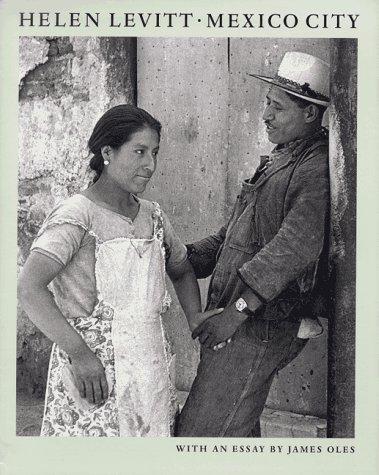
Helen Levitt: Mexico City
Helen Levitt
Helen Levitt: Life and Work
Siri Hustvedt