Hans Bollongier
Blooms That Outlast the Season Forever
Artist Spotlight · The Collection Editorial
There is a moment, standing before a Hans Bollongier canvas, when time seems to fold in on itself. The petals of a parrot tulip, rendered in creamy yellows and streaked reds, appear so present and alive that the fact of their painting four centuries ago becomes almost incomprehensible. That quality, the sense of arrested time held tenderly in paint, is precisely why museum curators, scholars, and private collectors continue to return to Bollongier with fresh eyes. His work endures not as historical curiosity but as a genuinely moving encounter with beauty.
Hans Bollongier
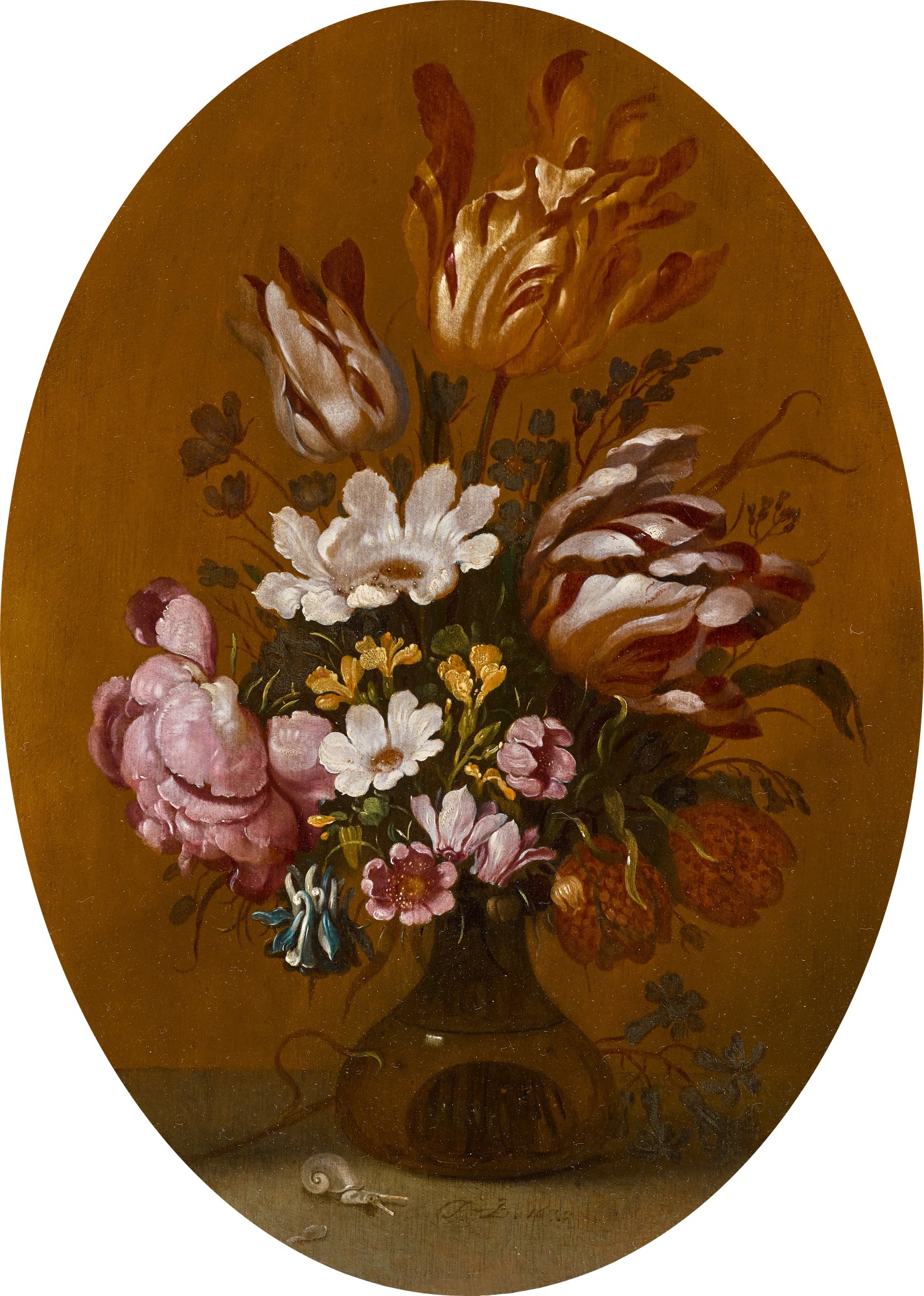
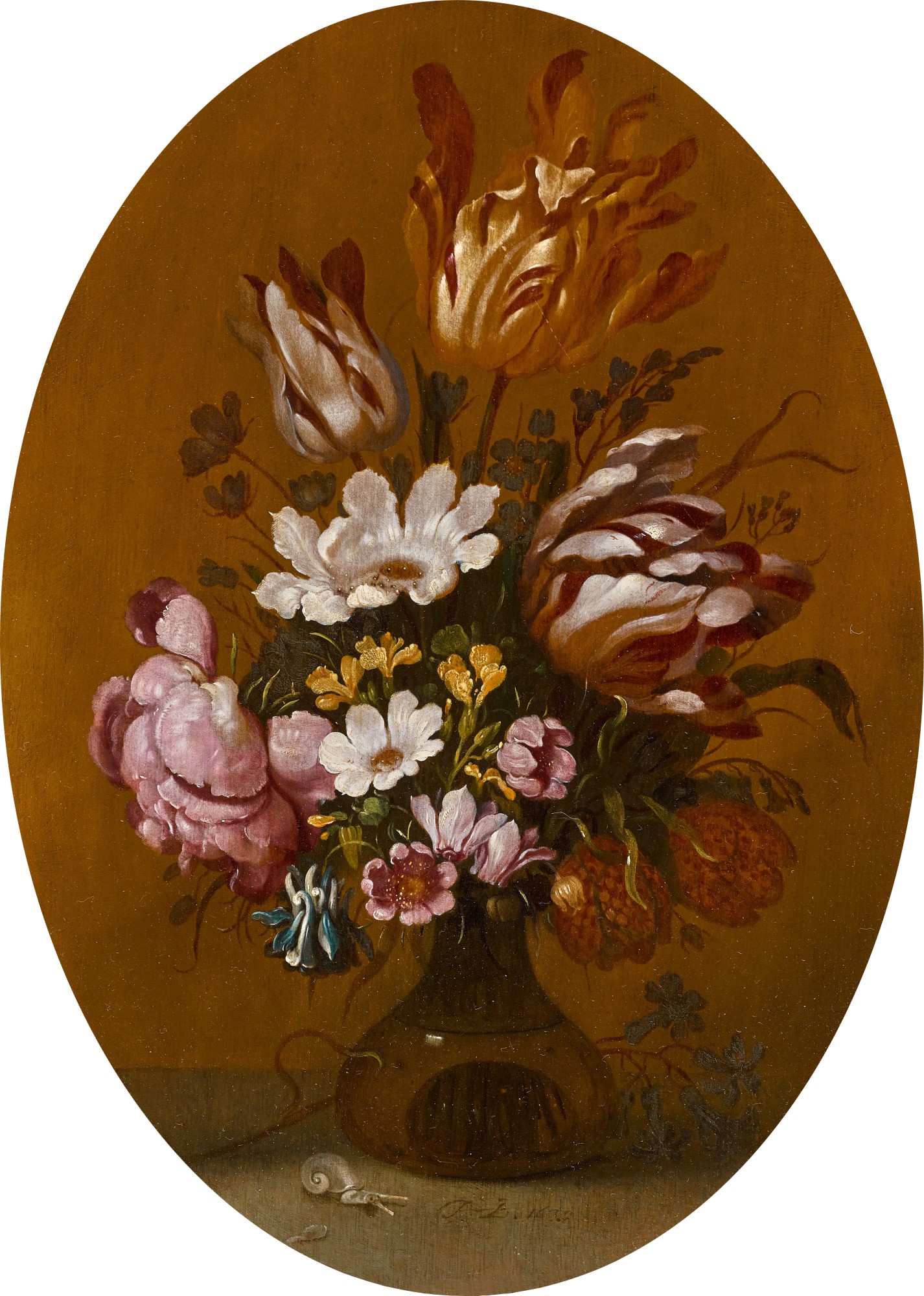
A still life of parrot tulips, roses and other flowers, in a glass vase
Bollongier was born around 1600 in Haarlem, the city that stood at the very center of Dutch still life painting during the early seventeenth century. Little documentation survives about his early years, but the artistic environment of Haarlem was extraordinarily fertile, shaped by the ambitions of painters who were transforming modest tabletop arrangements into profoundly meditative works of art. The city's connections to the flower trade, and particularly to the tulip market that would eventually convulse the Dutch economy in the mania of the 1630s, gave painters like Bollongier access to extraordinary botanical specimens and an audience hungry to possess images of them. He absorbed these influences with evident care, developing a sensitivity to surface and light that would define his mature practice.
His training remains a matter of some scholarly conjecture, but his technical command strongly suggests an apprenticeship within the sophisticated workshop culture of the Dutch Golden Age. By the time he was producing his most accomplished canvases in the 1630s, Bollongier had arrived at a style that was unmistakably his own. He worked primarily in Amsterdam, where the prosperous merchant class provided a steady appetite for refined still life paintings. His compositions favored the intimate scale, typically oil on panel or oil on paper laid onto panel, formats that suited the domestic interiors of his patrons and allowed him to achieve an extraordinary density of detail within modest dimensions.
Hans Bollongier
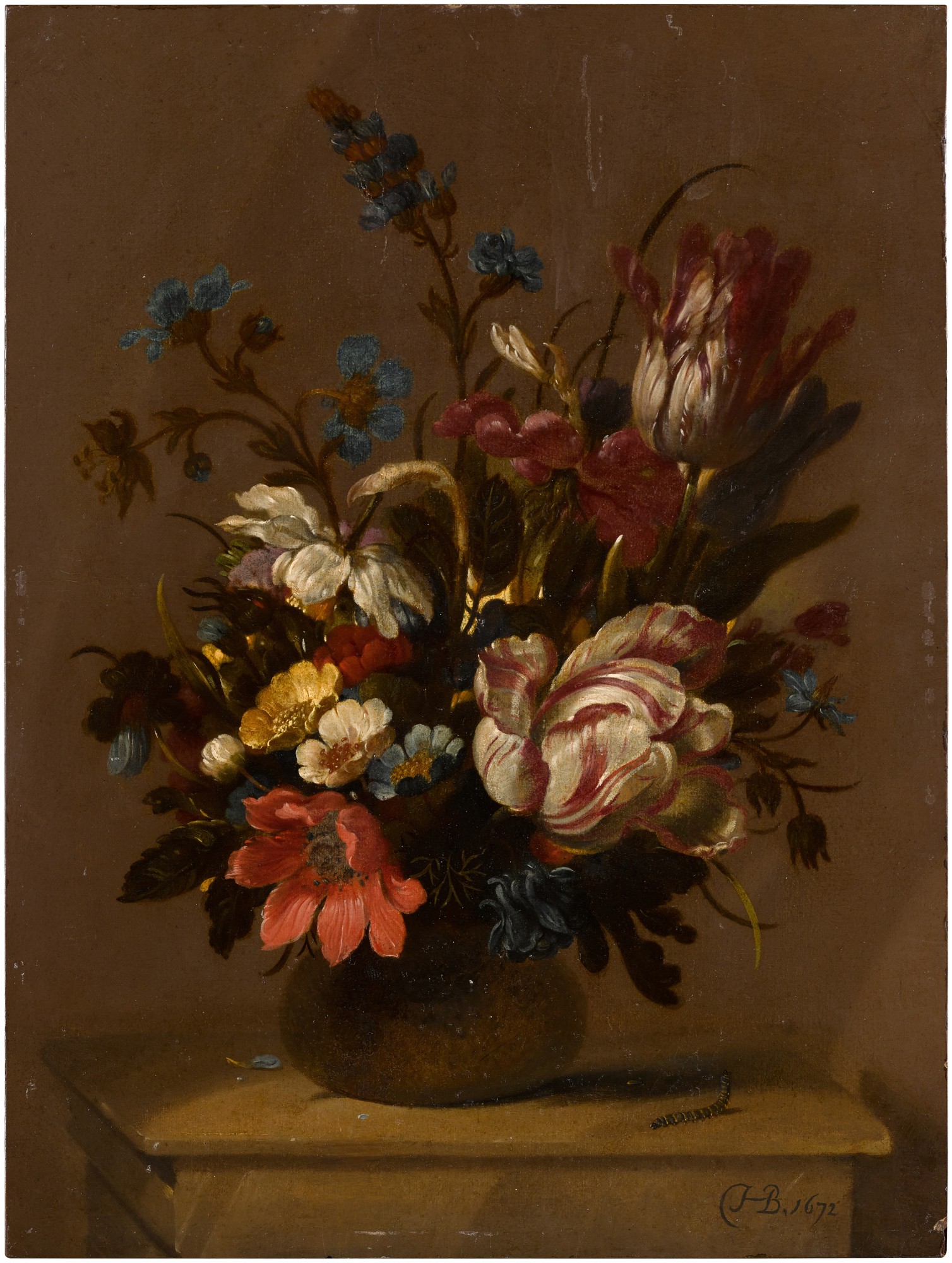
Still life with tulips, anemones and other flowers in a vase, on a stone ledge
What distinguishes Bollongier within the rich tradition of Dutch floral painting is his combination of scientific attention and genuine painterly warmth. He was particularly drawn to rare and exotic specimens, the parrot tulip with its fringed and flamboyant petals, the anemone with its dark center staring out like an eye, roses in various stages of opening. These were not merely decorative subjects but symbols of wealth, curiosity, and the global ambitions of the Dutch Republic, which through its trade networks was importing botanical novelties from the Ottoman Empire and beyond. Bollongier understood the cultural weight of his subjects and treated them accordingly, giving each flower its full dignity while assembling them into compositions of remarkable visual harmony.
His glass vases, rendered with careful attention to transparency and reflection, anchor these arrangements in a convincing physical world even as the flowers themselves transcend ordinary experience. His painting "A still life of parrot tulips, roses and other flowers, in a glass vase" stands as one of the most eloquent expressions of his gift. The parrot tulips in particular command attention, their extravagant forms placed with apparent ease yet clearly the result of considered compositional thinking. The glass vase below them catches light and bends it, offering a small lesson in observation within the larger lesson of the painting as a whole.
A second major work, "Still life with tulips, anemones and other flowers in a vase, on a stone ledge," demonstrates his ability to work across different supports, here oil on paper laid onto panel, with no loss of painterly authority. The stone ledge, a motif shared with other masters of the period, grounds the arrangement in something solid and earthly, a quiet reminder that all this beauty is passing even as the painting preserves it. For collectors, Bollongier occupies a genuinely compelling position in the market for Old Master works. His name carries real art historical significance without the stratospheric prices attached to the very top tier of Dutch Golden Age painters.
Works by Bollongier appear with some regularity at the major auction houses, and they reward close inspection in ways that reproductions never fully convey. The intimacy of his preferred formats means that his paintings were made to be lived with, to be encountered across a breakfast table or in the corner of a study, rather than to command a gallery wall at distance. Collectors who have discovered him tend to speak of the experience of daily proximity to his work as unusually satisfying. The surfaces repay attention over years in a way that more showy paintings often do not.
To understand Bollongier fully it helps to situate him within the constellation of Dutch and Flemish floral painters who were his contemporaries and near successors. Jan Davidsz de Heem, Ambrosius Bosschaert the Elder, and Rachel Ruysch all worked within the same tradition, each bringing a distinct personality to the genre. Bosschaert, slightly older than Bollongier, shared his passion for rare specimens and his preference for glass vessels. De Heem pushed the genre toward greater opulence and complexity.
Ruysch, working later in the century, brought a theatricality that Bollongier never sought. Among these peers Bollongier reads as the painter of a certain quietude, a certain tender precision, that feels remarkably contemporary in its restraint. The legacy of Hans Bollongier is inseparable from larger questions about what painting is for and what it can hold. In an age obsessed with novelty and spectacle, his canvases offer something rarer: a complete and generous attention to the world as it is, petal by petal, stem by stem.
The tulip mania that surrounded his working years was in part a collective delusion about value, a moment when flowers became financial instruments and reason briefly abandoned the Dutch Republic. Bollongier's response was to paint flowers with such care and fidelity that they became genuinely priceless, immune to the fluctuations of any market. That the best of his work survives in excellent condition and continues to move viewers four centuries after it was made is the most eloquent argument for his permanent place in the history of Western painting.