Han Snel
Bali's Golden Light, Beautifully Captured Forever
Artist Spotlight · The Collection Editorial
There is a moment, just before the tropical sun reaches its midday zenith over the rice terraces of Ubud, when the light of Bali becomes something almost impossible to describe. It is warm and suffused, golden and alive, as though the island itself is exhaling. It is precisely this light that Han Snel spent a lifetime chasing across canvas and wood panel, and it is why his paintings continue to arrest viewers decades after they were made. To stand before a Snel is to feel the heat of the Indonesian afternoon, to hear the distant gamelan, to sense the extraordinary beauty of a place and a people rendered through the eyes of someone who chose, above all else, to belong there.
Han Snel
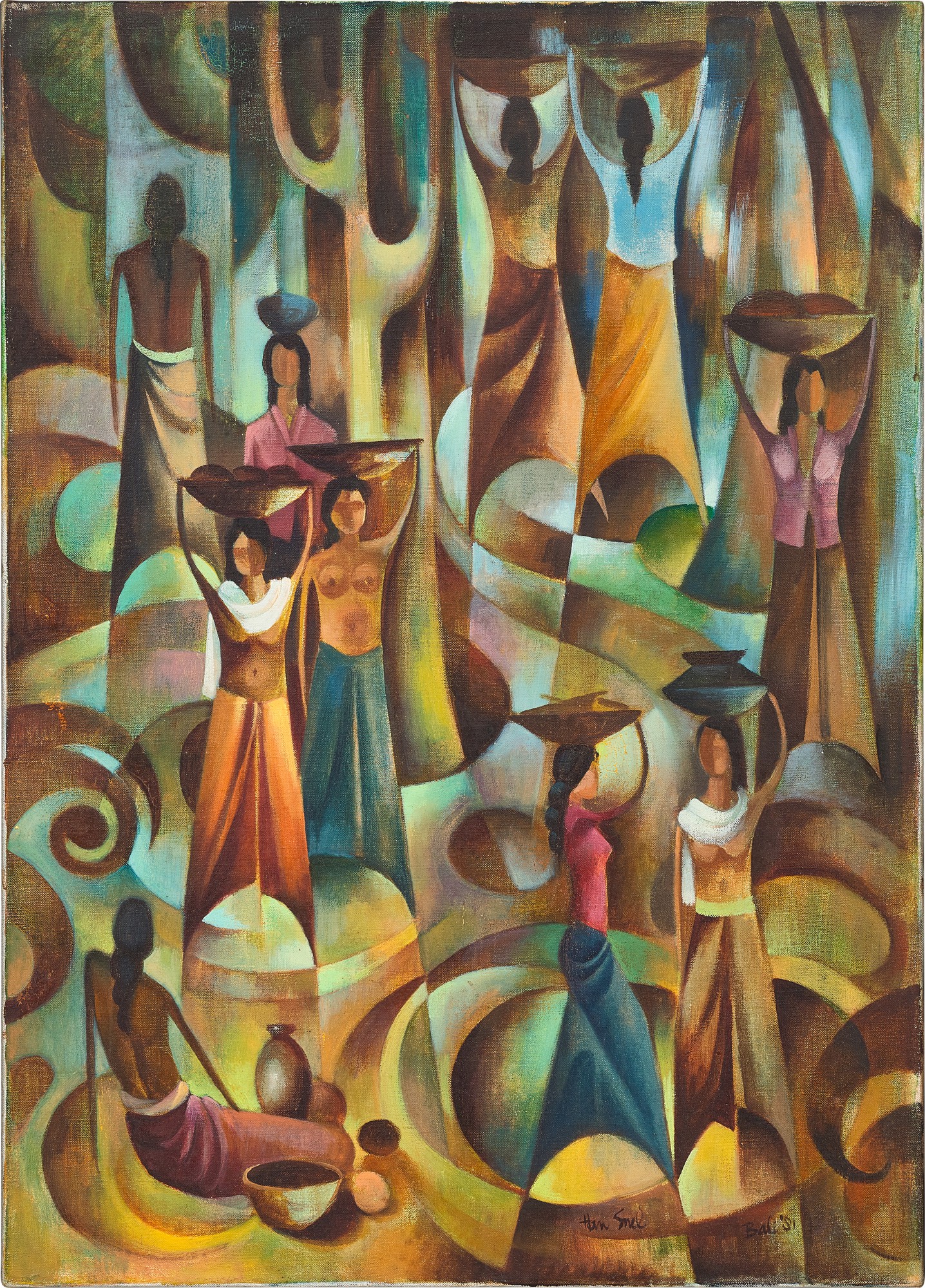
Market Scene, Bali 巴厘市場景象
Han Snel was born in The Hague, the Netherlands, in 1925, into a world that would soon be consumed by the catastrophe of the Second World War. Like many young Dutch men of his generation, his early years were shaped by disruption and displacement. He came to the Indonesian archipelago through his service in the Dutch military in the late 1940s, during the turbulent and painful period surrounding Indonesian independence. What was for many soldiers a posting, became for Snel a revelation.
He encountered Bali not as a colonial outpost but as a living world of staggering cultural richness and visual abundance, and he made the decision that would define the rest of his life: he would stay. Snel settled permanently in Ubud in the early 1950s, becoming one of the small but remarkable community of Western artists who made Bali their true home rather than merely a subject for picturesque souvenir painting. He married a Balinese woman, Siti, and integrated himself into the rhythms of village and ceremonial life with a seriousness of purpose that distinguished him from passing visitors. He studied the island on its own terms.
Han Snel
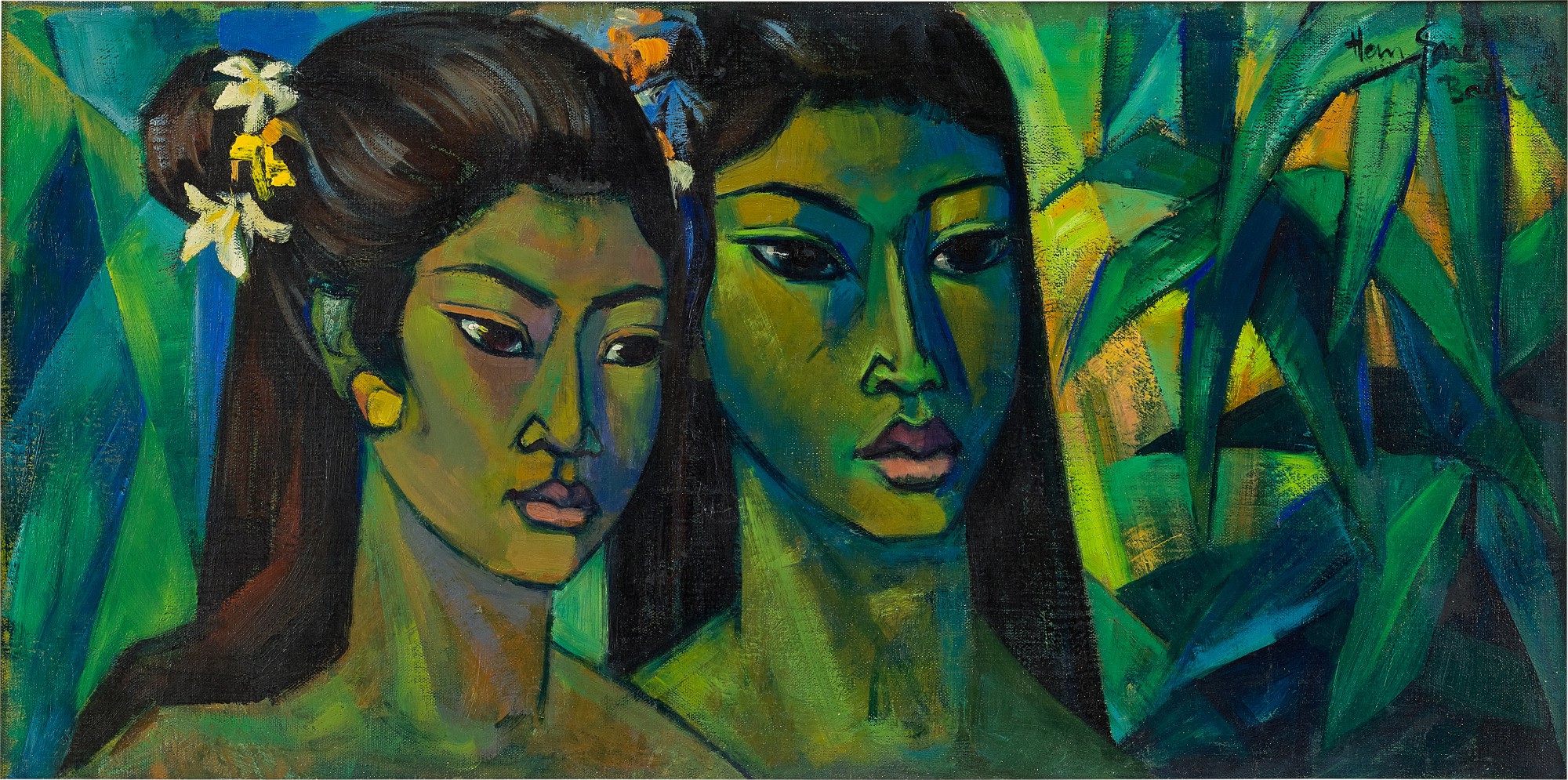
Balinese Beauties 巴厘島美女
This rootedness is the foundation of everything that makes his work compelling. Snel was not painting Bali from the outside looking in. He was painting it from within, from the vantage point of someone who had eaten its food, spoken its language, raised his children there, and watched its ceremonies with the patient understanding of a neighbor rather than a tourist. His artistic development in Bali unfolded across several decades and drew on a rich inheritance of European modernism that he carried with him from the Netherlands.
His handling of oil paint shows the influence of Post Impressionism, with a particular debt to the loose, luminous brushwork that traces back to Gauguin and the broader tradition of artists who sought in the tropics a visual and spiritual intensity unavailable in northern Europe. But Snel was never merely derivative. He evolved a genuinely personal style characterized by warm, resonant color palettes, confident compositional structures, and a tenderness toward his subjects that elevates his figurative work well beyond the merely decorative. His paintings of Balinese women in particular carry a dignity and interiority that reflects genuine affection and familiarity.
Han Snel
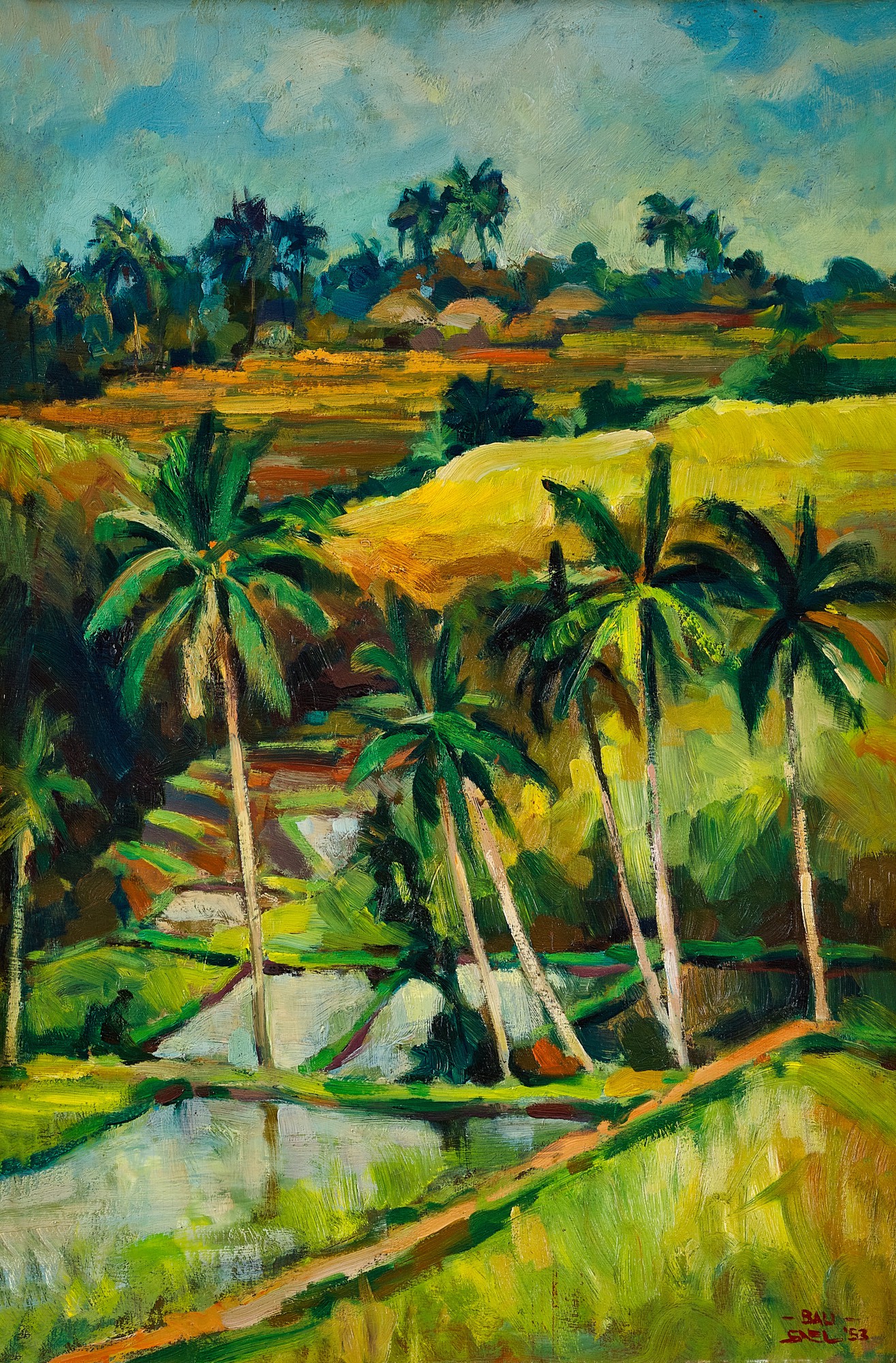
Balinese Landscape 巴厘島風景
Among his most celebrated works are his market scenes and figure compositions, paintings that capture the social fabric of Balinese daily life with an intimacy that could only come from long acquaintance. A work such as Market Scene, Bali draws the viewer into a bustle of color and movement, with the artist's brush orchestrating light and shadow across draped cloth and bare skin and heaped tropical produce with remarkable economy. Balinese Beauties demonstrates his gift for portraiture in the broader sense: the figures are not posed in any stiff or formal way but rather observed in a moment of natural ease, rendered with the confidence of an artist who has drawn and painted these faces countless times and knows exactly which gesture or angle carries the truth of a personality. Balinese Landscape, executed on wood panel, shows his sensitivity to the particular quality of Balinese terrain: the layered greens of the rice fields, the gentle architecture of the volcanic hills, the filtered light that gives everything a sense of gentle radiance.
For collectors, Han Snel represents a particularly rewarding area of focus within Southeast Asian modernism. His works appear at regional auction houses and through specialist dealers in the Netherlands, Indonesia, and Singapore, and prices have reflected growing recognition of his significance both as an artist of genuine quality and as a figure of historical importance in the development of Balinese cultural life. Collectors drawn to the postwar School of Paris, to artists such as Le Mayeur de Merprès or Adrien Jean Le Mayeur, or to the broader tradition of European painters who found their true subjects in Asia, will find in Snel a natural and deeply rewarding companion. His works on wood panel are particularly prized for their textural richness and intimacy of scale, while his larger oil on canvas compositions command attention for their ambition and color confidence.
Within the art historical framework of Western artists in Bali, Snel occupies a distinct and honored position. The tradition of which he is a part includes Walter Spies, the German painter and musician who was central to the cultural life of Ubud in the 1930s, and Rudolf Bonnet, the Dutch artist who co founded the Pita Maha artists cooperative with Spies in 1936. Snel arrived in the generation after these foundational figures and benefited from the cultural infrastructure they helped to create, while bringing his own sensibility and his own commitment to a practice that was genuinely embedded in the life of the island. He is also usefully considered alongside artists such as Affandi, the great Indonesian expressionist, in understanding the richness and diversity of modern painting in the archipelago.
Han Snel passed away in Ubud in 1998, having spent nearly half a century giving visual form to one of the most beautiful places on earth. His legacy endures in the collections of museums and private collectors across Europe, Asia, and the Americas, and in the memory of the Balinese community that accepted him as one of their own. At a moment when the art world is rightly broadening its sense of which stories matter, of which geographies deserve sustained attention, Snel's life and work stand as a powerful reminder that genuine encounter across cultures can produce art of lasting and universal resonance. To collect a Han Snel is to possess not merely a beautiful painting but a fragment of a life fully and joyfully lived.