Haim Steinbach
Haim Steinbach Turns Everyday Objects Into Wonder
Artist Spotlight · The Collection Editorial
“I am interested in the relationship between objects and how they communicate with each other and with the viewer.”
Haim Steinbach, interview with Parkett magazine
There is a particular kind of attention that Haim Steinbach demands from the world, and the world, with increasing gratitude, is paying it. In recent years, major institutional surveys have reaffirmed his position as one of the most quietly radical artists to emerge from the 1980s New York scene. His 2013 retrospective at the Kunsthalle Zürich and the subsequent traveling exhibition "Once Again the World Is Flat" offered audiences a sweeping view of four decades of practice, confirming that his shelves are not merely art objects but philosophical propositions made physical. That renewed institutional embrace has brought fresh eyes to a body of work that rewards sustained looking, and collectors who discovered him early will tell you they have never stopped finding new meaning in the things he chooses to place beside one another.
Haim Steinbach
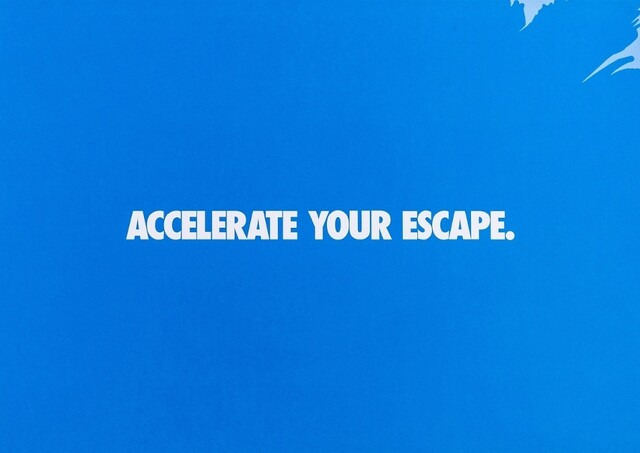
Accelerate Your Escape, 2006
Steinbach was born in 1944 in Rehovot, Israel, a city with a strong scientific and intellectual character that perhaps left some imprint on his methodical, almost taxonomic sensibility. He immigrated to the United States in 1957, settling into the rhythms of American suburban life at exactly the moment that consumer culture was expanding with the most gleeful confidence it had ever known. Supermarkets were becoming cathedrals. Packaging was becoming language.
For a young immigrant learning to read a new country through its objects, this was an education unlike any other. He went on to study at the Pratt Institute in Brooklyn, and later earned his MFA from Yale University in 1968, entering a conversation in American art that was then dominated by Minimalism and Conceptualism, two movements that would permanently shape his thinking. What makes Steinbach's development so compelling is the patience with which it unfolded. Through the 1970s he worked through painting and more traditional sculptural forms, absorbing the lessons of artists like Donald Judd and Carl Andre while also staying alert to what was happening in critical theory, particularly around questions of representation, value, and desire.
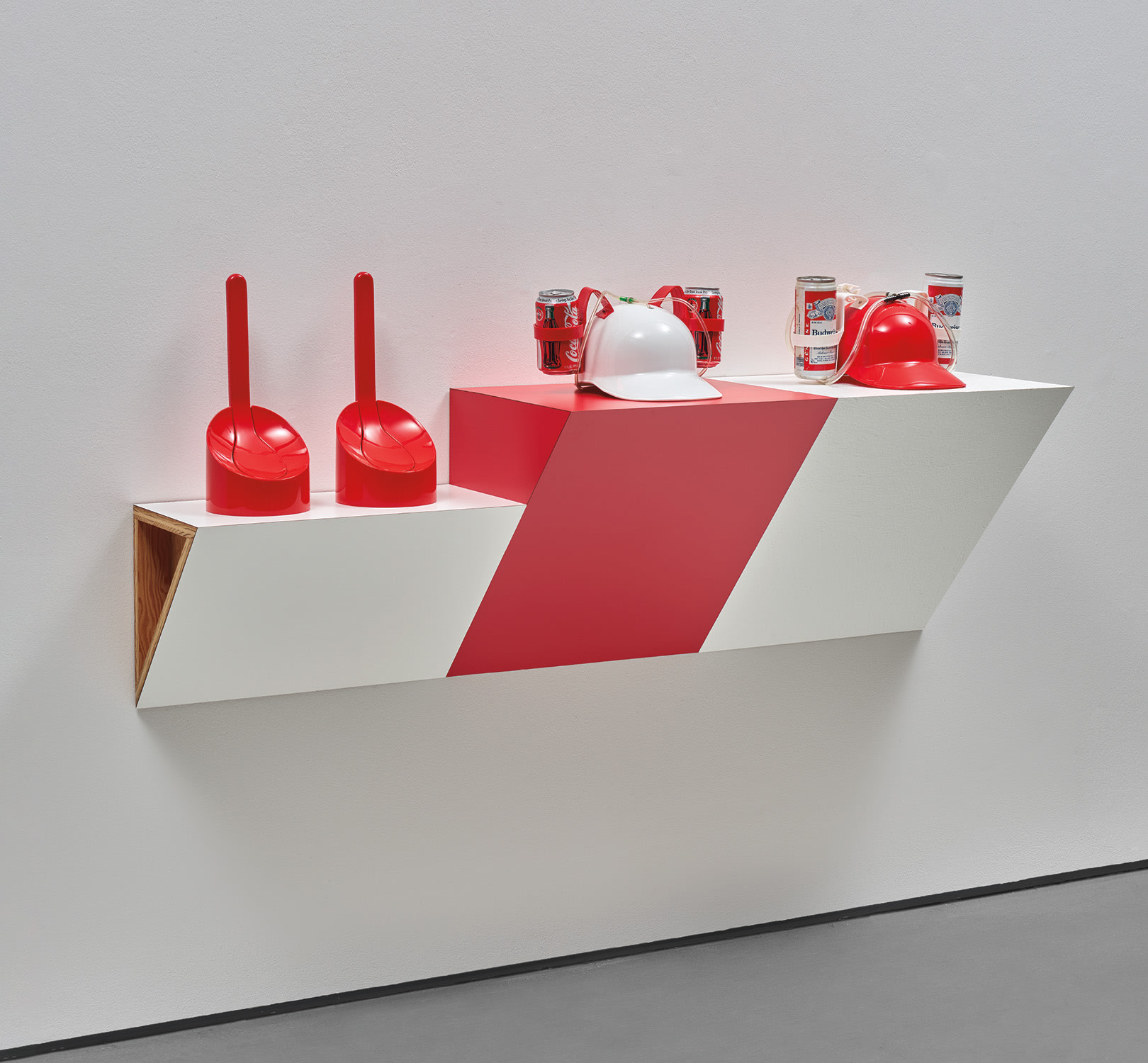
Haim Steinbach
exuberant relative #2, 1986
By the early 1980s he had arrived at what would become his signature gesture: the arrangement of commercially purchased objects on custom built, wedge shaped shelves covered in plastic laminate. The shelves themselves, with their insistent geometry and their surfaces that mimic the finish of discount furniture or kitchen countertops, are as deliberate as the objects they hold. Nothing is accidental. Everything is a choice.
The works from the mid to late 1980s represent some of the most concentrated thinking in his practice. "Black and White Pitcher Series 4A" from 1988, in which two Hall ceramic pitchers sit on a plastic laminated shelf, demonstrates the precision of his eye. He is not interested in the pitchers as antiques or as functional objects but as carriers of color, shape, cultural memory, and retail logic all at once. Works like "chrome laminated wood shelf, 2 felt hats and 2 glass heads" from 1990 push further into the uncanny, pairing objects that share a formal relationship to the human body while maintaining an almost clinical distance from sentiment.
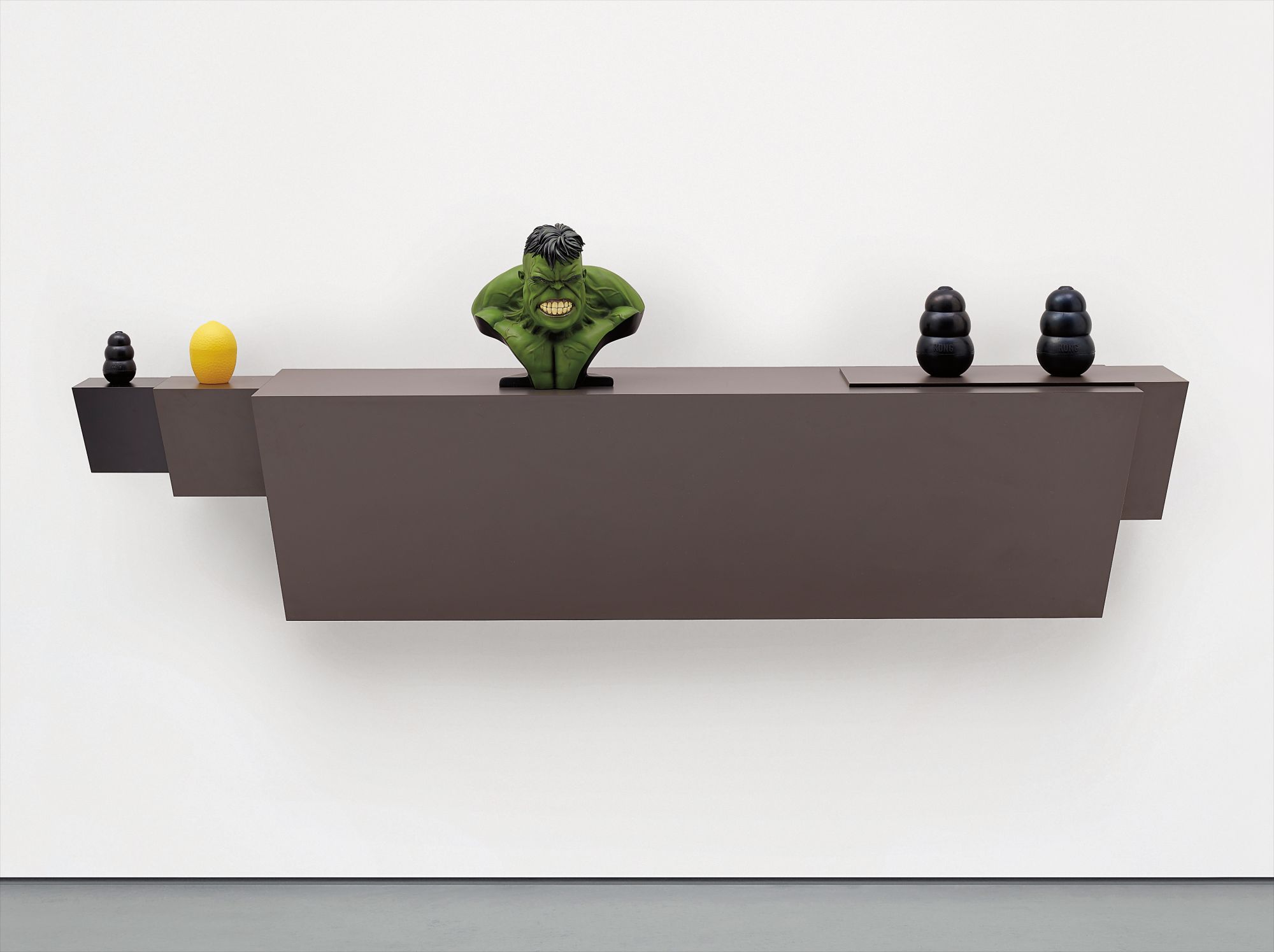
Haim Steinbach
plastic laminated wood shelf, small rubber dog chew, plastic lemon/lime saver, polystone 'Hulk' bust, 2 large rubber dog chews, 2009
This is the tension that animates everything he makes: the warmth of familiar things held in a cool, considered frame. He became associated during this period with the Neo Geometric Conceptualism movement, alongside artists such as Jeff Koons, Ashley Bickerton, and Peter Halley, all of whom were shown at Sonnabend Gallery and shared a preoccupation with what consumer society was doing to aesthetics, desire, and identity. Later works reveal an artist who never stopped experimenting within the logic he established. "crate and barrel 2" from 2008 places rubber dog chews and Crate and Barrel cardboard boxes alongside a stainless steel vase by Ron Arad, a juxtaposition that is witty and pointed in equal measure.
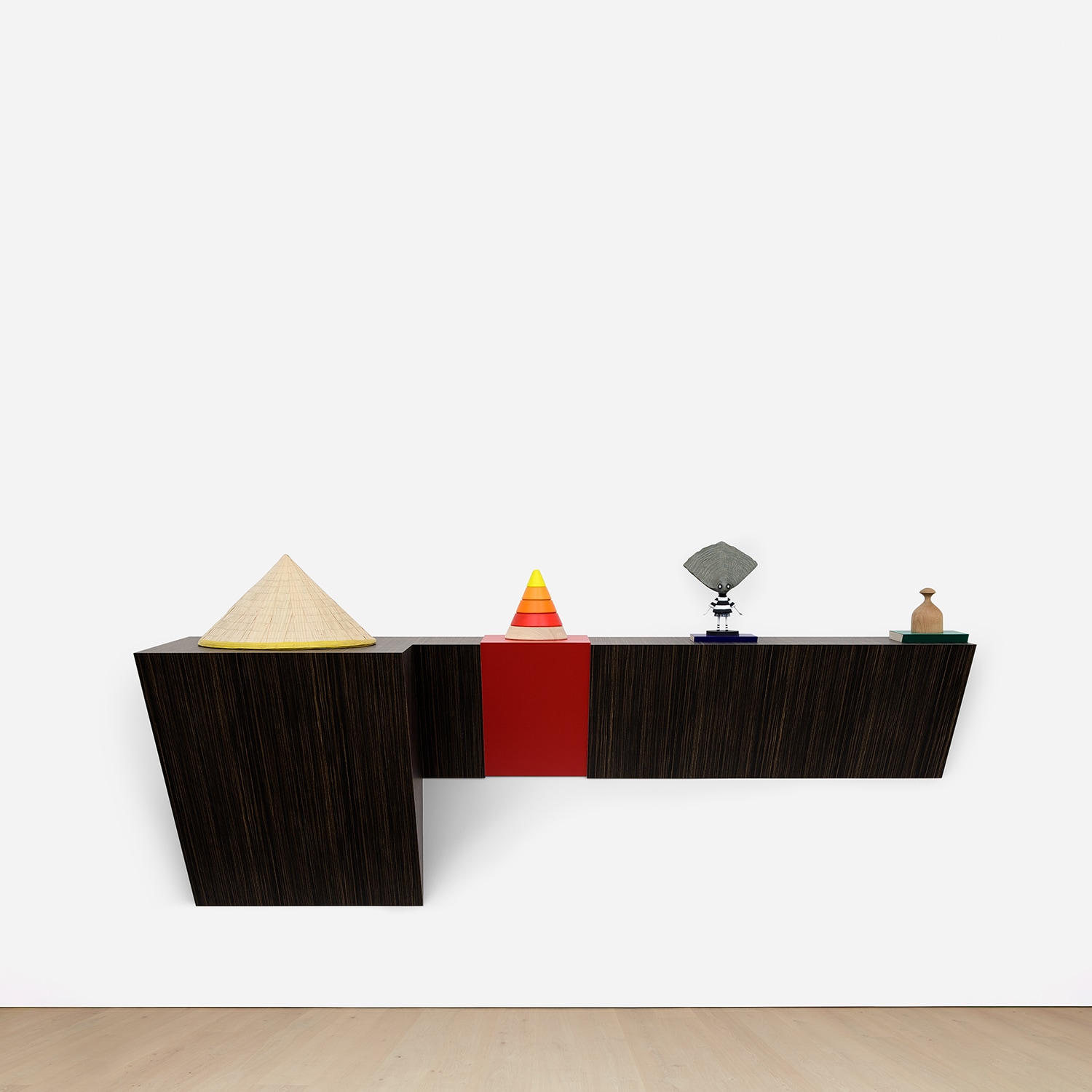
The brand name becomes a readymade sculpture within a sculpture. "plastic laminated wood shelf, straw Chinese hat, Plan Toys wooden cone sorting toy, Tim Burton Oyster Boy figurine and Whetstone wooden biscuit cutter" from 2012 shows the range of cultural registers he moves across effortlessly: children's toys, film merchandise, craft tools, folk headwear all placed in conversation without hierarchy or irony alone guiding the arrangement. And "El Lissitzky II 3" from the same year nods directly to a founding figure of geometric abstraction, reminding us that Steinbach sees his shelves as continuous with the longest traditions of composition in Western art. For collectors, Steinbach offers something genuinely rare: work that is intellectually rigorous without being cold, and formally elegant without being decorative.
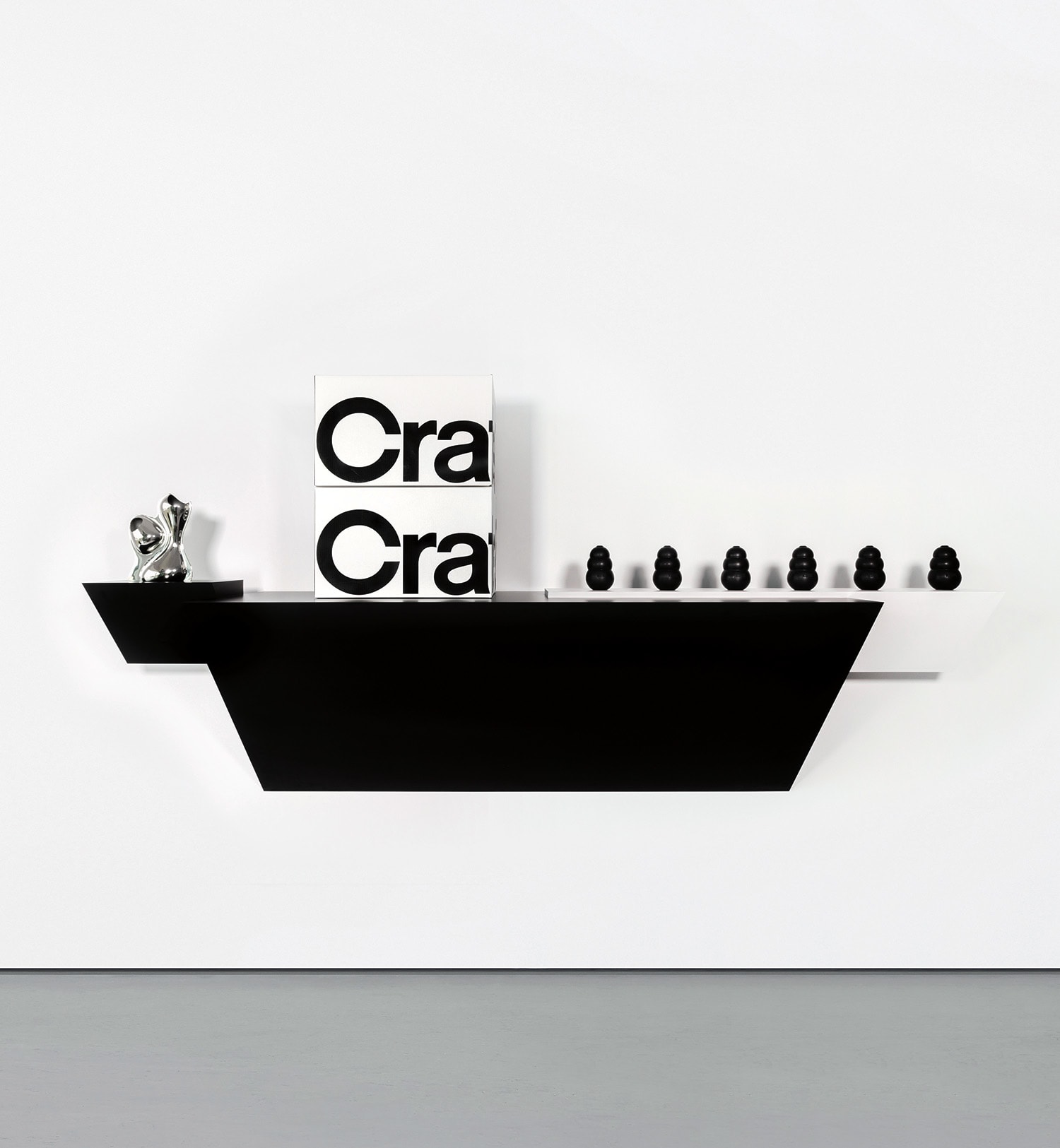
Haim Steinbach
crate & barrel 2, 2008
His pieces hold their interest across years and decades because the questions they ask, about why we want what we want, about what it means to display something, about the line between use value and aesthetic value, do not grow stale. Works from the late 1980s have performed well at auction, with pieces regularly appearing at Christie's and Phillips, and strong institutional holdings at MoMA, the Tate, and the Centre Pompidou signal the kind of long term confidence that serious collectors look for. Newer works and prints such as "Accelerate Your Escape" from 2006 offer accessible entry points into a practice that has only deepened with time. Collectors drawn to artists like Jeff Koons, Sherrie Levine, or Allan McCollum, or those who love the cool rigor of Minimalism alongside the cultural literacy of Pictures Generation work, will find Steinbach a natural and deeply satisfying complement.
What endures most powerfully in Steinbach's legacy is the generosity hidden inside his apparent detachment. He does not mock the objects he selects or the culture that produced them. He elevates them through attention, through composition, through the seriousness with which he treats the act of placement. In doing so he asks us to look at our own shelves, our own accumulations, and consider what they say about who we are and what we value.
In an era when the relationship between objects and meaning has only grown more complicated, that question feels more alive than ever. Haim Steinbach has spent six decades teaching us how to see the world we have built around ourselves, and there is still so much left to discover in his vision.
Featured Works
Accelerate Your Escape
2006
exuberant relative #2
1986
plastic laminated wood shelf, small rubber dog chew, plastic lemon/lime saver, polystone 'Hulk' bust, 2 large rubber dog chews
2009
crate & barrel 2
2008
!['Objects, commodity products, or artworks have functions for us that are not unlike words, [and] language. We invented them for our own use and we communicate through them, thereby getting onto self-realization.'](https://rtwaymdozgnhgluydsys.supabase.co/storage/v1/object/public/artwork-images/auction-lots/UK010215-132015-lot1774337008709.jpg)
'Objects, commodity products, or artworks have functions for us that are not unlike words, [and] language. We invented them for our own use and we communicate through them, thereby getting onto self-realization.'
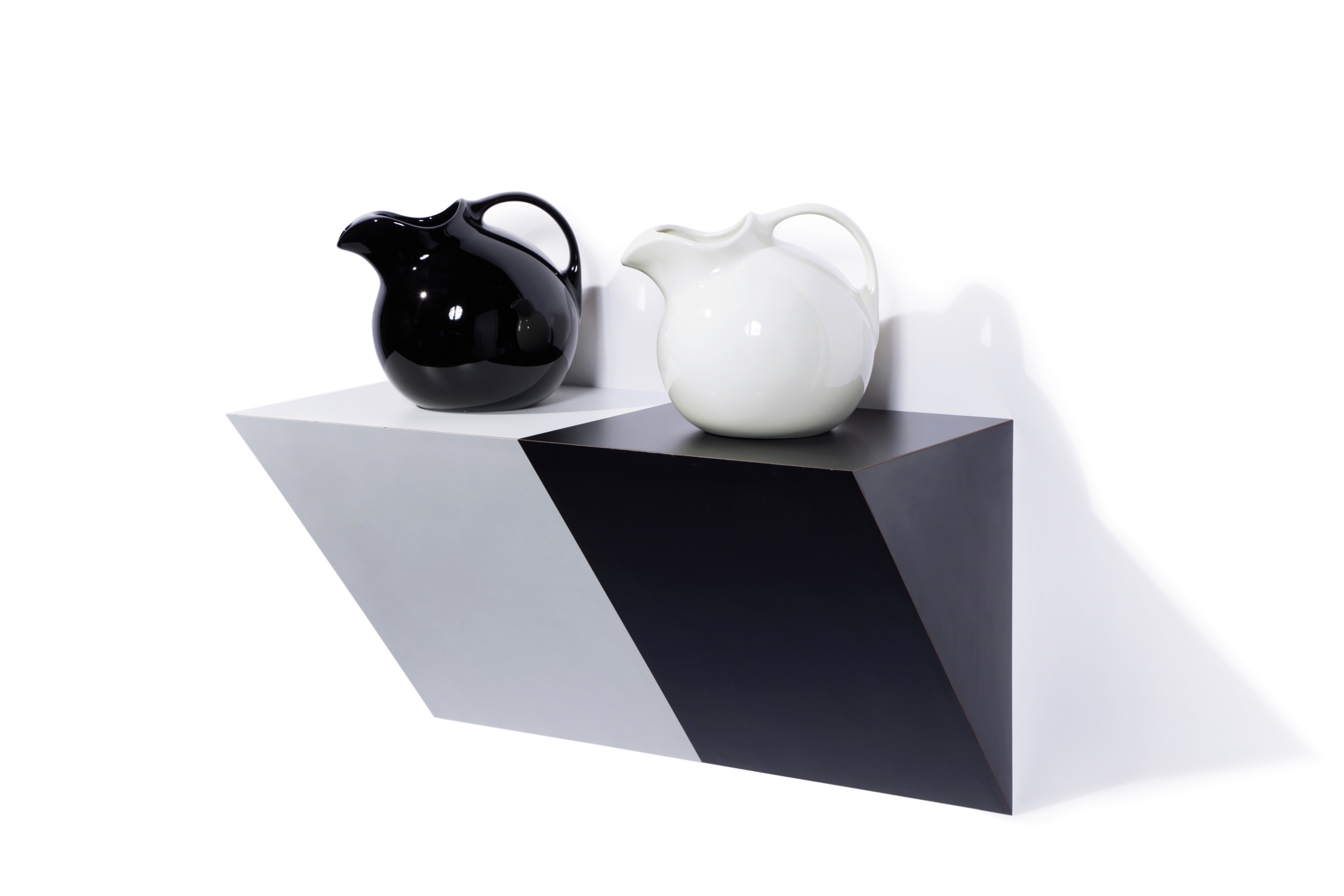
Black and White Pitcher Series #4A
1988
Explore books about Haim Steinbach