Guy de Cointet
Guy de Cointet, Master of Beautiful Mysteries
Artist Spotlight · The Collection Editorial
There are artists who make work that rewards looking, and then there are artists who make work that rewards a kind of patient, almost devotional attention, the sort that asks you to sit with uncertainty and find pleasure there. Guy de Cointet was emphatically the latter. In recent years, major institutions have returned to his practice with fresh urgency: the Museum of Contemporary Art Los Angeles has revisited his legacy in group presentations, and galleries including Sprüth Magers have championed his drawings and performance documents to a new generation of collectors who are hungry for art that operates at the intersection of language, theater, and the visual object. For an artist who died in 1983 at just forty nine years old, de Cointet's presence in contemporary conversation feels less like revival and more like belated recognition of someone who was always, simply, ahead.
Guy de Cointet
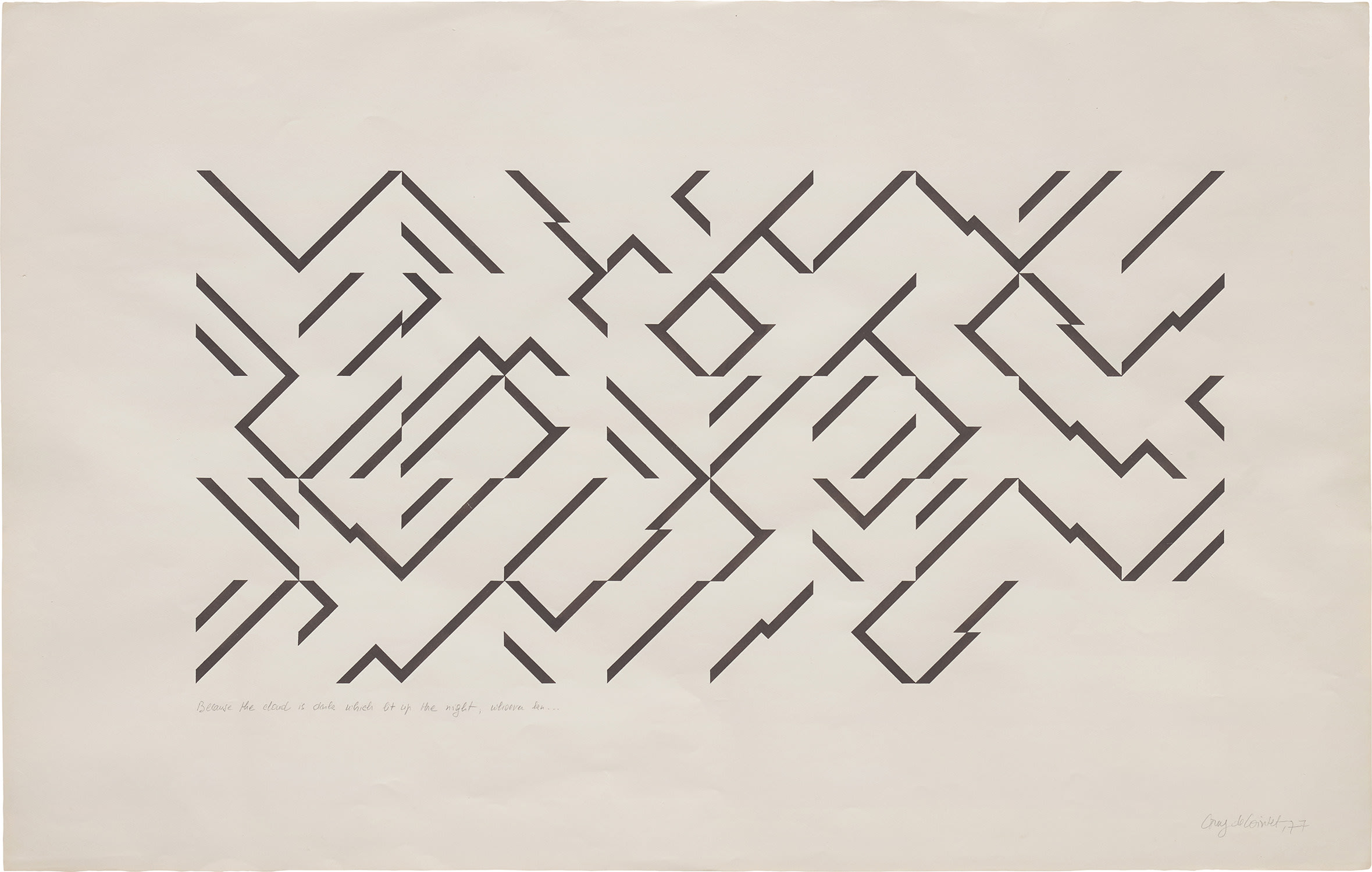
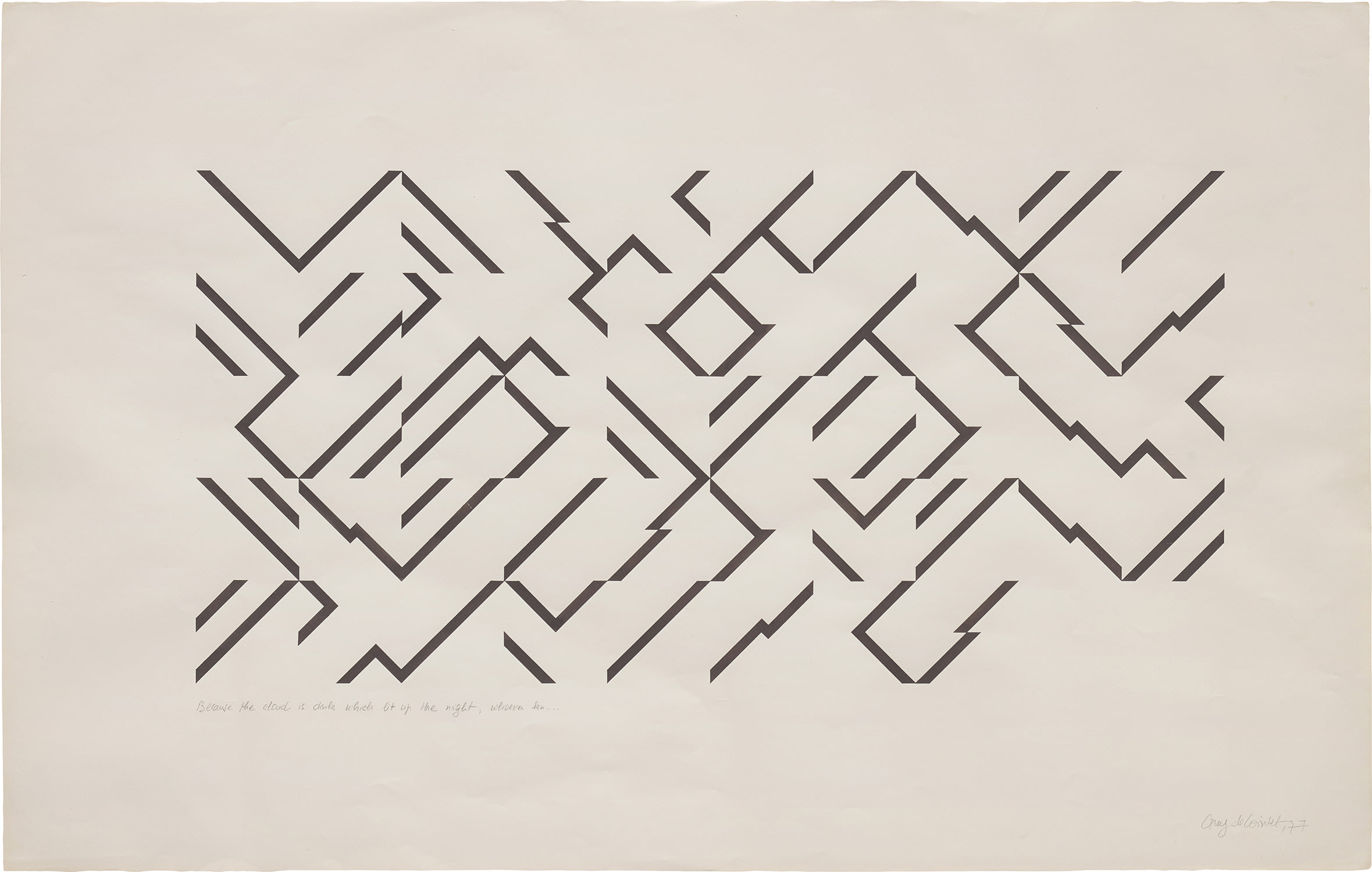
Because the Cloud is Dark Which Lit Up the Night, 1977
Guy de Cointet was born in Paris in 1934, into a world of European cultural richness that would leave deep marks on his sensibility. He came of age in the postwar period, absorbing the Surrealist legacy and the literary experimentation that characterized mid century French intellectual life. The influence of writers like Raymond Roussel, whose novels employed elaborate cryptographic and procedural devices to generate narrative, would prove formative. De Cointet emigrated to the United States in the 1960s, eventually settling in Los Angeles, a city whose particular quality of sun drenched unreality and its distance from the established art world centers of New York and Europe gave him room to develop a practice that answered to no existing category.
Los Angeles in the late 1960s and 1970s was a genuinely generative environment for conceptual experimentation. De Cointet arrived into a scene that included artists such as John Baldessari, whose engagement with language and instruction based art ran on parallel tracks, and Ed Ruscha, whose deadpan treatment of words as visual objects resonated with de Cointet's own obsessions. Yet de Cointet remained singular. Where his peers often worked with the vernacular language of American commerce and culture, de Cointet invented his own languages entirely: systems of symbols, ciphers, and encoded scripts that appeared legible at first glance and dissolved into productive confusion on closer inspection.
Guy de Cointet
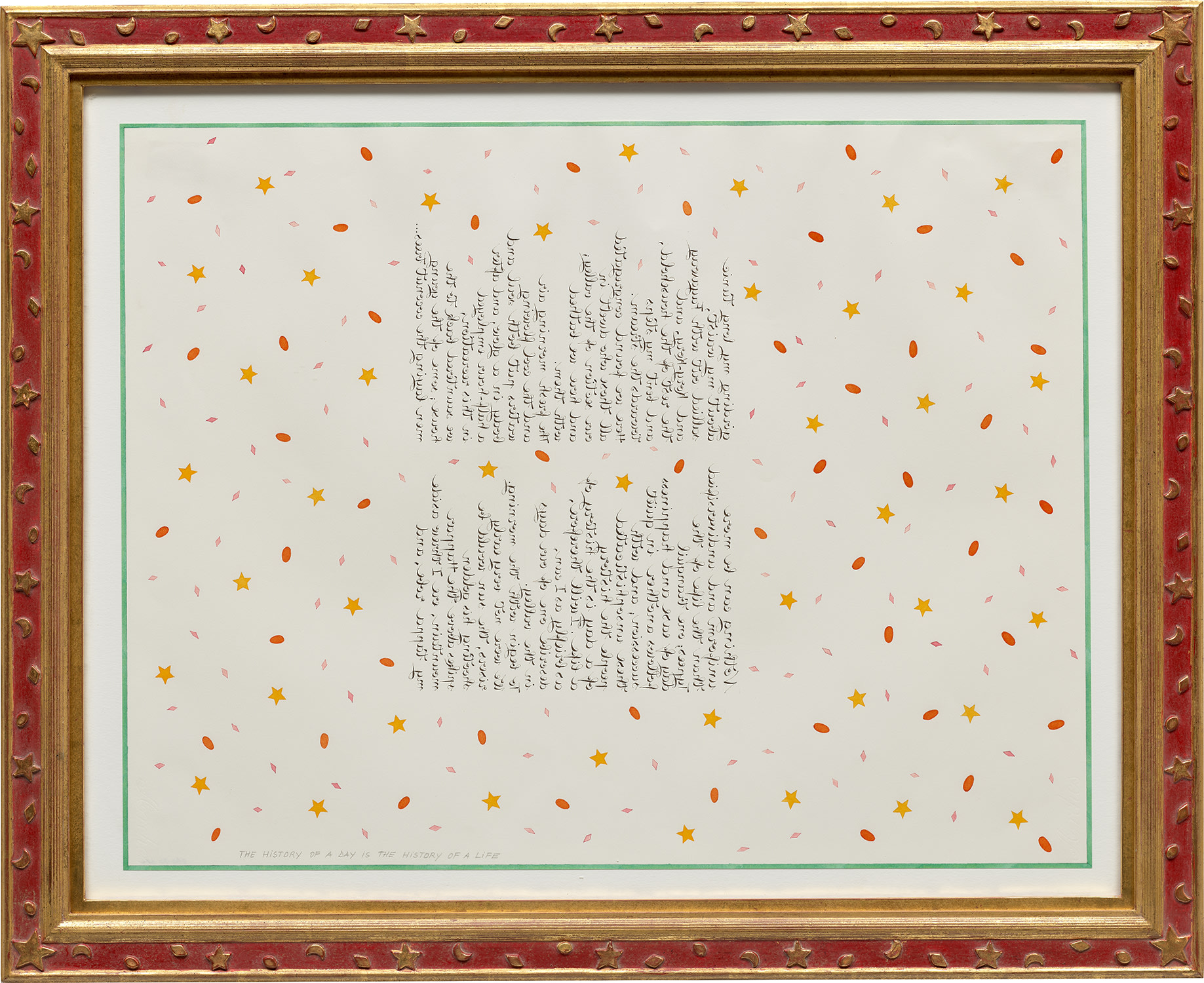
The History of a Day is the History of a Life, 1983
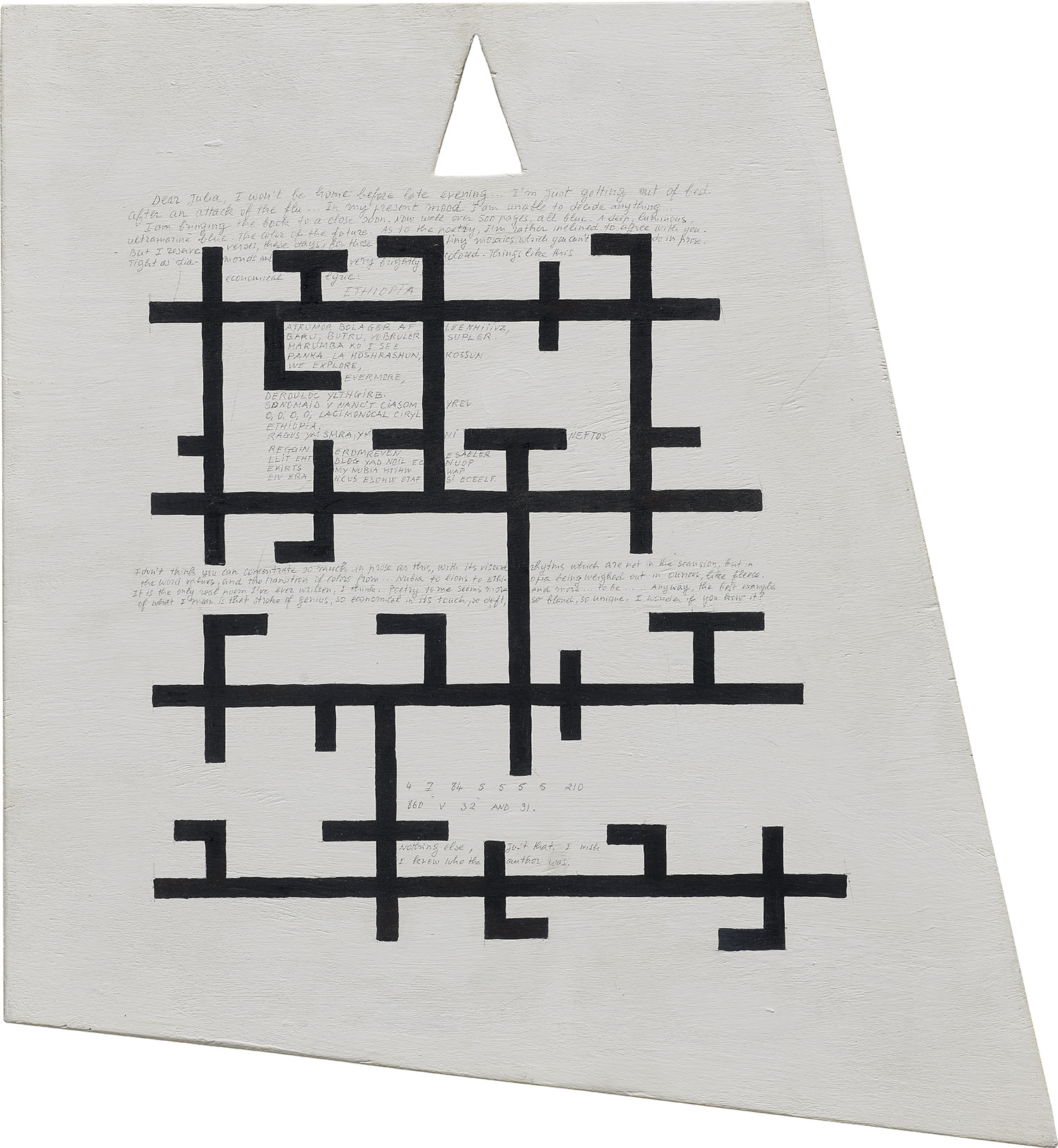
He was a conceptualist who was never cold, an absurdist who was never merely playful. The core of de Cointet's practice resided in the relationship between text and image, between the act of reading and the act of seeing. His works on paper are among the most quietly radical objects produced in Los Angeles during this period. In pieces such as Note from Ethiopia, created in 1976 using acrylic, ink, and graphite on panel, he constructed what appears to be a document of some kind, a communication from elsewhere, its meaning held just out of reach.
The surface combines the material immediacy of painting with the implied urgency of written correspondence. Because the Cloud is Dark Which Lit Up the Night, from 1977 and executed in ink and graphite on Arches paper, carries a title of extraordinary poetic resonance, naming a paradox and leaving it there for the viewer to inhabit. These are works that use the conventions of notation and language while quietly undermining the expectation that notation will deliver meaning on demand. The History of a Day is the History of a Life, completed in 1983, the year of his death, represents one of the most moving objects in his body of work.
Guy de Cointet
Note from Ethiopia, 1976
Rendered in ink and graphite on paper and housed in a frame the artist made himself, it functions as a kind of total artwork, the frame's handmade quality insisting that the container is as considered as the contained. The title gestures toward something universal and philosophical while the work itself remains particular, intimate, even cryptic. To hold this work in a collection is to hold a distillation of de Cointet's entire project: the sense that meaning is always present, always almost graspable, always finally one's own to construct. De Cointet's theatrical performances, for which he also became celebrated, extended these concerns into live experience.
He wrote scripts in his invented languages, constructed elaborate props and painted backdrops, and directed performers in works that unfolded with the logic of dreams. Productions such as Tell Me, staged in Los Angeles in 1979, demonstrated that his interest in coded communication was inseparable from his interest in bodies in space, in the gap between what is said and what is understood, in theater as a form of collective puzzlement. These performances have been restaged posthumously by institutions and estates working from his meticulous documentation, and they retain their uncanny charge entirely intact. For collectors, de Cointet's works on paper and panel represent an area of genuine importance and, relative to his critical standing, remarkable accessibility.
His drawings occupy the territory where conceptual rigor and visual beauty are not in tension but are, in fact, the same thing. Works from the 1970s carry particular weight given their proximity to the performances that generated much of the symbolic vocabulary de Cointet deployed across his career. Collectors drawn to artists who worked in the space between art movements rather than within them, those who admire Vito Acconci, Lawrence Weiner, or the French artist Christian Boltanski, will find in de Cointet a figure whose commitment to language as both material and mystery is entirely distinctive. Auction appearances remain relatively rare, which makes direct acquisition of works such as those available through platforms dedicated to serious secondary market collecting all the more significant.
The legacy of Guy de Cointet is one of those that art history is still in the process of properly assembling. He worked outside the main commercial circuits of his time, operated in a city that was itself operating outside the critical mainstream, and produced a body of work that demanded a literacy in multiple disciplines at once: visual art, theater, literature, linguistics. What makes him so compelling now is precisely this refusal of easy categorization. In an art world that has grown increasingly interested in hybrid practices, in work that crosses between performance and object, between the legible and the encoded, de Cointet looks less like a footnote and more like a source.
To discover his work is to understand that some of the most fertile territory in late twentieth century art was cultivated quietly, in Los Angeles, by a Frenchman who invented his own alphabet and asked the world to read between the lines.
Explore books about Guy de Cointet