Gustavo Montoya
Gustavo Montoya: Mexico's Tender, Timeless Visionary
Artist Spotlight · The Collection Editorial
There is a particular quality of light in Gustavo Montoya's paintings that stops you mid step. It falls softly across a child's cheek, catches the weave of a cotton rebozo, and holds the whole world still for just a moment. That capacity to suspend time, to find something sacred in the everyday life of Mexican children and the streets they inhabit, is why Montoya's work continues to draw the attention of serious collectors and curators decades after his most celebrated canvases were completed. His paintings feel less like historical documents and more like living things, warm to the touch.
Gustavo Montoya
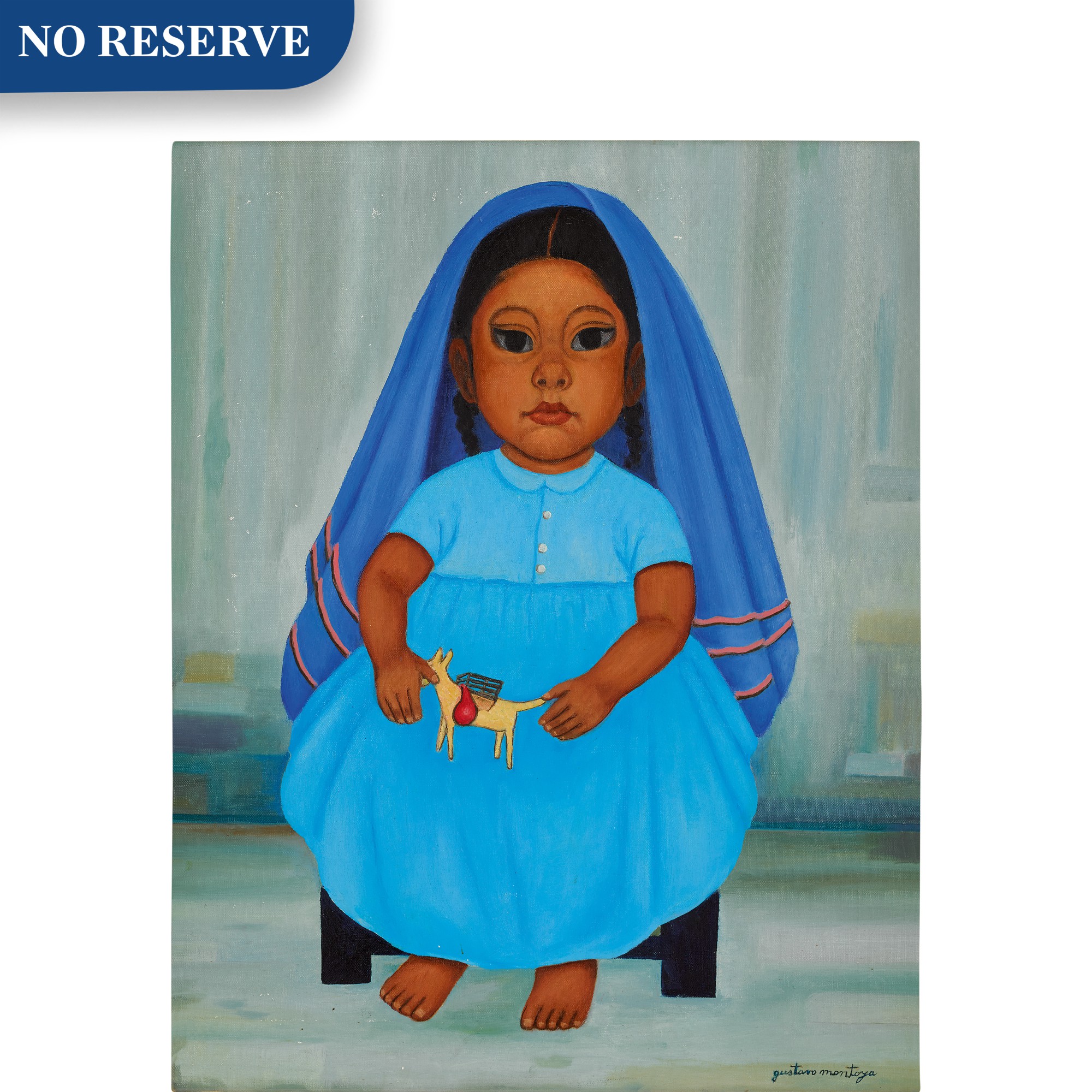
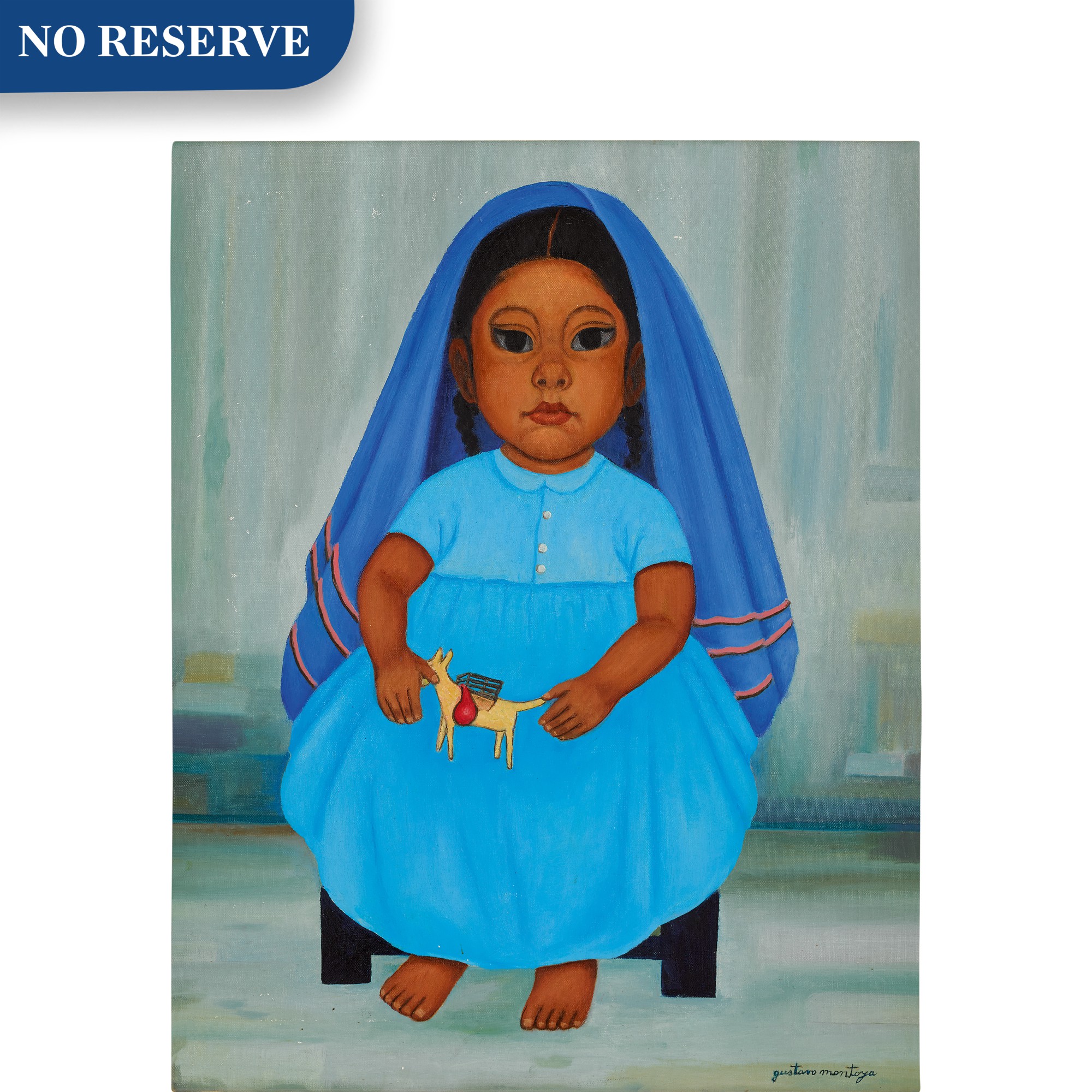
Niña en azul, 1968
Gustavo Montoya was born in Mexico City in 1905, at a moment when Mexico itself was on the edge of enormous transformation. The Revolution was only years away, and with it would come a seismic reimagining of what Mexican identity could mean, what it could look like on a wall or a canvas. Growing up in the capital placed Montoya at the center of that cultural ferment. He came of age surrounded by the ambitions of a nation trying to see itself clearly for the first time, and that search for authentic self representation would become the animating force of his entire artistic life.
His formal education began at the Academy of San Carlos, the oldest and most prestigious art institution in the Americas, where the foundations of Mexican modernism were being actively debated and constructed. San Carlos had trained Diego Rivera and a generation of artists who would go on to define the Mexican School of Painting, and Montoya absorbed that tradition deeply. He learned the discipline of observation, the rigor of compositional thinking, and the particular reverence for the human figure that would remain central to his work throughout his long career. The academy gave him structure; what he did with it was entirely his own.
Gustavo Montoya
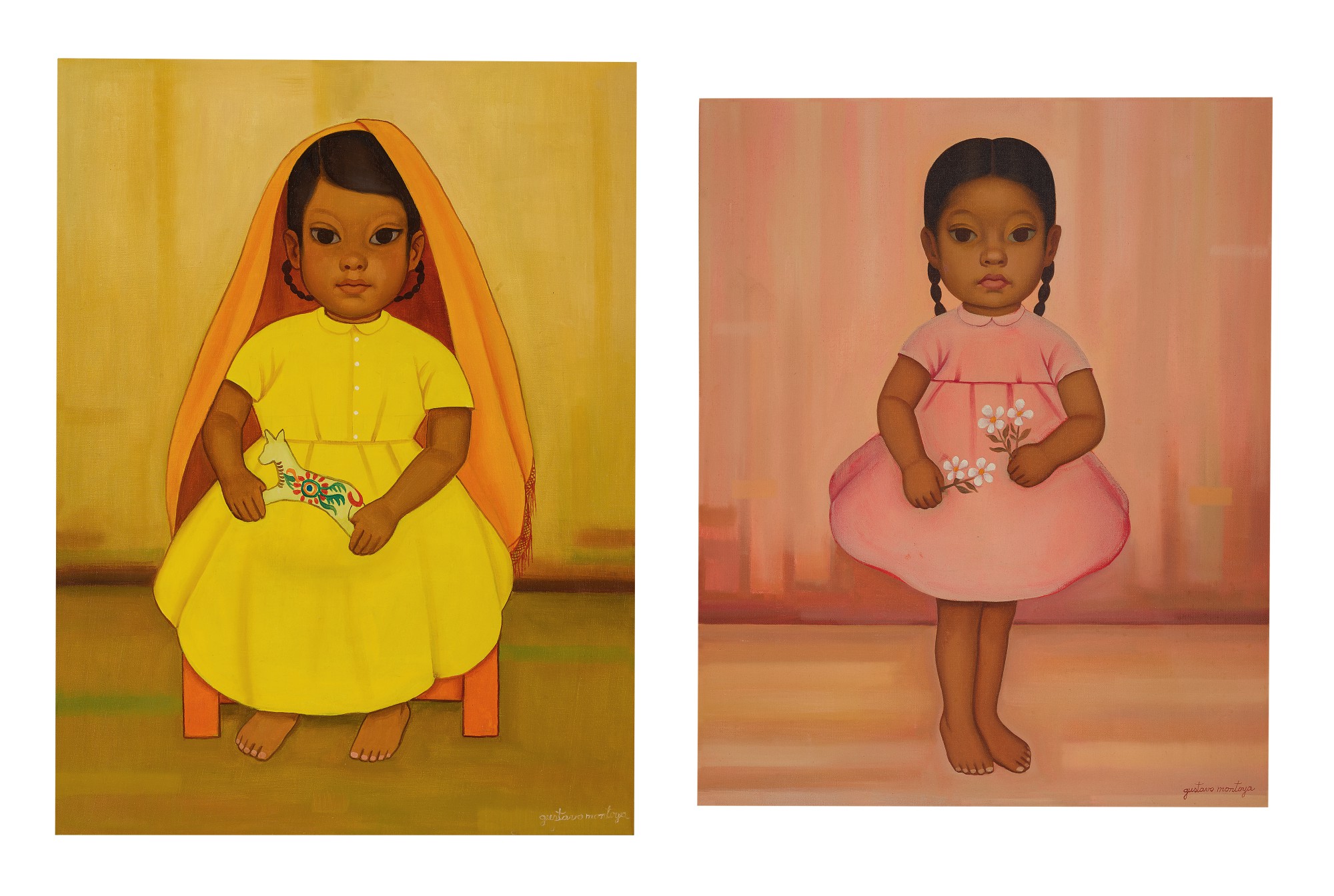
Untitled & Niña Con Rebozo: A Pair, 1960
Like many ambitious artists of his generation, Montoya eventually made his way to Paris, that great mid century crucible of artistic identity where Mexican painters went to test themselves against the international avant garde and, often, to discover what was most distinctly Mexican about their own vision. He made the journey alongside his wife, the accomplished artist Cordelia Urueta, whose own practice was bold and abstract in ways that beautifully complemented Montoya's figurative warmth. Paris sharpened him. The exposure to European modernism, to post Impressionist color theory and the psychological depth of portraiture as practiced by masters across the continent, refined his eye without diluting his essential sensibility.
He returned to Mexico not as a convert to European abstraction but as a more fully realized version of himself. It is the children who define Montoya's legacy in the imagination of collectors and art historians alike. His depictions of young Mexican figures, dressed in the richly varied traditional clothing of different regions, are among the most tender and technically accomplished works produced within the broader tradition of the Mexican School. A canvas like "Niña en azul," painted in 1968, exemplifies everything that makes his work so compelling: the precise, loving attention to textile and embroidery, the psychological presence of a child who is not posed so much as simply seen, and the luminous color relationships that give the painting an almost interior glow.
The blue of the title is not merely a color choice but an emotional key, setting the mood of quiet dignity that runs through all his finest portraits. The 1960 paired work known as "Untitled and Niña Con Rebozo" offers a slightly different register, presenting two canvases in dialogue with one another and allowing Montoya to explore the rebozo, that most iconic of Mexican garments, as both cultural symbol and painterly subject. The rebozo, with its layered weave and the way it wraps and frames the body, gave Montoya a vehicle for connecting individual figures to the broader tapestry of Mexican regional identity. These are not ethnographic illustrations.
They are paintings of individuals who happen to be wearing their heritage, and the distinction matters enormously. Montoya's subjects are never types; they are people. For collectors approaching Montoya's work today, several qualities stand out as markers of quality and significance. Works from the 1960s represent a particularly mature and confident phase of his practice, when his palette had deepened and his compositional instincts were at their most assured.
The condition and provenance of textiles within his paintings offer a useful guide to quality as well, since Montoya's handling of fabric was one of his most distinctive and demanding technical achievements. Collectors who appreciate the tradition of Diego Rivera and Rufino Tamayo, or who are drawn to the intimacy of artists like Francisco Zúñiga, will find in Montoya a natural and rewarding complement to works in those veins. His paintings carry the warmth of the Mexican School without any of its occasional political heaviness, making them genuinely livable works that reward long acquaintance. Montoya is best understood in the context of that rich generation of Mexican artists who followed in the wake of the great muralists without being entirely defined by them.
Where Rivera and David Alfaro Siqueiros painted walls and made ideology visible at monumental scale, Montoya chose the intimate register of the easel, the small canvas, the single figure seen up close. His closest spiritual kin might be found in artists like Olga Costa or even aspects of María Izquierdo, fellow travelers in the Mexican School who brought personal feeling and lyrical color to figurative painting without surrendering to didacticism. In the international context, his work bears comparison to certain strains of European social realism elevated by genuine painterly gift, though his subject matter and his palette are unmistakably and irreducibly Mexican. Montoya lived until 2002, reaching the age of ninety seven, and his extraordinary longevity gave him a unique vantage point on a century of Mexican art history.
He witnessed the birth of muralism, survived its institutionalization, watched abstraction rise and fall and rise again, and continued painting with consistent devotion throughout it all. That fidelity to his vision across nearly a century of artistic change is itself a kind of statement, a quiet insistence that the children of Mexico, their clothing, their faces, their presence in the streets and plazas of a living culture, were worthy of the most serious and sustained attention a painter could offer. The collectors who live with his work understand this. His canvases are not relics of a bygone era but invitations to look more carefully at the world, which is perhaps the most enduring gift any artist can offer.