Gustave Courbet
Courbet: The Radical Who Painted Everything
Artist Spotlight · The Collection Editorial
“I am not only a socialist but a democrat and a Republican as well, in a word, a partisan of all revolution.”
Gustave Courbet, letter, 1851
There is a moment, standing before a large Courbet canvas, when the paint itself seems to breathe. The surfaces are thick, almost sculptural, worked with palette knives and sometimes with bare hands, carrying the physical presence of a man who believed that what he could see and touch was the only subject worth painting. That conviction, radical and uncompromising in nineteenth century Paris, changed the course of Western art. Today, Courbet's work appears in the permanent collections of the Musée d'Orsay, the Metropolitan Museum of Art, and the Art Institute of Chicago, and major retrospectives in recent decades at institutions including the Grand Palais have cemented his reputation not merely as a founder of Realism but as one of the most consequential painters of the modern era.
Gustave Courbet
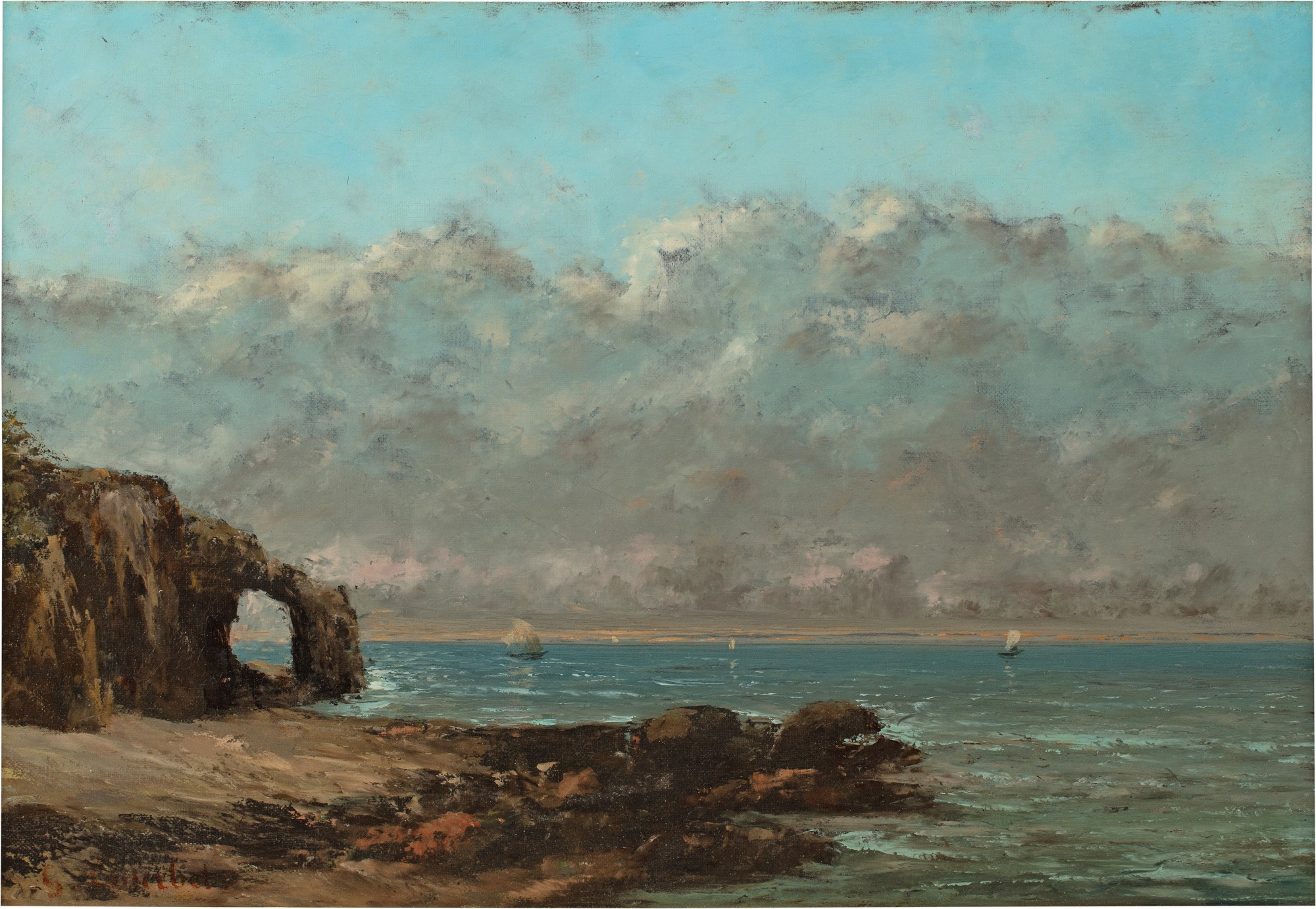
Rivage normand
Gustave Courbet was born on June 10, 1819, in Ornans, a small town in the Franche Comté region of eastern France, close to the Swiss border. The landscape of that region, its limestone cliffs, dense forests, rushing rivers, and wide grey skies, would remain the emotional and visual bedrock of his art for his entire life. His father, Régis Courbet, was a prosperous landowner with political ambitions, and Gustave grew up in comfortable, confident circumstances that gave him a lifelong sense of entitlement to be heard. He moved to Paris in 1839 ostensibly to study law, but quickly immersed himself in the studios of the city, copying the Old Masters at the Louvre and absorbing the work of Rembrandt, Velázquez, and the Dutch genre painters whose honest attention to ordinary life would prove formative.
Courbet was largely self taught in temperament if not in practice. He rejected the academic hierarchy that placed history painting and mythological subjects above depictions of ordinary people and everyday scenes. By the late 1840s he had developed both a distinctive technique and a provocative philosophy, and in 1850 he unleashed both upon the Paris Salon with three monumental canvases: A Burial at Ornans, The Stone Breakers, and Peasants of Flagey Returning from the Fair. These works, enormous in scale and unsparing in their attention to the unidealized faces of rural people, caused a sensation.
Gustave Courbet
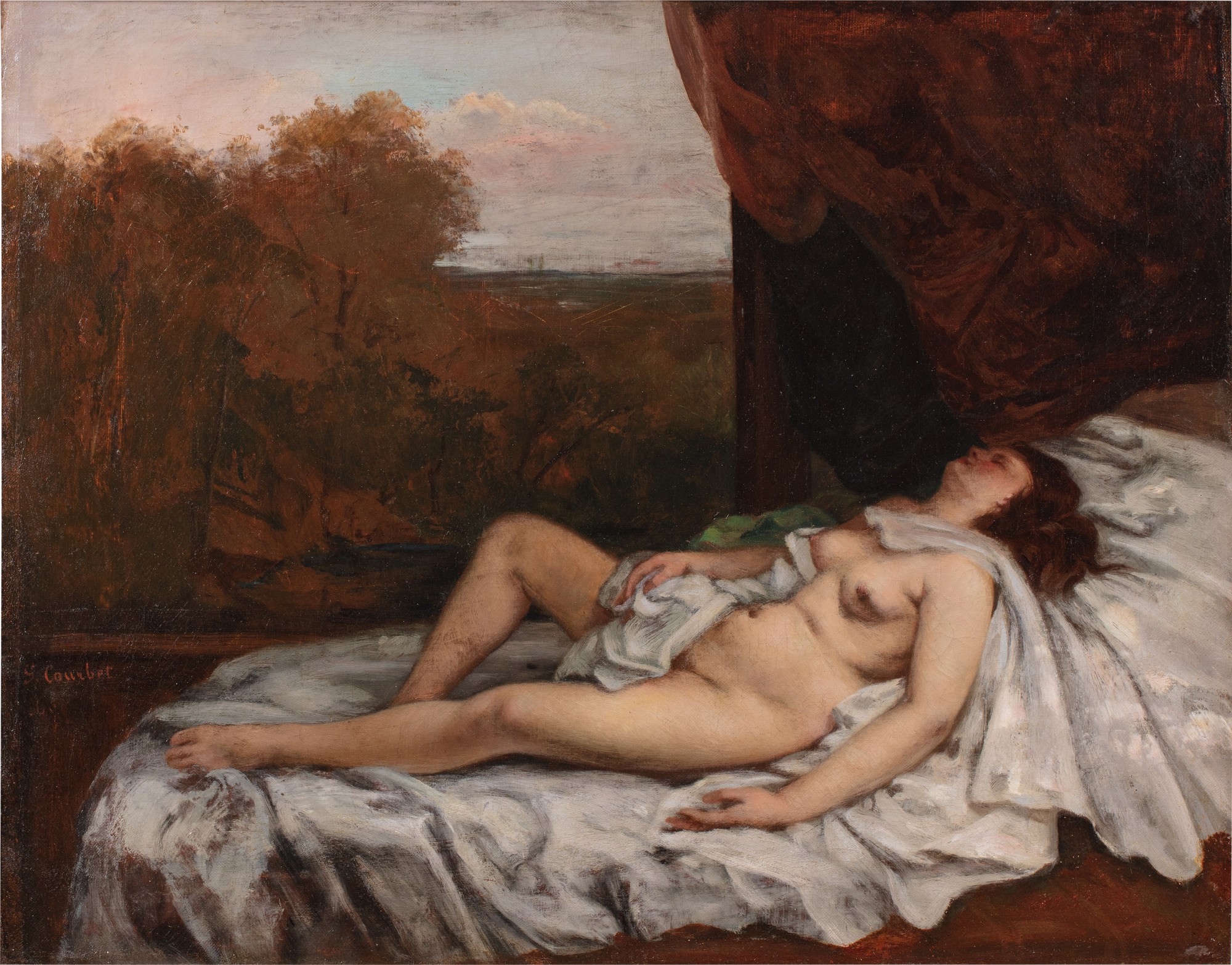
La Dormeuse nue
Critics attacked them as vulgar, socialist, even blasphemous. Courbet welcomed the controversy with relish. His artistic development through the 1850s and 1860s was one of extraordinary productivity and range. He painted portraits, nudes, hunting scenes, seascapes, and landscapes with equal ambition and technical authority.
“I cannot paint an angel because I have never seen one.”
Gustave Courbet
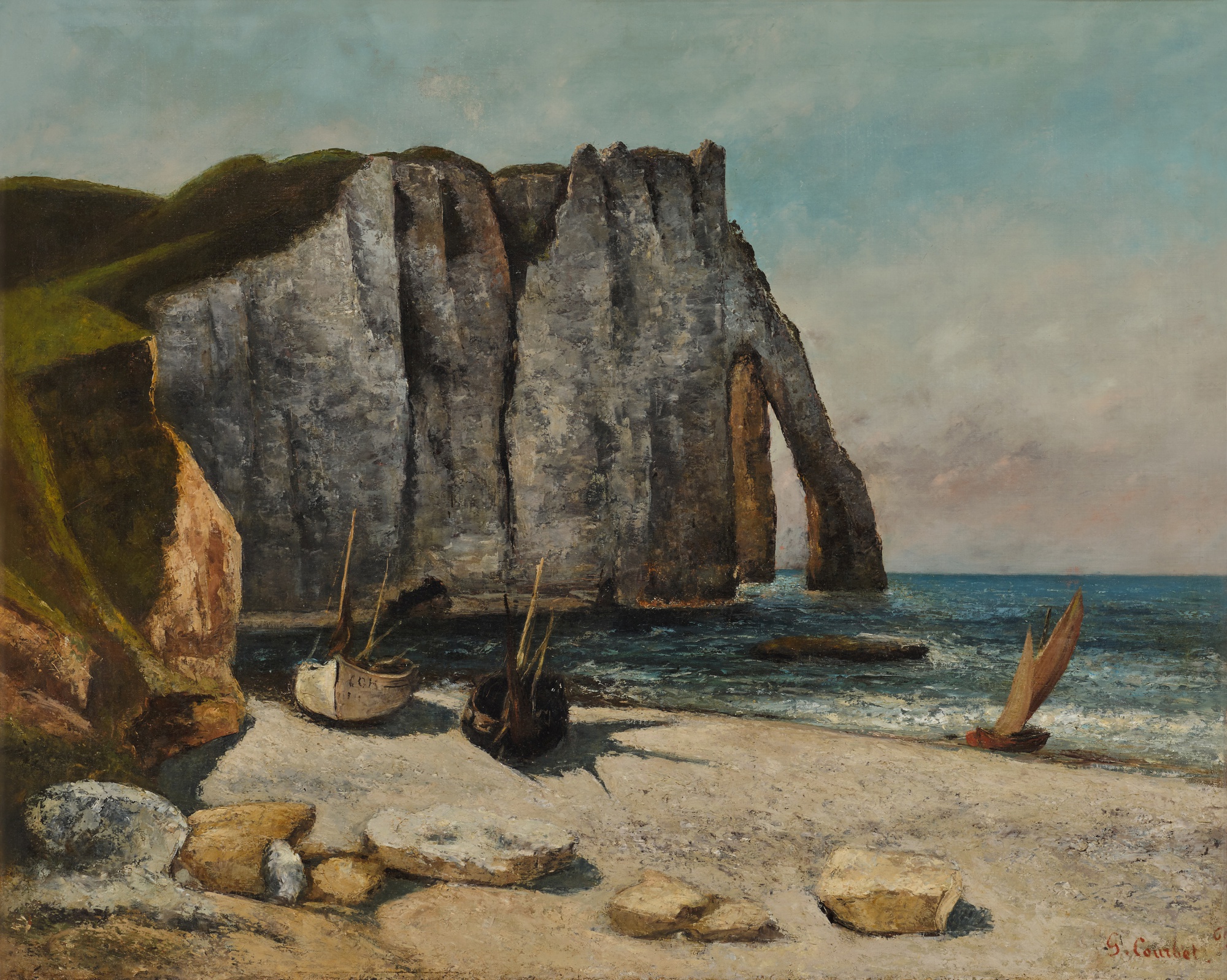
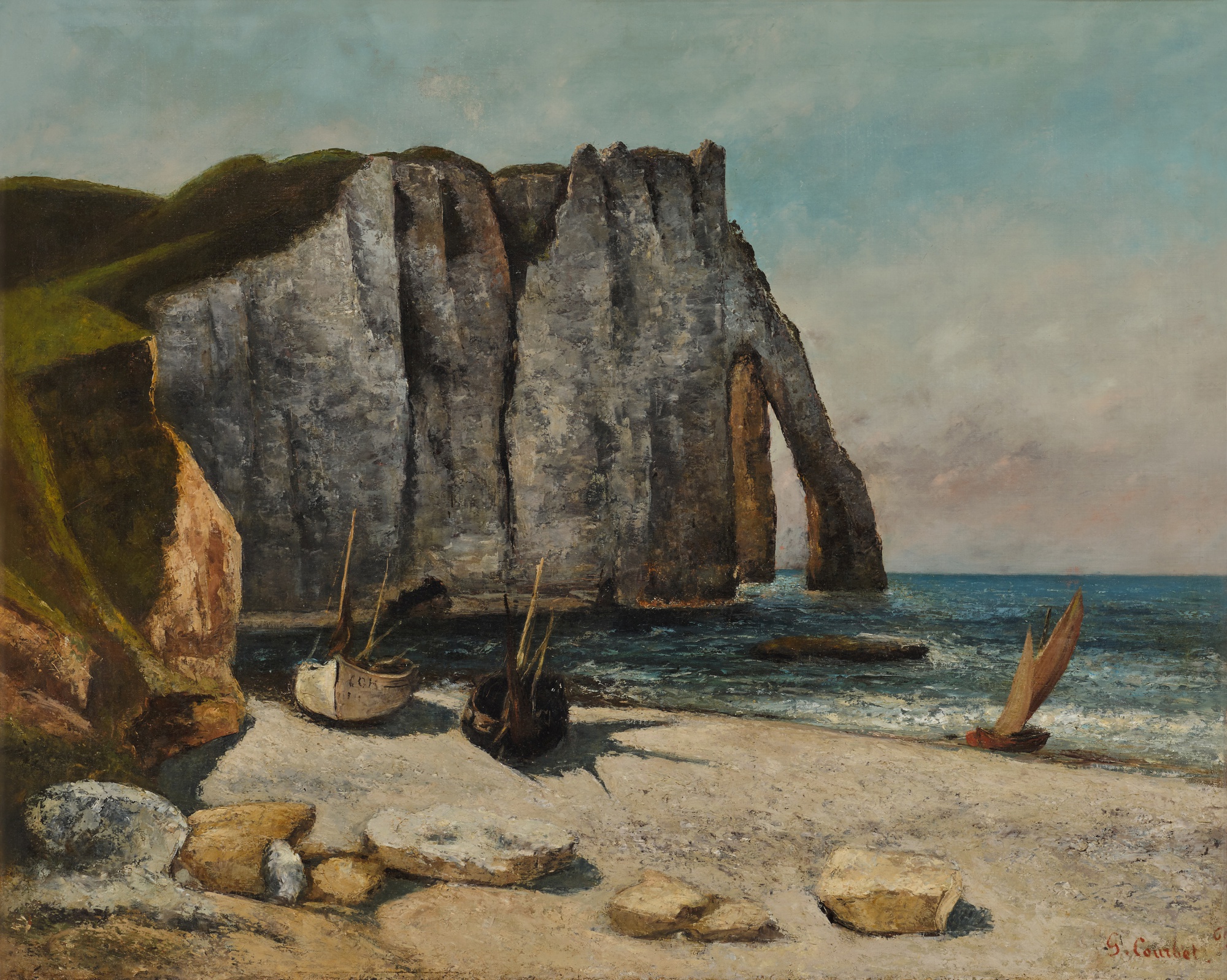
The sea at Étretat, on the Normandy coast, became one of his great recurring subjects, and his paintings of those dramatic chalk cliffs capture both their geological grandeur and their atmospheric mutability with a directness that anticipates Monet. Works such as The Cliff at Étretat and the luminous Cliff of Étretat, La Porte d'Aval demonstrate his ability to translate the weight of water and stone into pigment with visceral immediacy. His forest interiors and river scenes, including Baigneuses dans la forêt and the dreamy Rivage normand, show a painter equally at ease with stillness and sensation. Among his most celebrated and debated works are his nudes, which scandalized contemporary Paris and continue to command attention today.
Gustave Courbet
Cliff of Etretat (Falaise d'Etretat, la Porte d'Aval)
La Dormeuse nue is a characteristic example of his approach to the female figure: sensuous, unhurried, observed with a painter's eye rather than a moralist's. His portraits, too, reveal a psychologist of quiet intensity. Mme L... (Laure Borreau), painted in 1863, is a work of penetrating directness, the subject rendered with the same unflinching attention he gave to cliff faces and river pools.
“Painting is an essentially concrete art and can only consist of the representation of real and existing things.”
Gustave Courbet, Realist Manifesto, 1855
His Portrait Présumé De Tony Marlet shows his gift for capturing individual presence without flattery or formula. Even his works on paper reward close looking: the 1865 Landscape with Large Trees, executed in black chalk with stumping on brown wove paper, demonstrates the full range of his draughtsmanship. Courbet's politics were as bold as his brushwork. A committed Republican and admirer of the anarchist philosopher Pierre Joseph Proudhon, he aligned himself with the Paris Commune of 1871 and served as head of a commission tasked with protecting the city's art during the uprising.
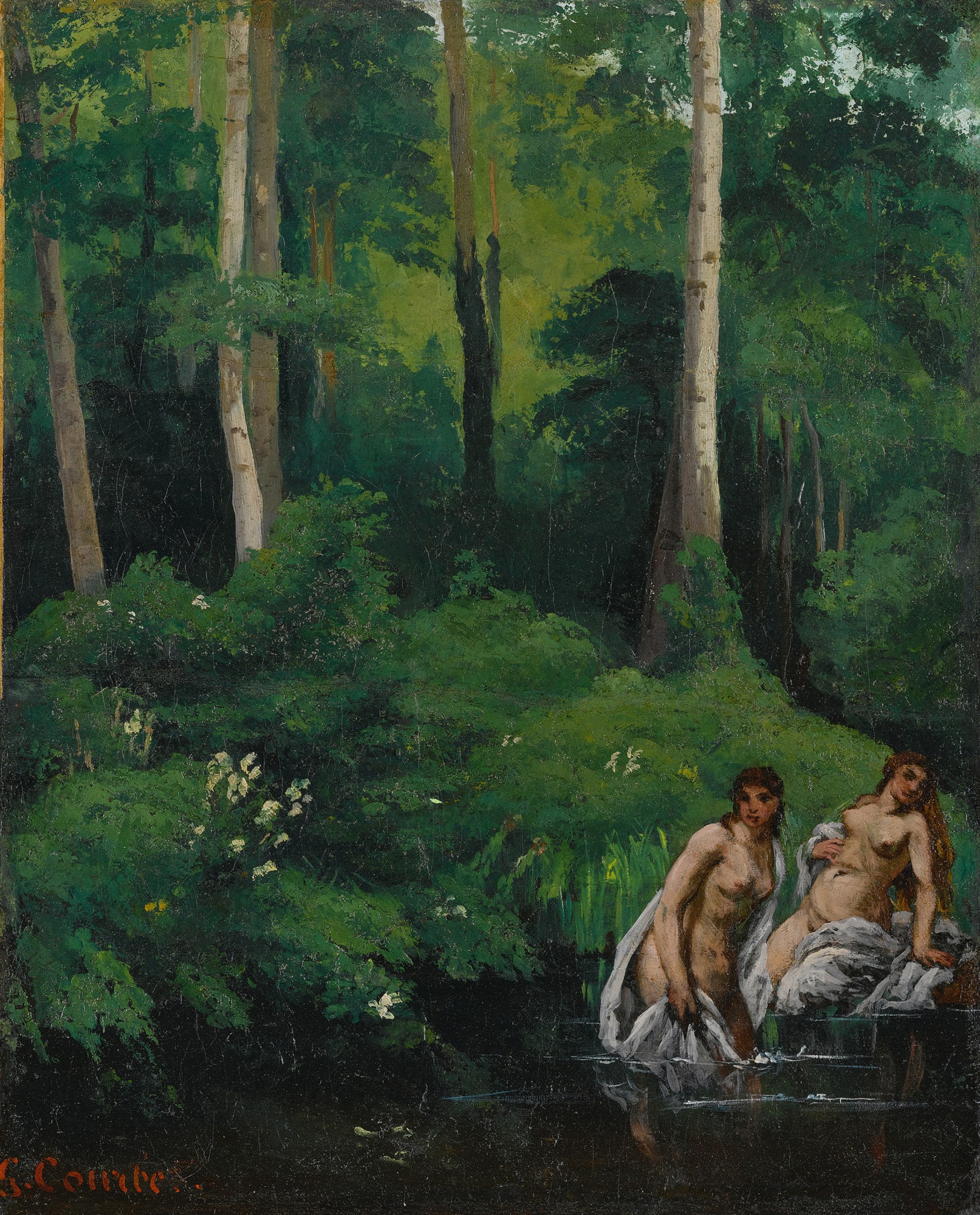
Gustave Courbet
Baigneuses dans la forêt
He was later implicated in the toppling of the Vendôme Column, a Napoleonic monument, and was sentenced to pay for its restoration, a financial burden that effectively drove him into exile in Switzerland. His final years were spent near Lake Geneva, where he continued to paint with remarkable energy, producing the sweeping Panoramic View of the Alps, Les Dents du Midi in 1877, the year of his death. That canvas, vast and serene, is in some ways a fitting valediction from a painter who never stopped looking at the world with wonder and defiance in equal measure. For collectors, Courbet's work occupies a position of enduring appeal and genuine rarity.
Major canvases appear at auction only occasionally, and when they do they attract significant competition from institutional and private buyers alike. His landscapes and seascapes, particularly those connected to Normandy and the Franche Comté, are among the most sought after works in the French nineteenth century market. Works on paper, including lithographs such as Jean Journet Departing for the Conquest of Universal Harmony from 1850, offer a more accessible entry point into his practice while still carrying the full force of his artistic personality. Collectors are drawn to his work for its directness, its physical energy, and its remarkable contemporaneity: a Courbet landscape placed beside a twentieth century abstraction rarely looks out of place.
Courbet's position within art history is both foundational and relational. He stands at the hinge between Romanticism and Modernity, pointing forward to the Impressionists, who admired and learned from him, and beyond them to Cézanne, whose commitment to the materiality of paint owes something to Courbet's example. His contemporaries Honoré Daumier and Jean François Millet shared his interest in ordinary life and social subject matter, while Édouard Manet, younger by thirteen years, absorbed his confrontational directness and carried it into a new register. To understand Courbet is to understand the roots of modern painting in Western Europe.
What makes Courbet matter today is precisely what made him scandalous in his own time: his insistence that the world as it is, unbeautified and unashamed, is the proper subject of great art. In an era that values authenticity, his work feels not like history but like a living argument. His cliffs still stand. His forests still breathe.
His people still look back at you without apology.
Explore books about Gustave Courbet
Gustave Courbet
Linda Nochlin
Courbet: A Dream of Stone
Sarah Faunce
Gustave Courbet and the Image of Labor
Linda Nochlin
Courbet: Painting and Politics
James Henry Rubin
The World of Gustave Courbet
Robert Fernier
Gustave Courbet: The Invention of Realism
Werner Hofmann
Courbet: The Complete Works
Robert Fernier
Gustave Courbet: Man and Nature
Paul Hayes Tucker