Gustav Klimt
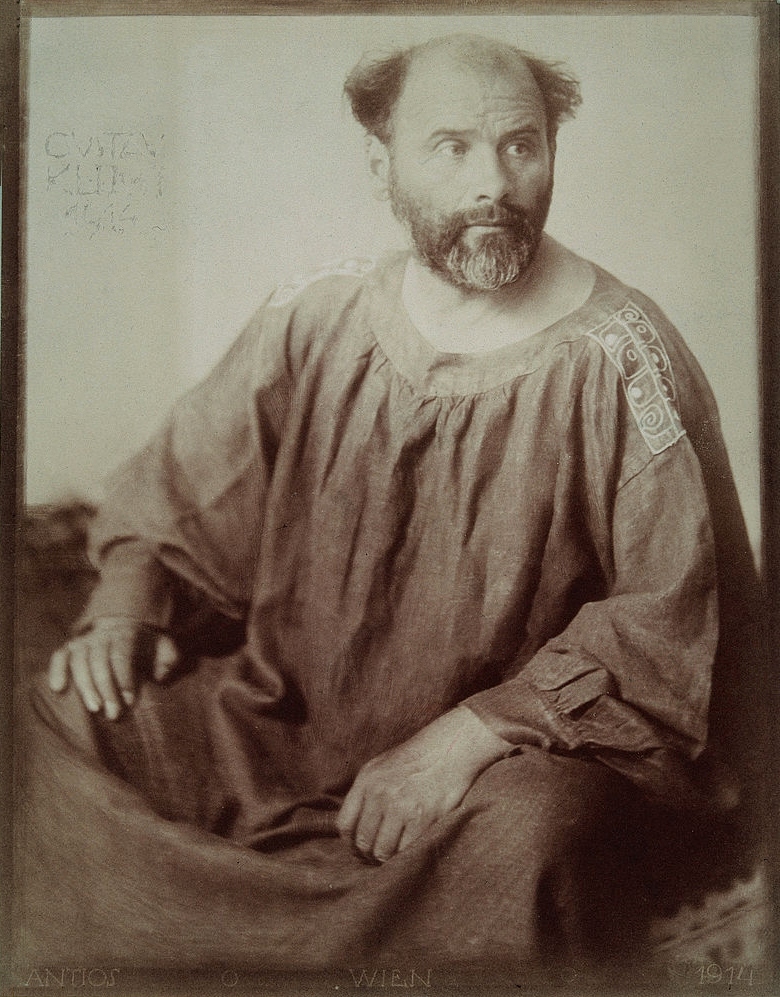
Gustav Klimt, Gold, Glory, and Grace
Artist Spotlight · The Collection Editorial
“I am not interested in myself as a subject for a painting, but in others, above all women.”
Gustav Klimt
There are paintings that stop you in your tracks, and then there are paintings that make you question whether you have ever truly looked at anything before. Gustav Klimt achieved this with remarkable regularity. When the Belvedere in Vienna reunited several of his major canvases for its landmark survey in recent years, visitors stood in hushed reverence before works that have lost none of their power to astonish. The Portrait of Adele Bloch Bauer I, which fetched 135 million dollars at Christie's New York in 2006 when it was restituted to the Bloch Bauer heirs and subsequently sold to Ronald Lauder for the Neue Galerie, remains among the most discussed transactions in the history of the art market.
Gustav Klimt
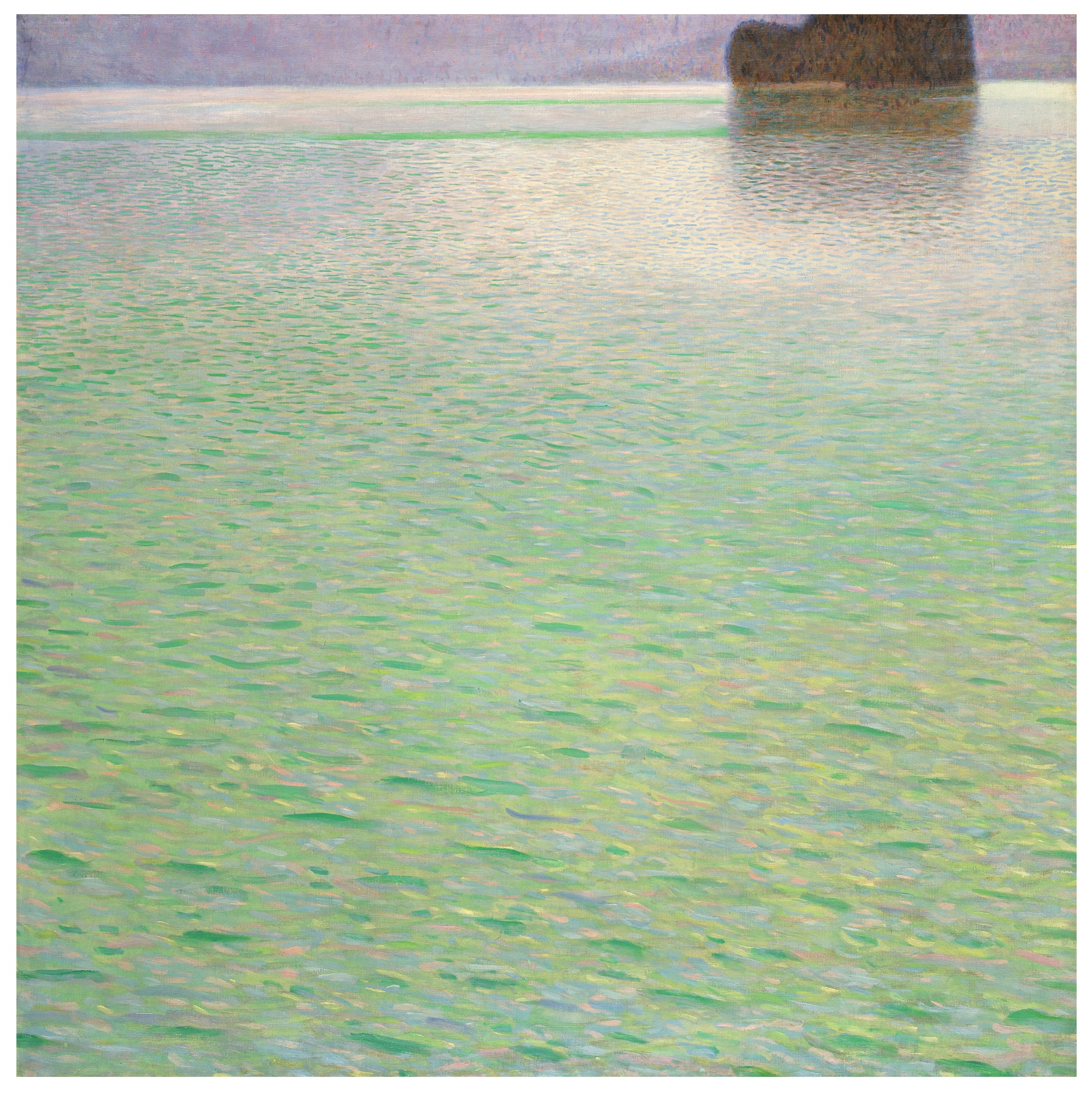
Insel im Attersee (Island in the Attersee), 1901
That one painting could carry so much history, so much beauty, and so much human complexity is a testament to what Klimt built across a career of restless, passionate invention. Gustav Klimt was born on July 14, 1862, in Baumgarten, a suburb of Vienna, the second of seven children in a family of modest means. His father, Ernst Klimt, was a gold engraver, and it is not difficult to trace the son's extraordinary sensitivity to surface, texture, and the luminous properties of metal back to those early years watching a craftsman at work. At fourteen, Gustav and his younger brother Ernst both enrolled at the Vienna School of Arts and Crafts, where they received rigorous academic training in the decorative and applied arts.
This foundation in craft rather than pure fine art would prove definitive. Klimt never lost his sense of the made object, the worked surface, the collaboration between image and material. In his early professional years, Klimt worked in partnership with his brother Ernst and their classmate Franz Matsch as a successful commercial decorating firm. They received prestigious commissions to paint ceiling murals and theatrical decorations across the Austro Hungarian Empire, including celebrated work at the Burgtheater in Vienna and the Kunsthistorisches Museum.
Gustav Klimt
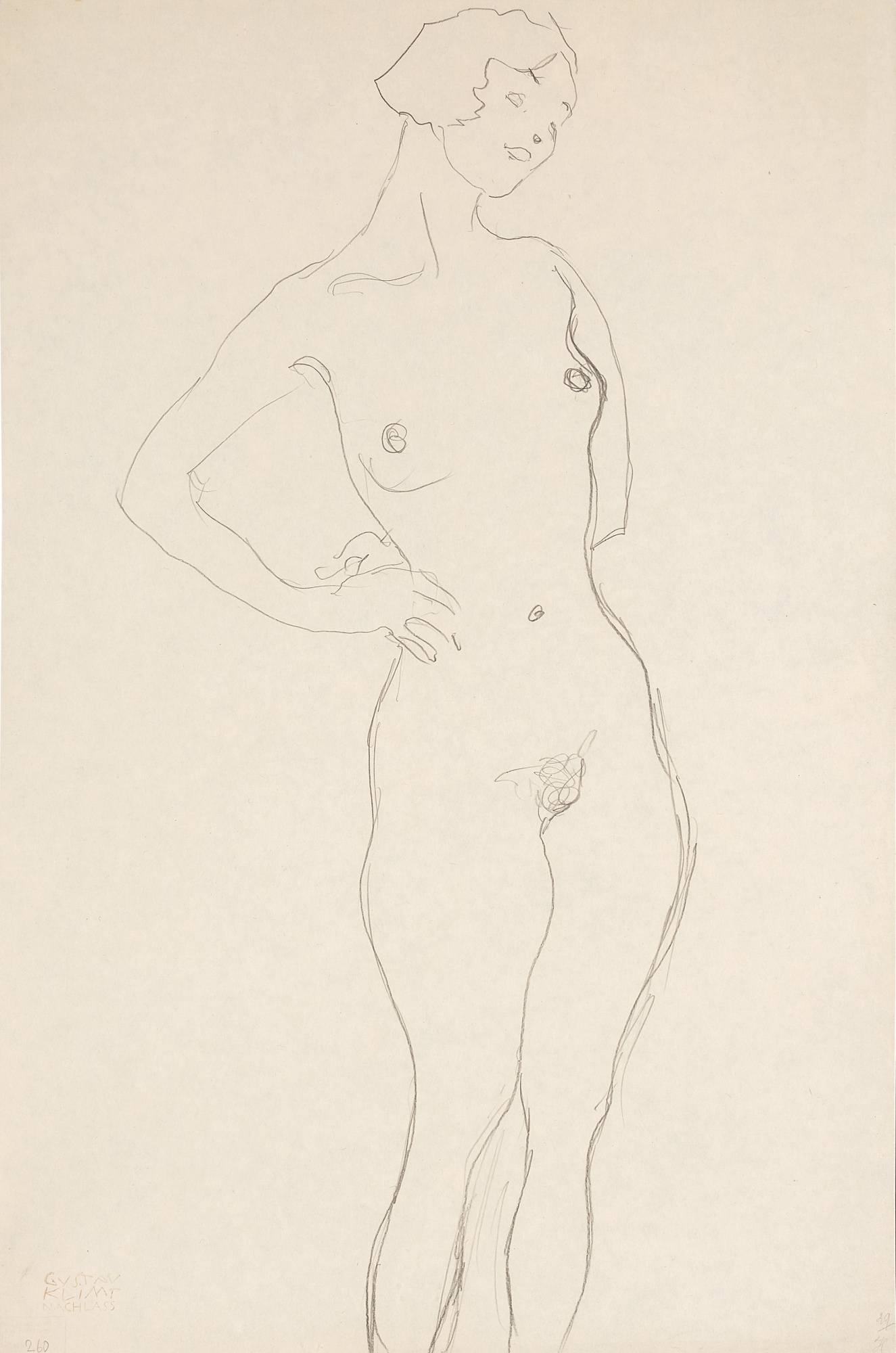
Stehender Akt nach links; Stehender Akt nach rechts (Standing Nude to the Left; Standing Nude to the Right) (A Double-Sided Work), 1916
These were grand, accomplished, academically correct projects that earned official praise. The death of his brother Ernst in 1892 was a profound rupture. Klimt withdrew from the partnership and spent years in near isolation, reading widely, absorbing new ideas filtering in from Paris and Munich, and slowly reconceiving what painting could be. When he emerged, he was a different artist entirely.
“Whoever wants to know something about me ought to look carefully at my pictures.”
Gustav Klimt
The founding of the Vienna Secession in 1897 announced that transformation to the world. Klimt served as the first president of the Secession, the radical exhibition society that declared its independence from the conservative Academy and its ethos with the famous motto: To every age its art, to art its freedom. The Secession's journal Ver Sacrum became a vehicle for the new aesthetic sensibility Klimt and his peers were developing, one that drew on symbolism, the arts and crafts movement, Japanese woodblock prints, Byzantine mosaic, and the psychological intensity of the emerging age of Freud. The University of Vienna ceiling paintings, commissioned in 1894 and delivered across the following decade, scandalized authorities with their writhing, allegorical nudes and were ultimately rejected.
Gustav Klimt
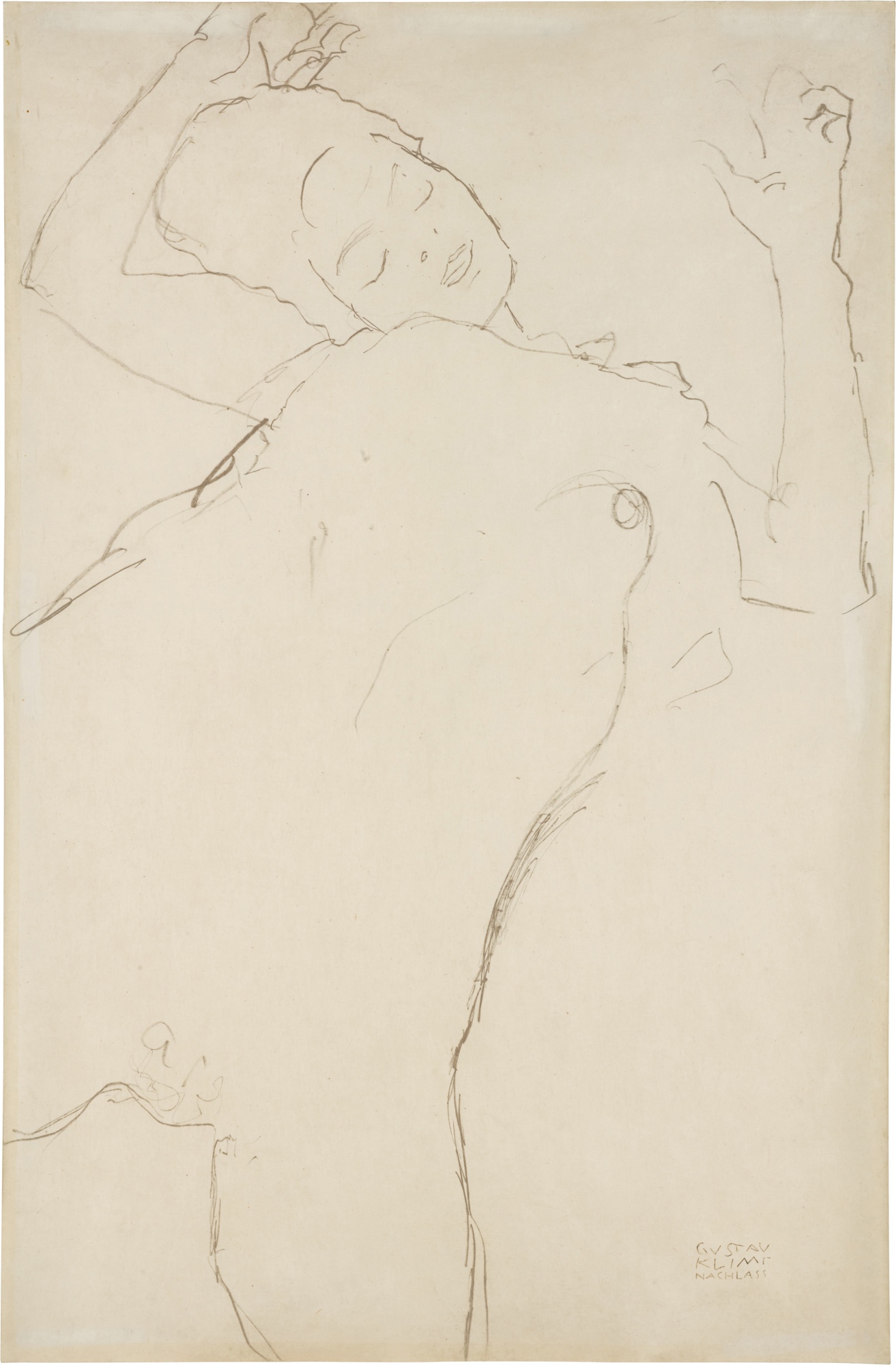
Halbakt mit erhobenen Armen (Half nude with raised arms)
The scandal only deepened Klimt's commitment to his vision. The decade between roughly 1907 and 1917 represents the full flowering of what has come to be called Klimt's Golden Period. Works such as The Kiss, completed in 1908, and the portrait of Adele Bloch Bauer deploy gold and silver leaf alongside paint in compositions that collapse the boundary between painting and mosaic, between fine art and decorative object. The figures in these works emerge from and dissolve into seas of flattened, geometric ornament derived from Byzantine apse decoration and ancient Mycenaean goldwork that Klimt studied with scholarly intensity.
Yet the psychological truth of the faces and hands that emerge from those golden fields is unmistakably modern and deeply human. This tension between the decorative and the psychological is what gives the Golden Period works their inexhaustible fascination. Alongside the monumental oils, Klimt maintained an extraordinary practice as a draughtsman throughout his life, and it is in these works on paper that collectors today find some of the most intimate and direct encounters with his genius. His figure studies, executed primarily in pencil and occasionally in coloured crayon, are among the most celebrated drawings of the early twentieth century.
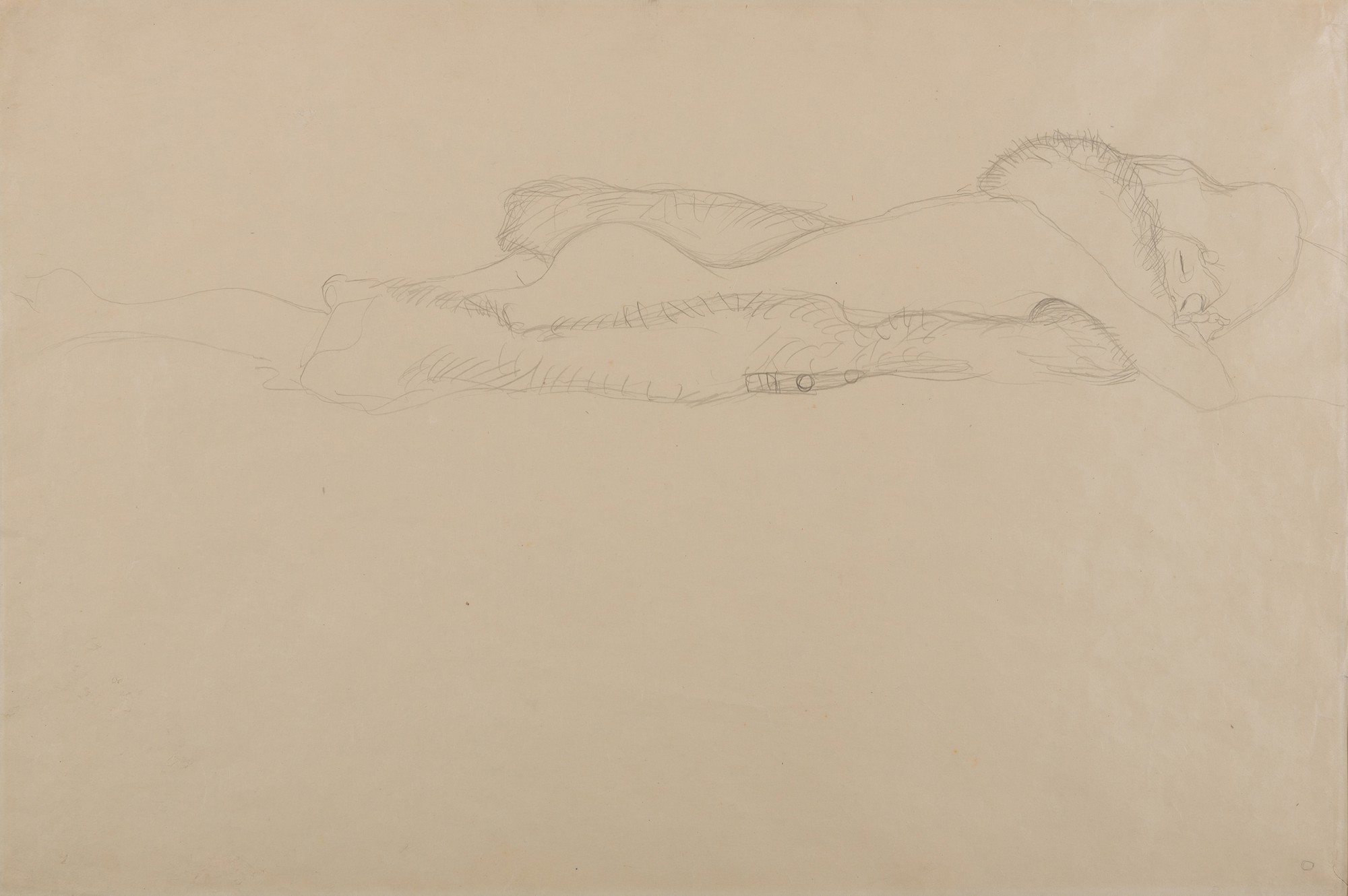
Gustav Klimt
Auf dem Bauch liegender Akt mit Pelzboa (Reclining Nude with Fur Boa) , 1904
Works such as the Reclining Nude with Fur Boa from 1904 and the Standing Nude to the Left and Standing Nude to the Right demonstrate the qualities that made him one of the supreme draughtsmen of his era: a line of extraordinary economy and sensuousness, a compositional intelligence that activates the whole sheet, and an unflinching commitment to the truth of the body in all its particularities. His preparatory studies for major paintings, including the chalk study for the figure of Lex in Jurisprudence, reveal the intellectual rigour beneath the sensuous surface. His landscape paintings, such as the shimmering Island in the Attersee of 1901, show yet another dimension of his practice, works of sustained optical intensity executed during summers at the Attersee lake in the Salzkammergut where he would paint for hours looking through a telescope to flatten and compress the picture plane. For collectors, works on paper by Klimt represent an opportunity to own something both genuinely intimate and historically significant.
The drawings were not considered secondary by Klimt himself; he made thousands of them across his career and regarded the practice as fundamental to his thinking. In the market, his drawings appear at major auction houses with genuine regularity and command prices that reflect their standing as works of art in their own right rather than merely preparatory material. Portrait studies of women from the Viennese bourgeoisie, such as the Hermine Gallia chalk study of 1899, connect directly to the painted portrait tradition while offering a directness and freshness that is entirely their own. Collectors drawn to works on paper from the Viennese fin de siècle will naturally find Klimt in conversation with Egon Schiele, whose raw psychological intensity represents both a continuation of and a departure from the older artist's example.
Schiele studied directly under Klimt's influence, and their relationship is one of the most productively analysed in modernist art history. The broader Viennese context connects Klimt to Oskar Kokoschka, to the architect Josef Hoffmann with whom he collaborated on the legendary Stoclet Palace mosaic frieze, and to the designer Koloman Moser, all figures who shared the conviction that beauty and meaning were inseparable. Klimt died on February 6, 1918, following a stroke, weeks before his fifty sixth birthday. He left a body of work that has only grown in cultural significance in the century since.
His influence runs through Art Deco, through the pattern and decoration movement of the 1970s, through contemporary artists working with ornament and the body, and through the broader cultural conversation about beauty as a form of knowledge. The restitution of works looted from Jewish collectors during the Nazi period has given his paintings a second life as symbols of justice as well as of beauty. But ultimately what draws people back to Klimt, what makes standing before his work feel like a privilege, is something simpler and more lasting: the conviction that the world is endlessly, abundantly worth looking at.
Explore books about Gustav Klimt
Gustav Klimt
Tobias G. Natter
Gustav Klimt: The Magic of Line
Christian M. Nebehay
Klimt
Frank Whitford
Gustav Klimt: Modernism in the Making
Alessandra Comini
The Essential Klimt
Klaus Albrecht Schröder

Klimt and Schiele: Drawings
Jane Kallir
Gustav Klimt: Painter of Modernity
Peter Vergo
Klimt: The World in Female Form
Susie Hodge