Günther Uecker
Günther Uecker: Light, Silence, and Transcendence
Artist Spotlight · The Collection Editorial
“The nail is my expressive tool. I hammer nails as others make brushstrokes.”
Günther Uecker, artist statement
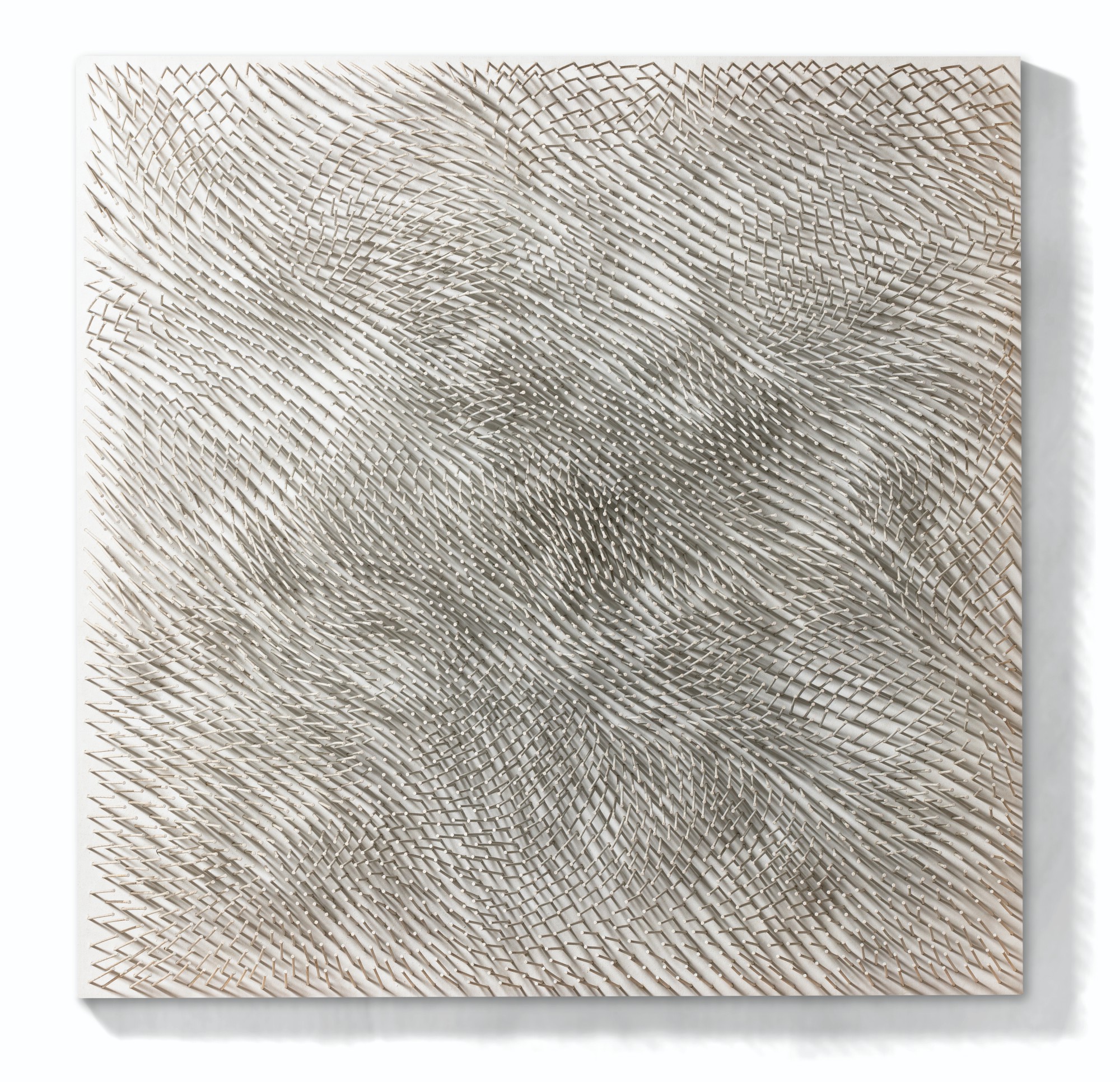
When the Kunstpalast in Düsseldorf mounted its landmark retrospective of Günther Uecker's work in recent years, visitors encountered something rarely achieved in contemporary art: a body of work that is simultaneously rigorous and deeply spiritual, demanding and immediately felt. Standing before one of his great nail reliefs, where thousands of hand driven nails catch and scatter light across a white surface, the experience is almost physiological. The work breathes. It moves without moving.
Günther Uecker
Weisses Feld, 1972
It is among the most singular visual experiences that postwar European art has produced, and Uecker, who passed in 2025 at the age of ninety four, left behind a legacy of extraordinary depth and enduring power. Günther Uecker was born on March 13, 1930, in Wendorf, a small village in the Mecklenburg region of northeastern Germany. His childhood unfolded against the gathering darkness of National Socialism and then the devastation of the Second World War, formative circumstances that would leave a permanent imprint on his sensibility as an artist. After the war, the region fell within East Germany, and Uecker trained initially at the art school in Wismar before finding his way to the Kunstakademie in Berlin Weissensee.
He eventually settled in West Germany, enrolling at the Kunstakademie Düsseldorf in the mid 1950s, the institution that would become the center of his artistic universe and one of the most important incubators of postwar European avant garde thought. It was in Düsseldorf that Uecker encountered Otto Piene and Heinz Mack, two artists whose preoccupations with light, vibration, and the dematerialization of the art object perfectly aligned with his own developing instincts. In 1957, Piene and Mack founded ZERO, a movement whose name evoked not nihilism but renewal, a clearing away of the rubble of traditional painterly conventions in order to begin again from nothing. Uecker joined ZERO in 1961, and his participation transformed the movement.
Günther Uecker
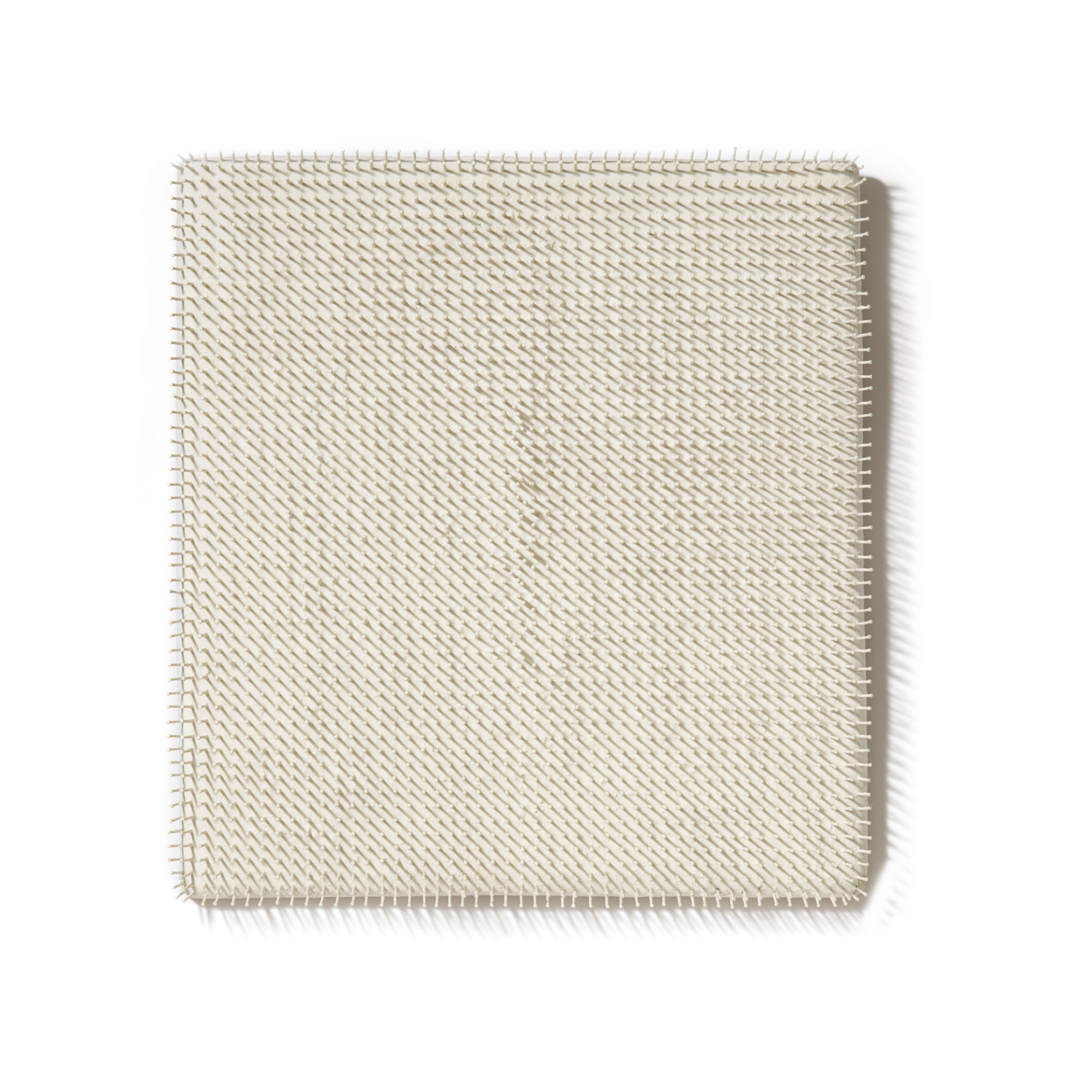
Ohne Titel (Weißes Bild)
Where Piene worked with fire and light grids and Mack with shimmering aluminum reliefs, Uecker brought his nails, and with them an almost meditative, labor intensive intensity that gave ZERO one of its most potent and recognizable voices. The movement had international ambitions and connections, aligning itself with the French Nouveau Réalisme artists and the Japanese Gutai group, situating Uecker within a genuinely global conversation about what art could be in the aftermath of catastrophe. The nail, for Uecker, was never merely a formal device. He has spoken about the act of hammering as a ritual, a kind of wound inflicted on a surface that simultaneously becomes an act of care and ordering.
“White is the color of silence, of infinity, of the beginning and the end.”
Günther Uecker, interview
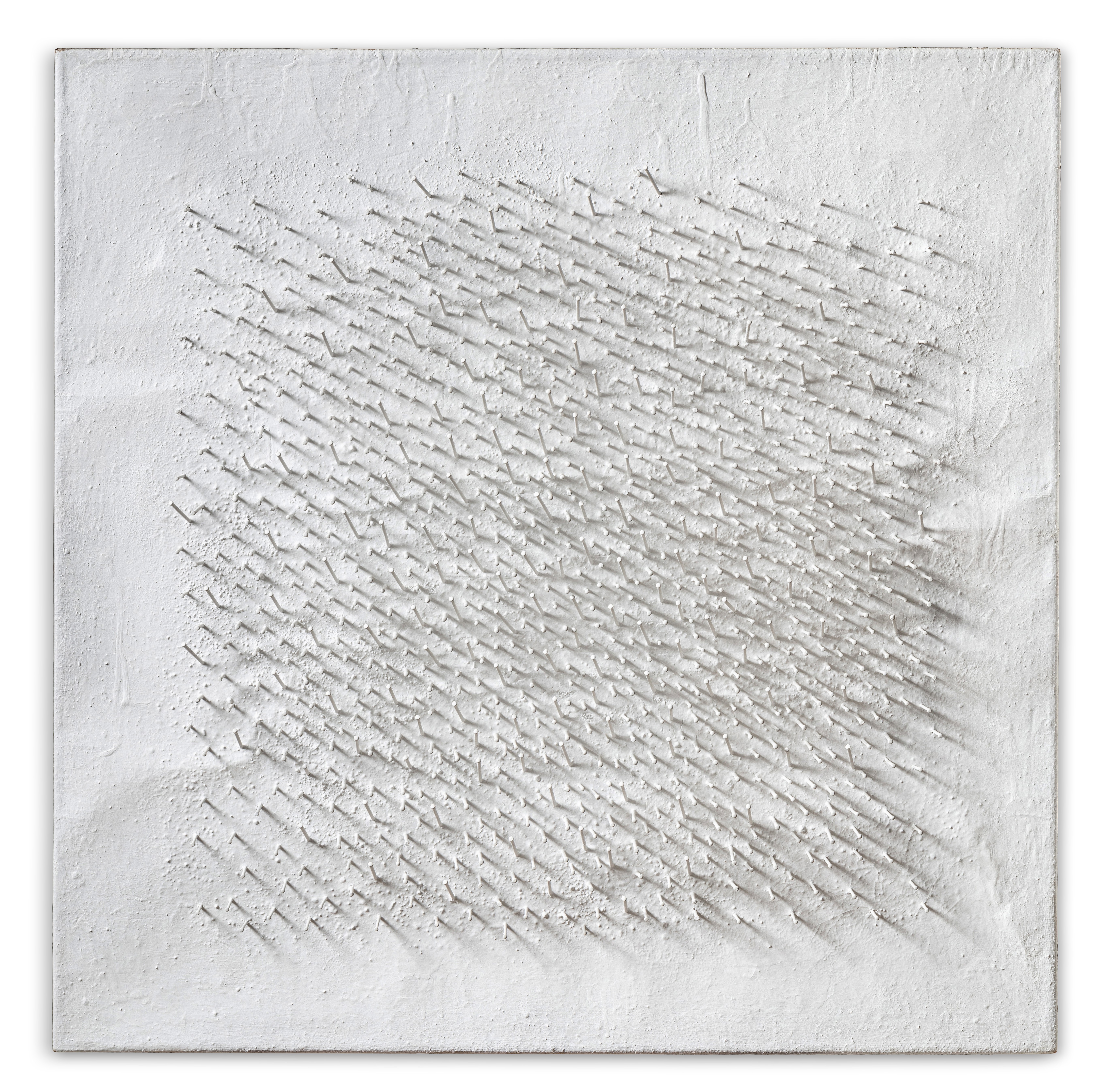
The nails are driven into canvas, into wood, into furniture and everyday objects, arranged in spirals, in radiating fields, in dense concentric circles that generate optical effects of stunning sophistication. As light moves across the surface of a work such as Ohne Titel (Weißes Bild), one of the most celebrated examples of his practice, the relief appears to ripple and rotate, to emit rather than receive illumination. The whiteness of these works is not the whiteness of blankness but of accumulation, of presence. They are among the great meditations on perception in all of twentieth century art.
Günther Uecker
Untitled, 1960
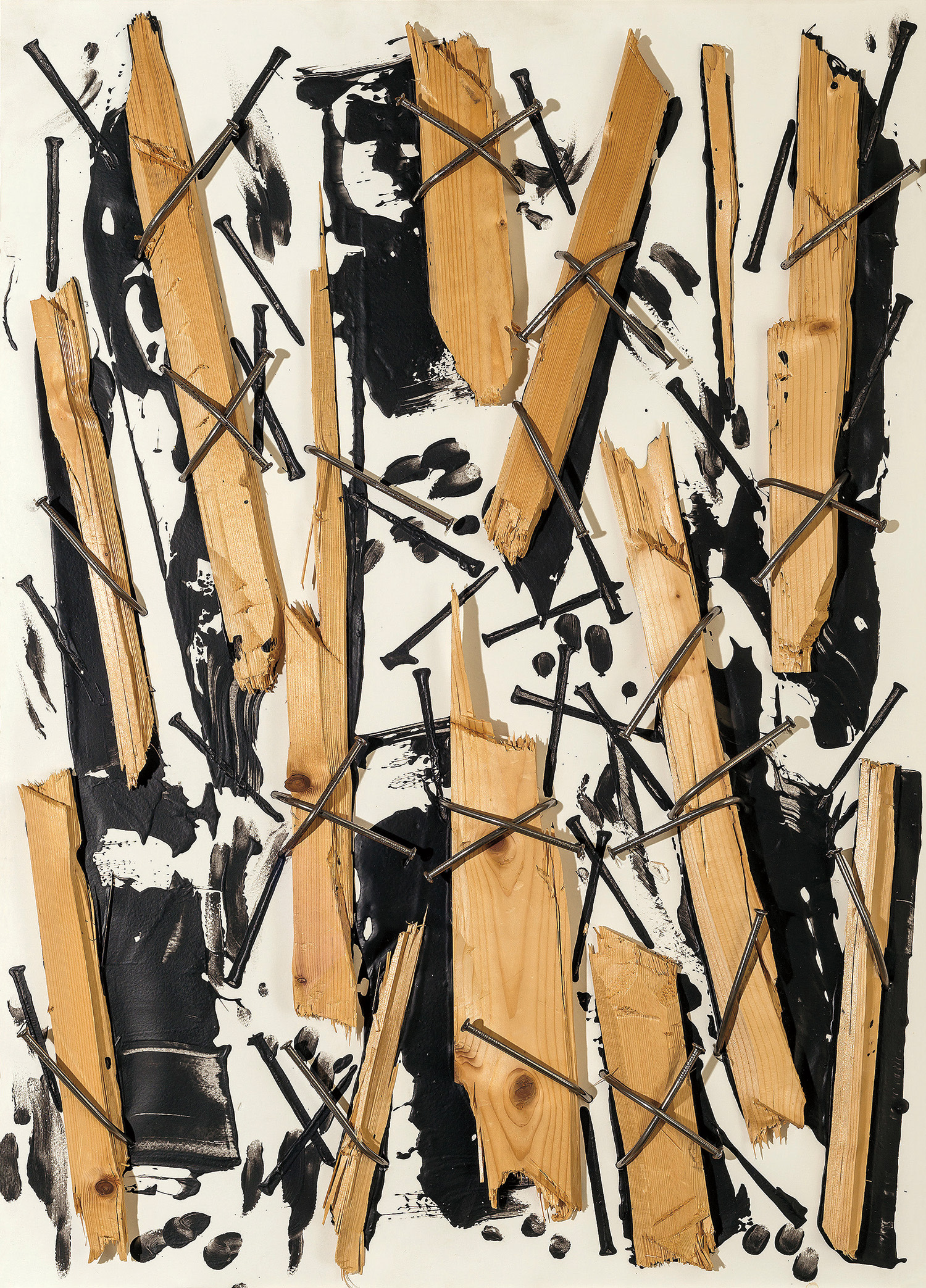
His 1970 work Reihung, in pencil, nails, and lacquer on wood, shows a more linear and architectural ordering of his obsession, demonstrating the range within what might seem at first a singular signature gesture. As Uecker's practice matured through the 1970s and beyond, it expanded to encompass an increasingly explicit engagement with memory, violence, and the possibility of healing. Works such as Verletzungen Verbindungen 1, from 2007, with its glue, black acrylic paint, nails, and linen canvas on plywood, carry a rawer, more sorrowful energy than the luminous white fields of his earlier decades. The title itself, which translates roughly as Wounds and Connections, announces a moral and emotional program.
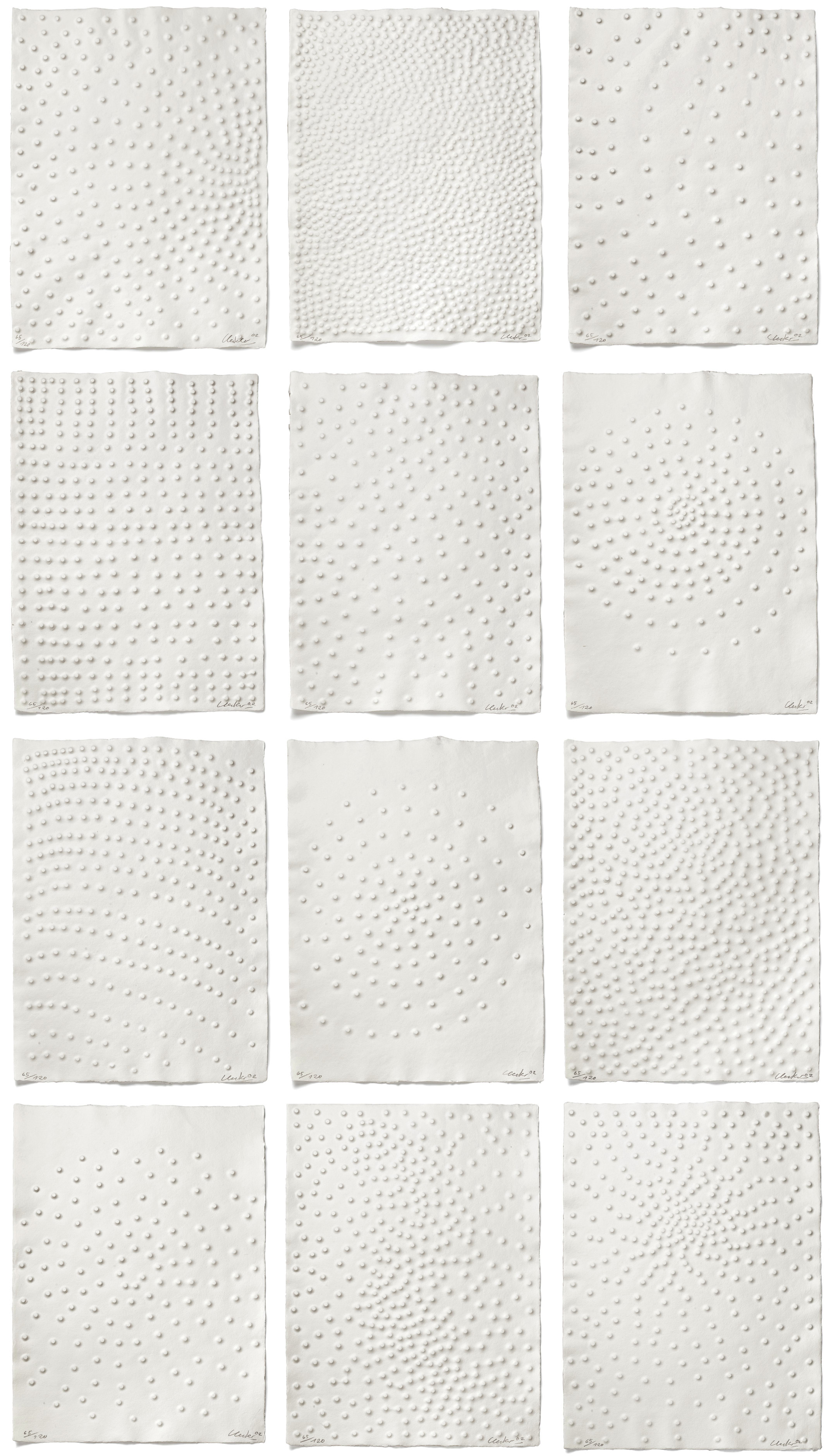
Barbarei und Hoffnung, from 1999, nails and latex paint on panel, places barbarity and hope in direct confrontation, the push of the nail and the stretch of the white surface becoming a metaphor for survival. The Nietzsche quoting work from 2000 gestures at his deep engagement with philosophical tradition, the artist positioning himself within a lineage of German thought that insists on the generative potential of inner chaos. Throughout, the prints and works on paper, including the quiet lithograph Zum Schweigen der Schrift, demonstrate that Uecker's sensibility translated fluidly across media, the silence he pursued on canvas finding an equally resonant expression in the intimacy of the printed page. For collectors, Uecker's work presents a rare combination: it is historically significant, emotionally potent, and visually distinctive in a way that makes attribution essentially self evident.
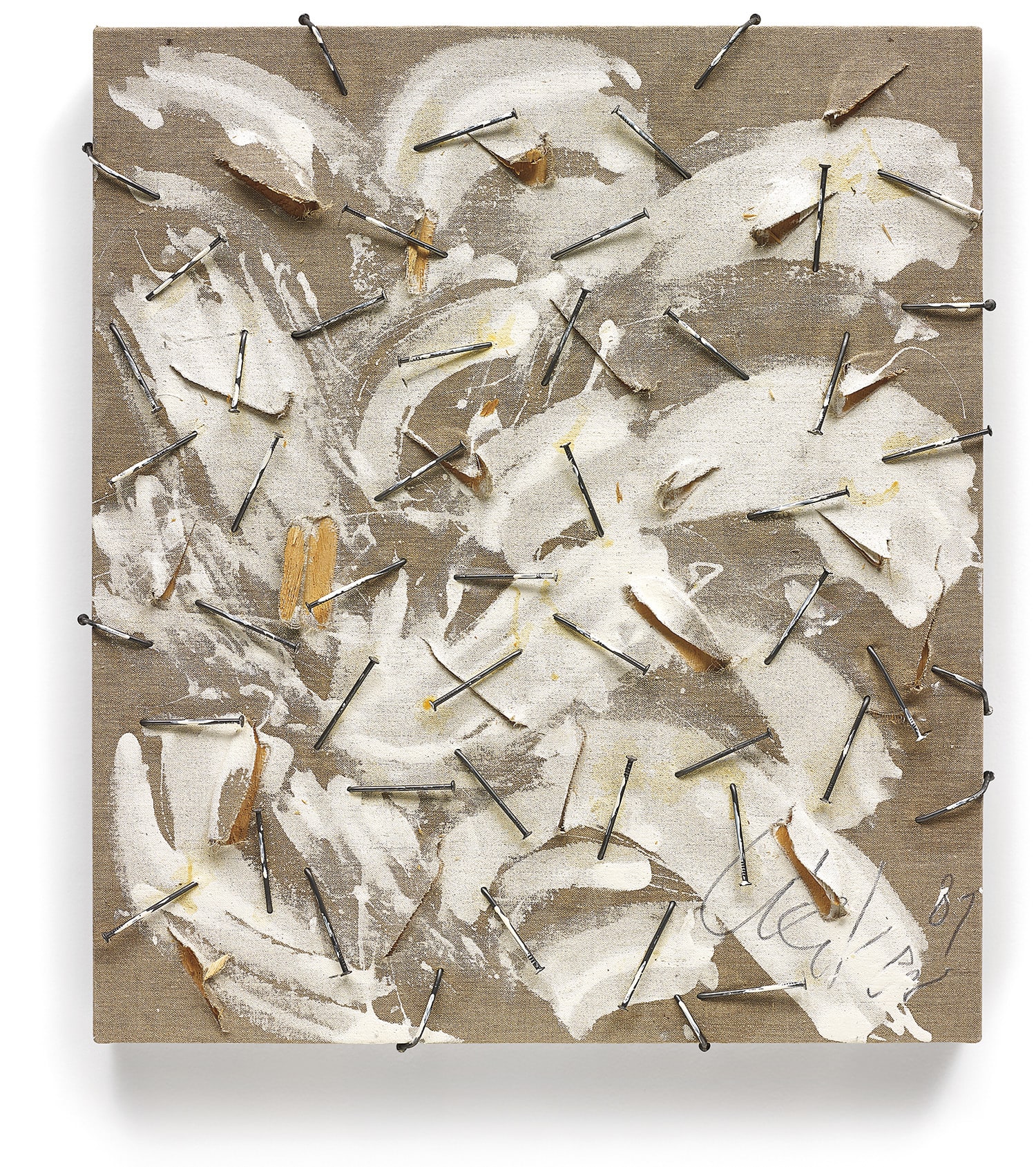
Günther Uecker
nails, adhesive and emulsion paint on canvas laid on panel, 1981
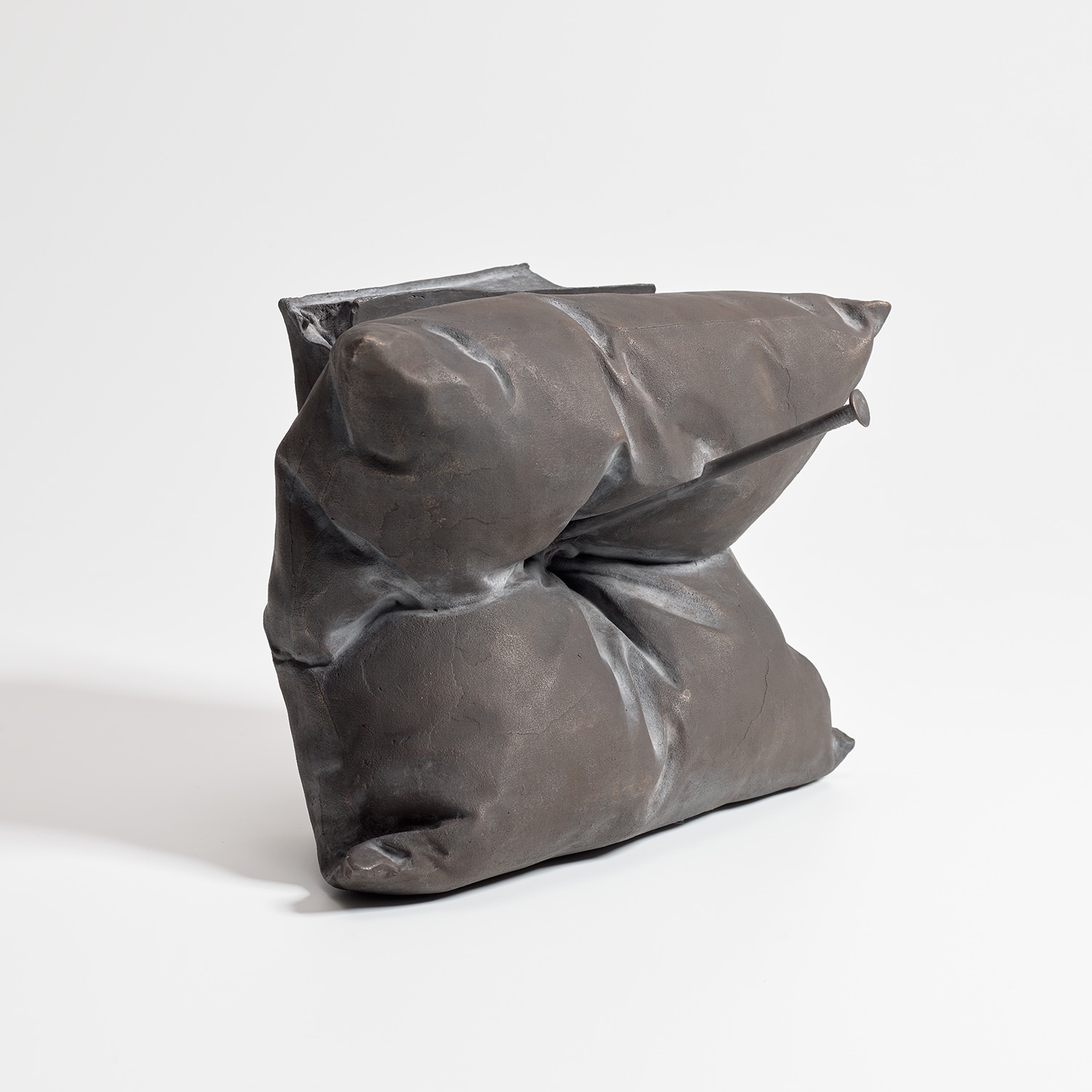
His nail reliefs are among the most collected objects from the ZERO era, and they appear regularly at the major international auction houses where they consistently attract strong interest. The white nail canvases from the late 1950s through the 1970s are considered the core of his achievement, though collectors with a deeper interest in his conceptual and philosophical development are increasingly drawn to the more complex works of the 1990s and 2000s. Works on paper and prints offer an accessible entry point into his practice, and the Kissenbuch bronze from 1969 represents a fascinating and less frequently encountered dimension of his sculptural thinking. Condition is paramount with the nail works, as the precise arrangement of the nails is integral to the optical effect, and any disturbance to the surface fundamentally alters the work's character.
To understand Uecker fully, it helps to situate him within a constellation of contemporaries who shared his commitment to light and material transformation. Lucio Fontana's slashed canvases and the Spatialismo movement in Italy, Yves Klein's monochromes and his obsession with immateriality, the subtle kinetic works of Jesús Rafael Soto and Jean Tinguely all circle around the same mid century conviction that painting as traditionally understood had been exhausted and that something more elemental was required. Uecker's achievement within this company is to have invented a gesture so specific, so physically grounded in craft and labor, that it transcends the theoretical and becomes a direct somatic experience. You feel a Uecker before you understand it, and that priority of feeling over analysis is one of the hallmarks of genuinely great art.
Günther Uecker's passing in 2025 closes a remarkable chapter in the history of European modernism, but his work feels anything but finished. Museums from the Museum Ludwig in Cologne to the Moderna Museet in Stockholm hold important examples of his practice, and the ongoing scholarly reassessment of the ZERO movement continues to reveal the depth and originality of his contribution. For collectors and for anyone who cares about the capacity of art to address the full range of human experience, from devastation to transcendence, from wound to wonder, his work remains as alive and as necessary as it has ever been. To encounter a Uecker nail relief in person is to be reminded of what art, at its most ambitious, can ask of a viewer and what it can give back in return.
Featured Works
Explore books about Günther Uecker
Günther Uecker: Retrospektive
Various curators
Günther Uecker: Nails, Light, Movement
Dieter Honisch
Günther Uecker: Werke 1955-1980
Werner Schmalenbach

Günther Uecker: Monograph
Klaus Gallwitz
Günther Uecker: Katalog der Werke
Various

Günther Uecker: Light and Movement
Christos M. Joachimides