Giuseppe Penone
Giuseppe Penone: Nature's Most Devoted Collaborator
Artist Spotlight · The Collection Editorial
“The tree is a shifting, changing image of the world. It is a living sculpture that grows by itself.”
Giuseppe Penone, interview with the Louvre, 2013
When the Palazzo delle Esposizioni in Rome mounted a sweeping survey of Arte Povera in recent years, one name resonated above nearly all others as the movement's living conscience: Giuseppe Penone. His works stopped visitors in their tracks, not through spectacle or scale alone, but through something quieter and more profound, the sense that here was an artist who had spent more than five decades listening to the world with extraordinary patience. Today, as ecological thought and humanity's relationship to the natural environment sit at the center of global cultural conversation, Penone's lifelong project feels less like art history and more like urgent, necessary poetry. Penone was born in 1947 in Garessio, a small town nestled in the Piedmont region of northwestern Italy, where the Alps begin their descent toward the Ligurian coast.
Giuseppe Penone
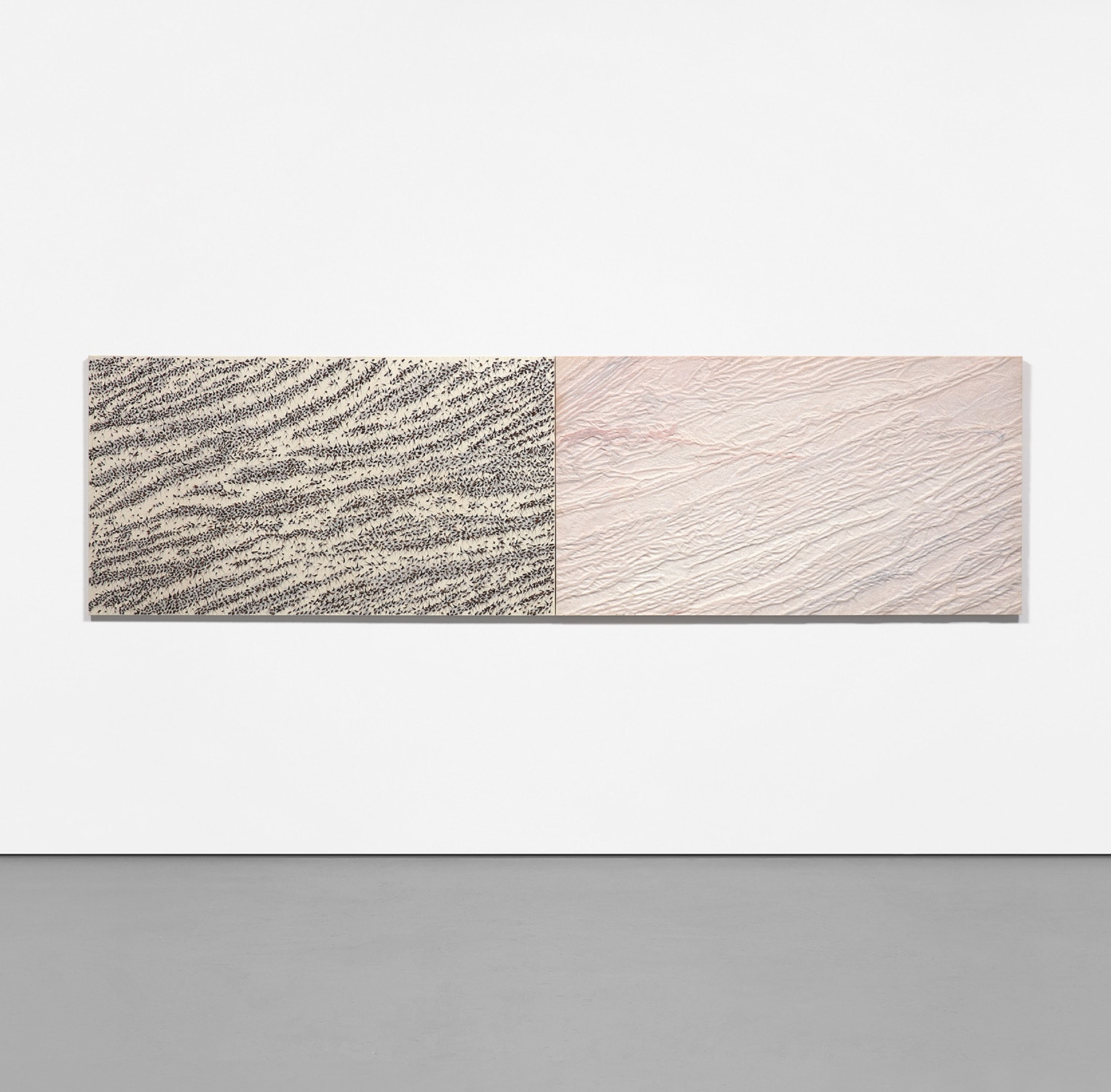
Pelle di Marmo e Spine d'Acacia - Lucrezia, 2003
He grew up surrounded by forests, rivers, and the particular quality of light that filters through dense deciduous canopy, and these early sensory experiences would become the permanent foundation of his art. He studied at the Accademia Albertina di Belle Arti in Turin, arriving at a moment when that city was crackling with intellectual energy. Turin in the late 1960s was the crucible in which Arte Povera was forged, animated by the gallerist and theorist Germano Celant, who coined the movement's name and gathered its practitioners into a loose but galvanizing collective. Penone was among the youngest of the Arte Povera generation, alongside figures such as Jannis Kounellis, Mario Merz, Giovanni Anselmo, Michelangelo Pistoletto, and Luciano Fabro.
What united these artists was a shared rejection of industrial consumer culture and a desire to return art to elemental materials and processes, wood, stone, earth, fire, breath, and time. Where many of his peers leaned toward the theatrical or the philosophical system, Penone moved almost immediately toward the organic and the durational. His earliest interventions, made directly in the forests around Garessio in the late 1960s, involved wrapping his hands around young trees so that the wood, growing year by year, would eventually absorb and preserve the shape of his grip. These gestures were simultaneously humble and radical: a young man asking nature to remember him.
Giuseppe Penone
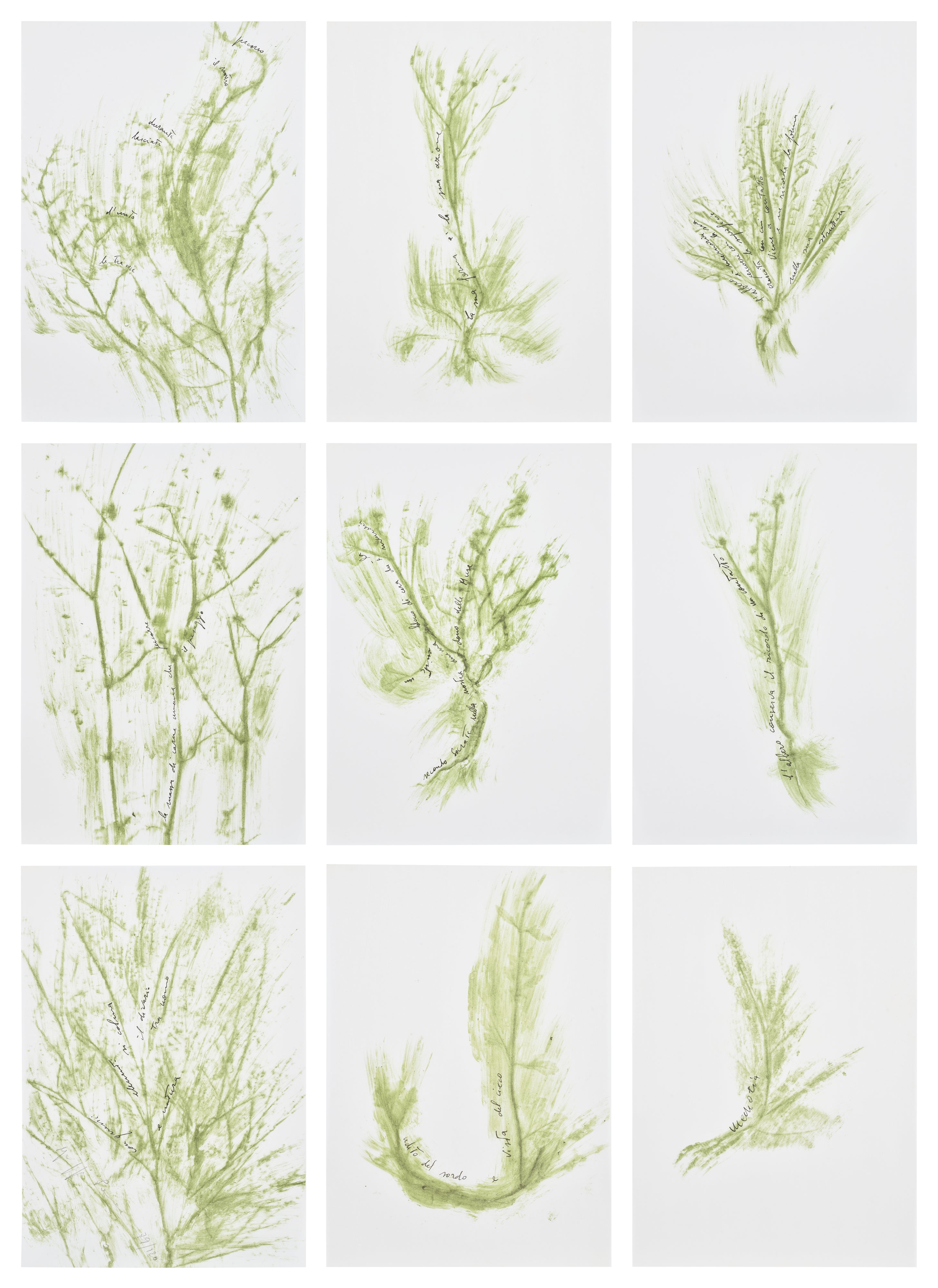
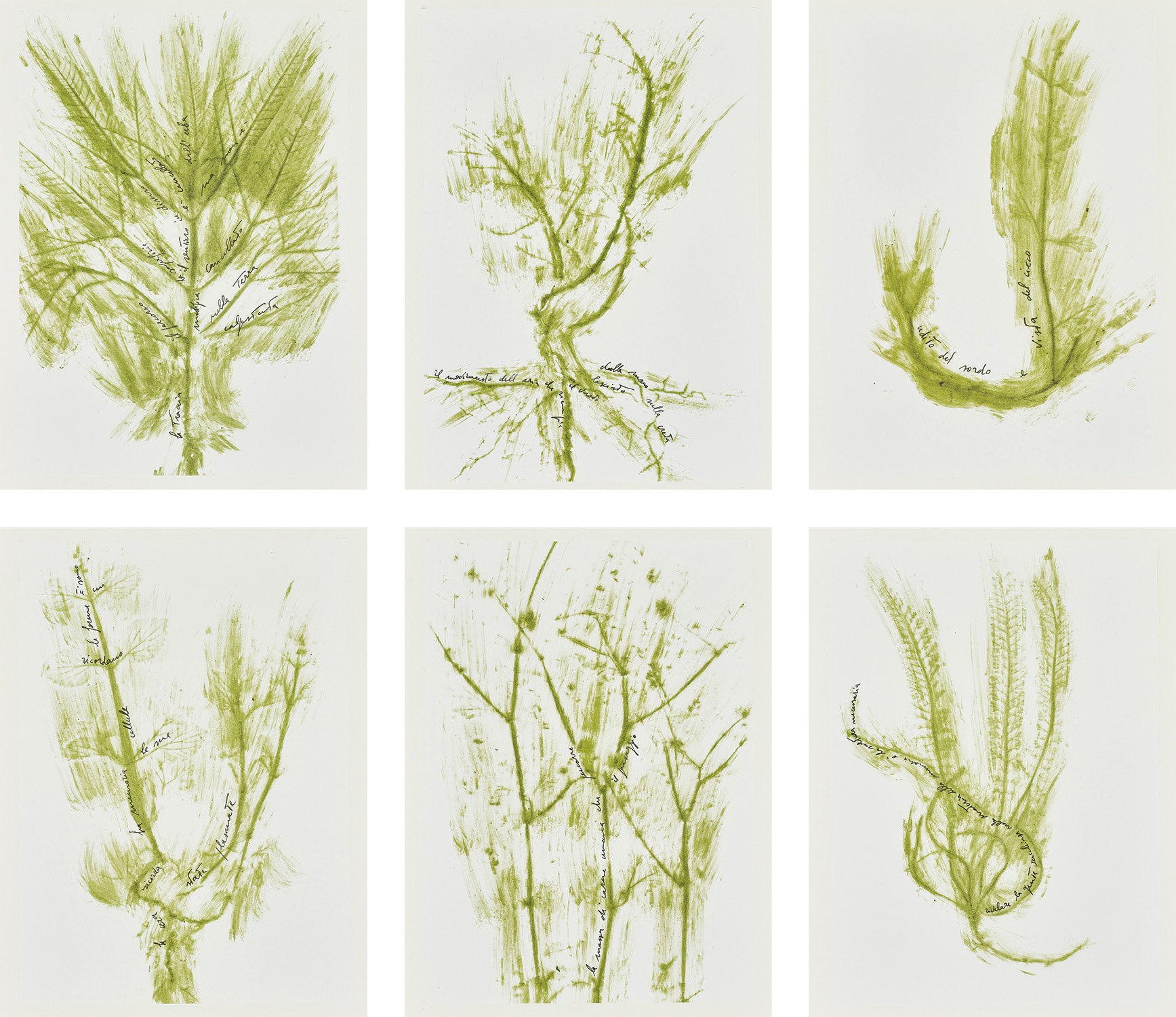
Trentatré erbe (Thirty-three Herbs)
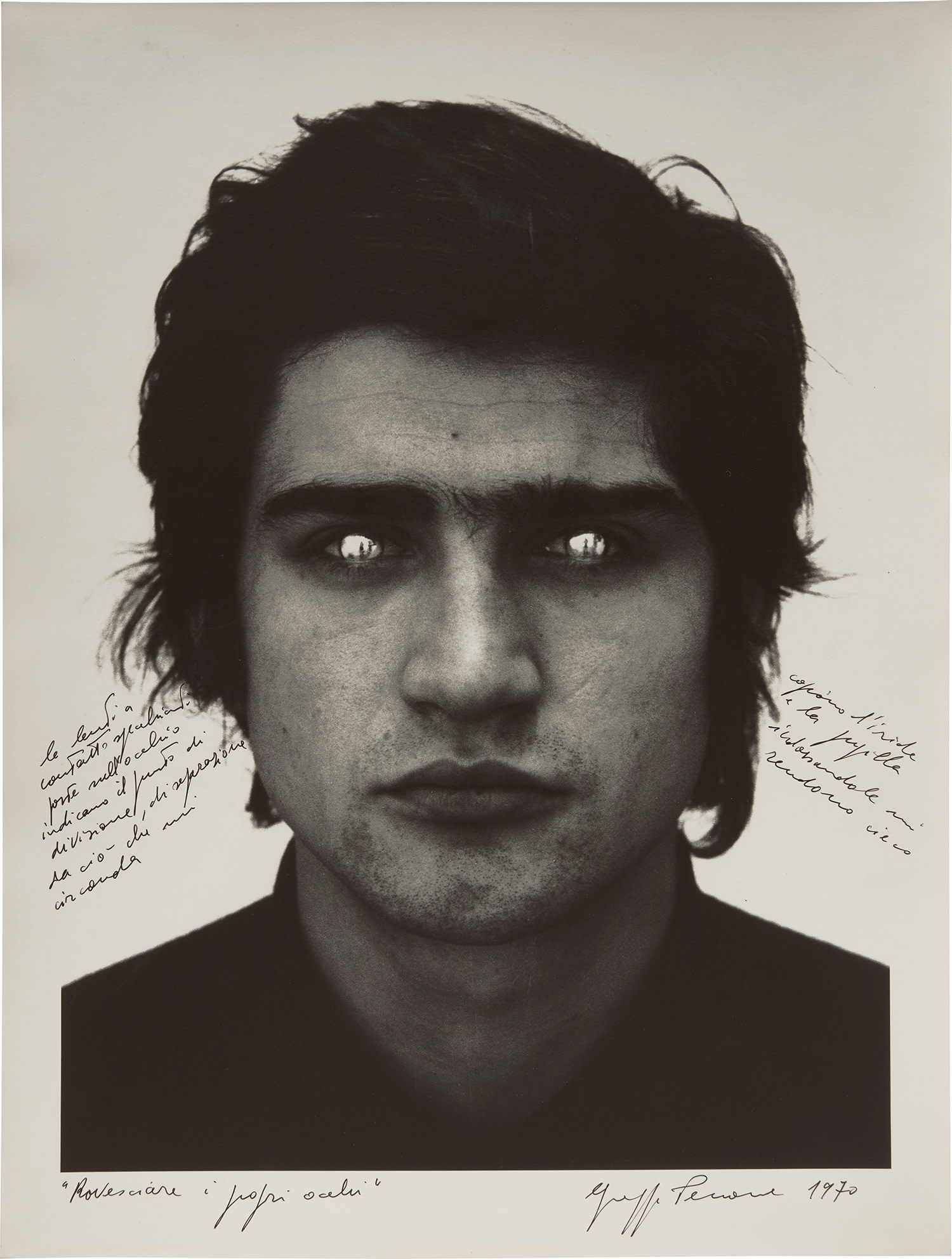
The work titled Rovesciare i propri occhi, or Reversing One's Eyes, from 1970, stands as one of the most arresting conceptual gestures of its era. In it, Penone wore mirrored contact lenses that reflected the external world back outward rather than receiving it inward, turning the act of seeing inside out. The piece encapsulates his persistent fascination with thresholds: between interior and exterior, between the body and its environment, between the human and the vegetal. This preoccupation deepened across the following decades into an increasingly rich and technically diverse practice that encompassed sculpture, drawing, printmaking, photography, and large scale installation.
“To touch a tree is to touch time. The wood holds every year of its life inside it.”
Giuseppe Penone
Among the most celebrated aspects of Penone's mature practice is his treatment of wood as a medium that holds memory within its very structure. By carving back through industrial timber beams to reveal the young sapling still present at their core, he makes visible the invisible biography of the material. These monumental works, shown to great acclaim at venues including the Louvre in Paris, where he became the first living artist invited to exhibit throughout the museum's sculptural galleries in 2013, demonstrate his ability to transform familiar materials into vehicles for profound reflection on growth, transformation, and the passage of time. His 2013 Louvre residency was a landmark moment in contemporary art, an institution founded on the Western canon extending an open hand to an artist whose work gently but insistently questions the boundary between culture and nature.
Giuseppe Penone
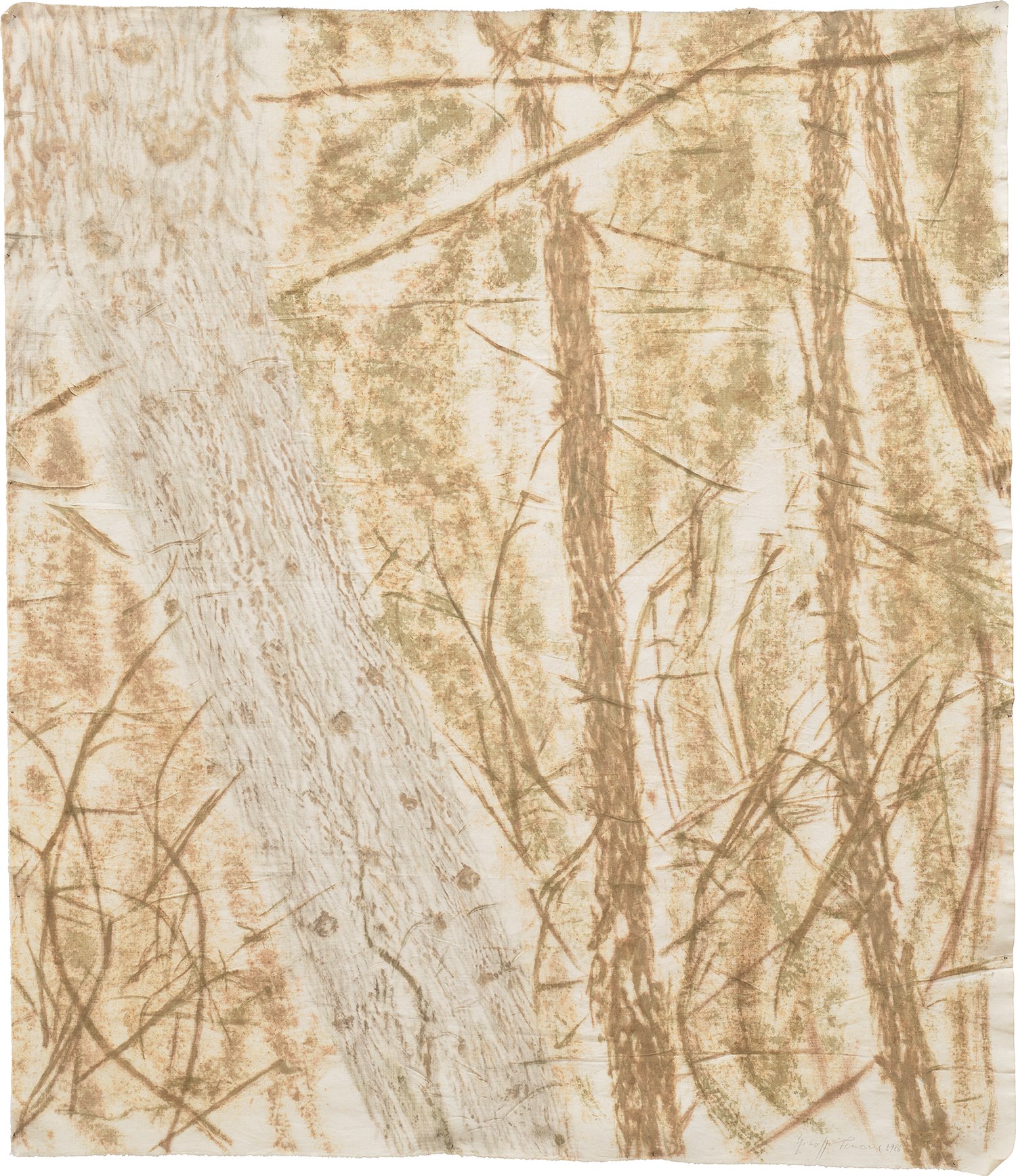
Verde del bosco, 1986
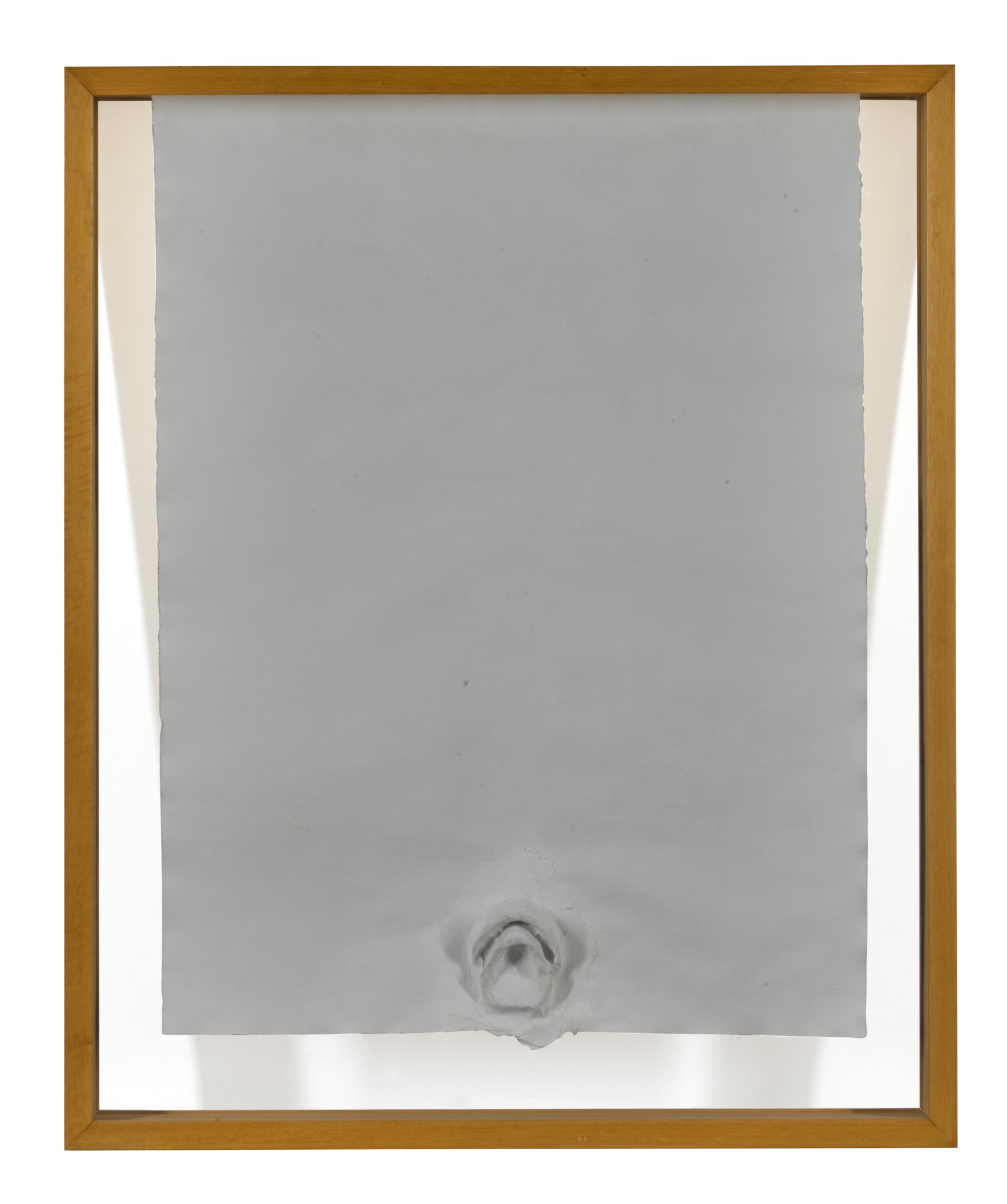
The works available through The Collection offer an illuminating cross section of Penone's practice and his extraordinary range. The 1989 graphite rubbing collage works on paper, Azzerare il solco prodotto dai piedi dell'uomo and Il paesaggio prodotto dal tempo dell'uomo, show his exquisite sensitivity to mark making and his tendency to locate the monumental within the intimate. The complete set of Images de pierres lithographs, printed directly from marble slabs, is a characteristic Penone gesture: allowing stone to author its own image, to press its skin onto paper and speak for itself. The 2003 work Pelle di Marmo e Spine d'Acacia, using pink marble, silk, and acacia thorns, brings his characteristic sensory tension to two dimensions, softness and sharpness held in a single breath.
The series Trentatré Erbe, published by Marco Noire Editore in Turin, reveals the artist's sustained engagement with botanical taxonomy and with the book as both archive and living document. For collectors, Penone occupies a particularly enviable position in the market. His works on paper and editions offer accessible points of entry into a practice whose monumental sculptures command institutional scale and institutional prices. Works such as 26 Unghiate from 1989, plaster and card laid on canvas, and the paired Unghia e marmo from 1988, speak to his long running meditation on the fingernail as a record of bodily time, a keratinous calendar.
![Giuseppe Penone — Azzerare il solco prodotto dai piedi dell’uomo (To Reset the Furrow Produced by Man's Feet) and Il paesaggio prodotto dal tempo dell’uomo (Landscape Produced by Man's Time) [Two Works]](https://rtwaymdozgnhgluydsys.supabase.co/storage/v1/object/public/artwork-images/auction-lots/N11170-20230303-lot324.jpg)
Giuseppe Penone
Azzerare il solco prodotto dai piedi dell’uomo (To Reset the Furrow Produced by Man's Feet) and Il paesaggio prodotto dal tempo dell’uomo (Landscape Produced by Man's Time) [Two Works] , 1989
These intimate works reward close looking and repay the kind of sustained private relationship that collecting at its best makes possible. Penone is represented by Marian Goodman Gallery and has been associated with Galerie Yvon Lambert in Paris, both institutions with impeccable programs and strong secondary market positions. His works appear regularly at Christie's, Sotheby's, and Phillips, where demand from European and international collectors remains consistently strong. Within art history, Penone's closest affinities extend beyond Arte Povera to connect him with a broader international tradition of artists who have engaged nature as a collaborator rather than a subject.
The earthworks of Richard Long and Andy Goldsworthy share his sensitivity to site and material, while the process based investigations of Eva Hesse and Barry Le Va illuminate different facets of his conceptual lineage. Yet Penone remains distinct from all of them: his work is rooted in a specifically Italian sensibility, shaped by centuries of thought about the relationship between the human body and the landscape, from the pastoral tradition through to twentieth century phenomenology. What makes Penone essential today is precisely what made him vital in 1968: his insistence that art can be an act of attentiveness rather than assertion. In an era of accelerating environmental crisis, his decades long conversation with trees, stone, water, and skin carries a new charge.
To own a work by Giuseppe Penone is to carry into your home a fragment of that conversation, a reminder that the natural world is not a backdrop to human life but its very ground. He has spent more than fifty years demonstrating this with materials as honest as the land he grew up in, and the art world is richer, and more alive, for every year he has continued.
Featured Works
Pelle di Marmo e Spine d'Acacia - Lucrezia
2003
Trentatré erbe (Thirty-three Herbs)
Verde del bosco
1986
Azzerare il solco prodotto dai piedi dell’uomo (To Reset the Furrow Produced by Man's Feet) and Il paesaggio prodotto dal tempo dell’uomo (Landscape Produced by Man's Time) [Two Works]
1989
Untitled
Trentatré Erbe (Thirty-three Herbs)
Explore books about Giuseppe Penone
Giuseppe Penone: Svolgimento del Processo Mentale
Giuseppe Penone
Giuseppe Penone: Drawings and Prints
Carolyn Christov-Bakargiev

Giuseppe Penone: Writings and Interviews
Giuseppe Penone, various editors
Giuseppe Penone: A Retrospective
Jean-Christophe Ammann
Giuseppe Penone: Nature and Culture
Pierre Restany
Giuseppe Penone: The Hand, The Eye, The Heart
Germano Celant
Penone: Opere 1968-1982
Achille Bonito Oliva