Giovanni Domenico Tiepolo
Giovanni Domenico Tiepolo, Venice's Brilliant Son
Artist Spotlight · The Collection Editorial
In the grand salons of the Palazzo Labia and beneath the frescoed heavens of the Villa Valmarana ai Nani near Vicenza, a particular kind of magic was set in motion during the eighteenth century. It was a magic born of two hands working in close proximity, father and son, tradition and invention, gravity and wit. Giovanni Domenico Tiepolo, known to the art world as Giandomenico, spent a lifetime navigating that exquisite tension, and the results remain among the most beguiling and intellectually alive works the Venetian school ever produced. As museums from the Metropolitan in New York to the Museo del Prado in Madrid continue to feature his drawings and canvases in exhibitions of Venetian Rococo mastery, collectors and scholars alike are returning to Giandomenico with fresh and genuinely admiring eyes.
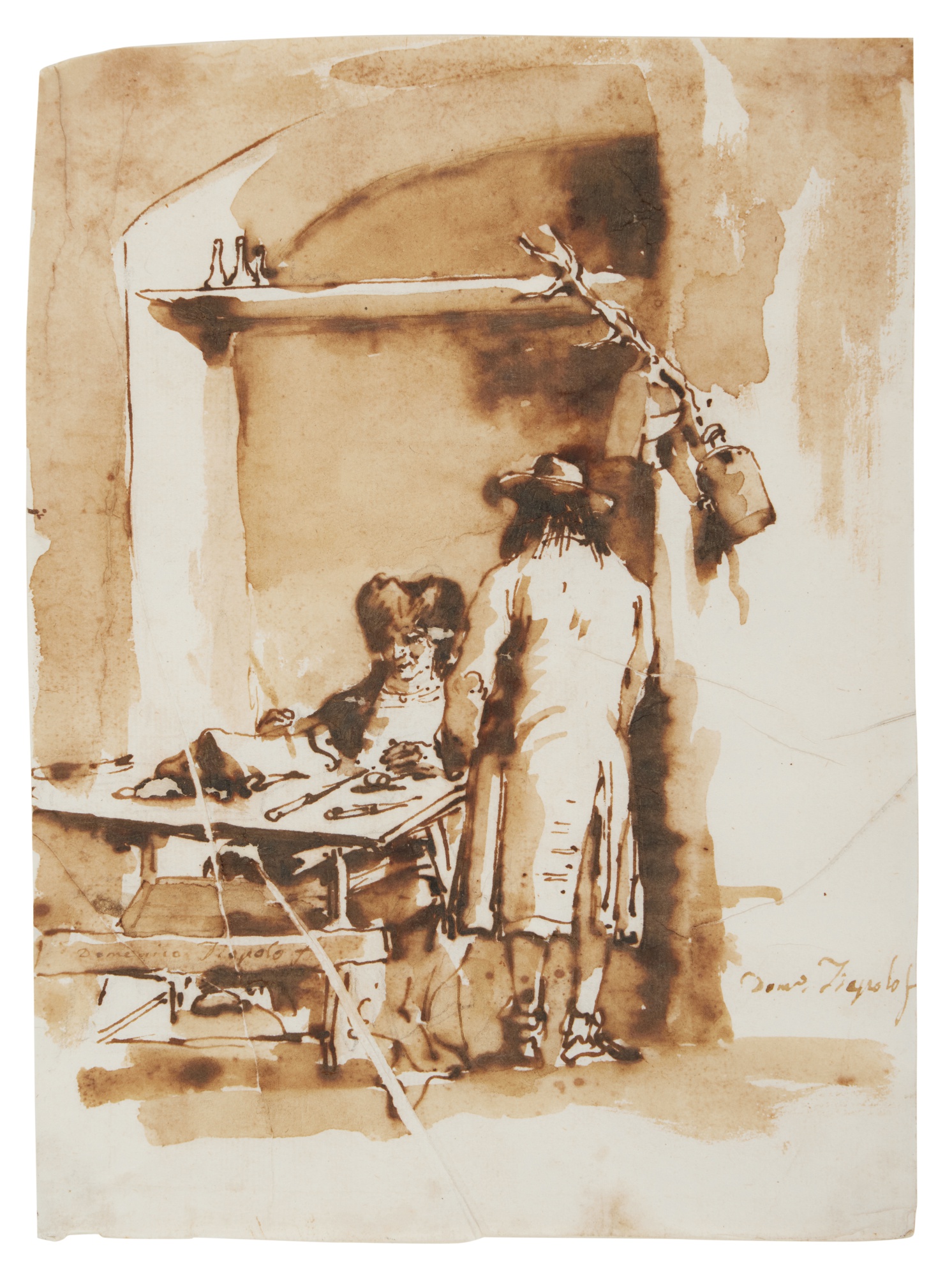
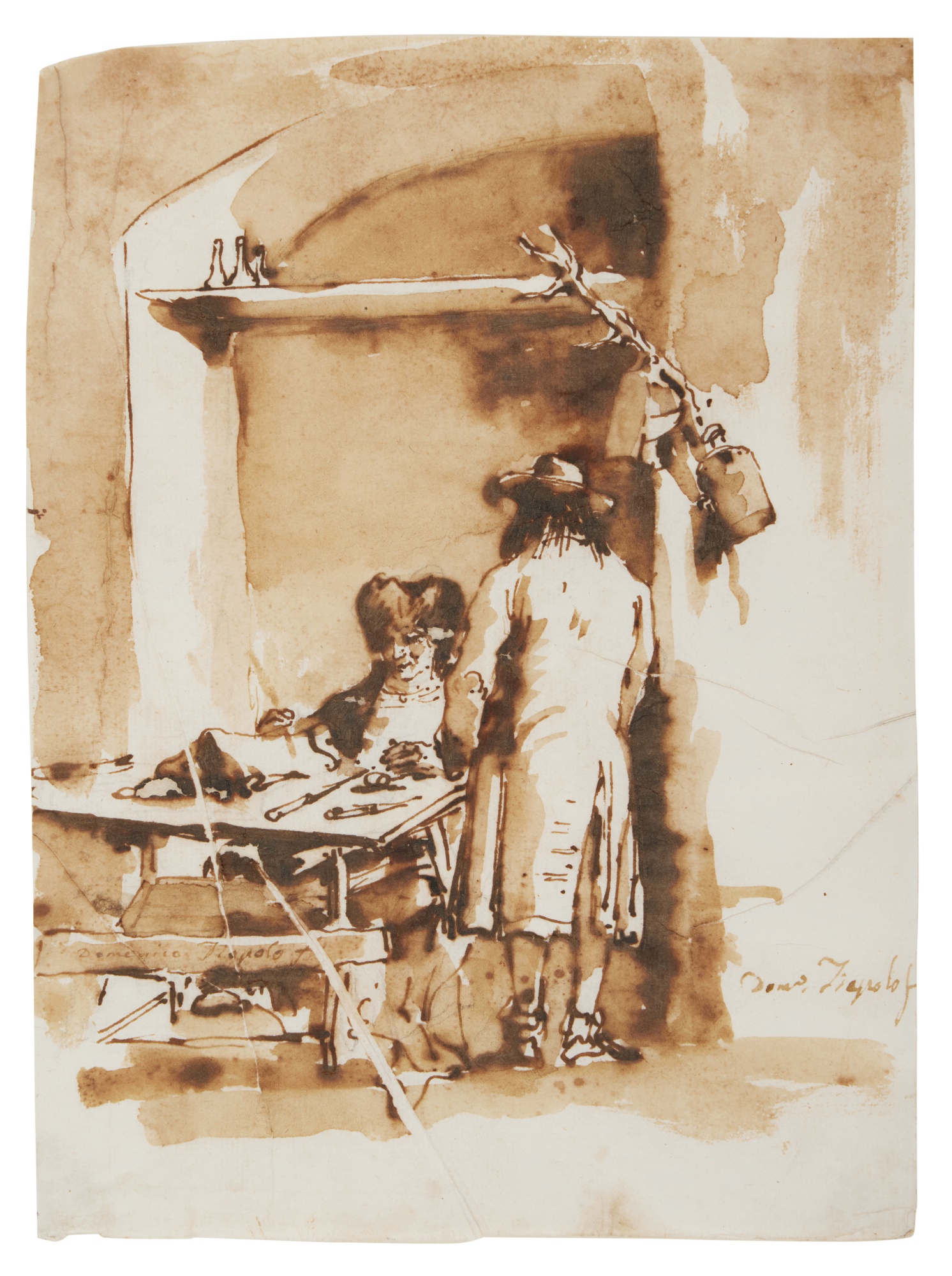
Giovanni Domenico Tiepolo
Two figures in an interior, possibly an apothecary
Giandomenico was born in Venice in 1727, the eldest son of Giovanni Battista Tiepolo, arguably the greatest decorative painter of the eighteenth century. Growing up in that household was an extraordinary education. The elder Tiepolo's studio was a world of perpetual invention, grand allegory, luminous color, and breathtaking spatial ambition. From his earliest years, Giandomenico absorbed the vocabulary of the Venetian tradition: the legacy of Veronese's gorgeous pageants, the chiaroscuro drama of the Tenebrosi, the supple draftsmanship that was the foundation of all serious Venetian practice.
He trained directly under his father and by his teenage years was already contributing meaningfully to major fresco commissions, a testament to both his precocious gifts and the confidence the elder Tiepolo placed in him. The formative decade of the 1740s and 1750s saw Giandomenico travel alongside his father to some of the most celebrated commissions of the era. The Würzburg Residenz in Bavaria, where the family worked from 1750 to 1753, was a crucible of creative experience. There, beneath the vast ceiling of the Imperial Hall and the staircase vestibule, Giandomenico contributed to one of the defining decorative programs of the Rococo period.
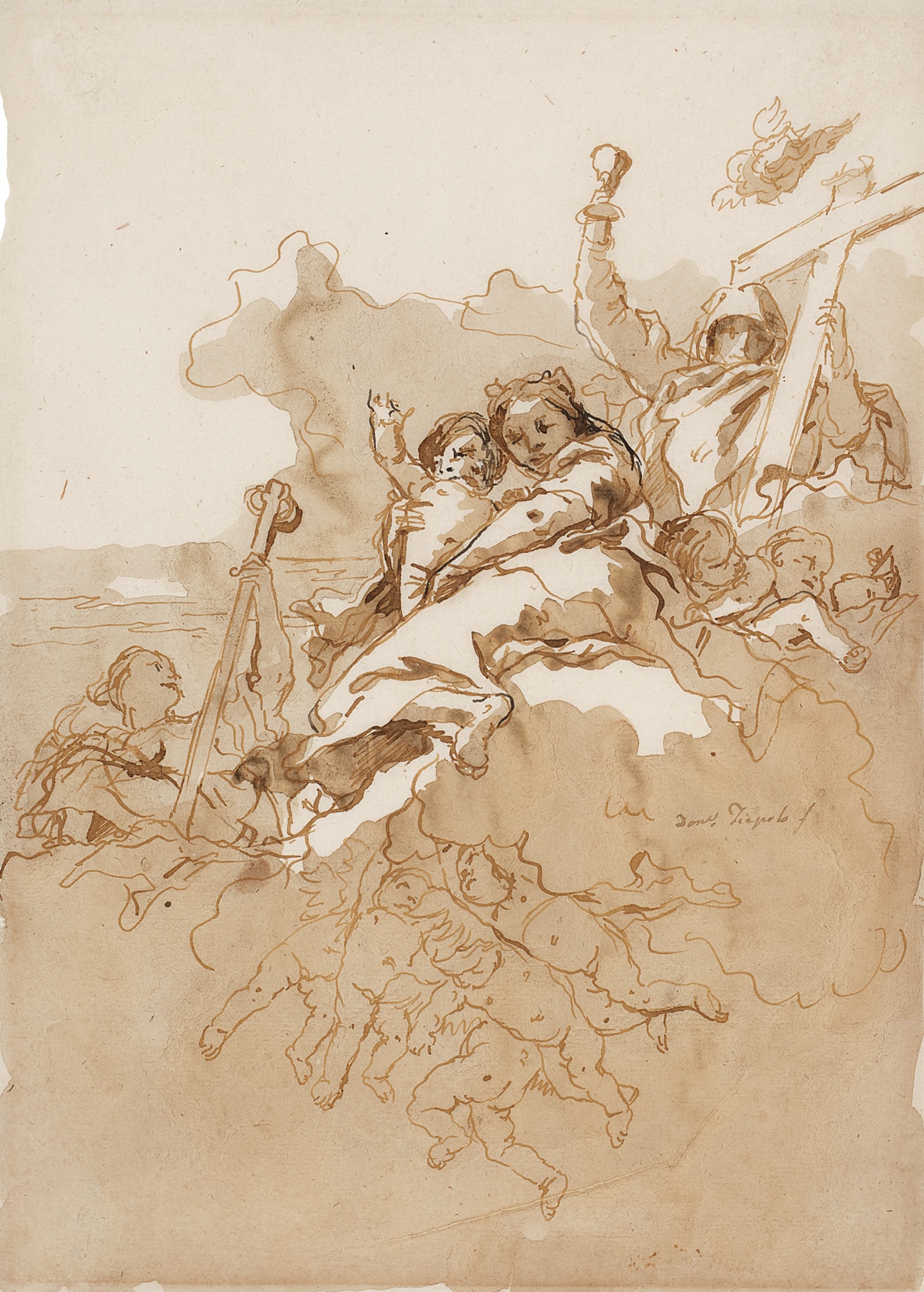
Giovanni Domenico Tiepolo
Faith, Hope and Charity with Putti among clouds
What is striking, even in these collaborative contexts, is how distinctly his own sensibility begins to assert itself: a taste for the earthy, the comic, and the closely observed alongside the celestial grandeur his father commanded so effortlessly. He was learning the language of heaven while already beginning to cultivate a deep affection for the world below. It is in his independent work that Giandomenico's singular genius fully reveals itself. His series of etchings, most notably the celebrated Via Crucis of 1749, demonstrated a printmaker of exceptional refinement and emotional intelligence.
The Divertimento per li Regazzi, his extraordinary late series of drawings depicting the commedia dell'arte figure Punchinello, stands as one of the great achievements of European draftsmanship. Executed in pen and brown ink with wash, these works possess a quality that is simultaneously carnivalesque and melancholic, celebratory and searching. They represent an artist who had absorbed every lesson the eighteenth century could offer and was now using those lessons to ask genuinely modern questions about identity, performance, and the passage of time. The drawings available through The Collection reflect this mastery: works executed in pen and brown ink and wash over black chalk reveal his command of layered mark making, his confidence with wash to build luminous atmospheric depth, and his instinct for figural drama whether the subject is mythology, scripture, or everyday life.
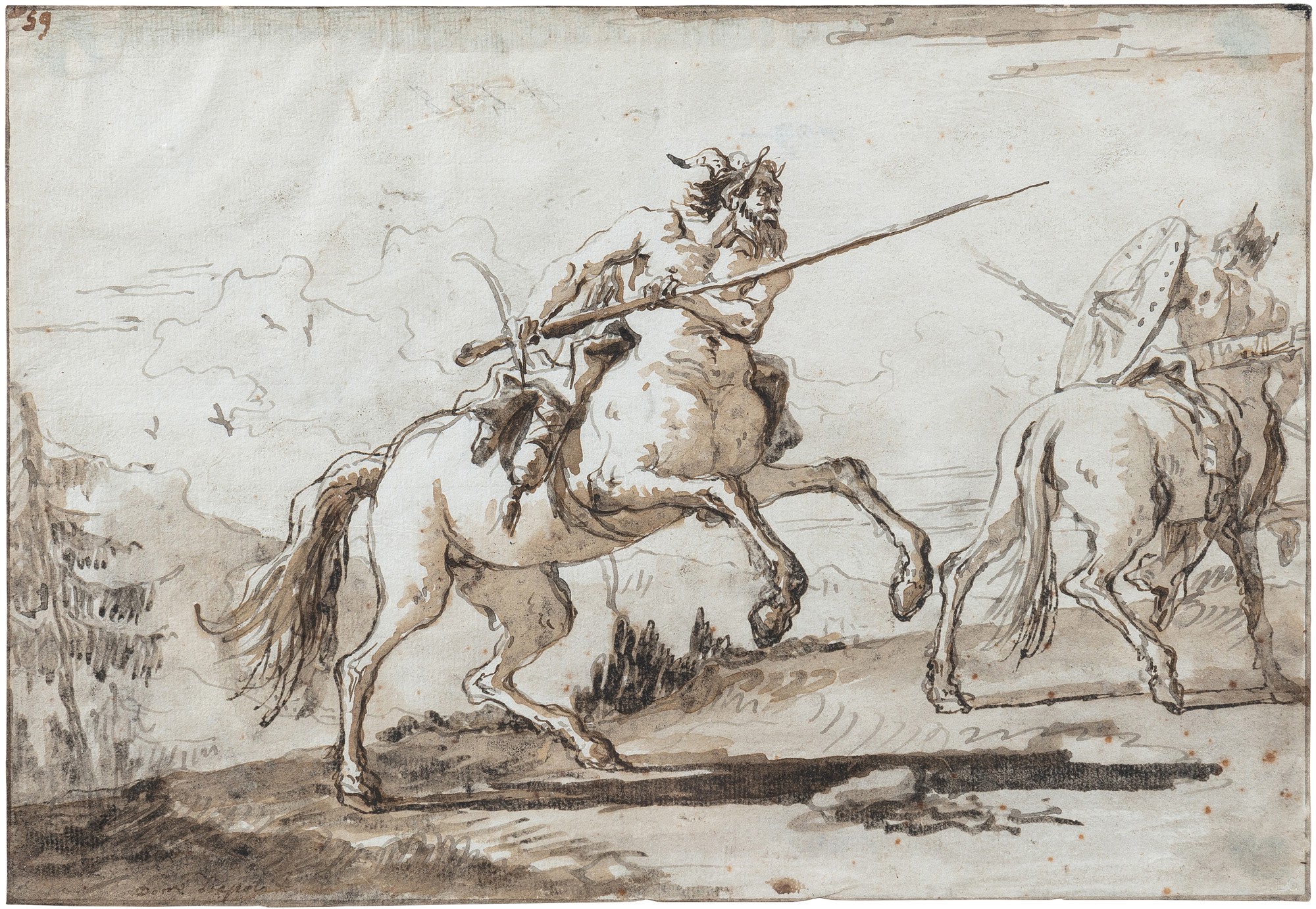
Giovanni Domenico Tiepolo
Two centaurs in combat
For collectors, Giandomenico's works on paper represent one of the most rewarding areas of the Old Master market. His drawings have appeared at Christie's, Sotheby's, and Bonhams with consistent interest from institutional and private buyers alike. What distinguishes a strong Giandomenico drawing is the quality of his pen line, at once controlled and spontaneous, and the sophistication of his wash application, which can suggest vast spatial recession with what appears to be effortless economy. His oil paintings, while rarer on the market, carry the full weight of his training and offer collectors a direct encounter with the warmth and technical authority that defined the best of Venetian painting.
Works depicting sacred subjects such as the Immaculate Madonna or the Baptism of Christ are grounded in deep iconographic tradition while animated by his particular gift for making the divine feel genuinely present and alive. A bearded head study in oil, unlined and therefore preserving the intimacy of its making, offers collectors something precious: access to the private, exploratory intelligence behind the grand public works. To understand Giandomenico fully, it helps to place him in the company he kept and the artists who surrounded him. His father Giovanni Battista Tiepolo is the obvious and essential comparison, and the relationship between their bodies of work is one of the most fascinating in art history.
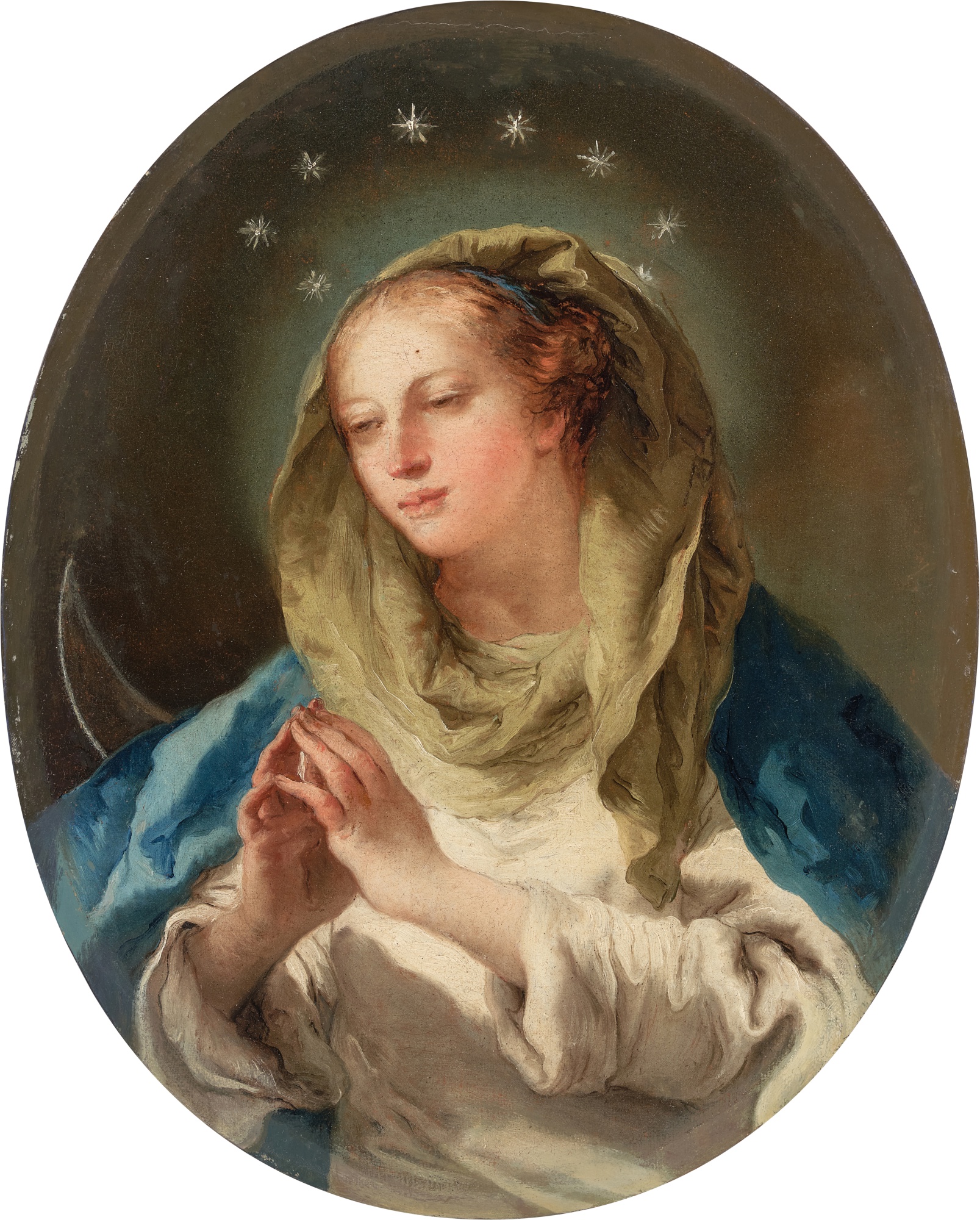
Giovanni Domenico Tiepolo
Immaculate Madonna
But Giandomenico's wit and his engagement with popular culture and theatrical life also invite comparison with Pietro Longhi, whose scenes of Venetian daily life captured a similar societal comedy. Francesco Guardi's atmospheric bravura and Antonio Canal's documentary precision were also part of the world Giandomenico inhabited. Beyond Venice, his printmaking sensibility resonates with that of Giovanni Battista Piranesi, whose etchings similarly transformed a technical medium into a vehicle for profound imaginative expression. These contexts help illuminate why Giandomenico, though long overshadowed by his luminous father, occupies a position that is genuinely irreplaceable.
The legacy of Giovanni Domenico Tiepolo is one of quiet persistence and expanding recognition. He outlived his father by more than three decades, dying in Venice in 1804, and spent those final years in a kind of creative solitude that produced some of his most personal and searching work. The great Punchinello drawings were largely a product of this period, works made not for a patron's ceiling or a church's altar but for the artist's own exploration. That spirit of personal inquiry, of an artist turning inward while the world outside changed beyond recognition, gives his late work a quality of extraordinary intimacy.
For collectors drawn to works that carry both historical significance and genuine emotional resonance, Giandomenico Tiepolo offers something rare: the pleasure of discovering an artist who was always more than the sum of his surroundings, and who rewards sustained attention with ever deepening rewards.
Explore books about Giovanni Domenico Tiepolo
Giandomenico Tiepolo: Master Draughtsman
James Byam Shaw
The Drawings of Giandomenico Tiepolo
Antonio Morassi
Giandomenico Tiepolo 1727-1804
Michael Levey
The Complete Drawings of the Tiepolo Family
James Byam Shaw
Tiepolo and His Contemporaries
Terisio Pignatti
Giovanni Domenico Tiepolo: Paintings and Drawings
Vittorio Sgarbi
Giandomenico Tiepolo: Life and Art
Keith Roberts