Giovanni Battista Piranesi
Piranesi: Rome's Most Magnificent Dreaming Eye
Artist Spotlight · The Collection Editorial
“I need to produce great ideas, and I believe that were I given the commission for a new building, I would act as follows.”
Giovanni Battista Piranesi, Parere su l'Architettura, 1765
Stand before one of Giovanni Battista Piranesi's etchings of Rome and something happens that rarely occurs in front of a work on paper: the architecture breathes. The stones seem to press forward out of the picture plane, the shadows deepen as you look, and a sense of tremendous, almost vertiginous scale overtakes you. It is no accident that Piranesi's Vedute di Roma, his great series of views of the Eternal City, continues to draw scholars, architects, designers, and passionate collectors to institutions from the Rijksmuseum in Amsterdam to the Avery Architectural and Fine Arts Library at Columbia University, where holdings of his prints are treated as primary documents of Western civilization. In recent years, renewed interest in the Grand Tour and its cultural legacy has placed Piranesi at the very center of conversations about how Europe learned to see, represent, and ultimately romanticize its own classical past.
Giovanni Battista Piranesi
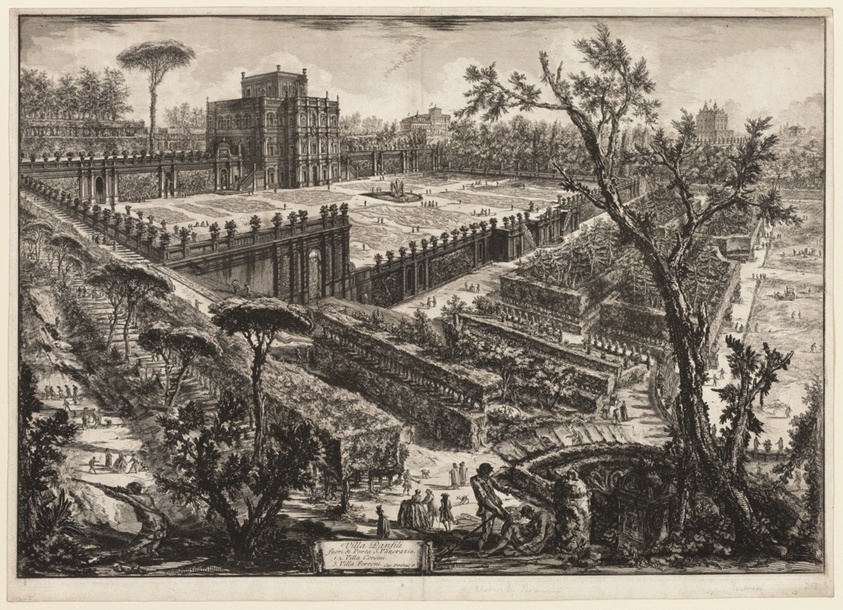
Villa Pamphili outside Porta S. Pancrazio, from Views of Rome, 1776
Giovanni Battista Piranesi was born in 1720 in Mogliano Veneto, a small town in the Republic of Venice, into a family with deep connections to the building trades. His uncle Matteo Lucchesi was a practicing architect and his brother Angelo became a Carthusian monk with architectural responsibilities, meaning that the grammar of construction, proportion, and spatial reasoning was woven into Piranesi's childhood. He trained initially as an architect in Venice, absorbing the theatrical spatial drama of the Venetian baroque and the rigorous scene painting traditions associated with the Bibiena family. This combination of structural thinking and theatrical vision would prove decisive: Piranesi would spend his life making prints that felt simultaneously like architectural documents and like staged performances of history.
His first journey to Rome came in 1740, when he traveled as a draughtsman in the retinue of Marco Foscarini, the Venetian ambassador to the papal court. Rome was a revelation. The scale of ancient ruins, the accumulation of centuries layered one upon another, the way republican monuments stood beside imperial triumphal arches and early Christian basilicas: all of this overwhelmed and then permanently reorganized his imagination. He studied etching under Giuseppe Vasi, the leading topographical printmaker in Rome, but quickly outgrew Vasi's measured, documentary approach.
Giovanni Battista Piranesi
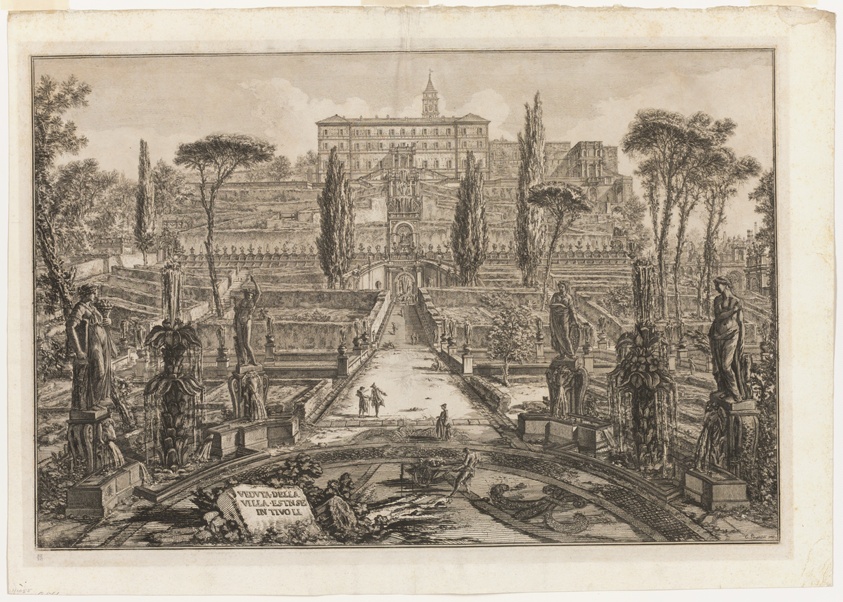
View of the Villa d'Este, Tivoli, from Views of Rome, 1773
Where Vasi recorded, Piranesi interpreted. Where Vasi charted, Piranesi dramatized. By the time he settled permanently in Rome in 1747, establishing himself on the Via del Corso and later near the Spanish Steps, he had developed a visual language entirely his own. The Vedute di Roma, begun in earnest in the late 1740s and continued with extraordinary productivity until his death in 1778, stands as the central achievement of his career.
These large format etchings, many of them towering over half a meter in height, depict Roman monuments with a combination of archaeological precision and atmospheric grandeur that no other artist of the period approached. Works such as the 1748 plate documenting the Arch of Titus alongside the Columns of the Temple of Jupiter Stator demonstrate his ability to compress multiple monuments into a single coherent composition without sacrificing topographical accuracy. The tiny figures he populates his scenes with, pilgrims, scholars, vendors, idling locals, serve not merely as staffage but as instruments of scale, making the surrounding architecture feel all the more immense and enduring. His views of Hadrian's Villa at Tivoli, including his remarkable rendering of the remains of the Praetorian Fort from 1770, show how sensitively he could treat ruins in a more pastoral, melancholic register, the stonework half reclaimed by vegetation, time made visible in every crumbling cornice.
![Giovanni Battista Piranesi — 1. Arch of Titus. 2. Villa Farnese. 3. Columns of the Temple of Jupiter Stator [the Supporter]. 4. Arch of Septimius Severus. 5. Temple of Peace, plate six from Some Views of Triumphal Arches and other Monuments](https://rtwaymdozgnhgluydsys.supabase.co/storage/v1/object/public/artwork-images/aic/131466/2e3af249-fec8-e6a8-3fd8-455c4e4bb261.jpg)
Giovanni Battista Piranesi
1. Arch of Titus. 2. Villa Farnese. 3. Columns of the Temple of Jupiter Stator [the Supporter]. 4. Arch of Septimius Severus. 5. Temple of Peace, plate six from Some Views of Triumphal Arches and other Monuments, 1748
The Tivoli subjects occupy a particularly beloved corner of his output. The waterfalls and temples of that hillside town above Rome gave Piranesi a subject where architecture and landscape merged completely, and he returned to it repeatedly across the decades. His 1761 view of the Temple of the Sibyl, his 1766 rendering of the Grand Cascade, and his later views of the small waterfall and rapids from 1769 form a suite of images that collectively defined how the picturesque landscape of the Roman campagna entered the European imagination. These were not merely souvenirs for Grand Tour travelers, though they served that function admirably.
They were arguments, passionately made in ink and acid, for the inexhaustible richness of Italian topography as a subject worthy of serious artistic attention. The Villa d'Este view from 1773 and the breathtaking Villa Pamphili plate of 1776 extended this sensibility to the great aristocratic garden landscapes outside the city walls, demonstrating that Piranesi's eye was as alert to cultivated nature as to ancient stone. For collectors, Piranesi presents an opportunity that is both historically significant and visually commanding in ways that few printmakers can match. His etchings were produced in multiple states over many years, and discerning the quality and period of impression is central to building a meaningful collection.
Giovanni Battista Piranesi
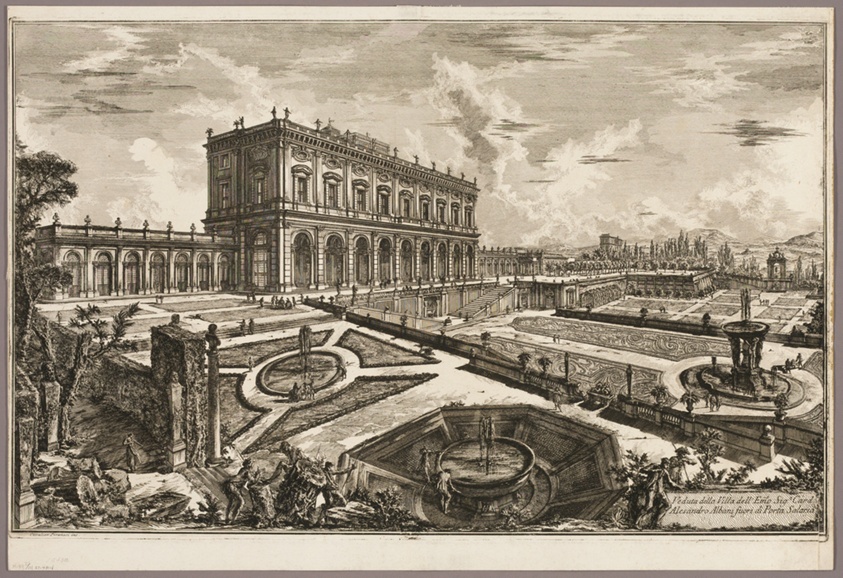
View of the Villa of His Eminence Cardinal Alessandro Albani, outside Porta Salaria, from Views of Rome, 1769
Early impressions, printed on the heavy ivory laid papers that appear consistently among his finest surviving sheets, tend to display a richness of tone and a crispness of line that later impressions, pulled from increasingly worn plates, cannot replicate. The works available through The Collection, printed on exactly these kinds of heavy ivory laid papers, represent precisely the quality that serious collectors and institutional curators seek. In the auction market, fine Piranesi impressions have commanded consistent and growing premiums at the major print sales at Christie's and Sotheby's in London and New York, reflecting both the enduring scholarly consensus around his importance and the sheer visual pleasure his work delivers in the room. To understand Piranesi fully it helps to place him in relationship to his contemporaries and to the broader tradition of architectural printmaking.
His closest predecessor in ambition was perhaps Giovanni Paolo Panini, the Roman vedutista whose painted views of ancient and modern Rome established a market and an appetite that Piranesi then dramatically expanded and transformed in the print medium. Across the Alps, his influence on architects was profound and immediate: John Soane in London, who collected Piranesi's prints avidly and whose house museum at Lincoln's Inn Fields remains one of the great monuments of Piranesean spatial thinking in built form, represents the most eloquent testimony to his reach. The French neoclassicists admired him, Robert Adam corresponded with him, and his theoretical writings, particularly the Della Magnificenza ed Architettura de' Romani of 1761, placed him in the center of heated debates about the relative merits of Greek and Roman architecture. Piranesi died in Rome in 1778 at the age of fifty eight, having produced a body of work that rivals any printmaker in the history of the medium for sustained ambition, technical invention, and sheer range.
His plates were continued and sold by his son Francesco, ensuring that his vision remained in circulation across the nineteenth century and into the twentieth. Today, as architectural culture rediscovers the expressive and poetic dimensions of its history, and as collectors increasingly seek works that operate with authority at the intersection of art and ideas, Piranesi's prints feel not like historical artifacts but like living arguments. They ask us to look harder, to think longer, and to recognize that the act of rendering a building or a ruin with passionate attention is itself a form of love. That is a proposition as compelling now as it was when he first set needle to copper in the workshops of Rome.
Explore books about Giovanni Battista Piranesi
Piranesi
Andrew Robison
Giovanni Battista Piranesi: The Complete Etchings
John Wilton-Ely
Piranesi as Architect and Designer
John Wilton-Ely
The Mind and Art of Giovanni Battista Piranesi
Hylton Thomas
Piranesi: Prints and Drawings
Arthur M. Hind
Giovanni Battista Piranesi: 1720-1778
Andrew Robison and Andrew Wilton
Piranesi: Architecture and Perspective
Manfredo Tafuri
The Prison Prints of Giovanni Battista Piranesi
Ficacci Maurizio