Giorgio Morandi
Giorgio Morandi: The Quiet Master of Everything
Artist Spotlight · The Collection Editorial
“Nothing is more abstract than reality.”
Giorgio Morandi
There is a particular room at the Museo Morandi in Bologna, housed within the Palazzo d'Accursio, where the full weight of Giorgio Morandi's achievement becomes impossible to deny. Bottle after bottle, vase after vase, arranged in gentle formations beneath a dusty northern Italian light. Visitors often go quiet here. The works are small, modest in scale, and yet they produce in the attentive viewer something close to the feeling of standing before a Vermeer or a Chardin.
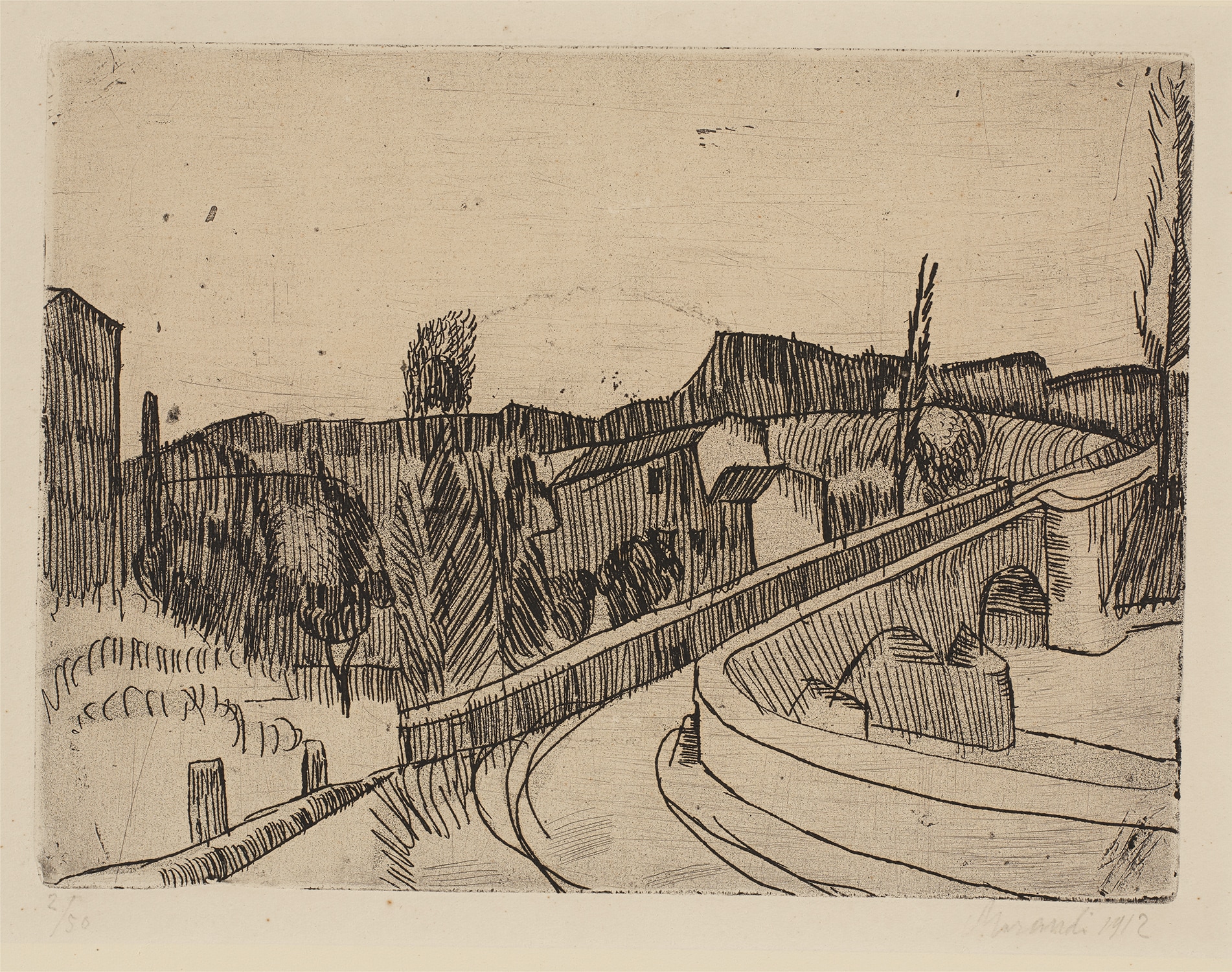
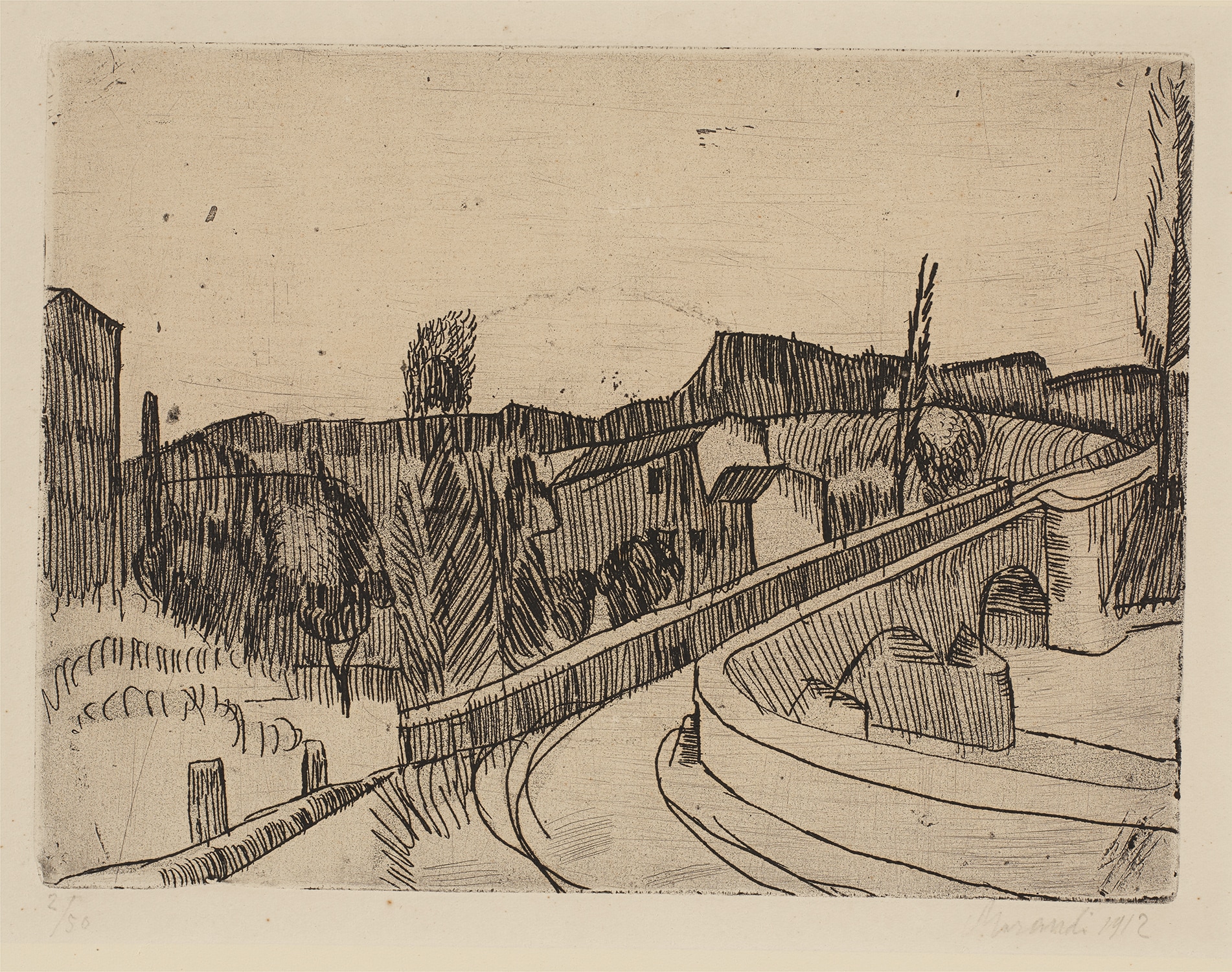
Giorgio Morandi
Il ponte sul Savena a Bologna (The Bridge Over the Savena in Bologna) (V. 1, C. 1)
That sense of profound concentration meeting profound generosity is rare in art at any moment in history, and it is the reason Morandi's reputation has done nothing but grow in the decades since his death in 1964. Giorgio Morandi was born in Bologna in 1890, the eldest of five children in a bourgeois family. His father was a merchant, and the household was respectable but not wealthy. When his father died in 1909, the teenage Morandi assumed responsibility for his mother and siblings, a weight he would carry quietly and without complaint for the rest of his life.
He enrolled at the Accademia di Belle Arti di Bologna in 1907 and trained there rigorously, absorbing the traditional disciplines of drawing and painting. Bologna, a city of arcaded streets and deliberate intellectual seriousness, suited his temperament entirely. He would live there, in the same apartment on Via Fondazza, for virtually his entire adult life, rarely traveling, rarely seeking the excitement of Rome or Paris or New York. His early formation was shaped by a hunger for the great masters he could not always easily reach in person.
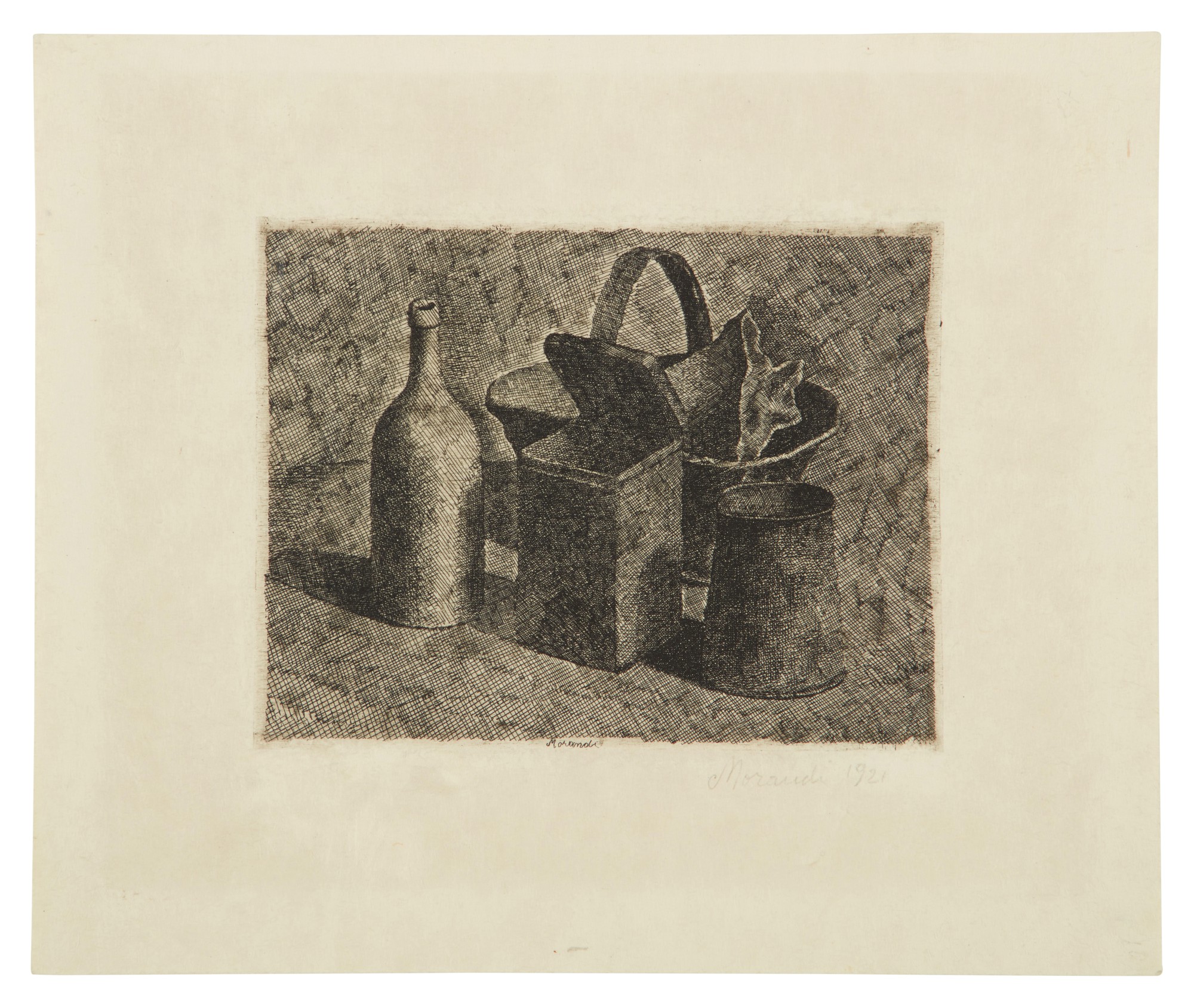
Giorgio Morandi
Natura morta con il cestino del pane (Lastra piccola) (Vitali 14)
He studied reproductions and catalogs obsessively, finding in Cézanne a guiding principle that form could be constructed through color and that every object contained within it a kind of structural truth waiting to be released. He was briefly drawn to Futurism around 1914, and for a short period his canvases crackle with that movement's fractured energy. But the fit was never quite right. Morandi was by nature more interested in slowing time down than in capturing its acceleration.
“I believe that nothing can be more abstract, more unreal, than what we actually see.”
Giorgio Morandi
By 1918 he had moved closer to the circles around Metaphysical painting, exhibiting alongside Giorgio de Chirico and Carlo Carrà, and the stillness and enigmatic quality of that movement left a lasting impression on his sensibility. The decisive turn came in the early 1920s when Morandi settled into what would become his lifelong subject: the still life. He gathered around himself a small population of objects, bottles, pitchers, bowls, boxes, and tin canisters, which he arranged and rearranged on a table in his studio with the care of a choreographer. These objects became his entire cast of characters.
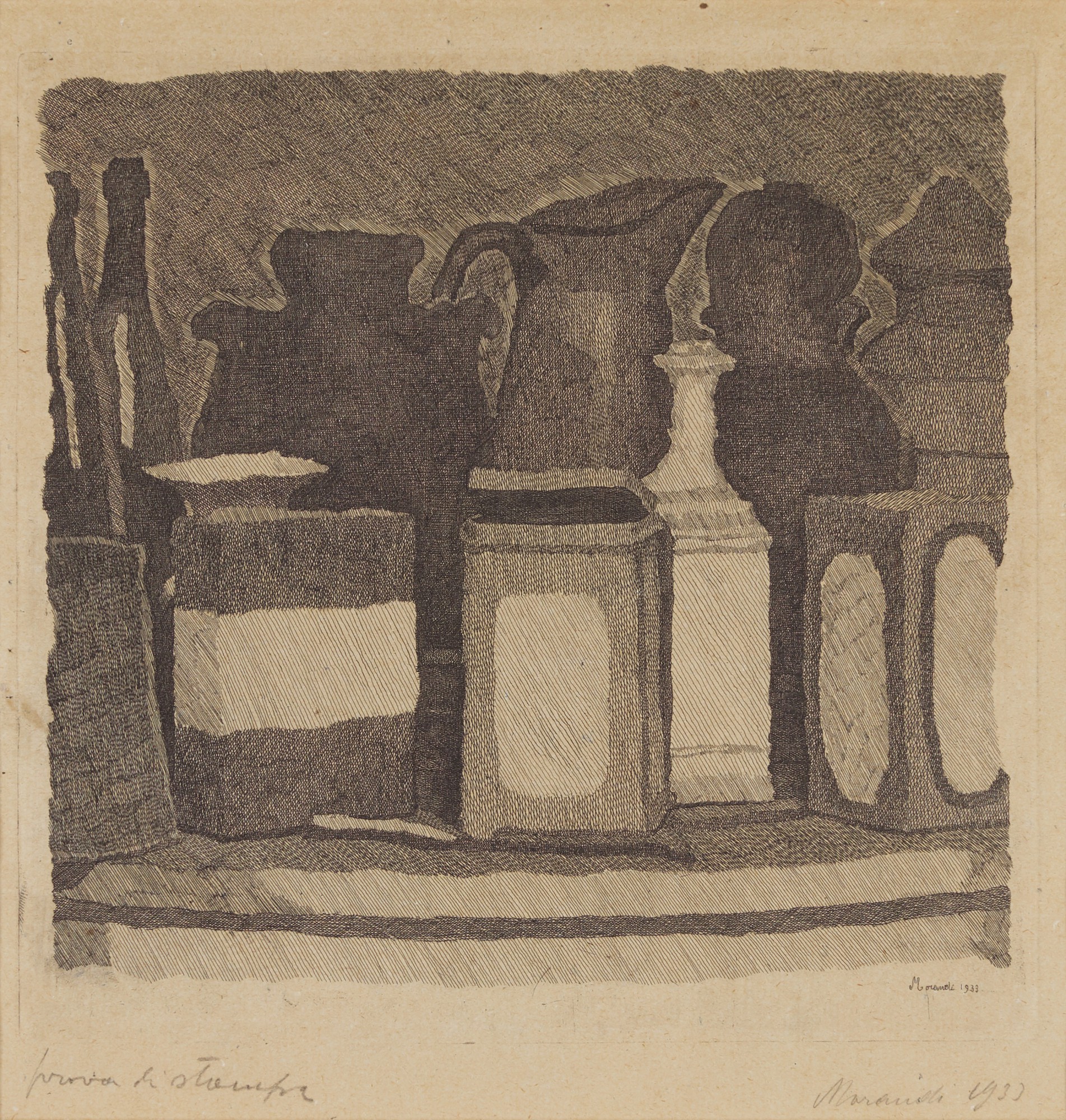
Giorgio Morandi
Natura morta (Vitali 101)
He dusted some of them with chalk or powder to neutralize their surfaces, to bring them into a closer relationship with one another tonally. He was interested not in what things are named or what they are used for, but in what they become when placed in proximity, in light, in silence. The resulting paintings and prints are among the most concentrated investigations of space and perception in the history of modern art. His palette of grays, ochres, dusty pinks, and warm whites became a language immediately recognizable as his own.
Among the works available to collectors through The Collection, several offer a privileged entry point into Morandi's world. His etchings, including works catalogued by Vitali, reward sustained attention in ways that differ fascinatingly from his paintings. The intaglio process suited his temperament: slow, deliberate, capable of infinite nuance in tone and texture. Works such as Natura morta con il cestino del pane and Natura morta con oggetti bianchi su fondo scuro demonstrate how he translated his spatial investigations into the language of printmaking with complete authority.
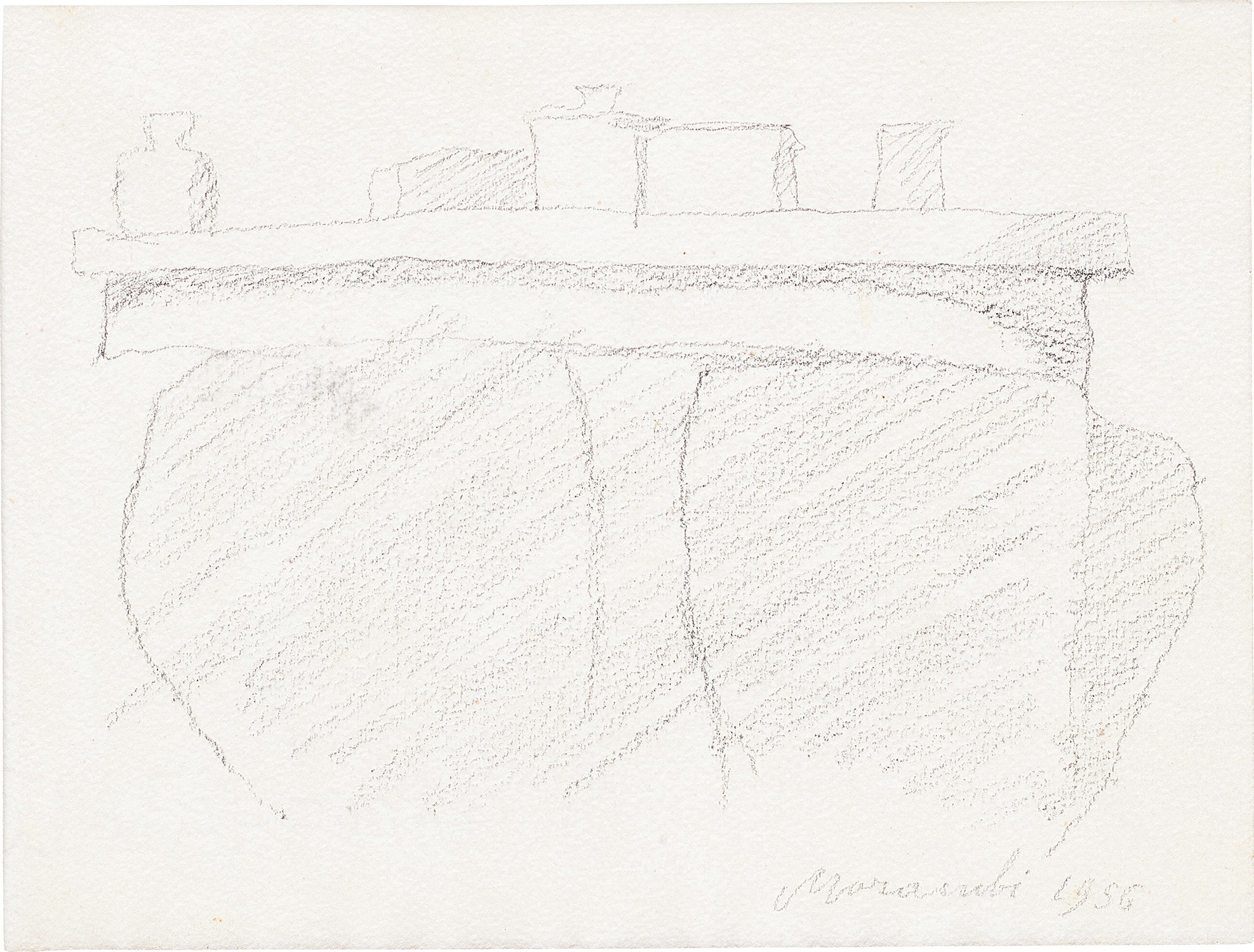
Giorgio Morandi
Natura morta, 1956
His early oil Natura morta con il busto di gesso from 1911 offers a glimpse of the young artist in the process of formation, the influence of Cézanne visible but the future Morandi already gathering in the shadows. The 1942 oil on canvas Natura morta belongs to a period of wartime withdrawal in which his work achieved a new austerity and emotional depth. On the collector market, Morandi occupies a position of unusual stability and prestige. His work has long attracted serious institutional and private collectors who understand that quality in art is not measured by scale or spectacle.
Major auction houses including Christie's and Sotheby's have seen his paintings achieve figures well into the millions, with notable results at international sales in London, New York, and Milan. His prints, which he made throughout his career in relatively limited numbers, are particularly valued for their accessibility and for the evidence they provide of his working process. Collectors drawn to Morandi tend to be those who have moved beyond novelty and toward depth. His work repays living with over time in a way that few artists can match.
In the broader context of art history, Morandi invites comparison with artists who share his commitment to an interior, meditative mode of seeing. Paul Cézanne is the obvious ancestor, and the debt is one Morandi acknowledged freely. Giorgio de Chirico and Carlo Carrà were fellow travelers in his early career. Further afield, one finds resonances with the work of Juan Gris in the structural clarity of his arrangements, and with Chardin in the seventeenth century French tradition of treating humble objects as worthy of the most serious pictorial attention.
Among his Italian contemporaries, his singular focus set him apart, and that singularity is precisely what has protected his reputation from the reversals of fashion that have diminished lesser figures. Morandi died in Bologna in June 1964, having rarely left his city and never having sought celebrity. He taught printmaking and etching at the Accademia di Belle Arti di Bologna for many years, a dedicated and respected teacher who shaped generations of Italian artists. His studio on Via Fondazza is now preserved as a museum.
His objects are still there, still arranged, still coated in their layer of quiet dust. The room is a place of pilgrimage for artists and collectors from around the world, and it communicates instantly what the paintings communicate slowly: that attention is itself a form of love, and that the greatest art is sometimes the art that asks the least of you and gives the most in return. To collect Morandi is to bring that quality of attention into your own home, and to discover, as collectors have for a century, that it changes everything around it.
Explore books about Giorgio Morandi
Giorgio Morandi
Lamberto Vitali
Morandi
Francesco Arcangeli
Giorgio Morandi: Catalogue Raisonné
Marilena Pasquali
Morandi: The Complete Etchings
Gabriele Simongini
Giorgio Morandi: Works on Paper
Daniele Lancioni
Morandi: Still Life and Landscape
Vittorio Fagone
Giorgio Morandi 1890-1964
Coen Edith