Giorgio De Chirico
Giorgio De Chirico, Dreamer of Waking Worlds
Artist Spotlight · The Collection Editorial
“To become truly immortal, a work of art must escape all human limits. Logic and common sense will only interfere.”
Giorgio De Chirico
Stand before a De Chirico canvas long enough and something quietly unsettling begins to happen. The shadows fall at the wrong angle. The arcades stretch too far. A figure turns away just as you notice it, and the piazza it inhabits feels less like a place than a memory of a place, filtered through fever or longing.
Giorgio De Chirico
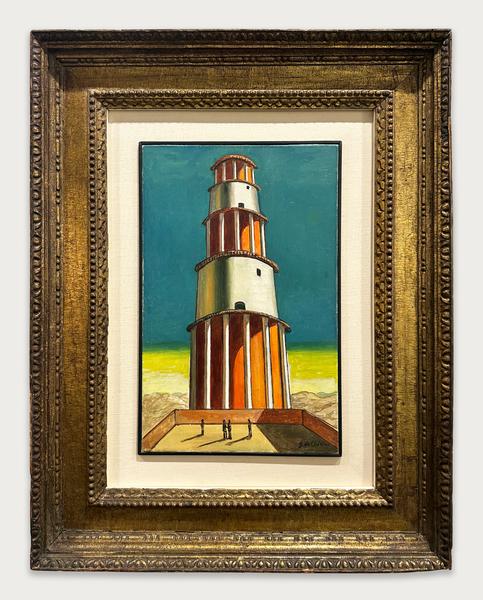
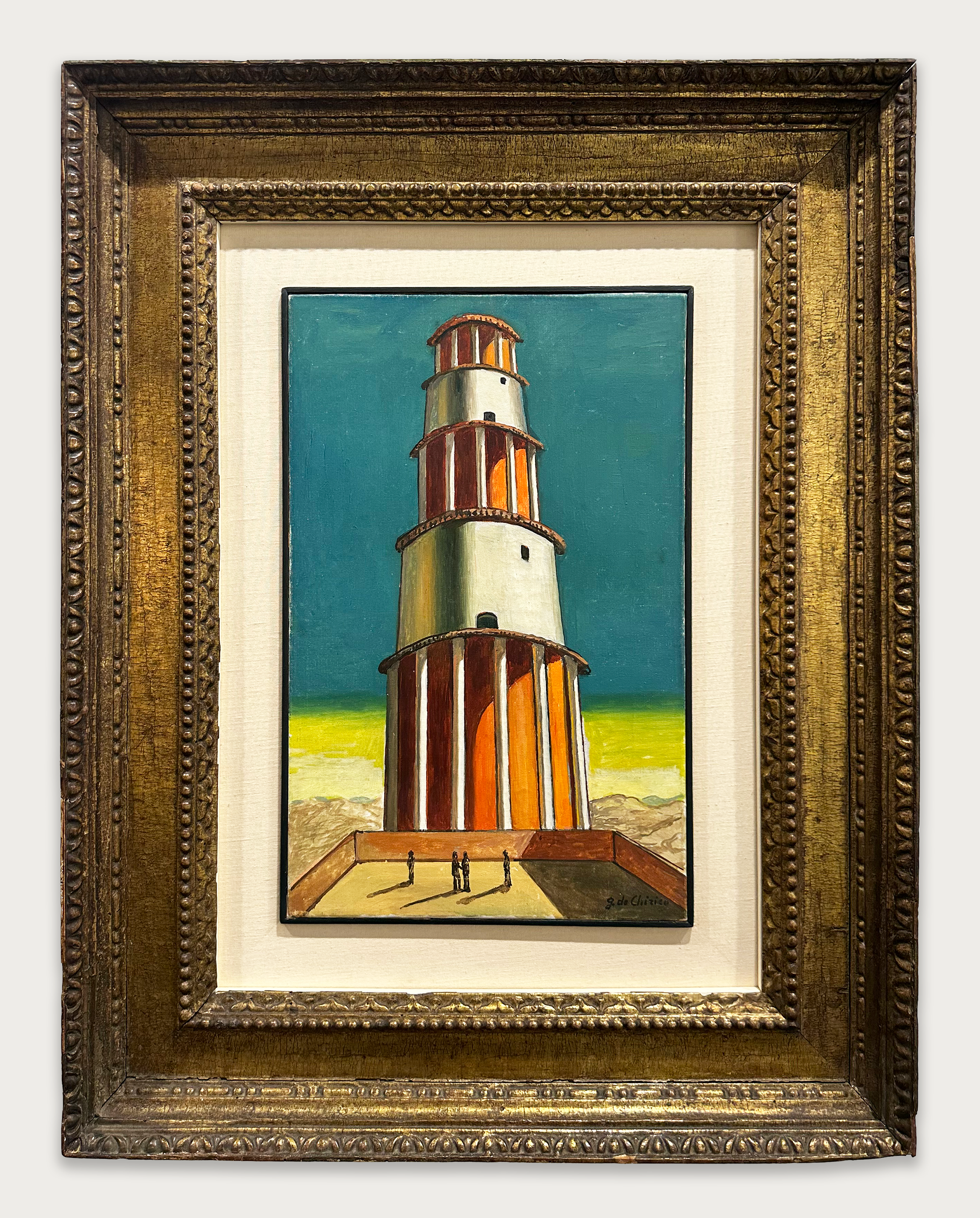
La Torre, 1966
This quality, so particular and so immediately recognizable, is precisely why museums and collectors continue to return to De Chirico's work with fresh urgency. The Centre Pompidou and the Museum of Modern Art in New York have both featured his paintings in major survey exhibitions examining the origins of Surrealism, and major auction houses including Christie's and Sotheby's have seen sustained collector interest in his paintings across multiple decades, with works regularly appearing in their marquee evening sales. His presence in contemporary cultural conversation feels not like nostalgia but like an ongoing discovery. Giorgio De Chirico was born on July 10, 1888, in Volos, Greece, to Italian parents.
His father was a railway engineer, and the family moved frequently across Greece before eventually settling in Germany and then Italy. This peripatetic childhood, spent amid the classical ruins of Athens, the industrial rhythms of railway towns, and the grand civic architecture of European cities, gave De Chirico an unusually layered visual vocabulary from an early age. He studied at the Athens Polytechnic and later enrolled at the Academy of Fine Arts in Munich, where he encountered the philosophy of Friedrich Nietzsche and Arthur Schopenhauer. Their ideas about the hidden enigma beneath the surface of ordinary life would prove formative, shaping not just his thinking but the very structure of his painted worlds.
De Chirico arrived in Paris in 1911 and quickly found himself at the center of the European avant garde. He exhibited at the Salon d'Automne, where his paintings attracted the admiring attention of Guillaume Apollinaire, the poet and critic who became an early and passionate champion of his work. Apollinaire coined the term "pittura metafisica" in conversation with De Chirico and the painter Carlo Carra, giving a name to what De Chirico had been doing almost intuitively. The movement was formally codified during the First World War, when De Chirico was stationed in Ferrara and collaborated closely with Carra and Giorgio Morandi.
“What shall I love if not the enigma?”
Giorgio De Chirico
The paintings from this period, featuring mannequin figures, geometric solids, maps, and fragments of classical statuary arranged in claustrophobic interiors, represent one of the most cohesive and philosophically coherent bodies of work in twentieth century art. The signature works from what is often called his "first Metaphysical period," roughly 1910 to 1920, remain the touchstone of his reputation. Paintings such as "The Nostalgia of the Infinite" and "The Disquieting Muses," both held in major institutional collections, establish the grammar of his visual language: deep perspectival recession, low afternoon light that casts elongated shadows, classical towers and arcades emptied of human presence, and isolated figures that seem to exist outside of time. These are not paintings about melancholy so much as paintings about the condition of seeing, about the strange gap between the familiar and the unknowable that opens up when you look at an ordinary thing too carefully.
The philosopher's equation runs underneath all of it: reality is a surface beneath which something else breathes. For collectors and the broader art market, De Chirico presents a rich and sometimes complex terrain. His career spanned nearly seven decades, and the work produced after his early Metaphysical masterpieces has long been the subject of debate. In his later career, De Chirico returned repeatedly to neoclassical themes and also produced a significant body of work in a more traditional figurative mode.
Works from the canonical early period command the highest prices and the deepest institutional interest, but there is a growing appreciation among sophisticated collectors for the later paintings, which demonstrate remarkable technical facility and a playful, self aware relationship to his own mythology. "La Torre," painted in 1966 and available on The Collection, is a compelling example of this mature vision. The tower, a recurring motif throughout his career, carries the full weight of his iconography: it is architectural, solitary, and freighted with an atmosphere that sits precisely between the real and the imagined. De Chirico's relationship to the Surrealists is essential context for any serious engagement with his legacy.
Andre Breton and the Paris Surrealists were electrified by his early work, seeing in it a pictorial method for accessing the unconscious that preceded and in many ways exceeded their own experiments. Salvador Dali acknowledged his debt to De Chirico openly, and the influence can be traced in Dali's desert landscapes and dislocated architectural forms. Rene Magritte's practice of placing familiar objects in unfamiliar contexts owes an equally direct debt. Max Ernst, Paul Delvaux, and even the American Edward Hopper, in his own way, absorbed lessons from De Chirico's treatment of light, emptiness, and urban architecture.
To collect De Chirico is to hold a key to one of the most generative lineages in modern art, a lineage that runs from the early twentieth century directly into contemporary painting and photography. What collectors tend to respond to in De Chirico, beyond the art historical significance, is the intimacy of the experience his paintings create. There is something deeply personal about standing before one of his piazzas. The emptiness is not cold; it is inviting, even tender.
He described his own practice as the discovery of "the enigma of sudden revelation," and that phrase captures something real about the viewing experience. His work rewards patience and private attention, which makes it ideally suited to a life lived alongside art rather than simply adjacent to it. Pieces from across his career appear regularly at auction and through private dealers, and institutions from the Museum of Metaphysical Art in Ferrara to the Fondazione Giorgio e Isa de Chirico in Rome continue to steward his legacy with care and scholarly rigor. De Chirico died in Rome on November 20, 1978, at the age of ninety, having outlived most of the movements he helped to inspire and having watched his early work become canonical within his own lifetime.
His legacy is not a closed chapter but an open question, one that each generation of painters, collectors, and viewers answers differently. The towers still stand. The shadows still fall wrong. The figure in the distance is still turning away, and you still find yourself wanting to call after it.
Explore books about Giorgio De Chirico
Giorgio de Chirico: The Memoirs of My Life
Giorgio de Chirico
Giorgio de Chirico
James Thrall Soby

Giorgio de Chirico and the Myth of Ariadne
Wieland Schmied
De Chirico: The Enigma of the Hour
Paolo Baldacci

Giorgio de Chirico: Museum of Modern Art
Alfred H. Barr Jr.
Giorgio de Chirico: 1888-1919
Günter Metken
The Complete Paintings of Giorgio de Chirico
Maurizio Fagiolo dell'Arco

Giorgio de Chirico: His Life and Work
Isabella Far