Gillian Ayres
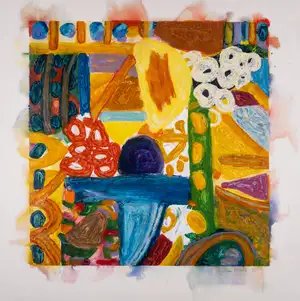
Gillian Ayres: Joy Rendered in Pure Paint
Artist Spotlight · The Collection Editorial
“I want the paintings to be pleasurable. I want people to feel that sense of joy.”
Gillian Ayres, interview
There are painters who work within the tradition of abstraction, and then there are painters who seem to detonate it from within, releasing something primal and radiant in the process. Gillian Ayres belonged emphatically to the second category. When the Tate staged a major survey of her work and the Royal Academy recognised her among the defining figures of British post war painting, critics reached repeatedly for the same words: exuberance, generosity, freedom. These are not incidental qualities in her canvases.
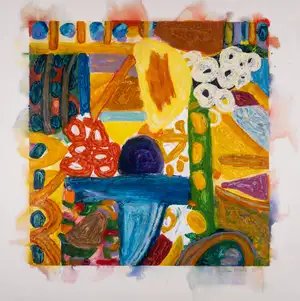
Gillian Ayres
Sikar II (not in Cristea)
They are the substance of them. To stand before an Ayres painting of any period is to feel the full force of a mind that refused, categorically, to be cautious. Born in Barnes, south west London, in 1930, Ayres studied at Camberwell School of Art and then at the Central School of Arts and Crafts, where she encountered an atmosphere charged with the possibilities of European modernism and American abstraction. The New York School was beginning to reach British shores in reproductions and rumour, and the generation that trained alongside Ayres absorbed its lessons with urgency.
She began teaching at the Bath Academy of Art in Corsham in 1959, an institution that became something of a crucible for adventurous British abstraction, and it was here that her commitment to painting as a fully physical, fully intuitive act deepened into something irreversible. Her earliest significant works, produced in the late 1950s and into the 1960s, placed her squarely within the orbit of British abstract painting at its most experimental. She worked with household paint on hessian and hardboard, building surfaces that were raw and immediate, closer to the spirit of action painting than to anything that felt European or restrained. A work such as her 1957 piece on burlap, which used household paint to create broad, overlapping fields of colour and gesture, announced an artist entirely uninterested in refinement for its own sake.
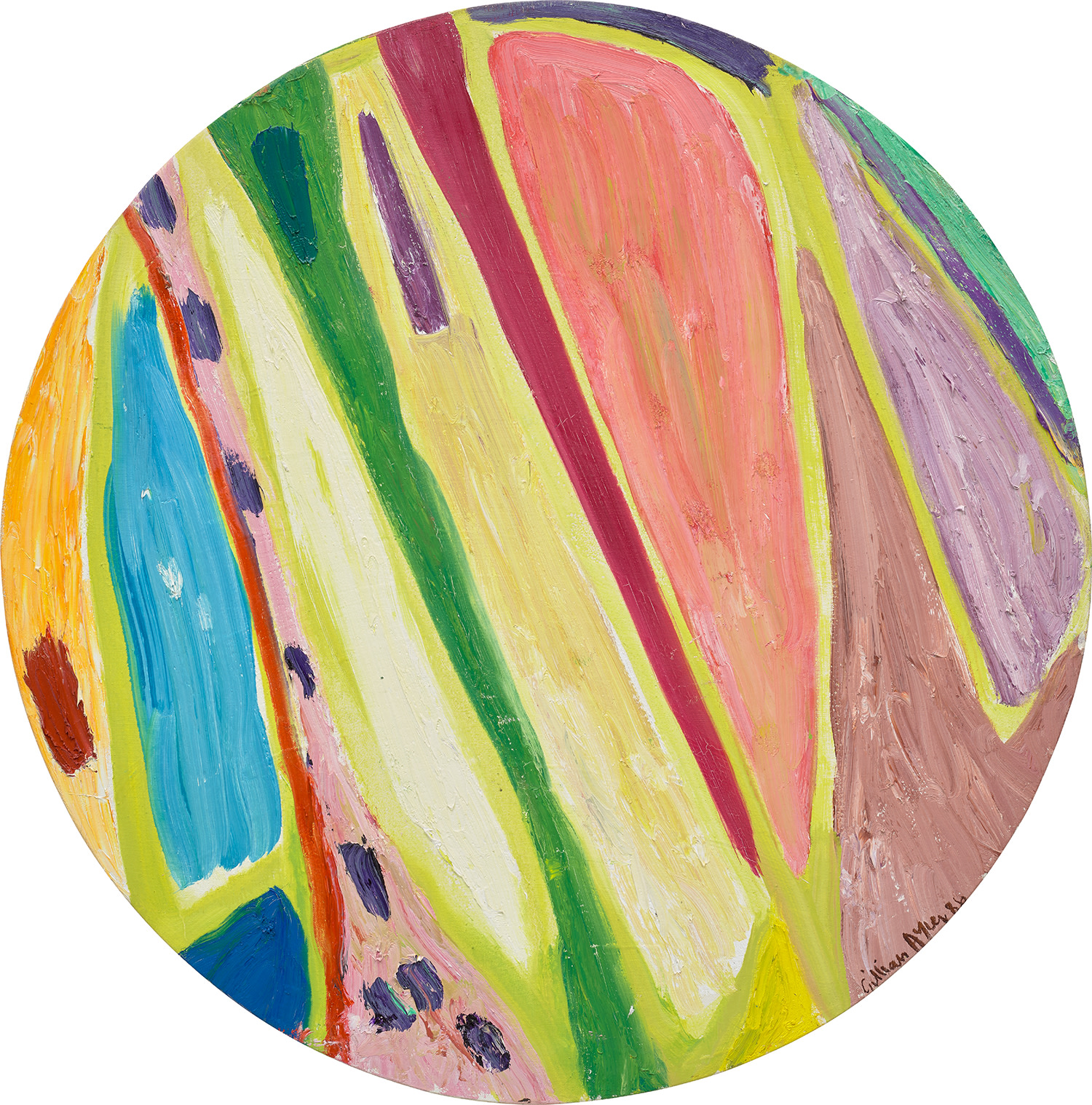
Gillian Ayres
The Nut Brown Maid, 1986
She was part of the post war avant garde that included artists such as Patrick Heron, Terry Frost, and William Turnbull, though her voice was always distinctly her own, more anarchic in its pleasures, less interested in the measured organisation of pictorial space. The evolution of her practice over the following decades was not a movement toward greater control but rather toward greater richness. From the 1980s onward, Ayres began working with oil and alkyd paints applied with palette knives and large brushes to produce surfaces of extraordinary density, the paint built up into jewelled, three dimensional configurations that caught light and seemed almost to breathe. She moved to a farmhouse in Wales and later to Cornwall, locations that gave her the space to work on an ambitious scale and at a physical remove from the art world's centre of gravity.
“Colour is the most powerful thing in painting. More powerful than drawing, more powerful than composition.”
Gillian Ayres
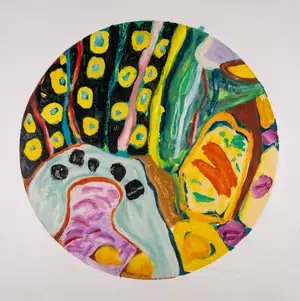
These were not paintings made to please a market or satisfy a critical consensus. They were made in something closer to a state of necessity. Among the works that collectors and curators return to most often is her canvas "The Nut Brown Maid" from 1986, a painting whose title gestures toward English folk tradition while the surface itself belongs to no tradition at all, a tumbling, colliding world of colour and form that feels simultaneously ancient and utterly contemporary. Her printmaking practice, developed in sustained collaboration with master printer Jack Shirreff at 107 Workshop in Wiltshire, produced a body of work in etching with carborundum and hand colouring that translated her painterly instincts into another register without diminishing them.
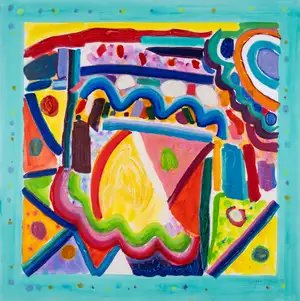
Gillian Ayres
Blueberry Hill (Cristea 13)
Works such as "Sikar II," "Juno and the Paycock," "Blueberry Hill," and "Someday" from editions produced between 1992 and 2010 and published through Alan Cristea Gallery in London are remarkable objects: the hand colouring in acrylic brings each print so close to painting that the distinction becomes philosophical rather than practical. These are not reproductions of ideas. They are ideas in their own right. From a collecting perspective, Ayres occupies a position of genuine significance.
Her paintings have appeared at major London auctions and are held in the permanent collections of the Tate, the Arts Council of Great Britain, and numerous regional British museums. The prints produced with Shirreff at 107 Workshop are particularly compelling for collectors approaching her work for the first time, precisely because the hand colouring makes each impression unique and because the scale, many sheets exceeding a metre in either dimension, carries the full ambition of her painted surfaces. Printer's proofs and proofs aside from edition, which appear with some regularity at auction, offer an additional layer of rarity and provenance, their connection to the workshop process itself a form of intimacy with how the work came to exist. What to look for is colour that feels genuinely uncompromised and surfaces where the hand colouring integrates with the printed matrix rather than sitting on top of it.
Gillian Ayres
Juno and the Paycock (not in Cristea)
Contextually, Ayres belongs to a lineage of British painters who understood abstraction not as a language of reduction but as one of expansion. Patrick Heron's colour fields, Peter Lanyon's physical engagement with landscape, and the lyrical abstraction of Roger Hilton all share certain atmospheric conditions with her work, though Ayres pushed further into what might be called the decorative in its highest sense, the sense intended by Matisse when he spoke of the art of balance and of purity. American collectors drawn to the work of Helen Frankenthaler or Joan Mitchell will find in Ayres a British counterpart of equal stature and substantially different sensibility, less interested in the elegiac and more committed to something closer to celebration. Gillian Ayres died in 2018, in her late eighties, having painted to the very end with an energy that made the word prolific feel insufficient.
Her legacy is not simply a body of work, though that body is large and varied and full of surprises. It is also a demonstration that painting, pursued with sufficient conviction and without concession to fashion, can accumulate authority across decades and arrive at something permanent. In a period when British abstraction is being reconsidered with fresh eyes, when the contributions of her generation are being written into art history with the seriousness they always deserved, Ayres stands as a reminder of what is possible when a painter trusts colour, trusts the body, and trusts the paint itself to know what to do.
Explore books about Gillian Ayres
Gillian Ayres
Andrew Causey
Gillian Ayres: Paintings 1956-1989
Lynne Cooke
Gillian Ayres: A Retrospective
Various
Gillian Ayres: Recent Paintings
Michael Peppiatt
Gillian Ayres: Works on Paper
Various