Gilbert
Gilbert: A Life Lived As Art
Artist Spotlight · The Collection Editorial
“We want our art to speak across the barriers of knowledge directly to people about their life, not about their knowledge of art.”
Gilbert and George, interview statement
There are few partnerships in the history of contemporary art as enduring, as formally rigorous, or as genuinely provocative as that of Gilbert and George. When the Tate Modern mounted its landmark retrospective of their work in 2007, audiences encountered not merely a survey of four decades of art making but something closer to a total world view, a philosophy made visible in monumental grids of photographic color and unflinching human imagery. Gilbert, born Gilbert Proesch in 1943 in the Dolomite mountains of South Tyrol, Italy, has spent more than half a century in creative union with George Passmore, and the fruits of that union remain among the most intellectually compelling and visually arresting bodies of work produced in the postwar era. Gilbert grew up in a remote, Catholic, rural community in northern Italy, and came of age speaking Ladin, a Rhaeto Romance language native to the valleys of the Dolomites.
Gilbert
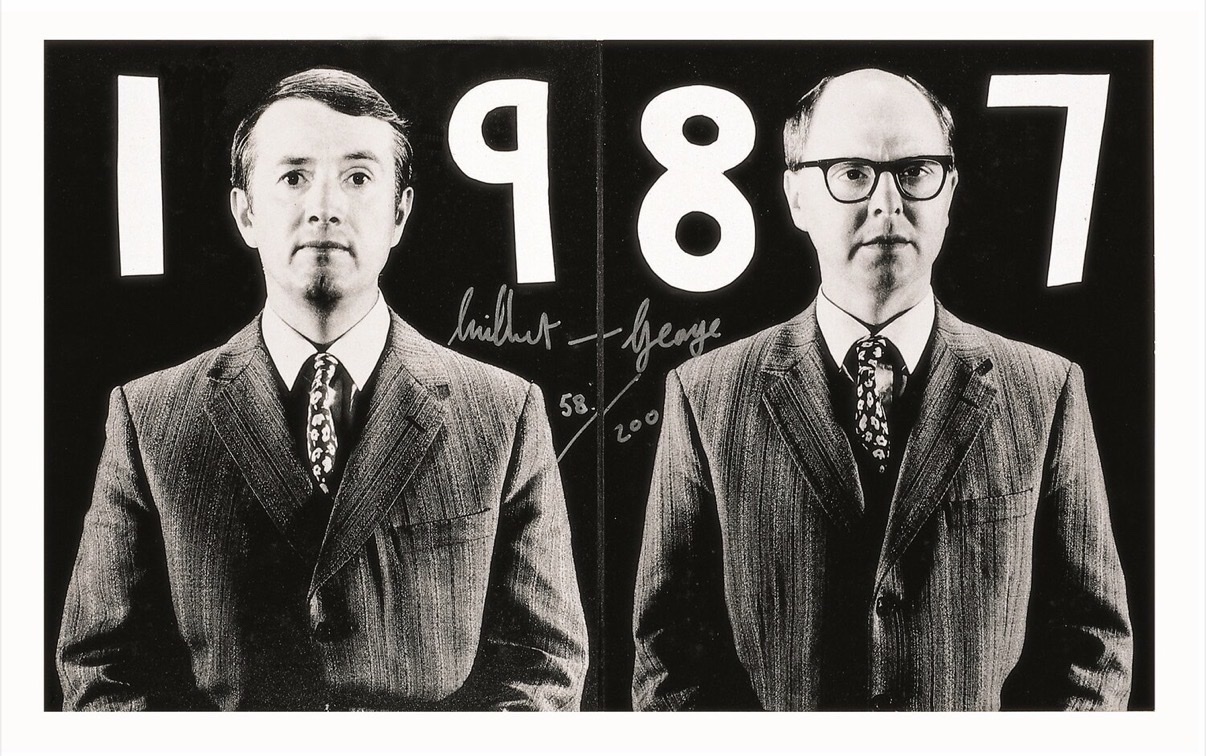
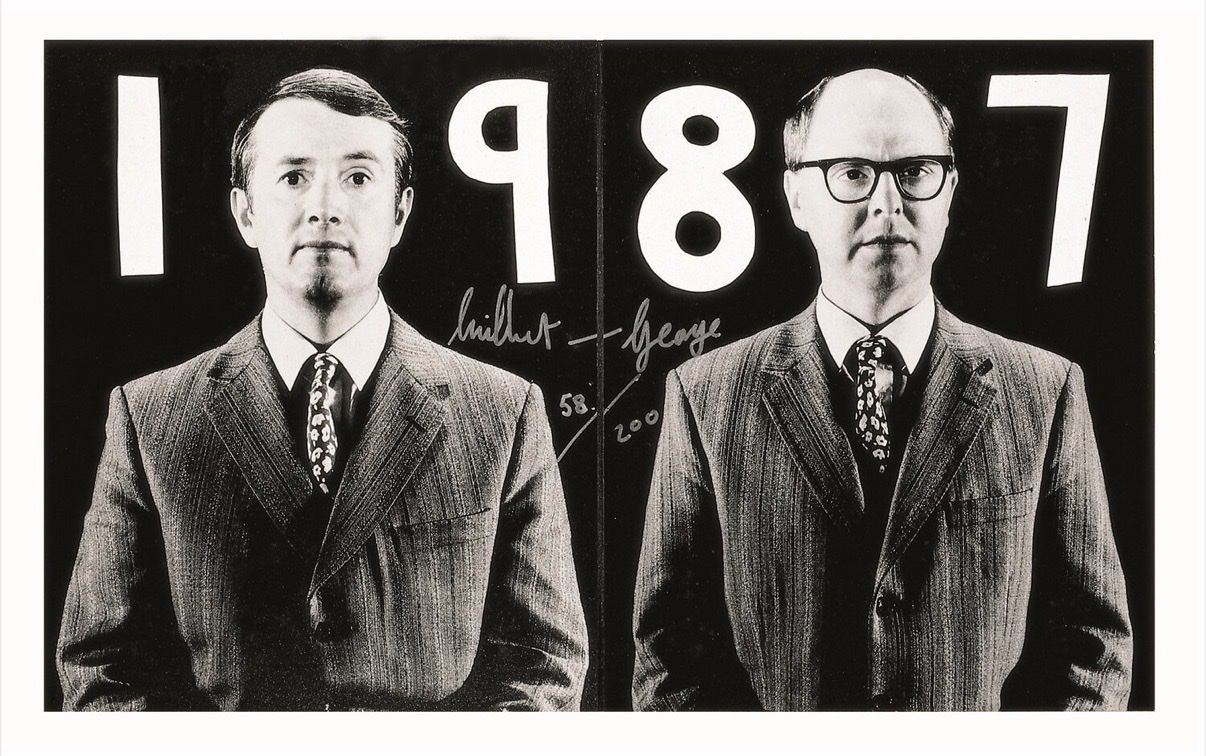
Parkett Edition No. 14, 1987
He studied at the Wolkenstein School of Art and later at the Hallein School of Art in Austria before traveling to Munich and then to London, where he enrolled at the Oxford School of Art and ultimately at Saint Martins School of Art. It was at Saint Martins, in 1967, that he met George Passmore, a fellow student from Devon. Their creative and personal partnership began almost immediately, and they have lived and worked together in Fournier Street in Spitalfields, East London, ever since. The East End, with its layered immigrant histories and its proximity to both the City and the margins of English life, would become the primary landscape of their art.
The early years of their practice were defined by a radical proposition: that they themselves were the artwork. As Living Sculptures, Gilbert and George performed and presented their own bodies as aesthetic objects, most famously in Singing Sculpture, first shown at the Nigel Greenwood Gallery in London in 1969 and later performed across Europe and the United States. The two men, faces painted in gold, moved with mechanical precision atop a table while a recording of the old music hall song Underneath the Arches played on a loop. The work was both deadpan and deeply poetic, drawing on the traditions of British working class entertainment while making a serious claim for performance as a primary art form.
Gilbert
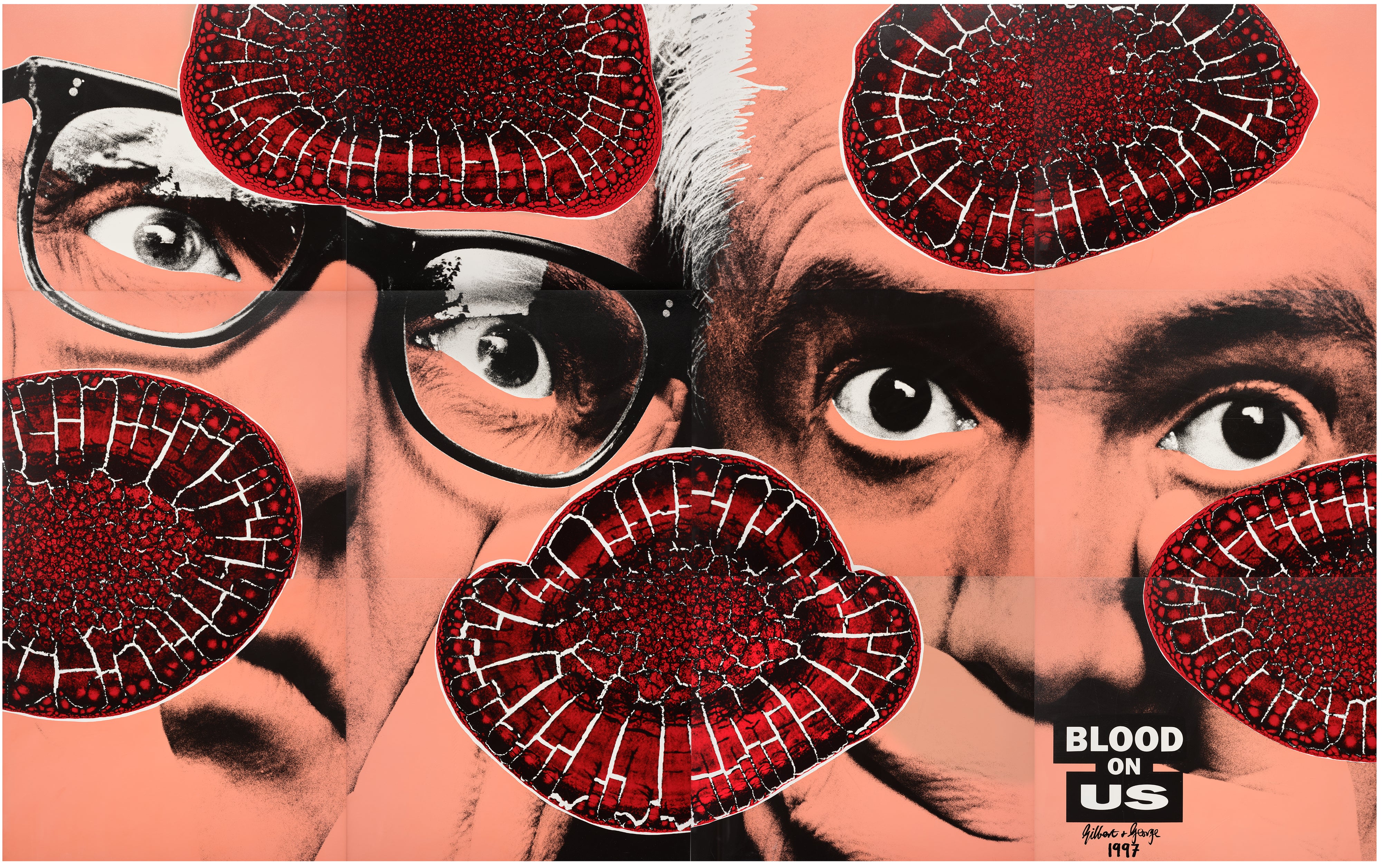
Blood on Us
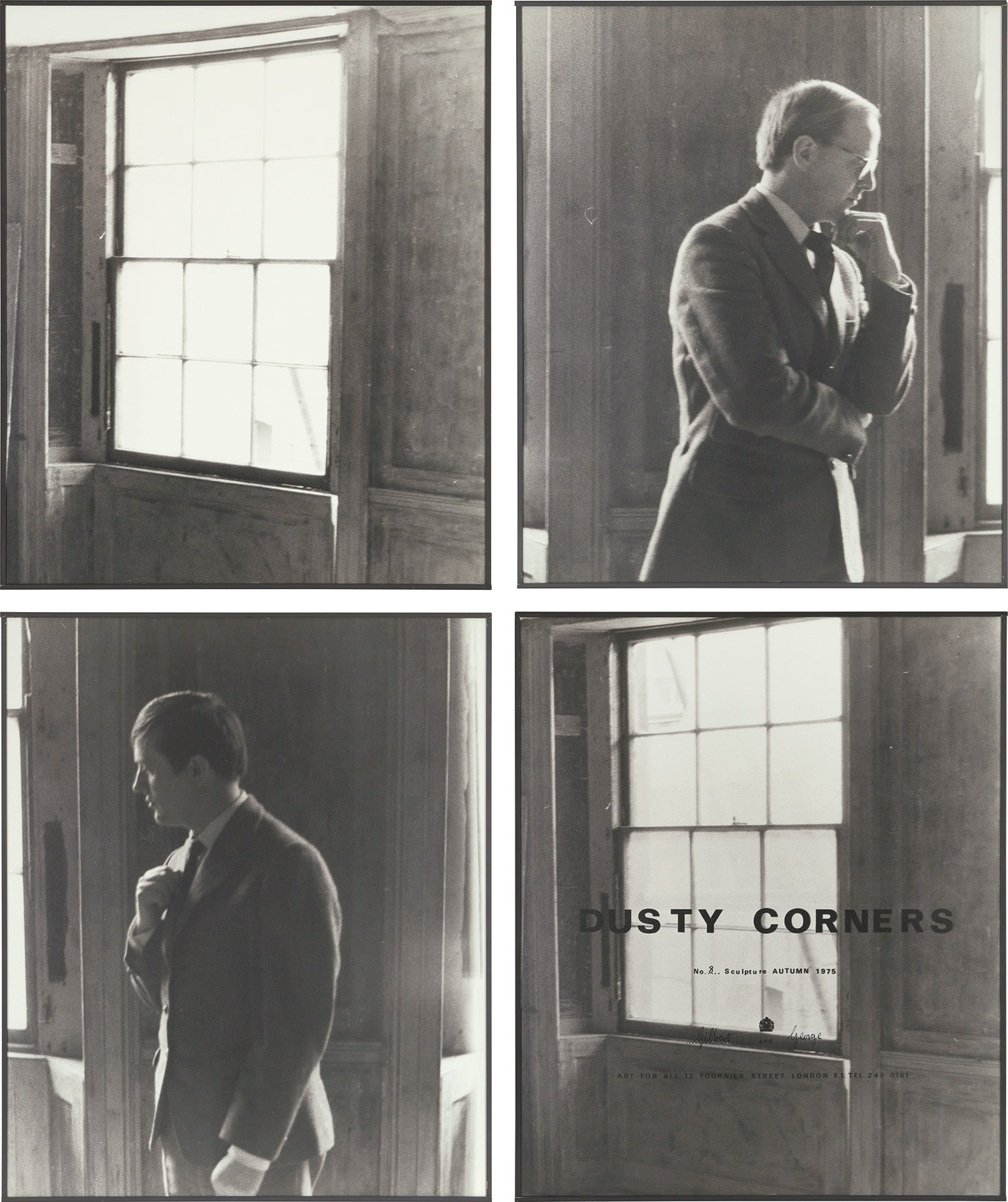
This was art that refused the separation between artist and artwork, between life and making. Through the 1970s, Gilbert and George developed their practice of making large scale photographic works, bringing together imagery drawn from their immediate environment, their own bodies, and the textures of everyday urban life. Works from the Dusty Corners series of 1975, including Dusty Corners No. 8 and Dusty Corners No.
“We are artists who have chosen the most radical proposition: to be the art.”
Gilbert and George
17, show this period at its most quietly revelatory. Rendered in gelatin silver prints, mounted in the artists own frames and arranged in four part compositions, these works transform the overlooked and the mundane into something ceremonial. The artist frame, a recurring element across many of their works, is itself a statement: the act of framing is an act of artistic authorship, and every border is a choice. The 1980s brought a new intensity and a broader palette, both literally and figuratively.
Gilbert
Dusty Corners No. 8, 1975
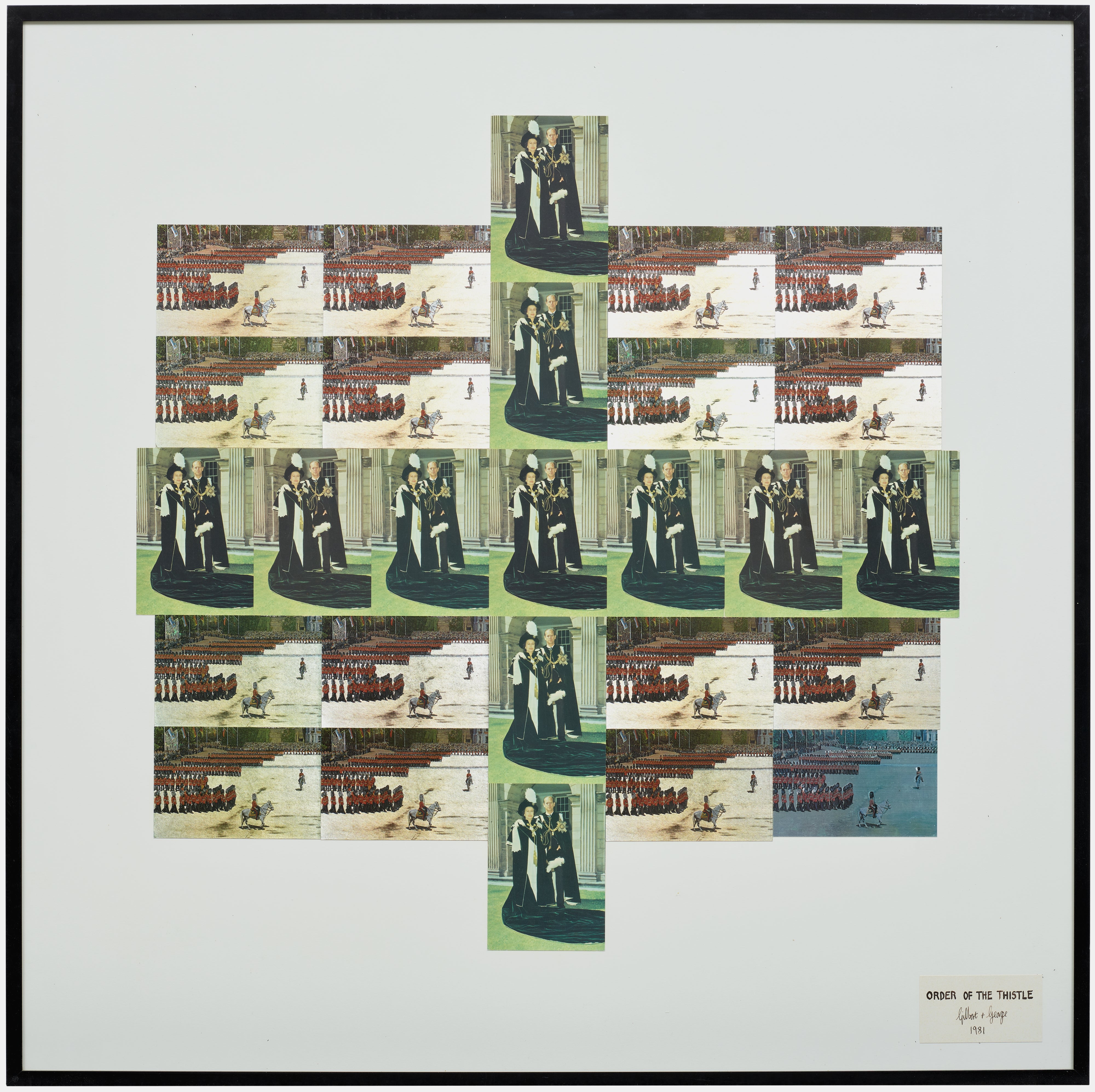
Faith Curse from 1982, a twenty part work in hand dyed gelatin silver prints presented in artists frames, exemplifies the decade's output: richly chromatic, symbolically loaded, and rooted in a confrontational engagement with religion, nationalism, and the body. The Order of the Thistle from 1981 similarly draws on the iconography of British identity, holding it up for inspection without easy resolution. These works announced Gilbert and George as artists working squarely in the tradition of the European avant garde while remaining unmistakably, stubbornly English in their preoccupations. The decade also saw them move toward increasingly large scale production, with monumental grid works that would eventually fill entire gallery walls.
By the 1990s and into the 2000s, works such as Spunk Mooning and Blood on Us demonstrated a willingness to engage directly with bodily fluids, sexuality, and mortality in ways that continued to unsettle and galvanize in equal measure. These are not works that seek approval. They seek engagement, and they demand that the viewer confront not only the image but their own response to it. The Shit and Piss series extended this logic further, insisting on the full range of human biological experience as legitimate subject matter for high art.
Gilbert
The Order Of The Thistle, 1981
In doing so, Gilbert and George placed themselves in a lineage that runs from Francis Bacon through Cindy Sherman and beyond, artists for whom the body is never incidental but always the central site of meaning. For collectors, works by Gilbert and George occupy a singular position in the market. Their output is disciplined and consistent in its formal logic, making individual works legible both as standalone objects and as part of a larger ongoing project. The gelatin silver print works from the 1970s and early 1980s are particularly prized for their material quality and historical significance, representing the foundational period of a practice that would grow to global prominence.
Works such as the Parkett Edition No. 14 from 1987 offer points of entry for collectors drawn to the breadth of their collaboration with international art publishing and institutions. The artists relationship with their audience has always been democratic in aspiration if not always in reception, and that tension gives their market a genuine vitality. Major examples have appeared at Christies and Sothebys across multiple seasons, with strong results reflecting sustained institutional and private interest.
The artists who come to mind alongside Gilbert and George are those who similarly collapsed the distance between art and life, between the personal and the political. Joseph Beuys, with his expanded conception of social sculpture, is an obvious reference point. So too are the photographers who turned documentary instincts toward the self and the social body, from Diane Arbus to Wolfgang Tillmans. Among British artists, the work of David Hockney in its engagement with queer identity and everyday beauty offers a useful parallel, as does the confrontational wit of the YBA generation, for whom Gilbert and George were undeniable forebears and, in some cases, direct influences.
What Gilbert has given to art, alongside his partner, is nothing less than a sustained argument for the total artwork, for a practice in which every element, the body, the frame, the street, the faith, the shame, the humor, is subject to aesthetic transformation. Across more than five decades, in works that range from intimate postal sculptures to room filling chromogenic grids, he has demonstrated that art need not choose between beauty and provocation, between form and content, between the local and the universal. For those who live with these works, they are not merely acquisitions but companions in thinking, objects that continue to ask questions long after the viewer has left the room.
Explore books about Gilbert
Gilbert and George: The Complete Pictures 1971-2005
Gilbert and George with text by museum curators
Gilbert and George
Carter Ratcliff
The Art of Gilbert and George
various contributors
Gilbert and George: A Portrait of the Artists
Andrew Graham-Dixon
Gilbert and George: Art and Ethics
Robert Pincus-Witten