Gerald Laing
Gerald Laing: Pop Art's Transatlantic True Believer
Artist Spotlight · The Collection Editorial
Picture New York in 1963, humming with the electricity of a cultural revolution. Andy Warhol was silkscreening Marilyn Monroe's face into mythology, Roy Lichtenstein was blowing up comic book panels to gallery scale, and arriving into this charged atmosphere was a young British painter named Gerald Laing, freshly graduated from St Martin's School of Art in London. He had come not as a follower but as a peer, a fellow traveler who had independently arrived at many of the same visual conclusions as the Americans around him, and who would go on to forge one of the most distinctive and genuinely transatlantic bodies of work the Pop Art movement ever produced. Laing was born in Newcastle upon Tyne in 1936, and his early life was shaped by the particular discipline of a British military education.
Gerald Laing
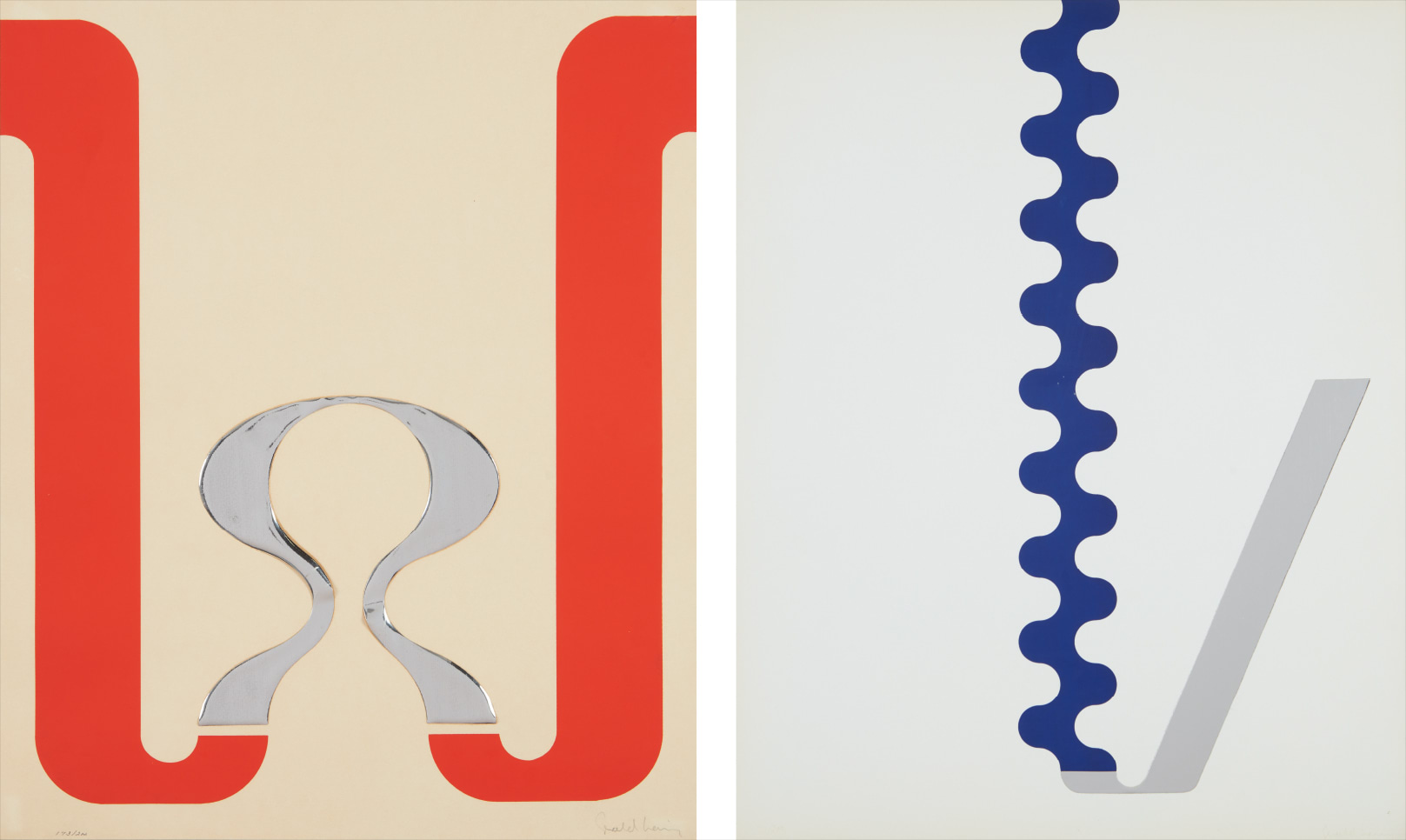
Compact, from 11 Pop Artists, Volume I; and Slide, from 11 Pop Artists, Volume II
He served as an officer in the British Army before enrolling at St Martin's in 1960, and that combination of rigorous structure and late artistic awakening gave his approach a quality that set him apart from his contemporaries. He was not a art school prodigy who had grown up sketching in the margins of textbooks. He came to painting with intention, with the deliberate focus of someone who had chosen it consciously and completely. That sense of purpose would remain a defining characteristic throughout his career.
At St Martin's and in the years immediately following, Laing developed the visual language that would make his reputation. Working from photographic source material clipped from newspapers and magazines, he translated images of parachutists falling through open sky, racing drivers gripping their machines through tight bends, and the faces of celebrities into monumental canvases built from ordered grids of Ben Day dots. These were not merely references to mass media imagery but a genuine interrogation of how photographs mediated modern experience, how the printed dot, the unit of mechanical reproduction, had become the atom of contemporary visual life. His large scale works from this period have a physical presence that photographs cannot fully communicate.
Gerald Laing
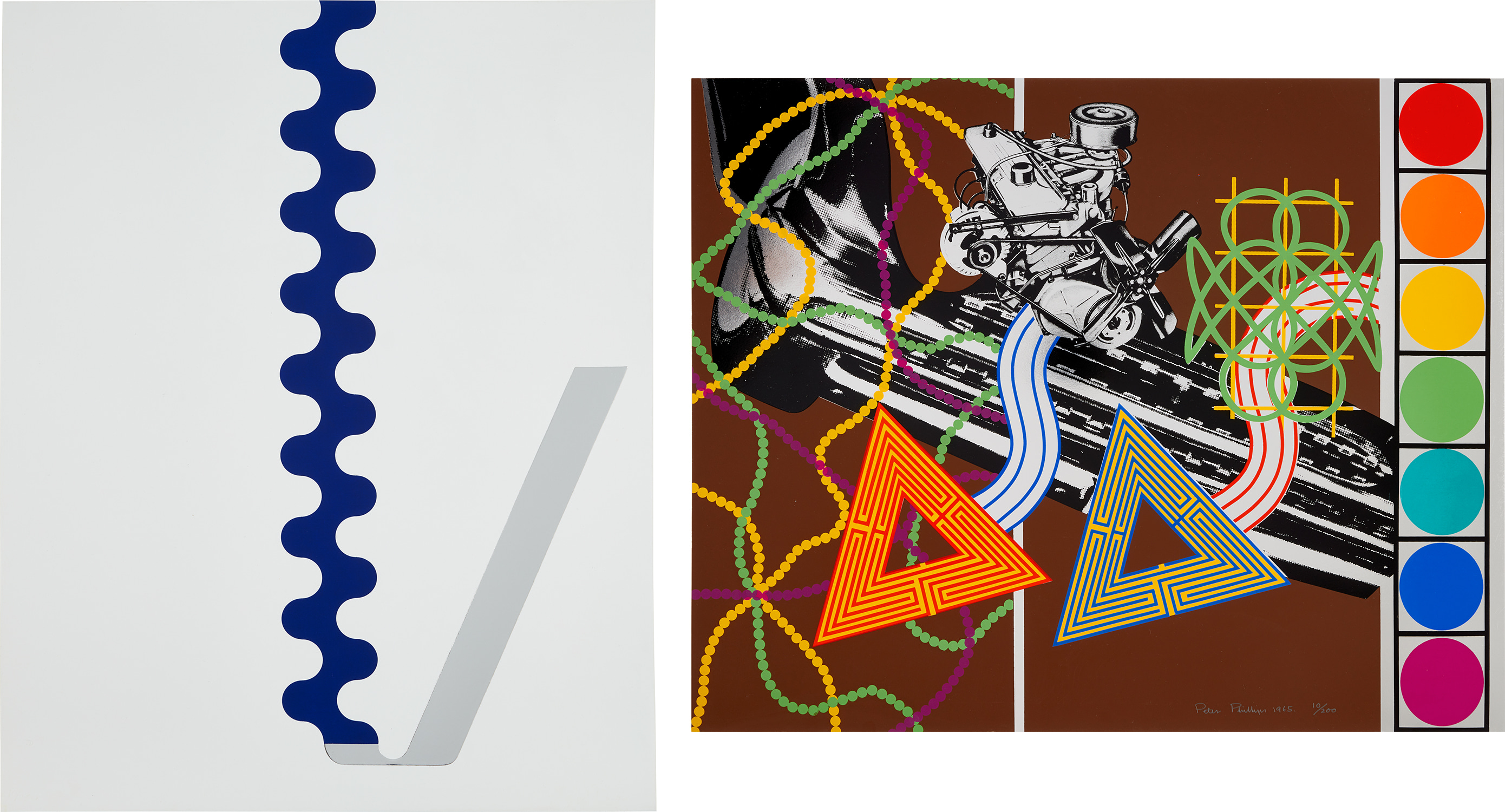
Slide; and Custom Print II, from 11 Pop Artists, Volume II (I. & H. 3)
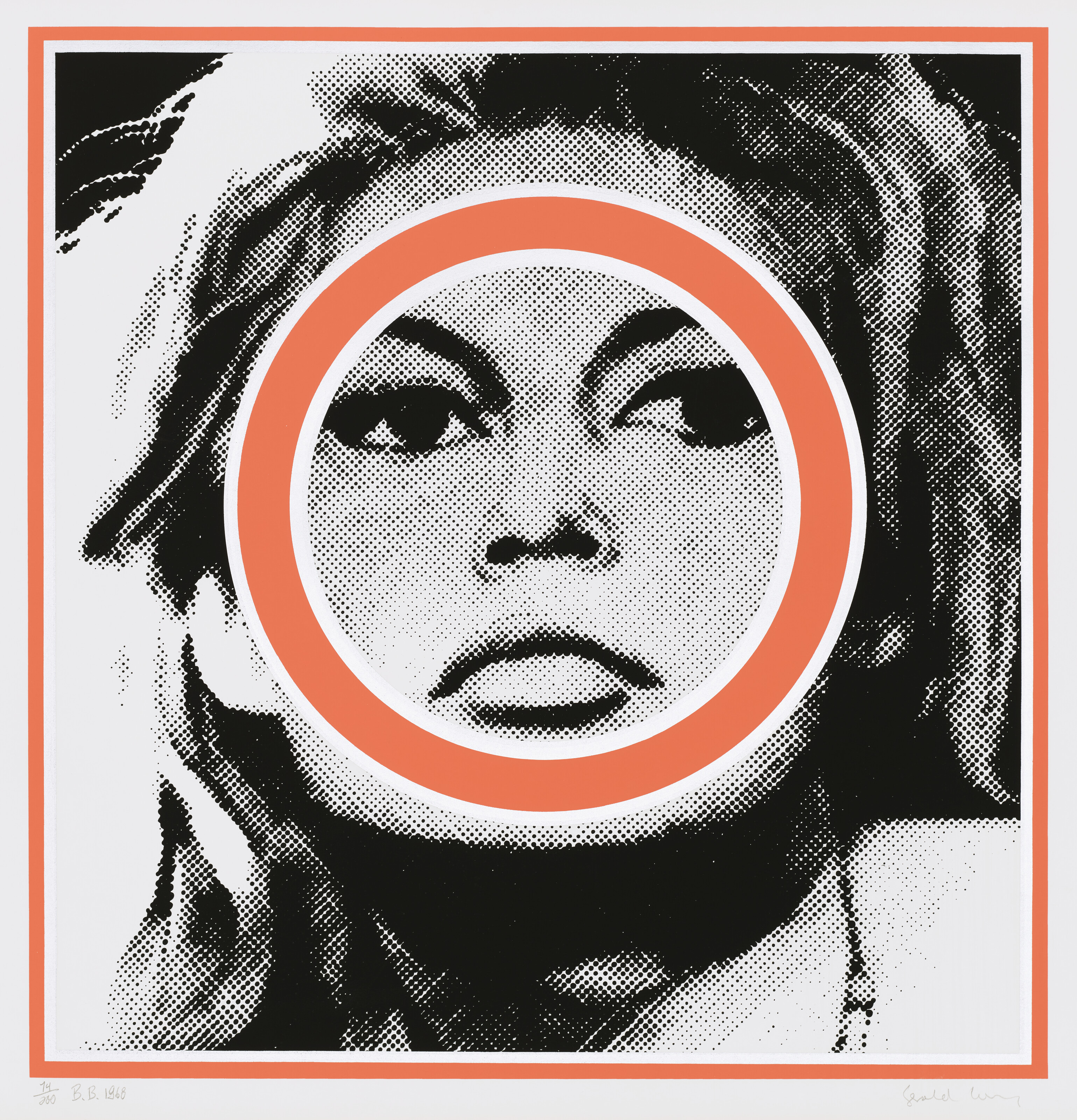
Standing before them, the dots assert themselves first, and then the image resolves, and in that moment of resolution something genuinely thrilling happens. His 1963 painting series including works such as Three Incidents from the Shock Film of the Year captures this approach at its most assured. The works pulse with a graphic intensity that feels both of their moment and entirely ahead of it. His screenprint Brigitte Bardot, catalogued among his most celebrated editions, demonstrates how he could collapse the distance between fine art and popular culture without condescension in either direction.
He regarded Bardot not as a lowbrow subject elevated by artistic treatment but as a genuinely iconic visual phenomenon worthy of sustained attention. The same democratic seriousness runs through his editions published through Original Editions in New York, including the works produced for the celebrated 11 Pop Artists portfolio series, which placed him alongside Warhol, Lichtenstein, and James Rosenquist as a recognised voice in the movement on both sides of the Atlantic. What makes Laing's story particularly rich is the dramatic turn it took in the late 1960s. At a moment when Pop Art had become something close to orthodoxy in the international art world, Laing walked away from it.
Gerald Laing
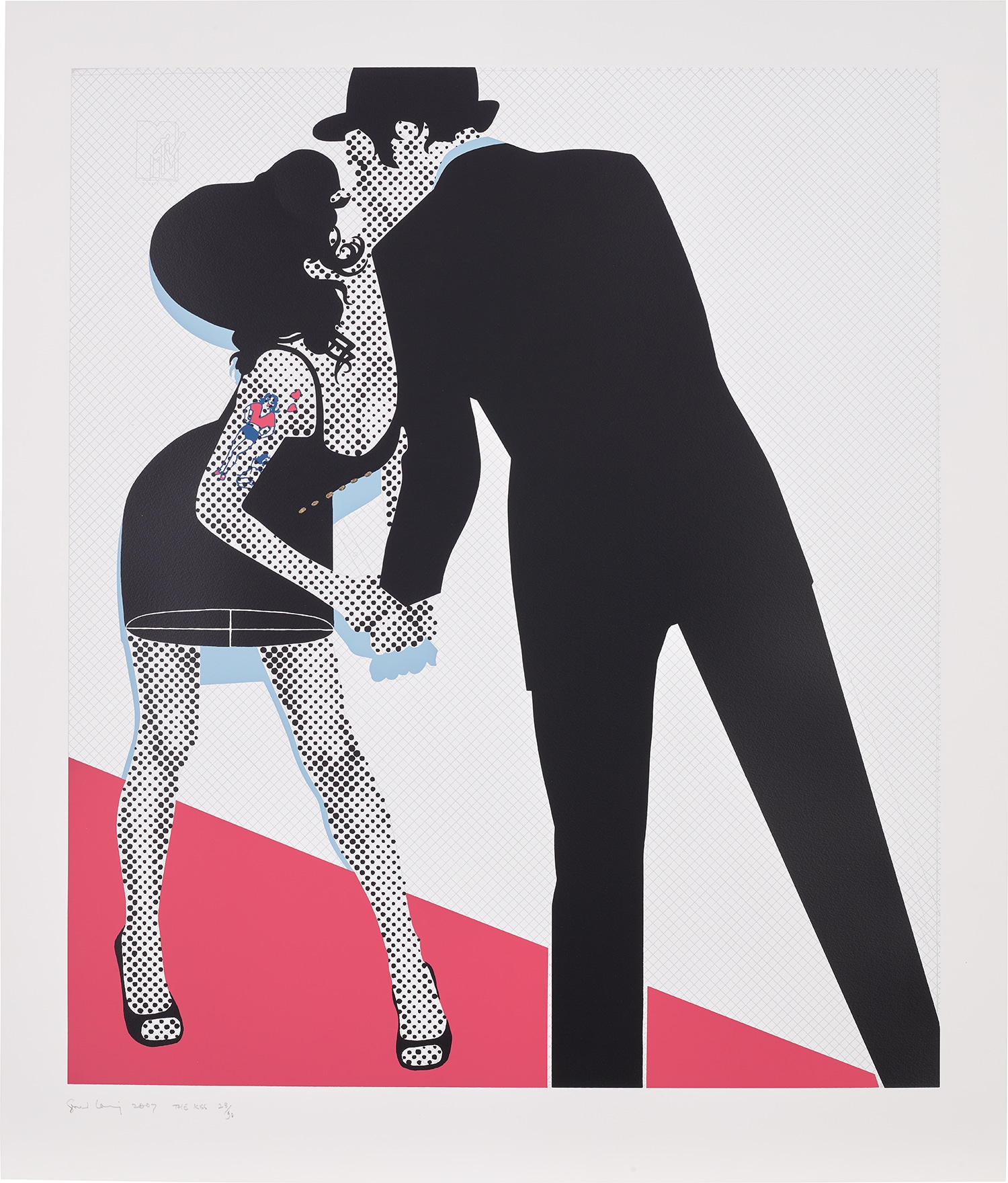
The Kiss
He moved to the Scottish Highlands, to a castle in Ross shire, and devoted himself to classical figurative sculpture. This was not a retreat but a genuine reckoning, an artist interrogating his own assumptions about what art could and should do. His bronze works, including the tender and psychologically complex portrait Galina V from 1976, made in the years following his marriage to the Russian emigre Galina Golikova, show a sculptor of real feeling and technical ambition. The Dressing Table at the Rosarito Hotel, a self portrait with Galina from 1972, bridges these worlds beautifully, retaining the compositional clarity of his Pop sensibility while exploring a register of private intimacy entirely new to his work.
Laing eventually returned to painting and printmaking, revisiting his Pop vocabulary with the confidence of an artist who had left it freely and come back to it on his own terms. Works such as The Kiss, a screenprint with hand applied gold leaf on Arches paper, and his later Kate Moss prints show someone who understood that the language he had helped invent in 1963 still had things to say, and who could now speak it with both fluency and depth. His Parachutes series, published as a signed and numbered edition, returns to his earliest and most iconic imagery with renewed clarity. The parachutist, that suspended figure caught between falling and floating, reads now as almost autobiographical, an artist permanently poised between gravity and grace.
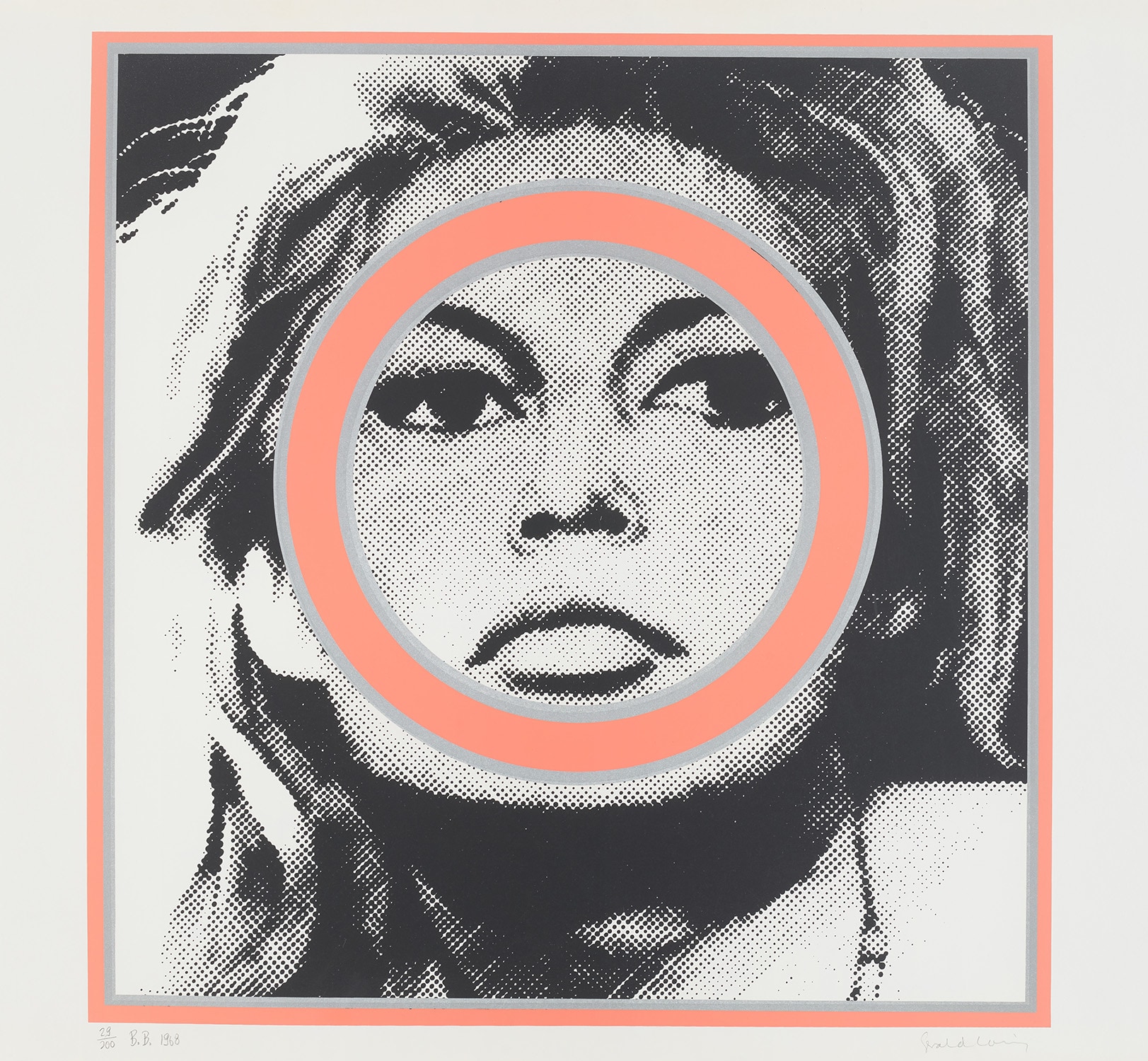
Gerald Laing
Brigitte Bardot (H. & I. 22)
For collectors, Laing represents a compelling and still underappreciated position in the Pop Art canon. His work offers genuine art historical significance at price points that remain accessible relative to his American contemporaries, whose market values have long reflected institutional recognition and auction competition at the highest levels. The signed and numbered editions from the 11 Pop Artists portfolios are particularly desirable because they situate Laing directly within the defining archive of the movement. Works on paper and screenprints in strong condition with full margins and clear provenance are the natural starting point for a new collector, while the paintings from both his early Pop period and his later figurative work represent the deeper ambition of an artist who was never content to simply repeat himself.
Laing occupies a singular position in the history of British art. He is not adequately described as a British follower of American Pop, nor as a purely transatlantic figure. He was something more interesting than either: an artist who participated in a genuinely international conversation as a full and original contributor, who then had the courage to abandon the movement that had made him famous in order to pursue questions that mattered more to him personally, and who returned, transformed, to offer a late body of work that reframes everything that came before it. Galleries including the Waddington Galleries in London have represented his work, and his prints have appeared at Christie's, Sotheby's, and Phillips.
He died in 2011 at his home in the Scottish Highlands. The house was a castle he had rescued and restored himself. That fact tells you almost everything you need to know about Gerald Laing.