Georges Seurat
Seurat: The Visionary Who Painted With Light
Artist Spotlight · The Collection Editorial
“Some say they see poetry in my paintings. I see only science.”
Georges Seurat
Stand before 'A Sunday on La Grande Jatte' at the Art Institute of Chicago and something remarkable happens. The painting, nearly ten feet wide and completed in 1886, does not simply depict a sun drenched afternoon on the banks of the Seine. It breathes. The dots of color, thousands upon thousands of them, seem to pulse with a luminosity that no blended pigment could ever achieve.
Georges Seurat
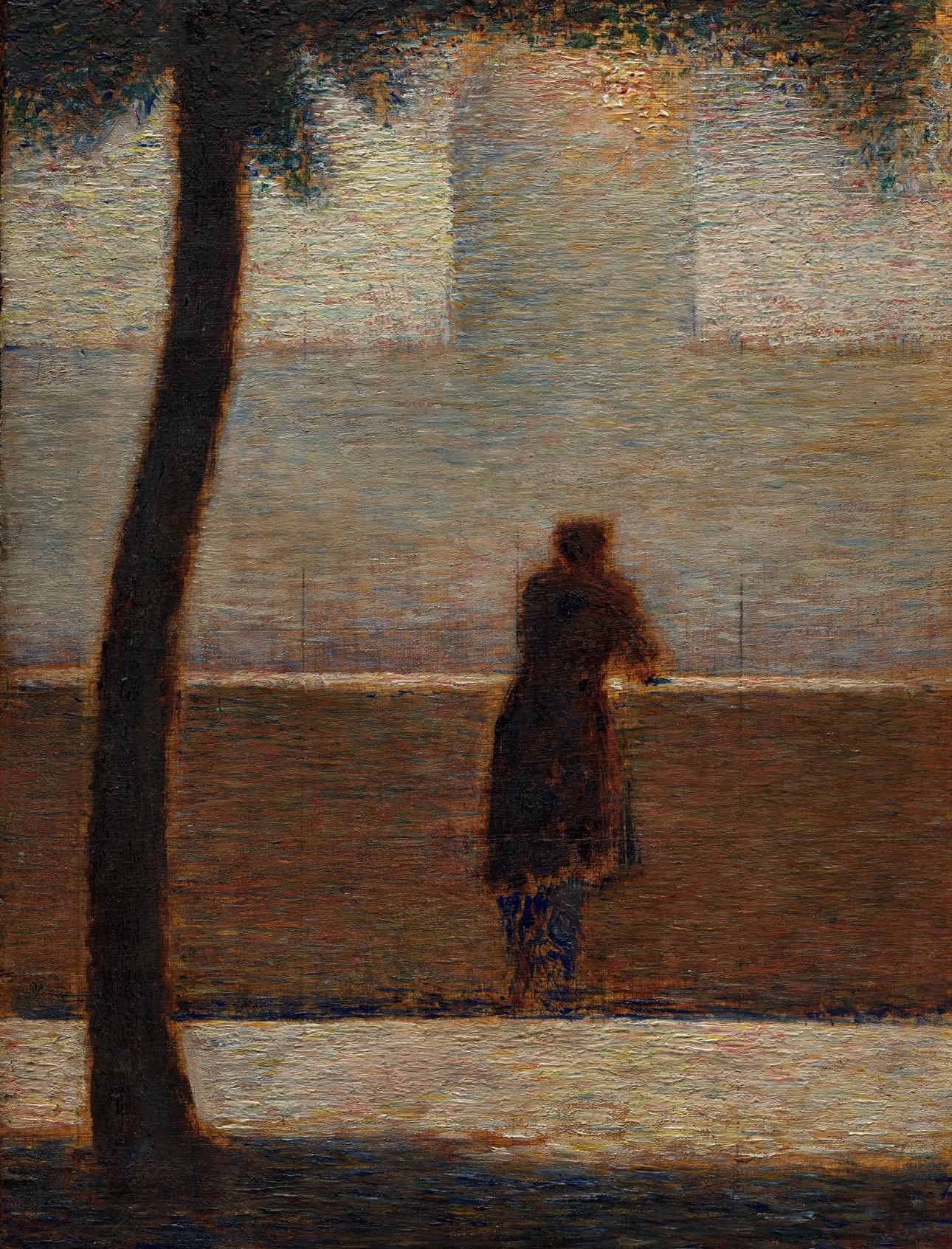
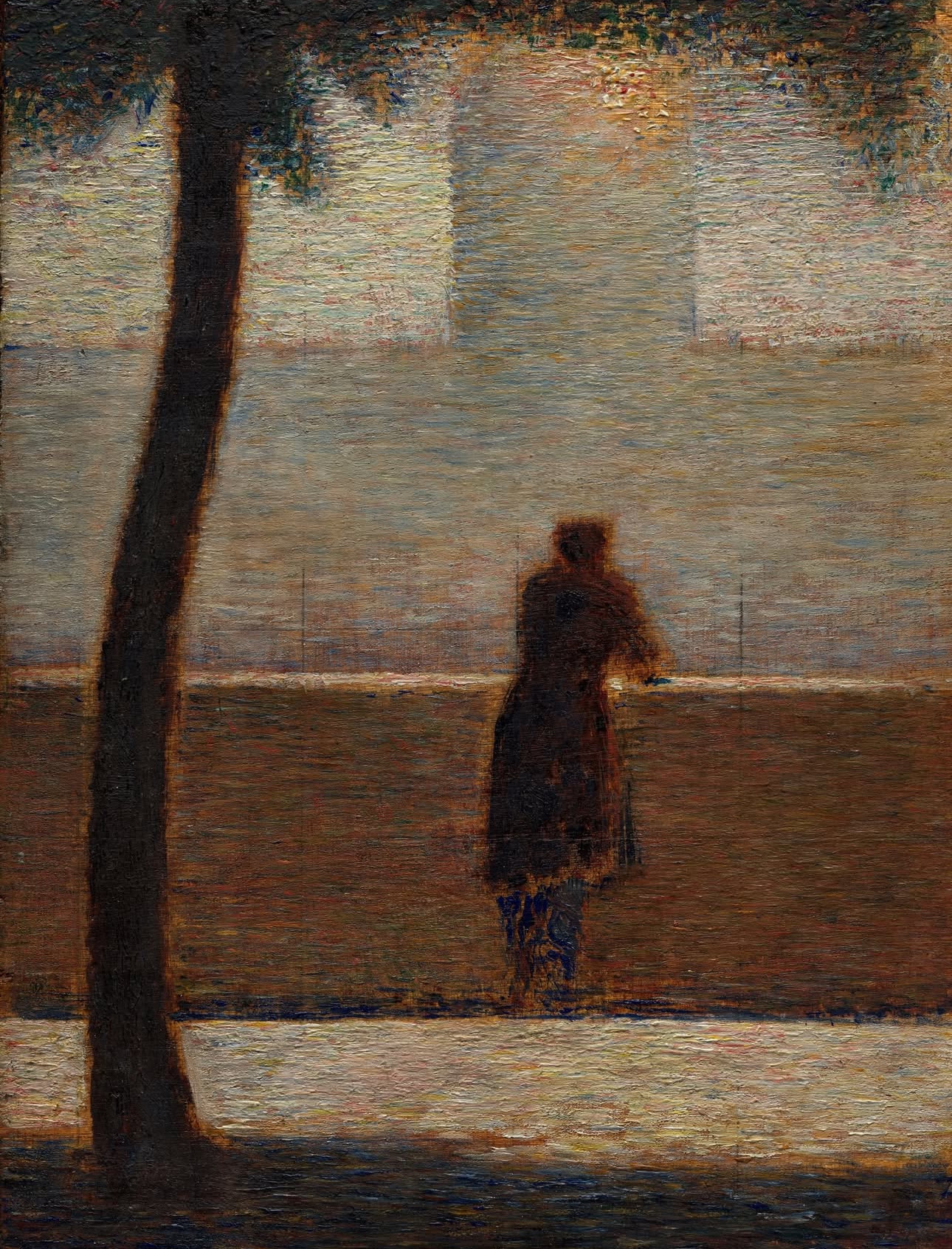
Man Leaning on a Parapet, 1881
It is one of the most analyzed canvases in the history of Western art, and yet it remains deeply, almost mysteriously alive. More than a century after Georges Seurat's death at the age of thirty one, his work continues to astonish scholars, collectors, and first time museum visitors alike with equal force. Georges Pierre Seurat was born in Paris on December 2, 1859, into a comfortable bourgeois family. His father, Chrysostome Antoine Seurat, was an eccentric legal official who lived largely apart from the family in Le Raincy, while his mother, Ernestine Faivre, oversaw Georges's upbringing in the city.
From an early age he demonstrated a quiet, methodical intensity that would come to define his entire practice. He entered the École des Beaux Arts in 1878, studying under Henri Lehmann, a disciple of Ingres, where he absorbed rigorous academic draftsmanship. It was a foundation that never left him. Even at his most radical, Seurat's compositions retain a classical stillness and structural authority that sets him apart from his Impressionist contemporaries.
Georges Seurat
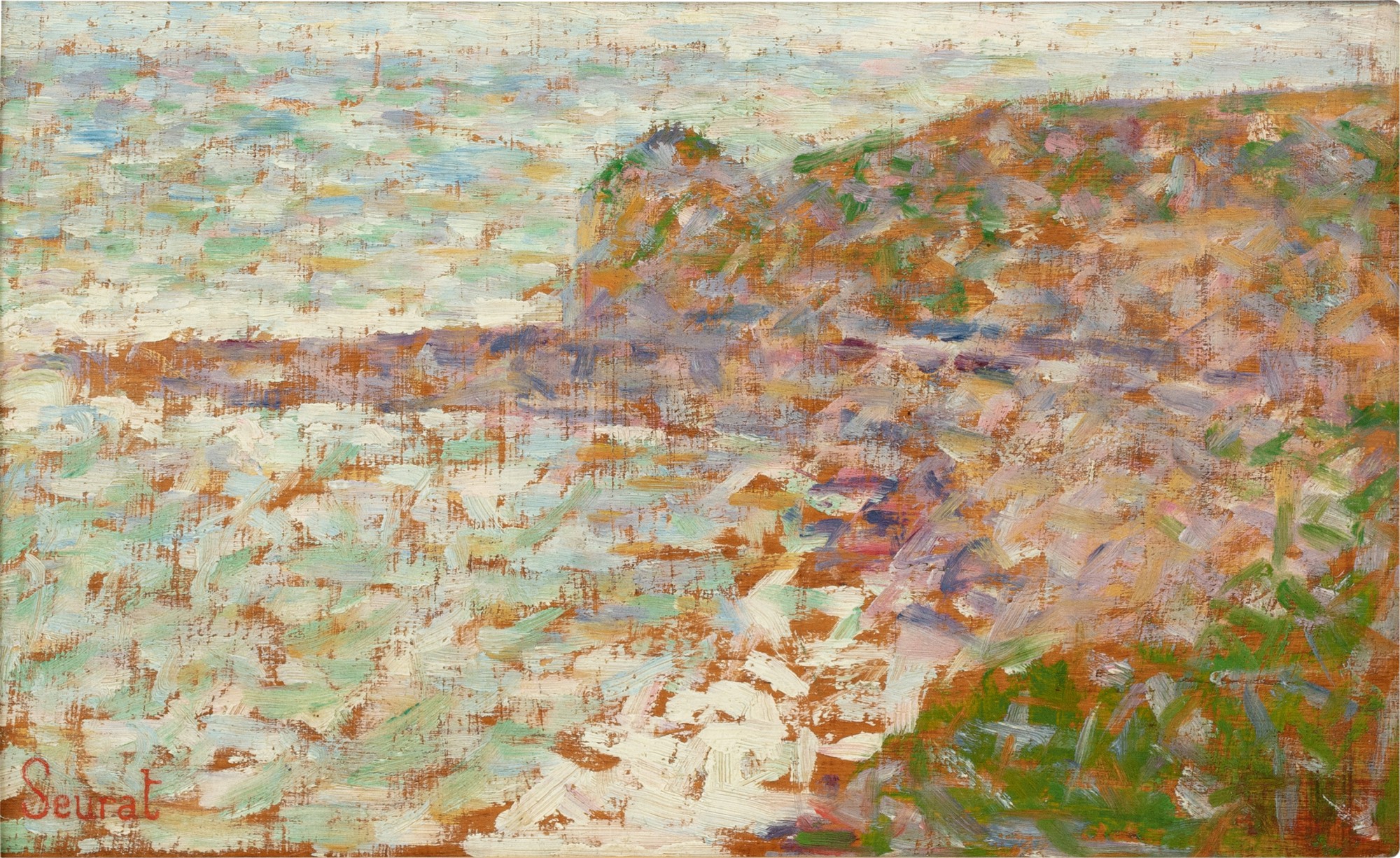
Marine à Grandcamp, 1885
The decisive turn in Seurat's development came not in the studio but in the library. His intensive reading of color theorists, particularly the chemist Michel Eugène Chevreul and the American scientist Ogden Rood, convinced him that color perception was not merely a matter of pigment mixing but of optical experience. Chevreul's theories on simultaneous contrast, which described how adjacent colors influence one another visually, gave Seurat the scientific foundation for what would become Pointillism, or as he preferred to call it, Chromoluminarism or Divisionism. He spent two years preparing for 'Bathers at Asnières,' completed in 1884, filling sketchbooks and small panel studies with color experiments before committing to the large canvas.
“The Panathenaeans of Phidias formed a procession. I want to make modern people move about as they did on those friezes.”
Georges Seurat, cited by Gustave Kahn
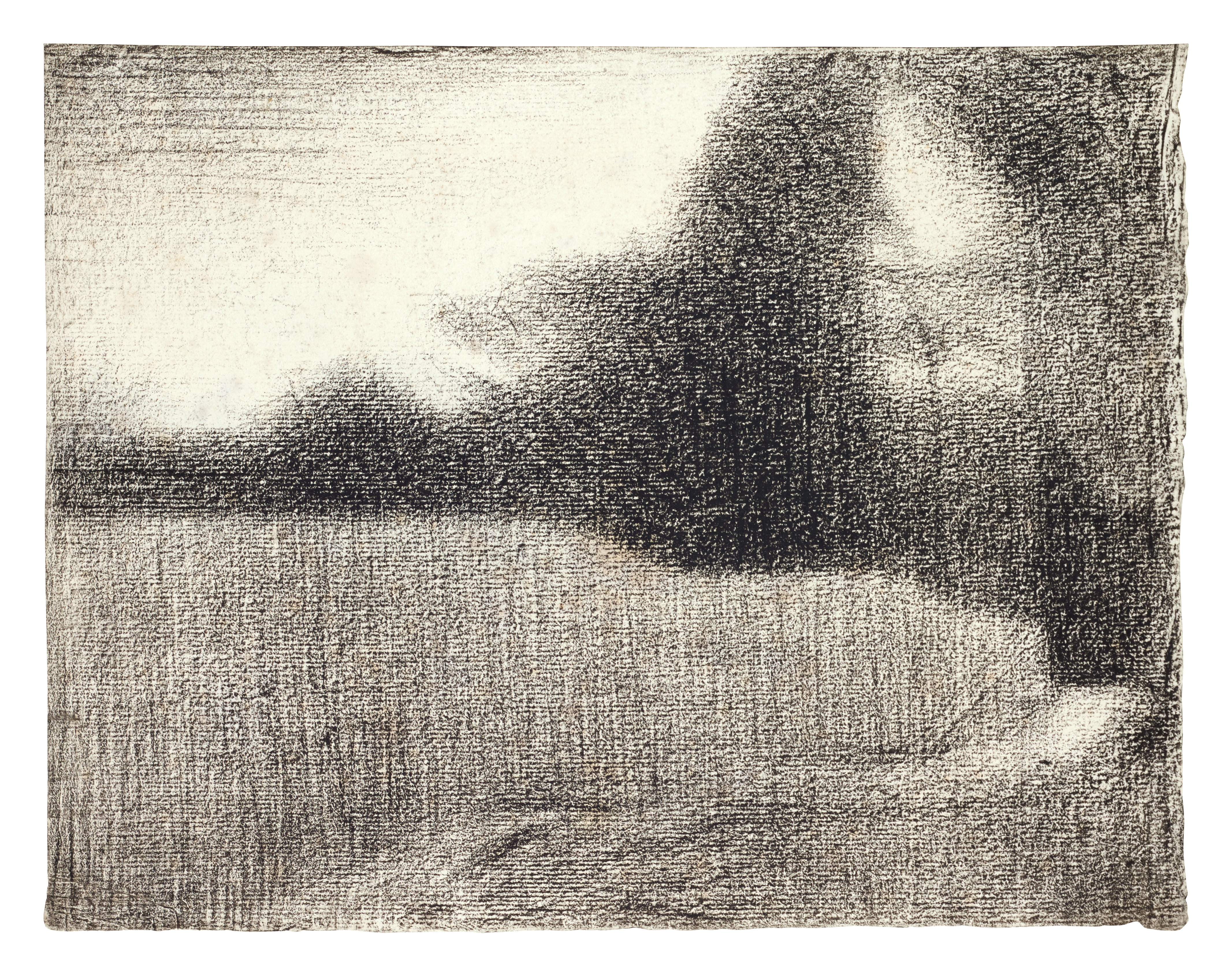
The painting was rejected by the official Salon but exhibited at the first Salon des Indépendants, a moment that signaled a new era in French painting. The works available on The Collection illuminate the full arc of Seurat's practice with remarkable depth. 'Man Leaning on a Parapet' from 1881 reveals the young artist in his academic mode, already in command of tonal modeling and atmosphere. The 1883 conté crayon work 'Blé et arbres' demonstrates the extraordinary graphic sensibility that ran parallel to his painting throughout his career.
Georges Seurat
Blé et arbres (Le Champ de blé) (recto); Portrait de Félix Fénéon (verso), 1883
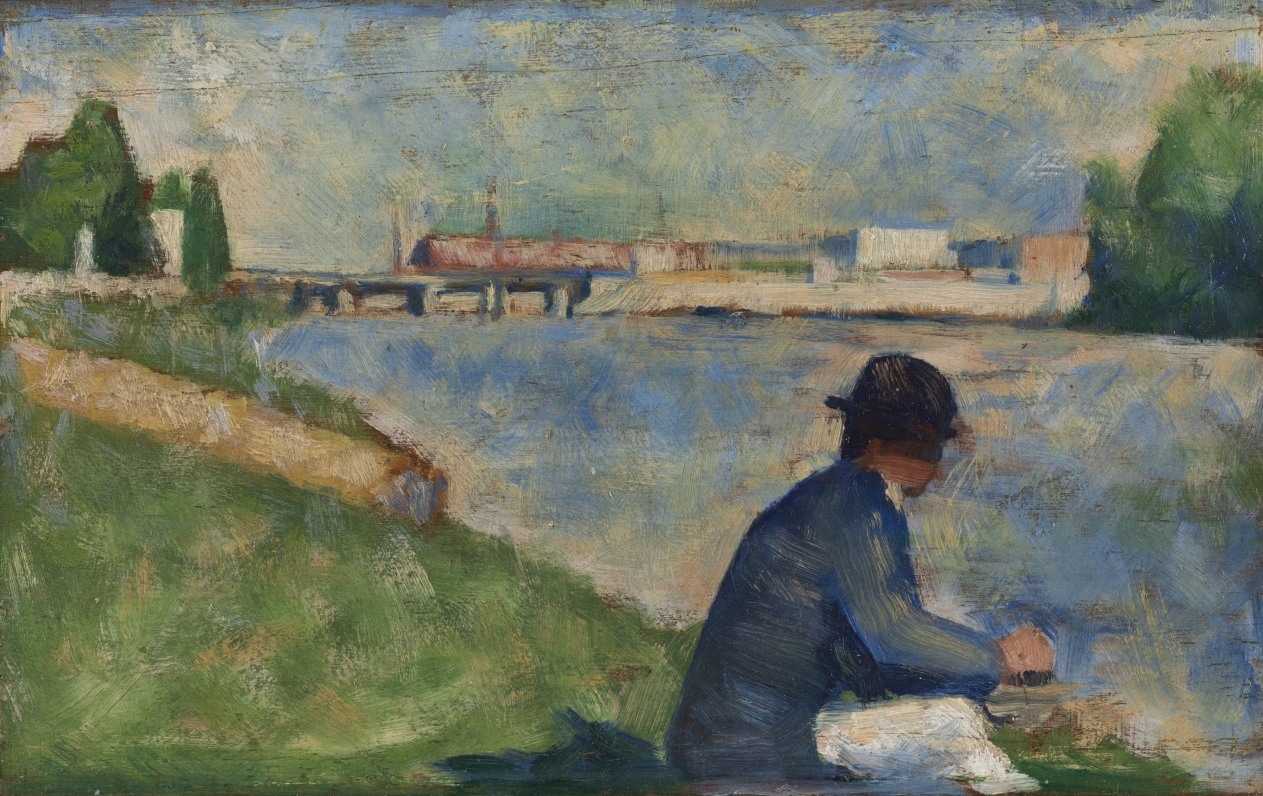
His drawings in conté crayon are among the most revered in the medium, achieving a velvety tonal richness through the careful manipulation of textured paper. 'The Zone (Outside the City Walls)' from 1882 is a superb example of this, its somber geometry of suburban Paris rendered with a gravity that anticipates the austere poetry of Giorgio Morandi. The 1883 oil panel 'Study for Bathers at Asnières' offers a rare glimpse into the preparatory intelligence behind his grand compositions, while 'Marine à Grandcamp' from 1885, painted during a summer visit to the Normandy coast, shows Pointillism at its most serene and meditative. The 1887 conté crayon 'At the Concert Parisien' and the 1890 ink drawing 'L'Homme à femmes' extend into his later period, when his interest in the expressive geometry of line and the psychological registers of entertainment and leisure deepened considerably.
From a collecting perspective, Seurat occupies a position of singular rarity. He worked for only a decade at full creative capacity and produced a relatively small body of major canvases. The large finished paintings are almost entirely held by major institutions. The Art Institute of Chicago, the National Gallery in London, and the Musée d'Orsay in Paris hold the canonical works.
Georges Seurat
Study for "Bathers at Asnières", 1883
For collectors, this makes the drawings, small oil panels, and studies not merely secondary objects but the primary arena of access to his genius. His conté crayon drawings in particular have commanded serious attention at auction for decades. The intimacy of the panels, many painted en plein air during his summer expeditions to the Channel coast at Grandcamp, Honfleur, and Gravelines, offers a directness and spontaneity that the large studio compositions deliberately suppress. Collectors drawn to the intersection of scientific rigor and poetic feeling find in Seurat a painter who satisfies both instincts simultaneously.
Seurat did not work in isolation. He was the center of a circle of like minded artists who developed and promoted Neo Impressionism together. Paul Signac, his closest ally, became the movement's tireless advocate and wrote its definitive theoretical text, 'D'Eugène Delacroix au Néo Impressionnisme,' published in 1899. Camille Pissarro, the elder statesman of Impressionism, was briefly converted to the method in the mid 1880s, lending the movement considerable credibility.
The critic Félix Fénéon, whose portrait appears on the verso of one of the works on The Collection, became Pointillism's most eloquent literary champion. Looking outward, Seurat's influence threads through the color field painting of the twentieth century, the systematic practices of Josef Albers, and the optical experiments of Bridget Riley, who has spoken openly about his foundational importance to her work. The legacy of Georges Seurat is inseparable from the idea that painting can be a form of thinking, that the application of color to canvas can be as rigorous and as exhilarating as a scientific experiment. He transformed a Sunday afternoon on an island in the Seine into one of the great monuments of modern culture.
He showed that pleasure and discipline are not opposites. He died in March 1891, possibly of diphtheria, just days after the illness also claimed his infant son. He was thirty one years old. The brevity of his career makes the achievement seem almost impossible and the work that survives feel all the more charged with life.
To collect Seurat, even in the form of a small panel or a velvety crayon drawing, is to hold a fragment of one of the most original minds painting has ever produced.
Explore books about Georges Seurat
Georges Seurat
John Rewald
Seurat and the Science of Painting
William Innes Homer
Georges Seurat: Drawings
Françoise Cachin
Seurat: A Life
David Sutter
The Complete Paintings of Seurat
Jean Sutter
Seurat: The Systematic Painter
Peter Brooke
A Sunday Afternoon on the Island of La Grande Jatte
Robert L. Herbert