Georges Croegaert
Sacred Rooms, Gentle Wit, Enduring Charm
Artist Spotlight · The Collection Editorial
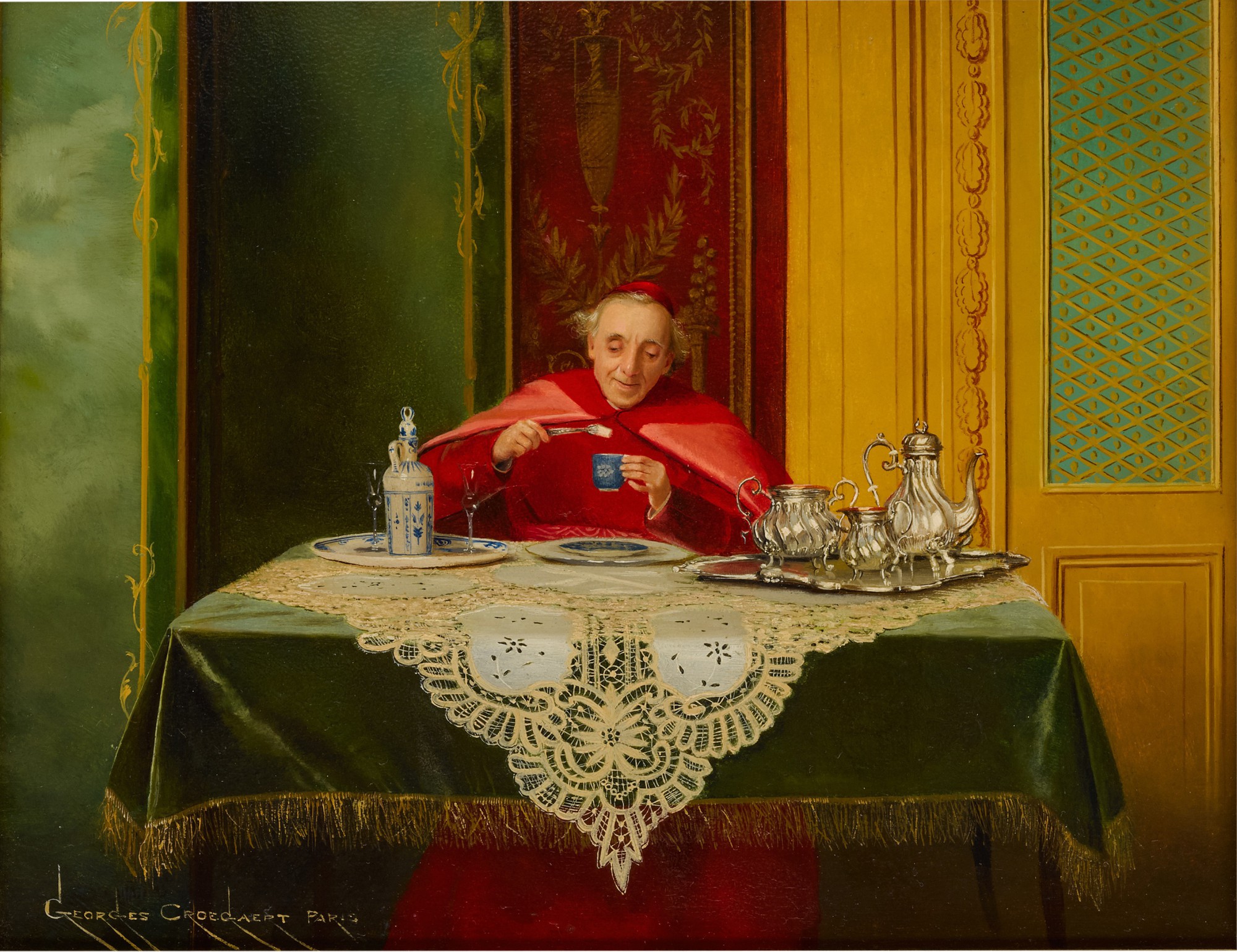
Imagine a cardinal seated at an elegantly appointed table, his scarlet robes pooling softly against an antique chair, a delicate porcelain cup raised to his lips with an expression of quiet, private pleasure. This is the world Georges Croegaert invented and perfected across a career that spanned the final decades of the nineteenth century and the opening years of the twentieth. It is a world of hushed interiors, accumulated treasures, and gentle human comedy, rendered with a technical precision that rewards the closest looking. That world is finding new admirers today, as collectors drawn to the warmth and craft of the Belle Époque rediscover an artist whose reputation deserves to stand far higher than it has in recent decades.
Georges Croegaert
Cardinal Taking Tea
Georges Croegaert was born in Belgium in 1848, a time when that young nation was producing painters of considerable refinement under the long shadow of the great Flemish tradition. The meticulous attention to surface, texture, and light that had distinguished the workshops of Antwerp and Bruges for centuries was very much alive in the Belgian academies of the mid nineteenth century, and it would leave a permanent mark on how Croegaert saw and transcribed the material world. He trained rigorously in the technical conventions of his era, learning to render fabric, wood, ceramic, and candlelight with the patience and care of an earlier age. That formation would prove decisive, giving him tools he would deploy with wit and originality once he arrived in Paris.
Paris was the gravitational center of the international art world in the 1870s and 1880s, and Croegaert joined the steady stream of European painters who made the city their permanent home and professional base. He became a fixture on the Salon circuit, that vast annual machinery for exhibiting and selling paintings to the bourgeois public that had grown prosperous and acquisitive in the years of the Third Republic. The Salon rewarded exactly what Croegaert did best: highly finished surfaces, recognizable subject matter, and a tone that was entertaining without being scandalous. He found his niche and developed it with genuine intelligence, carving out a specialty that was immediately recognizable and consistently beloved.
Georges Croegaert
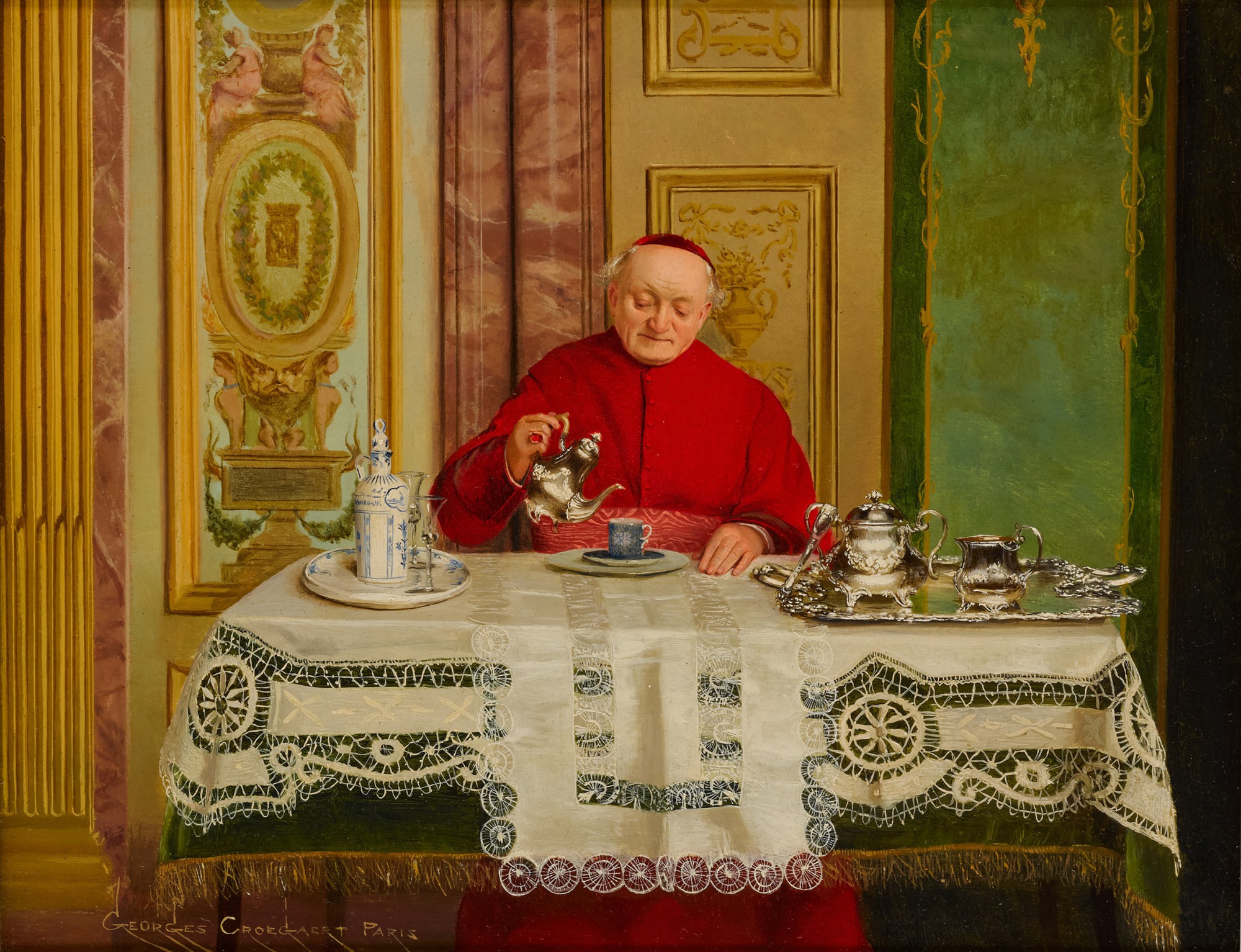
Cardinal Taking Coffee
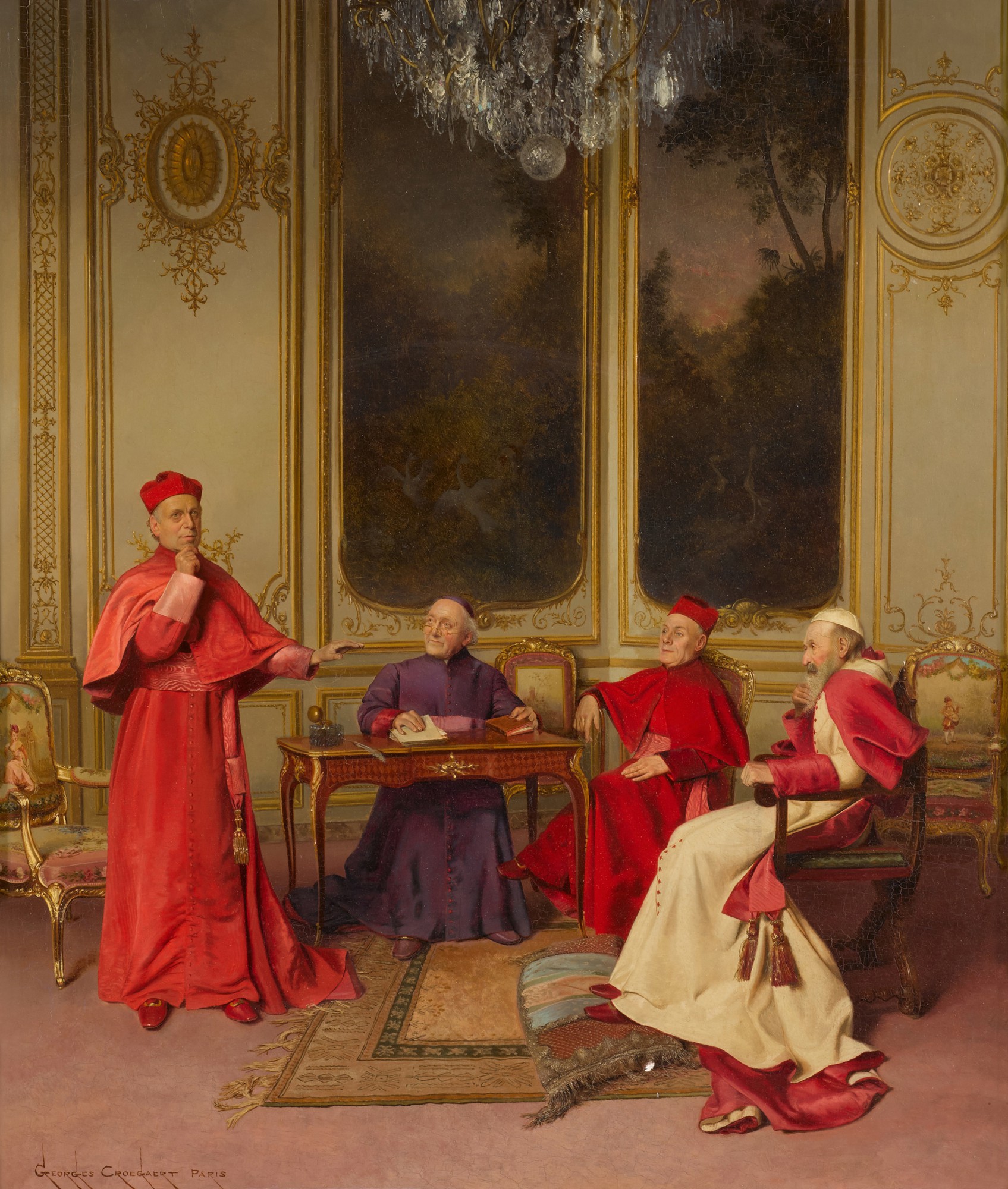
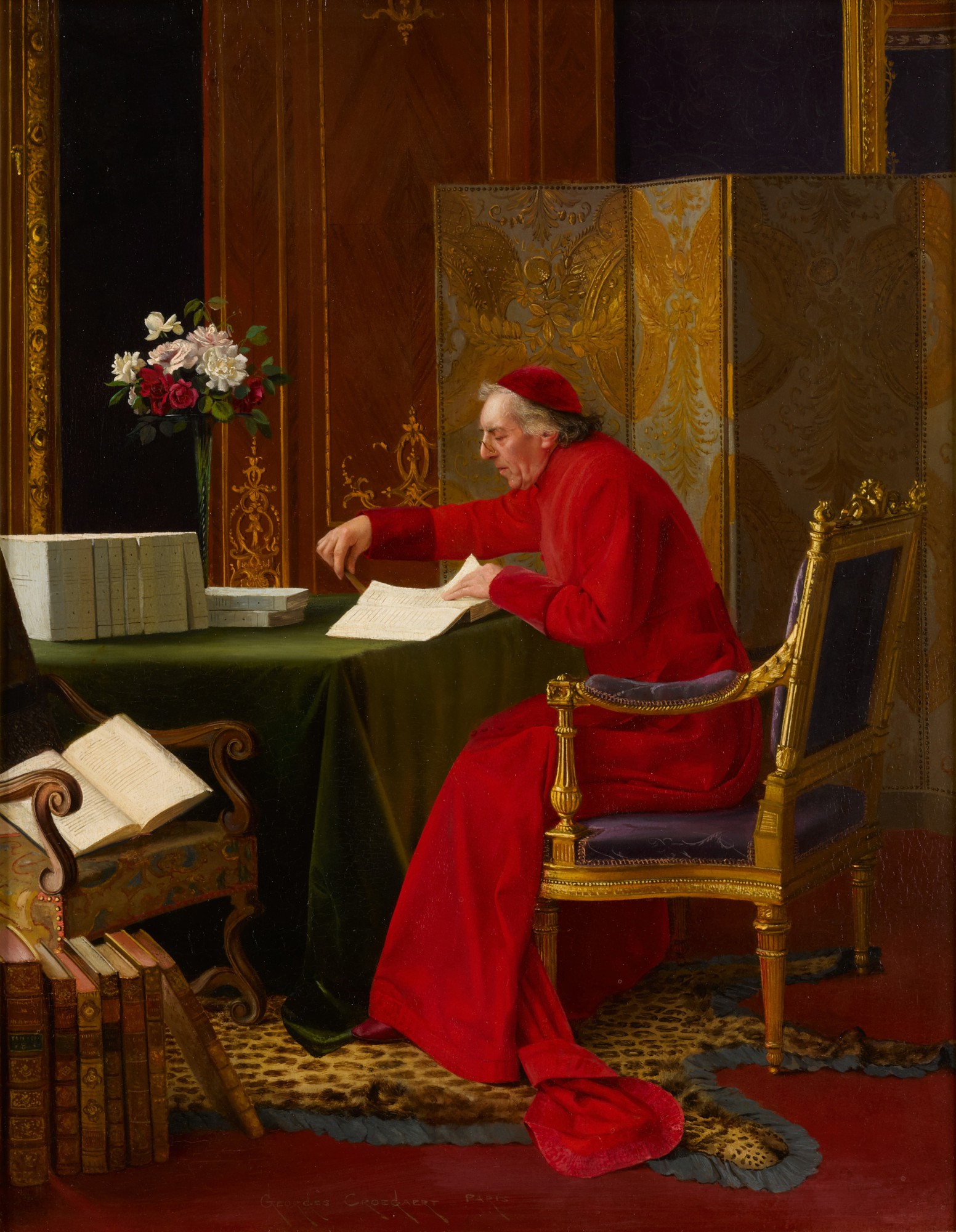
The subject that made Croegaert's reputation was, on its face, a simple one: Catholic clergy, almost always cardinals or senior churchmen, caught in moments of domestic leisure and mild indulgence. A cardinal savoring his morning coffee. A churchman absorbed in a newly acquired book. Senior ecclesiastics gathered in quiet conference, surrounded by bibelots, Persian carpets, gilded frames, and the accumulated furniture of cultivated lives.
The comedy in these paintings is never cruel. Croegaert clearly liked his subjects, and his cardinals read less as objects of satire than as portraits of a particular kind of refined, bookish, pleasure loving humanity that happened to wear red robes. The warmth is genuine, and it is part of why the pictures remain so immediately appealing more than a century after they were made. What elevates Croegaert's work beyond mere anecdote is the extraordinary quality of the painting itself.
Georges Croegaert
The Conference
His interiors are painted with the kind of loving specificity that suggests a man who spent real time among antiques and fine objects, and who understood their visual weight and historical resonance. The ceramics on a mantelpiece are not generic props but individually observed pieces, each with its own glaze, form, and provenance implied. The textiles that drape chairs and cover tables are rendered with a tactile precision that recalls the great Dutch interior painters of the seventeenth century. Works such as Cardinal Taking Tea and Cardinal Taking Coffee, both executed in oil on panel, demonstrate this mastery at full stretch.
The panel support itself is telling: it is the medium of the early Flemish masters, chosen for the smoothness it lends to fine detail, and Croegaert handles it with complete authority. For collectors, Croegaert occupies a particularly attractive position in the market for nineteenth century European genre painting. His works appear regularly at auction, where they attract both specialist collectors of Salon era painting and buyers drawn simply by the pleasure the pictures give on a wall. The cardinal subjects have a universal appeal that crosses cultural boundaries, combining the prestige of religious imagery with the intimacy of domestic genre.
Georges Croegaert
Cutting the Pages
Condition matters considerably with Croegaert, as with all panel painters of this period: the detail that makes his work remarkable is fully visible only when the paint surface is clean and the varnish fresh. Buyers should look for works that retain the original luminosity of his color, particularly the warm ochres and deep crimsons that give his interiors their distinctive glow. Titles like The Conference and Cutting the Pages represent the breadth of his invention within his chosen theme, showing that he was not simply repeating a formula but continually finding new human situations to explore within his signature mise en scène. Croegaert belongs to a distinguished company of painters who made the cultivated interior their primary subject in the decades around 1900.
His closest spiritual relatives include Jean Béraud, who chronicled Parisian social life with similar elegance and wit, and Jehan Georges Vibert, whose paintings of clergy in domestic situations share Croegaert's gentle satirical warmth and his delight in material splendor. The broader tradition of Salon genre painting, running from Meissonier through the great specialists in historical interior subjects, is the context in which Croegaert learned his trade and found his public. Understanding his place in that tradition helps explain both his contemporary success and the renewed collector interest that has followed the general reappraisal of nineteenth century academic painting over the past thirty years. Georges Croegaert died in 1923, at the close of an era whose values his paintings so perfectly embodied.
The world of plush interiors, leisured clergy, and Salon refinement was already a memory by then, swept aside by the upheavals of the war years. But the pictures survived, and they carry within them something that transcends period charm: a genuine love of fine things, a kind and amused view of human nature, and a technical accomplishment that continues to astonish anyone who looks closely. In an art world that sometimes mistakes difficulty for depth, there is something quietly radical about a painter who devoted his gifts entirely to giving pleasure, and who succeeded so completely. Rediscovering Croegaert today feels less like an exercise in nostalgia than like meeting a painter whose particular intelligence has simply been waiting for the right moment to be fully appreciated.