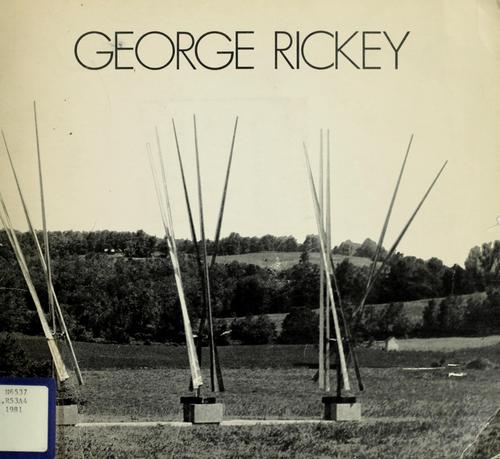
George Rickey
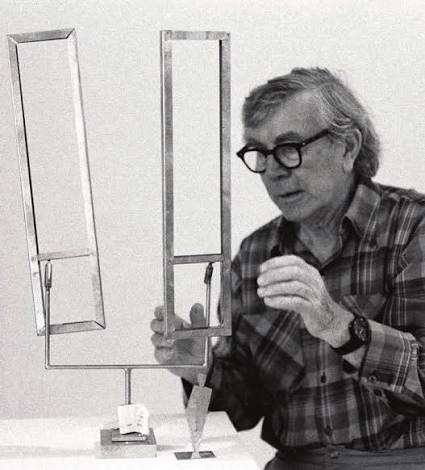
George Rickey: The Poet of Perpetual Motion
Artist Spotlight · The Collection Editorial
“I wanted to make things that move the way natural things move, driven by wind and gravity.”
George Rickey, artist statement
Stand before one of George Rickey's stainless steel sculptures on a still afternoon and wait. Within moments, the slightest breath of air sets the long tapered blades into motion, tilting and sweeping through space with a calm, almost meditative authority. This is the genius of Rickey's life work: the transformation of inert metal into something that feels genuinely alive. Major institutions from the Museum of Modern Art in New York to the Tate in London to the Nationalgalerie in Berlin have long celebrated his contribution to postwar sculpture, and the art market continues to affirm his standing as one of the defining voices of kinetic art.
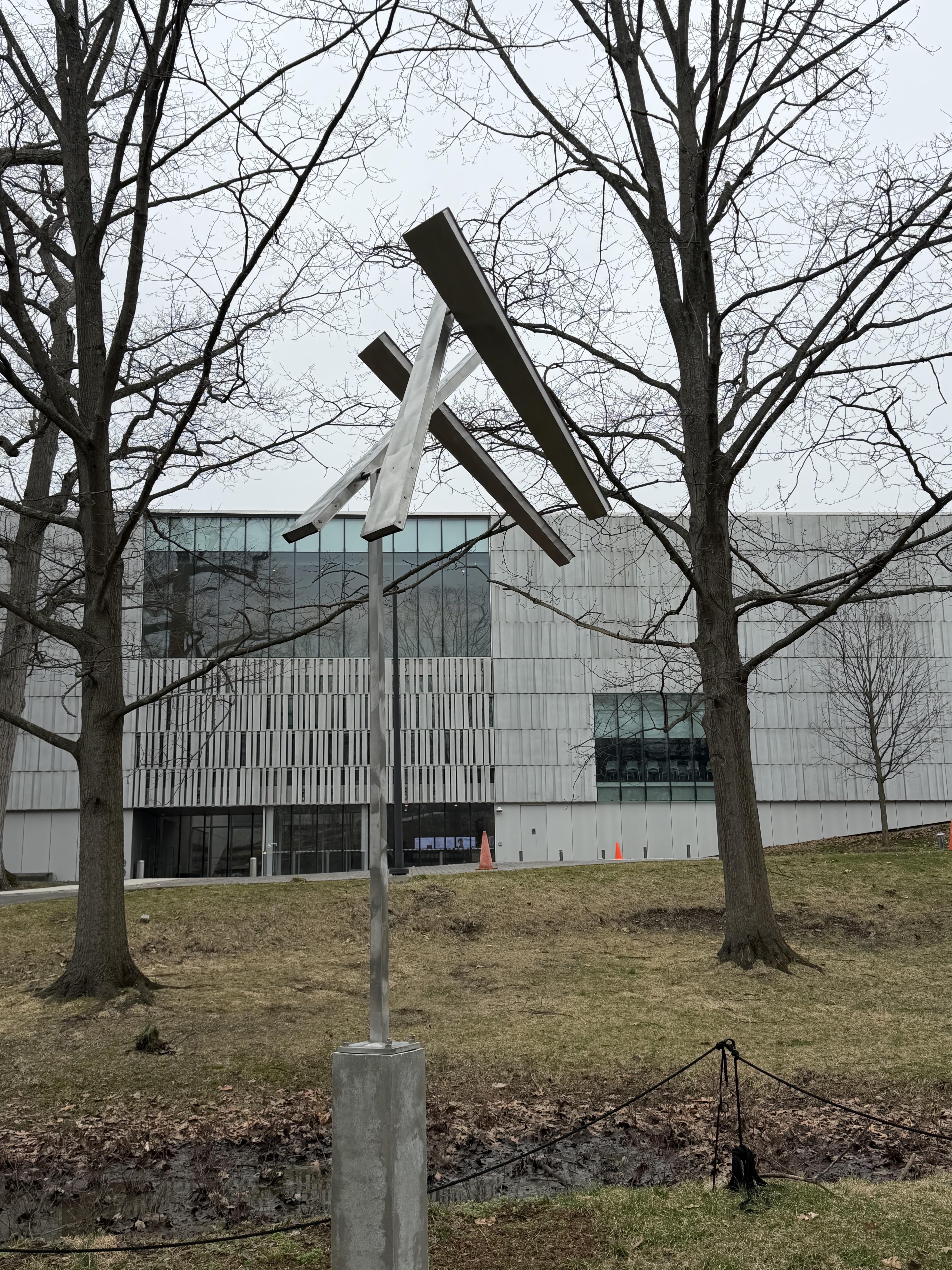
George Rickey
Two Lines Oblique
His works carry a timeless quality that makes each encounter feel new, regardless of how many times you have stood in their presence. George Warren Rickey was born in South Bend, Indiana, in 1907, and his childhood carried the distinctive imprint of transatlantic culture. His family relocated to Scotland when he was young, and he received his early education at Glenalmond College in Perthshire before studying history at Balliol College, Oxford. This rigorous classical formation gave Rickey an intellectual seriousness that would underpin everything he made.
He initially pursued painting, studying in Paris in the late 1920s at the Académie Lhote and the Académie Moderne under Fernand Léger, absorbing the lessons of Cubism and the broader European avant garde at a formative moment. That period in Paris planted seeds that would bloom decades later in a wholly original direction. Rickey served in the United States Army Air Forces during World War II, working as a mechanical engineer and gaining hands on knowledge of precision fabrication. This technical grounding proved transformative.
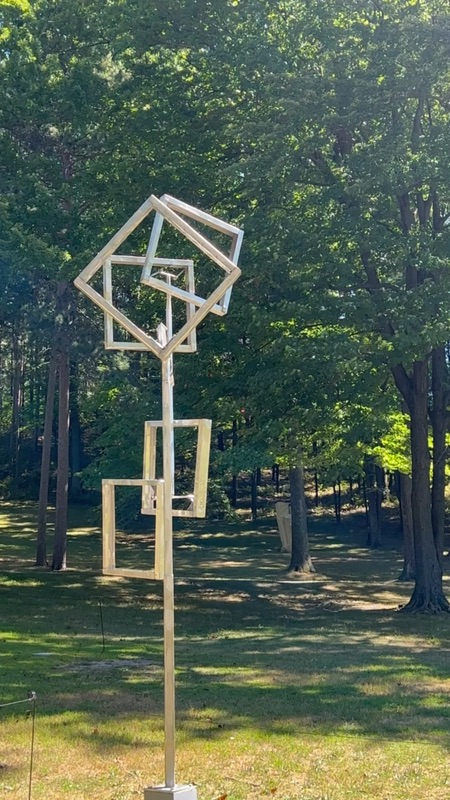
George Rickey
Untitled
After the war, he returned to painting but found himself increasingly drawn to sculpture and, specifically, to the problem of movement. He was galvanised by his encounter with the mobiles of Alexander Calder, which demonstrated that sculpture could inhabit time as well as space. Equally important was his deep study of Russian Constructivism, the tradition of Naum Gabo and Antoine Pevsner, which offered a rigorous geometric language rooted in space, rhythm, and material truth. Rickey synthesised these influences into something entirely his own, developing a practice anchored in precision engineering and poetic restraint.
By the late 1950s and through the 1960s, Rickey had arrived at the vocabulary for which he is best known: elongated blades and planes of highly polished stainless steel, engineered to pivot on gimbals and bearings of extraordinary fineness. Works such as Two Lines Vertical from 1964 and Broken Line from 1966 exemplify this mature phase. The forms are spare, almost reductive, but the behaviour of the work in space is endlessly varied. Each sculpture responds differently to each day, each wind, each viewer.
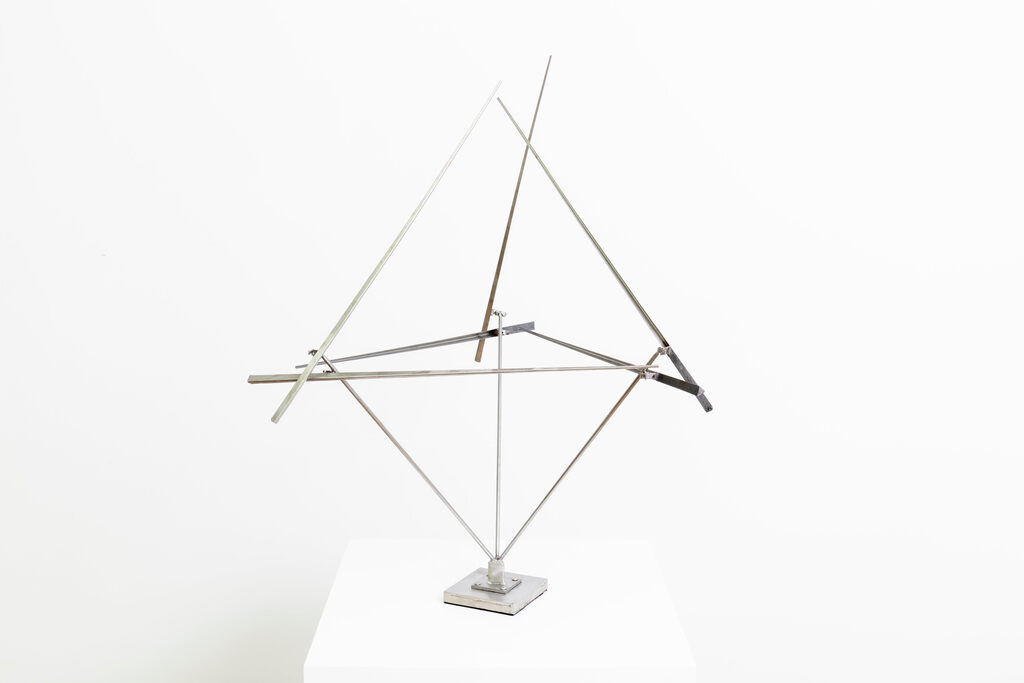
George Rickey
Fixed and Moving Tetrahedra II, 1971
Rickey was meticulous in calibrating the weight and balance of every element, often spending weeks adjusting a single piece until its motion achieved the quality he described as inevitability. The stainless steel surface catches light continuously, so that the sculpture becomes a kind of drawing in three dimensions, tracing arcs and angles that dissolve before they can be fixed. Among his most celebrated bodies of work are the Two Lines series, in which paired vertical blades of dramatically different scales move independently of one another, creating a visual dialogue of alignment and divergence. Column of Six Lines with Gimbals from 1975 extends this thinking into a more complex register, stacking multiple moving elements into a vertical hierarchy that achieves grandeur without losing delicacy.
Ommaggio a Bernini Variation III from 1958 reveals a different dimension of Rickey's imagination, nodding to the Baroque tradition of dynamic form while remaining fully committed to the abstract and the contemporary. Three Squares Triangle from 1989, executed in phosphor bronze, shows his willingness to explore new materials and configurations well into the later decades of his career. These works are not simply beautiful objects. They are propositions about the nature of time, balance, and the relationship between the made thing and the living world.
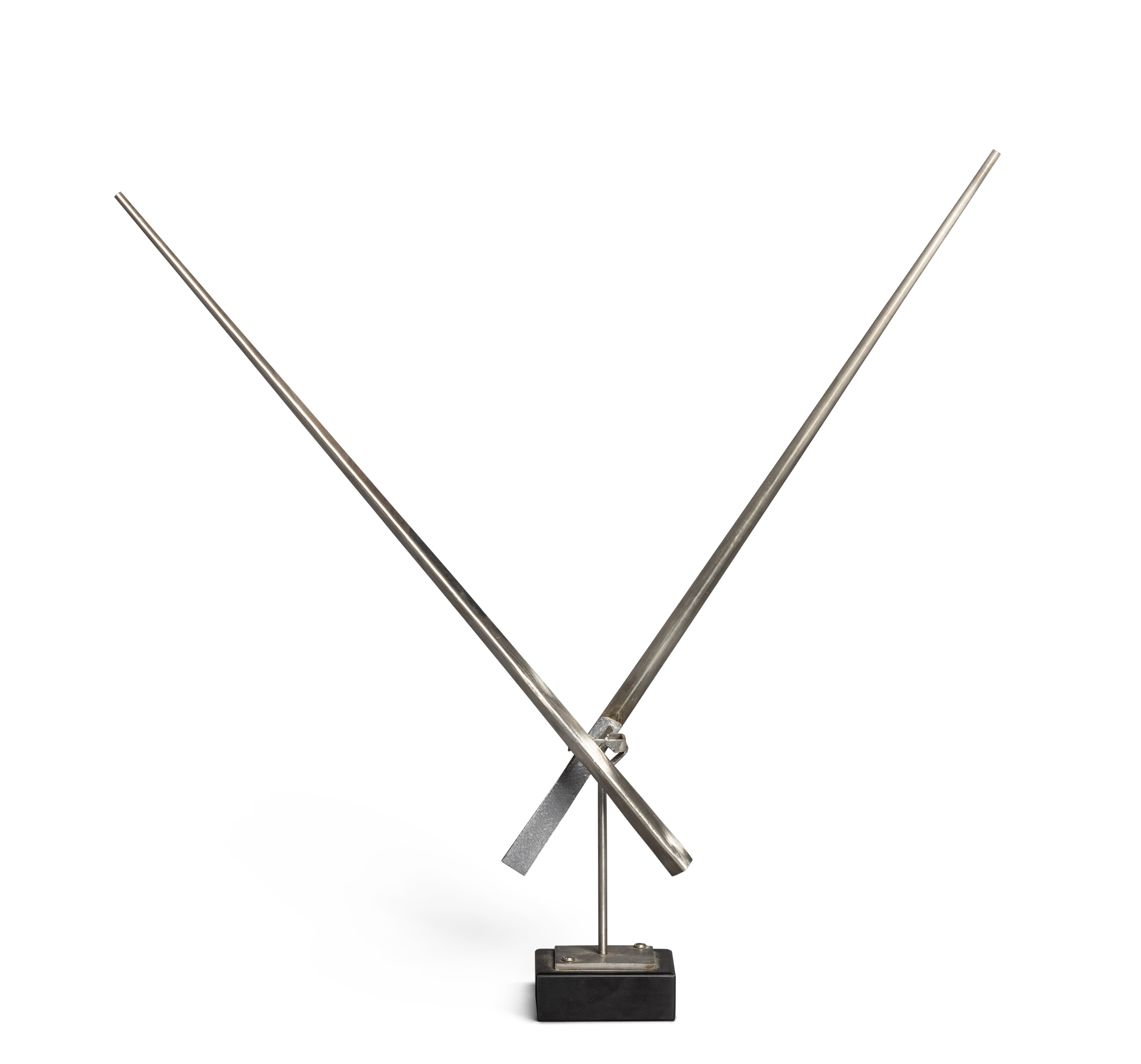
George Rickey
Two Lines Vertical, 1964
For collectors, Rickey's work presents a compelling combination of art historical importance and enduring visual power. His sculptures occupy a singular position at the intersection of kinetic art, Minimalism, and engineering culture, making them relevant to a wide range of serious collections. Works on the secondary market range from intimate tabletop pieces to monumental outdoor sculptures designed for architectural settings, giving collectors at many levels of engagement an entry point. Auction results at Christie's, Sotheby's, and Phillips have consistently demonstrated strong demand, particularly for the mature stainless steel works from the 1960s through the 1980s.
Collectors are advised to pay close attention to the mechanical condition of any piece, since the precision bearings and gimbals are central to the work's meaning. A Rickey that moves is a Rickey alive. Rickey's place in art history is best understood alongside the broader kinetic movement that emerged in the postwar decades. Calder remains the most obvious point of reference, but Rickey's sensibility is more severe, more indebted to the Constructivist tradition.
He shares intellectual terrain with Jesús Rafael Soto, Jean Tinguely, and László Moholy Nagy, artists who collectively redefined the boundaries of what sculpture could do and mean. Unlike Tinguely's exuberant machine theatre or Soto's immersive environments, Rickey's work is characterised by quietude and economy. He distilled the kinetic idea to its most elegant essence: two lines, moving, in a field of light. Rickey died in 2002 at the age of ninety five, leaving behind a body of work that continues to reward attention with each passing year.
His sculptures are installed in public spaces across Europe, the United States, and Japan, where they have become beloved fixtures of their environments, always changing, always returning. In an era saturated with digital spectacle and manufactured sensation, Rickey's works offer something genuinely rare: a reminder that the simplest forms, governed by the simplest forces of nature, can produce experiences of lasting wonder. To collect Rickey is to bring something quietly miraculous into your world.
Explore books about George Rickey