George Auriol
George Auriol, Art Nouveau's Quietly Brilliant Master
Artist Spotlight · The Collection Editorial
There is a particular pleasure in rediscovering an artist who worked in the margins of the canonical narrative, whose fingerprints are everywhere yet whose name is spoken too rarely. George Auriol is precisely such a figure. In the grand flowering of Art Nouveau that transformed Paris at the turn of the twentieth century, Auriol was not a peripheral presence but a central one, a designer, illustrator, typographer, and graphic poet whose work shaped the visual language of an entire era. As collectors and institutions worldwide continue to reassess the decorative and graphic arts of the Belle Époque with fresh seriousness, Auriol's refined and deeply personal vision feels more relevant and more collectible than ever.
George Auriol
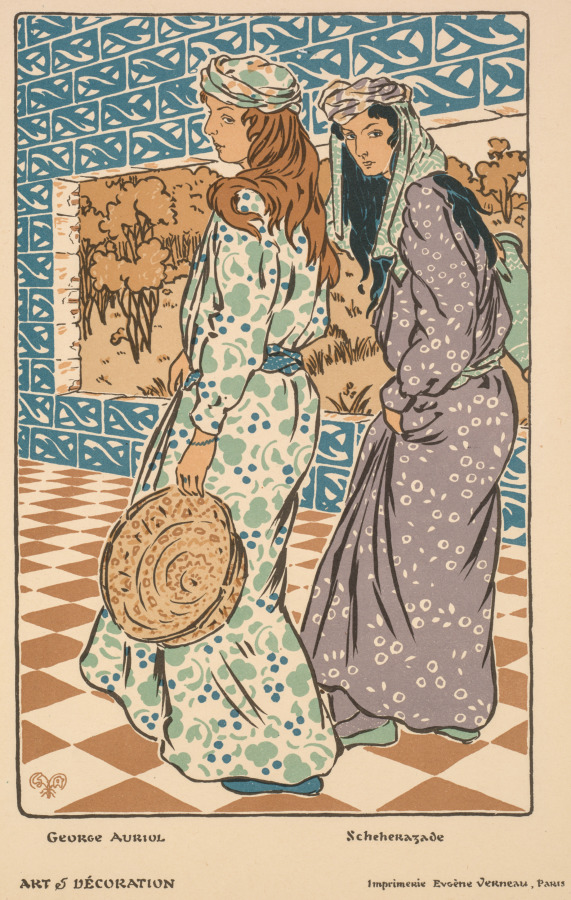
Scheherazade, 1901
Born in 1863, George Auriol came of age in a Paris that was hungry for beauty in all its forms. The city was in the midst of a profound aesthetic transformation, and young artists of his generation were surrounded by the influence of Japanese woodblock prints, the sinuous line work filtering through from Symbolist painting, and an emerging conviction that design was not a lesser art but a vital one. Auriol absorbed these currents with characteristic intelligence. He moved through the creative milieu of Montmartre with ease, becoming closely associated with the legendary cabaret Le Chat Noir, where he contributed both illustrations and song lyrics, demonstrating from the very beginning of his career that he was an artist of unusual range and wit.
Auriol's development as a graphic artist unfolded through the 1880s and 1890s with a steady deepening of his personal style. He became a master of the color lithograph, a medium that in Paris at this time was undergoing a genuine revolution, driven by the technical ambitions of printers and the aesthetic demands of artists like Henri de Toulouse Lautrec, Pierre Bonnard, and Théophile Alexandre Steinlen. Auriol worked alongside and in dialogue with these figures, yet he cultivated a sensibility distinctly his own: more delicate, more literary, more attuned to the quiet beauty of decorative pattern and organic form. His lines curl and breathe; his compositions invite the eye to rest and wander in equal measure.
George Auriol
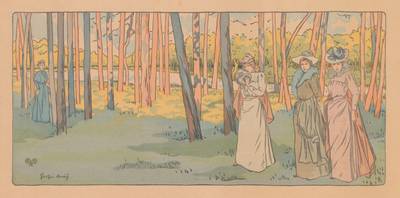
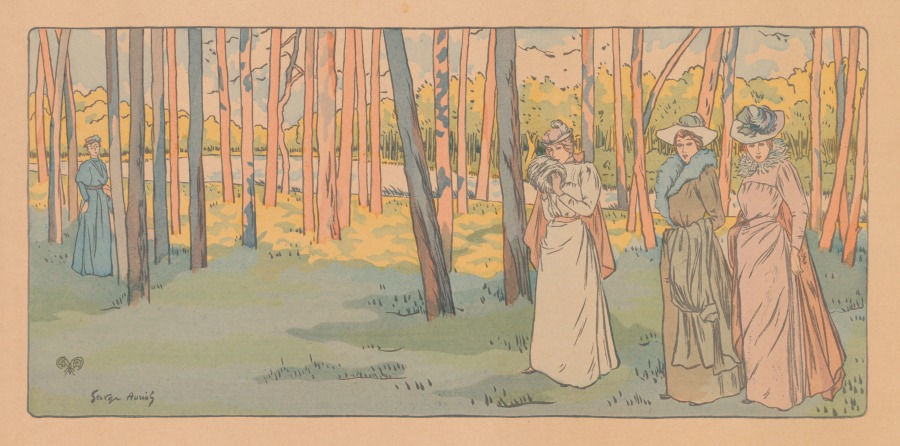
Promenade sur Bois, 1900
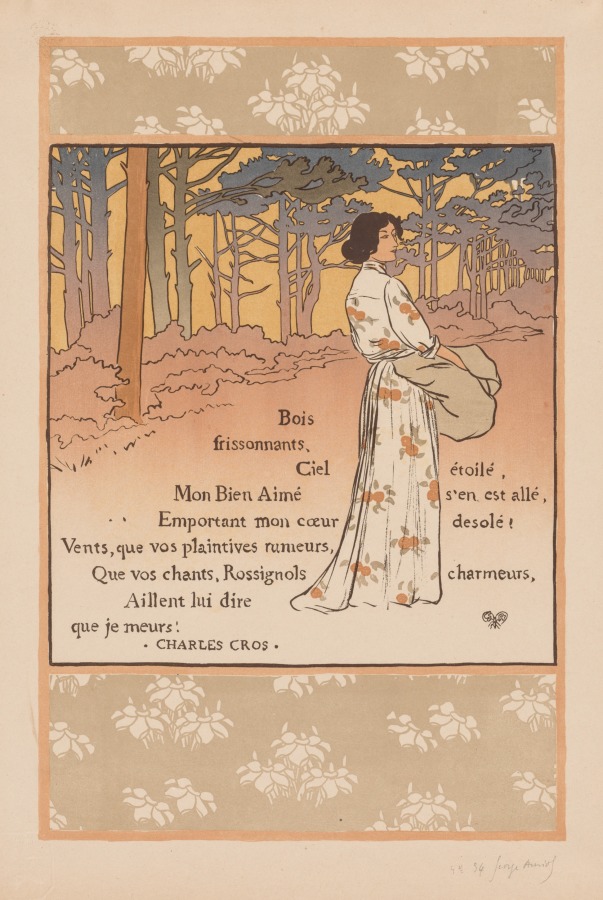
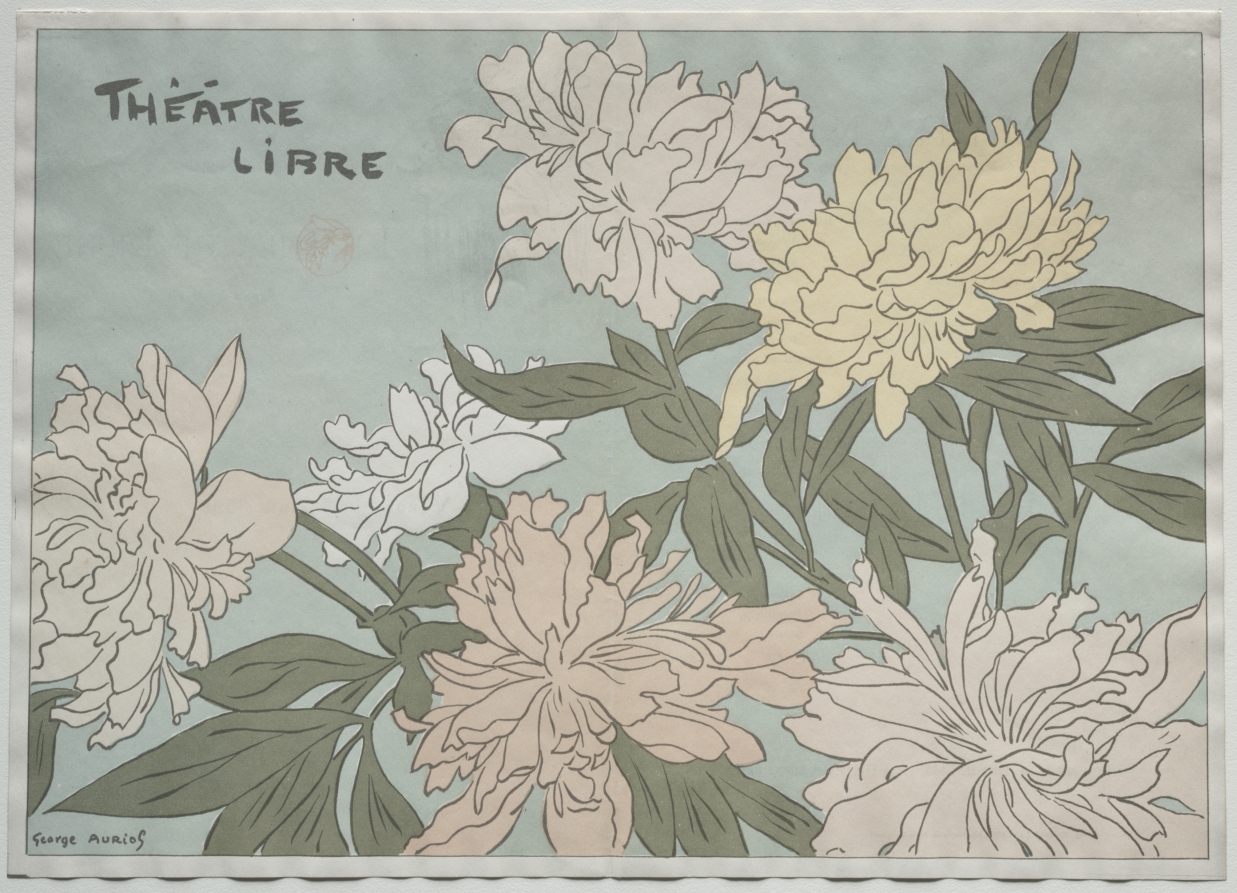
Among his most celebrated works are the color lithographs he produced around the turn of the century. "Trembling Woods" from 1893 is an early demonstration of his mastery, using the lithographic medium to evoke atmosphere and movement with a lightness of touch that feels almost musical. "Promenade sur Bois" from 1900 and "Scheherazade" from 1901 represent the full flowering of his mature style, works in which the influence of Japonisme merges seamlessly with the flowing natural forms of Art Nouveau to produce images of genuine enchantment. The theatre programme he designed for the Théâtre Libre, with its elegant color lithography, places him at the heart of Parisian cultural life in the late 1880s, a reminder that his work was not made in isolation but as a vital contribution to the living culture of his city.
His 1902 "Noel" demonstrates his gift for intimacy and occasion, a small work of exquisite proportion that rewards close looking. Auriol's contribution to typography deserves particular recognition. He designed several typefaces that remain significant in the history of French graphic design, most notably the Auriol typeface which was cut by the foundry Georges Peignot and became one of the defining Art Nouveau letterforms. The fact that he moved between illustration, decorative design, and typography with such fluency marks him as a true total artist in the tradition that Art Nouveau demanded.
George Auriol
Trembling Woods, 1893
He understood that a poster, a book, a programme, and a typeface were all expressions of the same underlying sensibility, and he brought that conviction to every project he undertook. For collectors approaching Auriol's work today, the opportunity is a genuinely exciting one. His color lithographs occupy a sweet spot in the market for Art Nouveau graphic work: they are historically significant and aesthetically substantial, yet they remain more accessible than the most celebrated names of the movement. Collectors who have built strong holdings in Toulouse Lautrec, Alphonse Mucha, or Jules Chéret will find in Auriol a natural and deeply complementary addition, an artist whose work illuminates the broader movement while possessing its own unmistakable character.
Works on paper from this period reward careful attention to condition and impression quality, and Auriol's prints, when found in strong, well preserved states, are objects of considerable beauty and scholarly interest. Within the broader story of Art Nouveau, Auriol belongs to a cohort of artists who understood the movement not merely as a decorative style but as a philosophy of making. His peers and contemporaries at Le Chat Noir and in the Parisian print world included figures like Adolphe Willette and Eugène Grasset, and his work resonates with the Japanese influenced graphic elegance of artists working across Europe in the same years. He was also a significant figure in the world of the illustrated book and the artistic programme, genres that have attracted growing collector and institutional interest as the history of graphic art is written with greater completeness and ambition.
George Auriol
"Myrane" et "Les Chapons", 1890
The Bibliothèque nationale de France holds examples of his work, a testament to the seriousness with which French cultural institutions have long regarded his contribution. George Auriol died in 1938, having witnessed the rise and fall of the movement he helped to define and the transformation of the visual world he had spent his life enriching. His legacy endures in the typefaces that still bear his name, in the prints that hang in collections from Paris to New York, and in the broader recognition that the graphic and decorative arts of the Belle Époque represent one of the great creative achievements of modern European culture. To collect Auriol is to hold in your hands a piece of that achievement: refined, personal, and quietly luminous.